Table of Contents
When the future feels like a threat You can’t see
If you live with a mind that runs worst‑case scenarios like a streaming service autoplaying the next episode, you are not weak, broken, or dramatic. You are using a survival‑first brain in a world it never evolved to navigate. Your nervous system was optimized for thin margins and fast decisions—rustles in tall grass, flickers at twilight, the faint sourness of a berry that might be poison.
In that habitat, assuming danger kept you alive. In ours, the same habit converts unanswered emails into career extinction events and ambiguous facial expressions into relationship collapse. You are contending not with a moral flaw but with an exquisitely loyal prediction system that errs on the side of alarm.
This article is not a pep talk about thinking positively. It is an owner’s manual and a love letter to your over‑protective brain. We will translate cutting‑edge models of mind and body into everyday language: predictive processing (why your brain is not a camera but a guesser), intolerance of uncertainty (why not knowing feels like pain), the nocebo effect (how expectation shapes experience), interoception (how the body’s signals teach the mind what to believe), and the default mode network (why rumination feels like getting lost in yourself). You will also learn a humane way to retrain your prediction engine that never shames you for having one in the first place.
The old algorithm in a new world
Our ancestors who over‑perceived danger left more descendants than those who under‑perceived it. Natural selection quietly wrote a rule into your operating system: treat uncertain threats as if they are real until you have proof otherwise. That rule does not politely step aside when you are negotiating a salary, sending a vulnerable text, or waiting for medical results.
It runs in the background, turning absence of information into evidence of the worst. You might notice the aftermath: postponing the application because failure feels inevitable; rehearsing an argument that hasn’t happened; bracing your shoulders before you open a message. You are not choosing fear; fear is choosing you on behalf of safety.
And yet, this rule is only part of the story. The human brain is not permanently biased toward the negative in some universal, unchangeable way. Context matters. Culture matters. Personal history matters. Specific tasks and goals matter. In some situations, optimism confers advantage; in others, caution does. Your job is not to delete pessimism but to calibrate it. When calibration fails—when the dial sticks at “alarm”—catastrophic thinking becomes a lifestyle instead of a tool.
The brain as a prediction machine, not a passive recorder
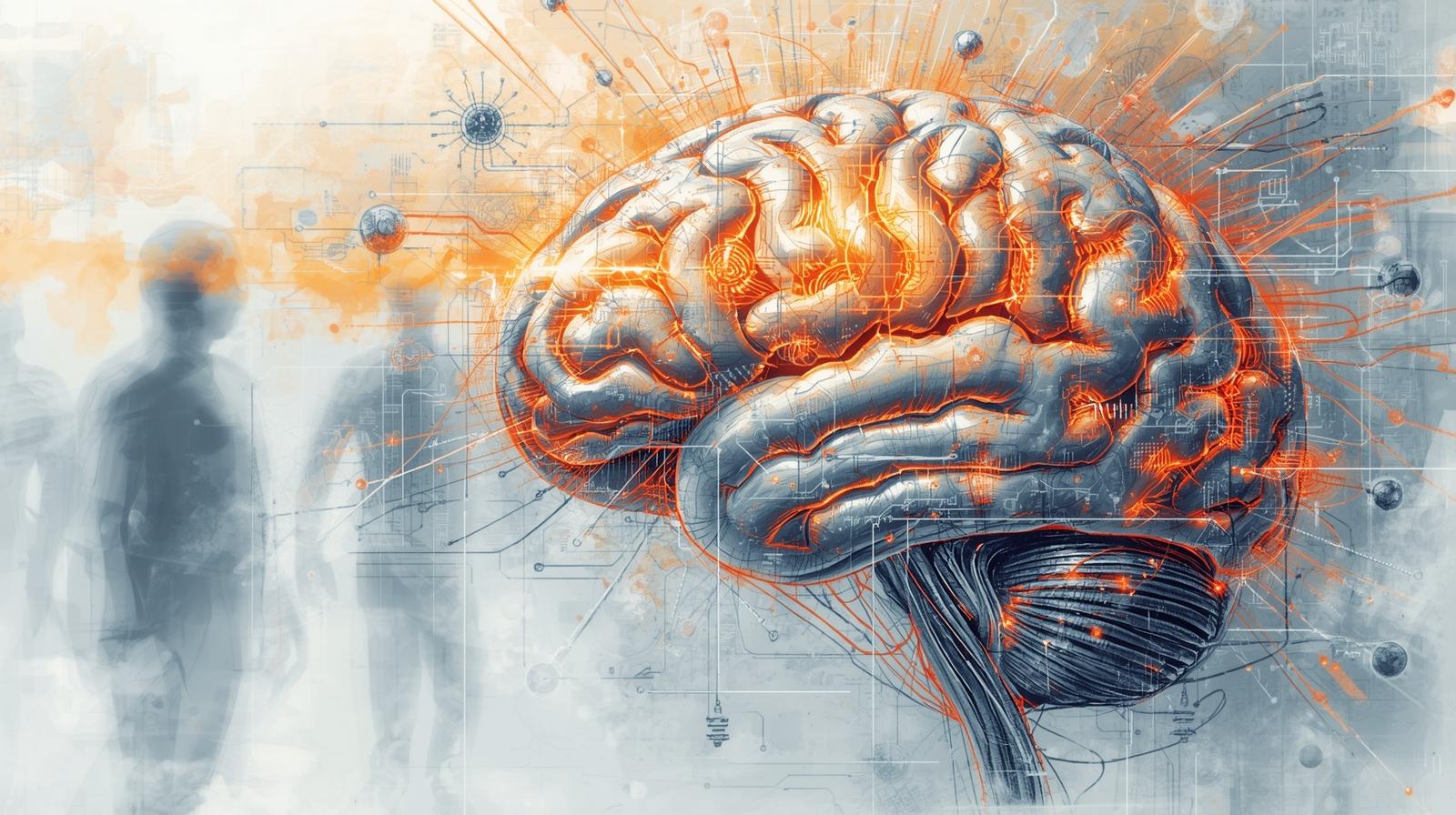
For a long time, psychology talked about perception as if your brain were a camera recording what is “out there.” A newer model—predictive processing—flips the direction. Your brain continuously generates best guesses about what the world and your body will do next, and it uses incoming signals to revise those guesses. When a prediction is confident, the brain can misread ambiguous evidence as confirmation.
If the prediction tilts toward threat, even neutral cues feel menacing. That is why reassurance from friends or data in your calendar often bounces off. It is not that you refuse to listen; it is that your brain trusts yesterday’s survival‑oriented guess more than today’s soft evidence.
Think of predictions as stories your brain tells to reduce uncertainty. They are built from memory, mood, cultural scripts, and present sensations. When those ingredients skew toward danger, the story does too. The miracle—and the pain—of prediction is that it bleeds into perception. Your brain does not just expect a harsh email; it reads a neutral sentence with a harsher tone. It does not just worry a conversation will go badly; it amplifies the body’s jitters into proof that something is wrong.
Interoception: The body teaches the mind what to believe
Interoception is your brain’s sense of the body’s internal landscape—heartbeat, breath, temperature, muscle tone, gut churn. Interoception is not a single skill; it is an ecosystem. It includes raw detection, interpretation, and the beliefs you attach to those signals. When anxiety narrows your attention and speeds your pulse, you are more likely to interpret those sensations as danger.
Over time, your brain learns that jitter equals threat and writes that rule into its operating code. The loop closes: worried stories make worried bodies; worried bodies make worried stories. This is why purely cognitive strategies often feel thin during a spiral. The prediction is embodied.
If this sounds discouraging, it shouldn’t. Loops can be retrained. Small, repeatable practices that alter your body’s baseline—unforced nasal breathing with long exhales, eyes‑open orientation to your environment, slow walks after screens—provide counterevidence that the system can register. The goal is not to erase sensation but to teach your brain a new contingency: intense sensation without catastrophe is common. That is what loosens the precision of danger priors and makes room for different interpretations.

Intolerance of uncertainty: When “not knowing” feels like pain
Many readers discover that the true trigger is not a specific feared outcome but uncertainty itself. Intolerance of uncertainty is the tendency to experience the ambiguous as intrinsically aversive. If you score high on this trait, your mind longs for certainty even if the certainty is bad, because at least the waiting would end. The worst‑case prediction becomes attractive not because you want to suffer but because it resolves the unknown. This explains why you may compulsively check, search, or ask for reassurance. You are not hungry for facts; you are hungry for an end to maybe.
Intolerance of uncertainty is modifiable. Treatment studies show that when people train their nervous systems to endure “not yet known” in controlled doses, their worry drops and flexibility rises. Practically, that means creating tiny experiments that leave questions open on purpose and then tracking what happens in your body: the discomfort peaks; it recedes; you remain intact. As your system learns that unresolved does not equal unsafe, the allure of catastrophe weakens.
The nocebo mindset: Expectation that hurts
The nocebo effect is the shadow twin of placebo. Where positive expectations can improve symptoms, negative expectations can worsen them—even in the absence of a harmful cause. In medicine, simply hearing about possible side effects increases the likelihood of feeling them. In daily life, framing a week as “awful already” primes your nervous system to register every minor bump as confirmation.
This is not an argument to ignore risks or sugarcoat reality. It is an invitation to practice expectation hygiene: choose words and frames that are honest but do not instruct your body to suffer in advance. “This meeting matters, and I will be uncomfortable, and I can stay curious for ten minutes,” is not naive; it is precise.
Rumination and the default mode network: Getting stuck in the self
The default mode network (DMN) is a set of brain regions most active when your attention turns inward—autobiographical memory, self‑talk, imagined futures. In rumination, the DMN becomes a rehearsal studio for catastrophe. It braids a memory of loss to a forecast of failure and a story about who you are, then plays the montage on loop. Telling yourself to “think of something else” rarely helps because the network is doing its job too well.
The intervention is not silencing the DMN but giving it different work: deliberate reflection framed around recovery instead of impact, short windows for scenario planning bookended by grounding, and frequent returns to sensory reality so you do not drown in simulated futures.
Developmental echoes: When history turns the volume up
Your prediction system learns not only from culture and context but also from your personal past. If you grew up with chaotic signals—adults who changed rules without warning, safety that evaporated, affection that could not be counted on—your brain generalizes that volatility. Uncertainty becomes not just unpleasant but dangerous. Later, even stable relationships can feel precarious; even successful work can feel at risk.
Recognizing this is not about blaming your history; it is about understanding that your catastrophic predictions are loyal attempts to make sense of experience. Healing often involves trusting that new data can actually update the model. That trust grows slowly, through repeated encounters with uncertainty that resolve without harm.
Modern life as a threat amplifier
Our devices monetize outrage and vigilance because they keep us engaged. Curated feeds skew toward emotionally charged content; notification badges act like micro‑alarms; headlines compress complex realities into binary cliffhangers. It is unsurprising that a nervous system bathing in this chemistry becomes a hypersensitive smoke detector. Protecting your prediction engine from chronic agitation is not a luxury. It is a requirement if you want to think clearly about the future. Cutting inputs that inflame alarm is not sticking your head in the sand; it is refusing to live in a man‑made hurricane.
What it feels like to re‑train a catastrophic brain
Change rarely arrives as a single epiphany. It feels more like a set of micro‑corrections your nervous system makes again and again until your inner weather shifts. At first, you will still predict the worst, and your heart will still race. What changes is your stance toward the prediction. You label it quickly—“my brain is predicting to protect”—and you turn your attention toward present anchors you can sense.
You choose one small action that moves your life forward rather than one more minute of rehearsal. You do this hundreds of times. Gradually, the brain downgrades the certainty of its own alarms. The future remains unknown, but it no longer feels like a knife at your throat.
A humane method: Precision over positivity
Most self‑help teaches you to replace negative thoughts with positive ones. That often fails because the nervous system recognizes propaganda and digs in. A softer, more honest approach is precision. Catastrophe thrives on vague, global statements—“this will be a disaster,” “I can’t handle it.” Precision dissolves the fog. You ask how exactly things might unfold, for how long, with what resources available, and what recovery might look like. You narrate specific next steps rather than sell yourself a happy ending. Precision turns a horror movie into a map.
The core loop You can practice anywhere
Begin by recognizing the mode: “I am in prediction, not reality.” That simple sentence breaks the spell without insulting your survival system. Then orient to what your senses can verify. Feel the pressure of your feet or the texture of the chair, lengthen your exhale, let your gaze sweep the room. This moves part of your attention out of imagined futures into the present stream of evidence.
Finally, choose a tiny real‑world action that is both safe and mildly uncomfortable in the direction you care about: send a two‑sentence email, close three tabs, sip water, open the document and write one paragraph. The point of the loop is not to make you feel amazing. It is to end a prediction cycle with agency in your hands.
Repeat this loop many times a day, especially when you feel you do not have time. In weeks, you will notice a subtle change: the worst‑case movie still screens, but the volume drops because your brain has learned that your responses—not its forecasts—decide what happens next.

Working directly with interoception: Teaching the body “not an emergency”
There is elegance in training interoception without drama. Five minutes of practice, done daily, is enough. Sit or stand with your eyes open. Let your breath travel through your nose and extend the exhale slightly longer than the inhale. As you breathe, gently widen your peripheral vision to include the edges of the room and name three ordinary objects. If a thought intrudes, let your gaze rest on a shape or color and notice its edges.
You are not escaping your life; you are adding low‑threat sensory data to your model. Over time, your brain learns that high arousal is a state it can regulate and that the external world is usually stable even when the internal world is noisy.
On difficult days, go for a slow, device‑free walk. Let your eyes do what they evolved to do: track horizons, follow motion, detect contrast. When you return, drink water and eat something with protein. You are replenishing the resources your prediction engine needs to update its beliefs. Exhausted brains cling to alarms because they cannot afford to compute alternatives.
Rewriting expectation without gaslighting Yourself
Expectation hygiene is not pretending everything will be fine. It is choosing language that does not instruct your nervous system to suffer more than necessary. Swap “This will destroy me” for “This will be painful, and I have ways to recover.” Replace “I can’t handle this” with “I can handle the next ten minutes.” Instead of “They’ll hate it,” try “Some people may not like it, and my job is to learn.” You are still acknowledging risk; you are also preserving agency. Words become predictions; predictions become physiology. Choose carefully.
Defensive pessimism: A sharp knife You use on purpose
There are careers and phases of life where expecting problems is wise. Surgeons run checklists. Pilots brief contingencies. Parents scan playgrounds. Use pessimism as a tool, not a home. Bound it in time: “For twenty minutes I will imagine what could go wrong with this project.” Pair it with action: “I will implement one safeguard.” Close the session deliberately: breathe, move, and reconnect with a person or place that signals safety. You are telling the DMN that risk‑planning belongs to a specific ritual, not the background hum of your life.
Uncertainty fitness: Building tolerance like a muscle
Treat uncertainty exposure like gentle strength training. Choose tiny, safe challenges that leave a question mark hanging in the air: send a message without rereading, take a new route and accept the extra minutes, choose a restaurant without scrolling reviews. Afterward, reflect for thirty seconds: Did I survive the unknown? What sensations rose and fell? What did I learn about my capacity? The value here is not in heroics but repetition. You are feeding your brain hundreds of examples in which “not knowing” did not end in harm. Accumulated, they recalibrate the system.
Relationships as nervous system technology
Co‑regulation—the way our bodies synchronize—may be the most underrated mental health tool we have. When you are with someone who speaks slowly, makes warm eye contact, and is not in a hurry to fix you, your body exits the red zone more efficiently than it can alone. If you chronically expect the worst from people, start with micro‑moments that are easy to digest: a barista who remembers your name; a neighbor who waves; a friend who can sit in silence. Let your system store these encounters as proofs that connection can follow uncertainty. Over time, relational safety becomes part of the predictive model, and your brain stops using isolation as the default forecast.
A story from real life: The email that felt like a trapdoor
Consider Maya, a creative professional who delays sending proposals because silence feels like rejection. Each time she drafts a pitch, her pulse jumps and her stomach tightens. Her mind flashes images of being ignored, mocked, and broke. In therapy she learns the prediction loop. She labels the moment, orients to her studio—light on the plant leaves, hum of the heater—then exhales until the muscles in her jaw release.
She sends the email with a single concrete goal: ship, don’t self‑evaluate. She repeats this for two weeks. In that time, one client says no, one says yes, and three do not reply. The old loop would treat silence as proof of doom. The new loop tags silence as “data pending” and moves on. Maya is not fearless. She is something better: precise and persistent. Her brain updates.
When the worst does happen
No method immunizes you from real losses. People will leave; projects will fail; bodies will ache. The aim of this work is not to paint over pain but to stop experiencing every hour as pre‑trauma. When something truly goes wrong, the same skills help you stay inside your window of tolerance. You label the shock, resource your body, and orient toward a first small step: text a friend, schedule a practical call, walk, nap, cry, eat. You rehearse recovery as deliberately as you once rehearsed disaster. The practice you have been doing in mundane moments becomes the muscle you use in the acute ones.
The smallest possible starting point
If everything above feels like too much, choose one practice for a week. Commit to the three‑part loop each morning before you touch your phone. Name your mode, orient with breath and gaze, then take one small action toward something that matters. Keep it short and unglamorous. You are not trying to have a meaningful morning; you are teaching your brain that you will move your life forward even when it predicts danger. A single reliable ritual can begin to uncouple your days from doom.
Your brain isn’t mean—It’s loyal
Catastrophic thinking is the mind’s way of loving you clumsily. It learned one move: brace early, brace often. You can teach it other moves. You can be the kind of animal that notices danger and still moves toward a meaningful life. You can learn to hold uncertainty without turning it into a verdict. You can talk to yourself in ways that do not give your body extra pain to process. The point is not to expect the best. It is to expect yourself to show up when the worst is possible and to keep updating your model as reality unfolds.
Related posts You’ll love
- The quiet rebellion of finally speaking Your truth
- The moment You realize worry isn’t love: How fear disguises itself as care — and what real love actually feels like
- The inner conflict between “good girl” and “free woman”
- Why We feel ashamed of being alone — And how to reclaim the beauty of solitude
- The psychology of why Women overstay in relationships — and what keeps Them from leaving
- Words for the Woman who thinks she has ruined everything: How to rewrite Your story, even after Your worst mistakes
- The anti-catastrophe lab: Tiny experiments to tame “the worst” predictions

FAQs
-
Why does my brain always expect the worst even when life is going well?
Even during calm seasons, your nervous system keeps prioritizing survival over satisfaction. The brain relies on prior beliefs about threat and, when energy is low or uncertainty is high, it assigns those beliefs extra confidence. That means neutral cues—an unread message, a delayed reply—are interpreted as danger simply because your prediction model prefers caution. Training better sleep, nourishment, and brief grounding rituals gives your brain enough metabolic room to consider alternatives to catastrophe without pretending risk is zero.
-
Is negativity bias the reason I catastrophize, or is something else going on?
Negativity effects play a role, but catastrophizing usually reflects several systems working together: a strong intolerance of uncertainty that treats “not yet known” as unsafe, a vigilant interoceptive map that mislabels arousal as threat, and a storytelling habit in the default mode network that keeps rehearsing scary futures. When you address each layer—body, belief, and narrative—the pull of the worst‑case weakens.
-
How does predictive processing explain my constant worst‑case scenarios?
Predictive processing says the brain is a guesser that updates its guesses with evidence. If your guesses about danger are too precise, new information gets ignored. You experience a feeling of certainty that something bad is coming even when the data are mixed. The fix is not arguing with yourself; it’s feeding the system new experiences—calm sensations during uncertainty and small, successful actions—that force those guesses to loosen.
-
What is intolerance of uncertainty and how do I reduce it without forcing toxic positivity?
Intolerance of uncertainty is the tendency to experience ambiguity as aversive. You can lower it by building “uncertainty fitness” with tiny exposures you choose: send a message without rereading, leave a small task slightly unfinished overnight, pick a restaurant without reviews. After each exposure, notice that your body settles and nothing catastrophic happened. You are not faking optimism; you are teaching your nervous system that unresolved does not equal unsafe.
-
Can the nocebo effect really make my anxiety worse day‑to‑day?
Yes. Pessimistic framing instructs your physiology to amplify discomfort. When you label a week as “ruined,” your body scans for evidence and finds it. Expectation hygiene—phrases like “this will be hard and I can handle the next ten minutes” or “data pending, not doom”—keeps you honest while avoiding unnecessary physiological stress.
-
Why doesn’t reassurance help me stop catastrophizing?
Reassurance is external data, and it can’t land if your internal threat priors are over‑confident. Pair any reassurance with bodily regulation—long exhales, orienting your gaze to the room—and one small behavior in the direction you value. As your system logs repeated instances of safety plus action, reassurance starts to stick because it matches lived evidence.
-
Is rumination the same as problem‑solving?
Rumination feels like work, but it rarely changes the next step. Effective problem‑solving is bounded in time, specific, and followed by a concrete action. Rumination is open‑ended, self‑referential, and often ends where it began. If you set a ten‑minute timer, list exactly three risks, choose one safeguard, and then close the session with movement, you’ve crossed the line into useful planning.
-
What role does interoception play in expecting the worst?
Interoception turns bodily noise into meaning. A racing heart during an uncertain moment can be interpreted as proof that danger is present. Daily five‑minute sessions of eyes‑open breathing with longer exhales and gentle visual scanning teach your brain to associate arousal with safety rather than with attack. Over time, the same sensations generate fewer catastrophic stories.
-
How can I prepare for real risks without living in constant dread?
Use defensive pessimism as a scheduled tool. Give yourself a short window to imagine and mitigate specific risks, then deliberately return to baseline with breath, movement, and connection. The ritual container prevents your default mode network from turning risk planning into an endless background process.
-
What’s a single practice I can start today to change worst‑case thinking?
Run a three‑step loop anytime you notice a spiral. First, label the mode—“prediction, not reality.” Second, regulate briefly with a long exhale and a slow visual sweep of the room. Third, do one tiny action that matters—send two sentences, drink water, open the document and write for three minutes. You are rewiring by ending the loop with agency instead of more analysis.
-
Does diet, sleep, and movement really change my catastrophic thoughts?
Yes, because the prediction machine is metabolically hungry. When sleep is poor or you’re under‑fed and over‑caffeinated, the brain defaults to conservative threat priors. Consistent sleep windows, balanced meals, hydration, and modest daily movement don’t make life easy; they make your brain flexible enough to update its guesses.
-
I’m afraid that if I stop expecting the worst, I’ll be blindsided. What then?
Recalibration doesn’t mean naivety. It means sensing accurately. When alarms are constant, you miss the one that matters. Training precision over pessimism gives you a quieter baseline and a sharper response when real danger appears. You’re not lowering vigilance; you’re improving signal‑to‑noise.
-
How do relationships help me stop catastrophizing?
Co‑regulation changes physiology faster than solo techniques. Short, attuned interactions—unhurried voice, warm eye contact—teach your system that connection often follows uncertainty. As your body learns this contingency, catastrophic social predictions lose credibility.
-
Can therapy help if I’ve tried self‑help for years?
A skilled clinician can target the exact loops keeping your system stuck: belief precision, interoceptive mislabeling, and rumination. Modalities that integrate body and cognition, and that include active experiments between sessions, tend to help your brain update faster because they provide dense, corrective experiences.
-
How do I measure progress if my brain still predicts the worst sometimes?
Track lag and recovery instead of perfection. How quickly do you notice the spiral? How fast can you return to baseline enough to take one step? How often do you complete the three‑step loop? These metrics improve before your predictions do, and they are the leading indicators that the model is changing.
Sources and inspirations
- Corns, J. (2018). Rethinking the negativity bias. Review of Philosophy and Psychology,
- Dugas, M. J., Laugesen, N., & Fear, C. (2022). Behavioral experiments for intolerance of uncertainty: A focused treatment for generalized anxiety disorder. Behavior Therapy.
- Grosso, F., Fava, G. A., & Benasi, G. (2024). Risk factors associated with nocebo effects: A meta‑review. eClinicalMedicine.
- Jenkinson, P. M., Fotopoulou, A., Ibáñez, A., & Rossell, S. (2024). Interoception in anxiety, depression, and psychosis: A review. EClinicalMedicine.
- McGovern, H. T., Hayes, J., & Fourie, J. (2022). Learned uncertainty: The free energy principle in anxiety. Frontiers in Psychology.
- Morriss, J., Christakou, A., & Van Reekum, C. M. (2023). Intolerance of uncertainty heightens negative emotional responses. Frontiers in Psychiatry.
- Tozzi, L., Zhang, X., Fiez, J., & Hariri, A. R. (2021). Meta‑analytic evidence linking default mode network connectivity and trait rumination. Translational Psychiatry.
- Colloca, L. (2024). The nocebo effect. Annual Review of Pharmacology and Toxicology.
- Näsling, J., Ebert, D. D., & Weisel, K. K. (2024). Effect of psychotherapy on intolerance of uncertainty: A systematic review and meta‑analysis. Clinical Psychology & Psychotherapy.
- Clemente, R., (2024). The relationship between self‑reported interoception and anxiety: A meta‑analysis. Neuroscience & Biobehavioral Reviews.
- Harris, D. J., (2023). From fear of falling to choking under pressure: A predictive processing account. Neuroscience & Biobehavioral Reviews.
- Azarias, F. R., (2025). The journey of the default mode network: Development and functions across the lifespan. Biology.
- Görner, K. J., (2024). Identifying the psychological effects of nocebo education: A randomized study. Frontiers in Psychology.
- Katayama, N., (2025). Dynamic neural network modulation during rumination. Translational Psychiatry.
- Harris, D. J., (2025). Counteracting uncertainty: Anxiety, predictive control, and action. Biological Cybernetics.




Leave a Reply