Table of Contents
“Why am I terrified when I should be happy?” → Naming the silent panic
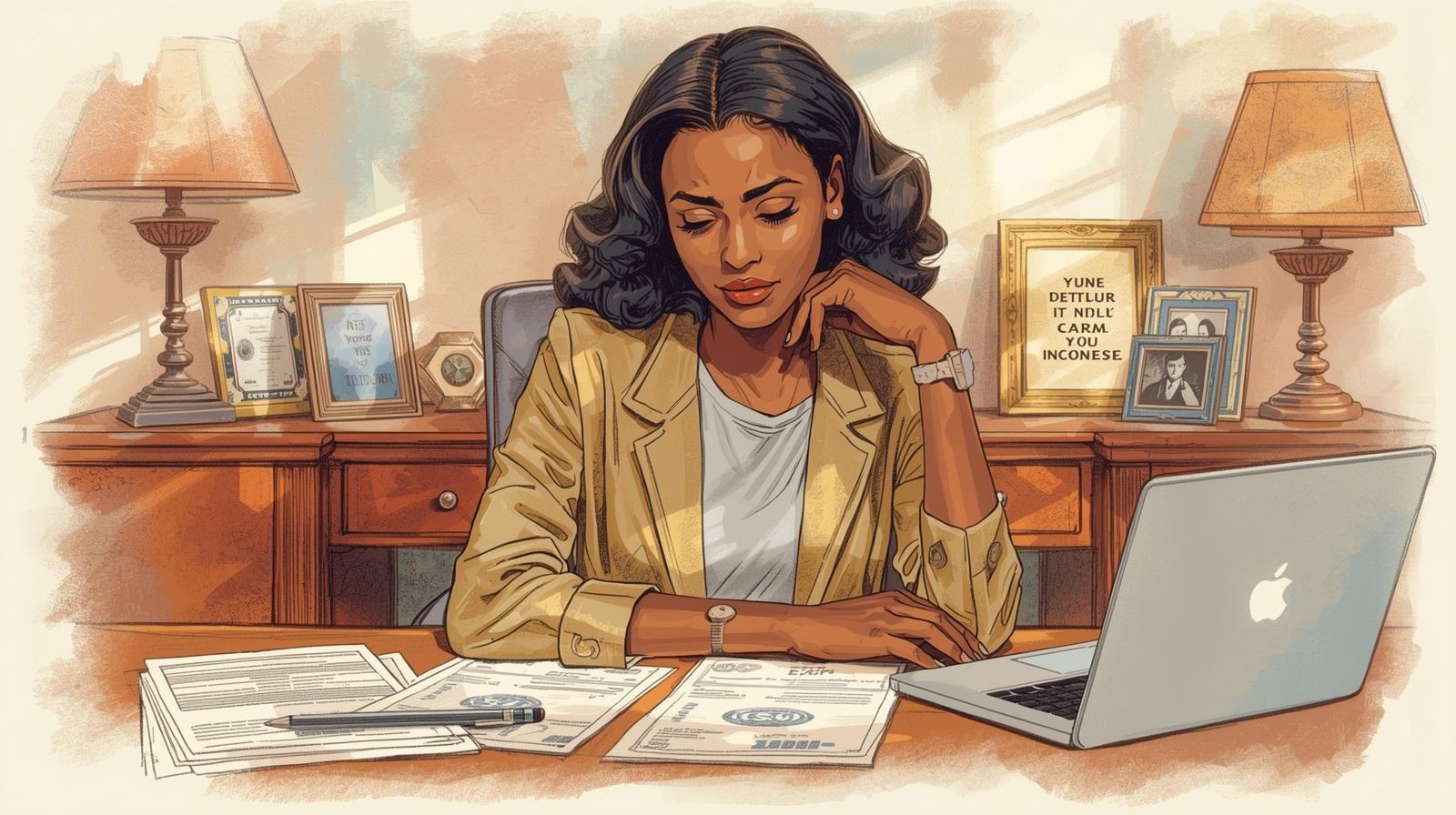
Imagine this: you open your banking app and see a number your younger self could barely even dream of. Your salary is bigger than what your parents ever made. You are the first woman in your family who can pay for her own life, choose where she lives, book a last-minute flight, say “no” to a terrible boss and not crumble.
And yet your chest is tight. Your shoulders are up near your ears. You feel guilty when you tap your card. You overthink every financial decision. A part of you wants to close the app and never look again.
That feeling has a name: financial anxiety. Research describes it as the emotional distress that appears when you perceive your financial situation as unstable or unsafe, even when the numbers on paper look objectively “fine”. It is not just “being bad with money”. It is a nervous-system-level response shaped by your history, gender, class, and family stories.
Across large international samples, women consistently report higher financial anxiety than men, even when controlling for income and other factors. Recent global data suggests that about half of women experience financial anxiety, compared to roughly four in ten men. Women are also more likely to feel overwhelmed by their finances, have less savings and feel less confident in money decisions.
Now layer on top of that the role of being the first woman in your family to cross an invisible income threshold. You are not just earning more; you are breaking an old pattern. That is not a small lifestyle update. It is an emotional earthquake.
So if you feel both proud and panicked, deeply grateful and secretly nauseous, you are not broken. You are a woman whose nervous system is trying to process a level of safety, choice and power that your lineage may never have had before.
The invisible rules you inherited about women, money and loyalty
Money is never just about math. By the time you receive your first paycheck, you have already absorbed a complicated set of hidden rules about what it means to be a “good woman”, a “good daughter”, a “good partner” and a “good mother” in your culture.
Studies on intergenerational trauma show that families transmit not only explicit messages but also unspoken beliefs and emotional patterns across generations. Economic hardship and structural inequality can crystallize into something researchers now describe as complex economic intergenerational trauma, particularly for women of colour and women from historically marginalized groups.
Maybe you grew up with beliefs like these sitting quietly in the background of your childhood:
“Men are the providers; women are the helpers.”
“Money is always scarce; if you have more, you must give more.”
“People with money become selfish, cold, or ‘like them’.”
“Family comes first, always, no matter the cost.”
Even when no one says these sentences out loud, you can feel them. You see who gets praised and who gets criticized. You watch which aunt is whispered about at parties because she “thinks she is better than us now”. You notice which cousin is called “ungrateful” the day she moves to another country.
Research on family expectations and highly educated women shows how powerful these scripts can be. Families often pressure women to make career choices that keep them close, available and aligned with traditional gender roles, even when they have the qualification and ambition to pursue more.
So when you become the first woman to make real money, your nervous system is not just processing a higher income. It is asking terrified questions beneath the surface:
“If I earn this much, will they still see me as one of them?”
“If I say no to helping, will they still love me?”
“If I succeed, am I betraying the women before me who had so little?”
Wealth, in this context, is not simply a number. It is a perceived threat to belonging.
The wellbeing penalty of being a female breadwinner
The romantic story says: “Once women finally earn more, they will feel empowered and free.” Reality is more complicated.
Multiple studies on female breadwinners show that when women become primary earners, they often experience guilt, shame and pressure rather than pure empowerment. Women report feeling as if they are failing at some aspect of womanhood when they cannot embody every role at once: nurturing mother, ever-present daughter, perfect partner and flawless professional.
Across European couples, research has even identified a “wellbeing penalty” associated with women’s breadwinning. In some contexts, women who earn more than their male partners report lower life satisfaction, underscoring how social norms can quietly punish women for stepping into economic power.
At the same time, financial stress has a more severe physiological impact on women. Studies link financial stress in women to higher rates of metabolic issues, including abdominal obesity, prediabetes and dyslipidemia, suggesting an increased risk of chronic health conditions later in life.
When you put all of this together, a painful picture emerges:
You work hard, outperform expectations and finally reach a level of financial stability your family never had. On the outside, you are the success story. On the inside, your body is paying a cost: poor sleep, panic scrolling in the middle of the night, emotional eating, migraines, mysterious fatigue.
Your nervous system is trying to carry two conflicting realities:
“I am safer than ever before.”
“I might lose everything that makes me feel loved.”
That tension is the heartbeat of the silent panic.
How the silent panic actually shows up in day-to-day life
The panic of being the first woman in your family to make “real” money rarely announces itself clearly. It disguises itself as everyday habits that seem logical on the surface but are driven by fear underneath.
You might notice yourself constantly overworking, taking on every project and saying yes to unpaid emotional labour because a quiet voice insists, “If they see how hard I work, maybe they will accept my success.”
You might find yourself downplaying your income with family or friends, choosing neutral phrases like “I am doing okay” or “I just get by” when the reality is that you are paying for everyone’s emergencies.
You might over-give financially, picking up every bill, paying family debts, funding siblings’ education, or becoming the default rescue plan whenever something goes wrong, even when it leaves you depleted or resentful.
You might self-sabotage by undercharging in your business, procrastinating on promotions, or spending impulsively so there is never “too much” money sitting in your account making you feel exposed.
You might feel a sharp, uncomfortable loneliness in relationships, especially if you are dating or partnered with someone who earns less and feels threatened or dependent. Conversations about money may become tense or avoided altogether.
These behaviours are not proof that you are “bad with money”. They are protective strategies. You are trying to solve an impossible equation: stay loyal to your past while not abandoning your future.

From quiet chaos to conscious awareness → decoding your patterns
To move from silent panic into grounded power, you first need to see your patterns clearly and compassionately, without shame. Think of this as turning on the light in a room you have tiptoed through in the dark for years.
The table below can help you name what is really happening when certain patterns appear in your life.
| What you might be doing or feeling | What it quietly protects you from | What is actually being asked of you now |
|---|---|---|
| Minimising your salary or downplaying your success when you talk to family | Fear of being seen as “too good for us” or becoming a target of envy and criticism | Learning to stay connected to your roots while telling the truth about your life and holding your worth steady |
| Paying for everything and everyone, even when you feel exhausted | Fear of being called selfish, ungrateful or “forgetting where you came from” | Practising boundaries that let you support others without replacing every safety net they never had |
| Hiding or softening your ambitions in romantic relationships | Fear that a partner will leave, feel emasculated or resent you | Choosing partners who can hold your power, and learning to tolerate healthy conflict around money |
| Procrastinating on investing, saving or raising your prices | Fear that more money will create more demands, jealousy or pressure | Letting yourself build real safety and wealth, even if it changes how others relate to you |
| Feeling physically anxious every time you check your accounts | Nervous system reacting to the unfamiliar experience of being safe and resourced | Slowly teaching your body that safety does not require being broke, small or constantly on the edge |
You do not need to fix every line of this table overnight. The point is awareness. Once you see that your habits are trying to keep you loved and safe, you can start to negotiate with them instead of shaming yourself.
Money, love and the fear of outgrowing your people
One of the most tender fears many first-generation wealthy women carry is this: “Will I outgrow the people I love?”
Research on intergenerational trauma and economic hardship reveals that when one person suddenly has access to more opportunities, travel, education or professional networks, it can destabilize family dynamics. The person who “gets out” may feel survivor’s guilt, while those who stay may feel abandoned, judged or left behind.
For Black women and other women from communities historically excluded from wealth, this fear is intensified by systemic inequities and racialized narratives about who “deserves” prosperity. Qualitative research on complex economic intergenerational trauma shows how Black women who are heads of households often carry both the weight of the wealth gap and the responsibility of caring for extended family.
Your brain might create unspoken rules to manage this tension:
“If I never say no, they will not feel abandoned.”
“If I never talk about money, no one will feel less than.”
“If I keep myself tired and overextended, they will see I did not have it easy.”
But here is the paradox: staying small does not actually protect your loved ones from pain. It only ensures that the person with the most capacity to create new options stays permanently depleted.
Cutting yourself off emotionally does not help either. Going “no contact” around money, refusing to share anything vulnerable or disappearing into a glamorous new life can leave unresolved wounds on both sides.
The work, then, is to learn how to stay in relationship while changing. That is much harder and more sacred than simply choosing “family” or “freedom”.
Letting your nervous system catch up with your bank account
You are not only building wealth; you are increasing what some therapists call your capacity for goodness. Your body has to learn that feeling safe, supported, and resourced is not a mistake that needs immediate correction.
Financial stress has a documented impact on mental health, increasing symptoms of anxiety and depression across age groups. When women experience financial stress, it is often amplified by gendered expectations and caregiving roles. That means your nervous system may not trust safety yet. It is used to scanning for danger.
Think of your new income level as emotional altitude. If your family lived for decades at sea level, your nervous system is now standing halfway up a mountain. Even if the view is breathtaking, your brain is busy gasping: “The air up here feels weird. Are we sure this is allowed?”
Instead of forcing yourself to “just be grateful”, treat this as somatic adaptation. The goal is to gently teach your body that:
Money in the bank does not automatically equal disaster.
Having options does not mean you are abandoning anyone.
Being comfortable is not the same as being selfish.
You might start with small, consistent rituals. You could check your accounts while taking slow breaths, placing a hand on your heart or belly to remind your body that you are here, alive, safe, not in danger. You could speak out loud to yourself: “It is safe for me to see these numbers. Nothing bad is happening right now.”
Over time, these small, bodily experiences of safety around money start to rewire what your nervous system expects. The panic becomes a whisper, then a memory.
Old rules vs new rules → rewriting your money story without betraying your roots
Every family operates on unspoken rules about money and gender. Being the first woman to make real money means you are rewriting those rules in real time.
You do not have to dishonour your background to update your script. Instead, you can consciously choose which parts of your inheritance you want to keep and which parts you are ready to gently retire.
Use the table below as a reflection tool. You might even copy it into your journal and fill it in with your own sentences.
| Old inherited rule about women and money | What it protected your family from | New rule you are allowed to write |
|---|---|---|
| “We do not talk about money; it causes fights.” | Avoiding open conflict when resources were scarce and unequal | “We talk about money with honesty and respect, because silence breeds shame and confusion.” |
| “Good daughters always say yes when family needs help.” | Ensuring survival when there was no other safety net | “I can support my family in ways that do not destroy my health, dreams or long-term stability.” |
| “Men know more about money; women should let them lead.” | Giving a sense of structure in a patriarchal context | “I am fully capable of understanding, managing and growing my own money.” |
| “If you succeed too much, people will hate you or curse you.” | Warning against visible ambition in hostile environments | “Some people may misunderstand my success, and some will be deeply inspired. I am not responsible for everyone’s projections.” |
| “You should be grateful for anything; never ask for more.” | Shielding the family from disappointment when opportunities were limited | “I can be deeply grateful and still reach for more, not because I am greedy, but because more allows me to heal, rest and give wisely.” |
These new rules are not just affirmations. They are contracts you are writing with yourself, your future children, nieces, nephews and anyone who will quietly refer to you as “the one who changed things”.
Boundaries that protect your money and your heart
When you are the first woman in your family to make real money, you are almost guaranteed to become everyone’s emergency contact. Requests for help are not theoretical any more; they are practical, urgent and emotional.
Studies on gendered financial stress show that women are more likely to shoulder financial responsibilities for others, feel obligated to give and experience guilt when they cannot. At the same time, female breadwinners frequently report pressure to sustain both emotional care and income, leading to exhaustion and burnout.
Healthy boundaries are not an optional luxury here; they are a survival tool.
Instead of seeing boundaries as walls, imagine them as roads that show where you are willing to drive and where you are not. A boundary might sound like:
“I can help with this one month’s rent, but I cannot commit to covering it regularly.”
“I love you and I want you to feel supported; I also need to protect my savings. Let’s look at other options together.”
“I am not able to lend money right now, but I can help you plan or find resources.”
Notice how these sentences combine care and clarity. They protect your ability to keep being a resource without turning you into a never-ending, self-erasing solution.
Your money needs you to be a good steward, not a martyr. And your heart needs you to support people in ways that do not plant seeds of resentment or secret anger.

Healing money shame as a woman who “went further” than her family
Shame is the emotion that whispers: “Something is wrong with me.” It is particularly sticky around money and gender.
Research on female breadwinners describes recurring themes of guilt and shame about not meeting traditional expectations of motherhood, caregiving and femininity, even when women are providing essential financial stability. Shame also flourishes in silence. The less we talk about money, the more our inner critic fills in the blanks.
You might feel shame when you:
Book a holiday your parents could never afford.
Wear clothes that look “expensive” in family pictures.
Pay for therapy or coaching when your relatives think such things are frivolous.
Save and invest instead of immediately sending money home.
But your shame does not mean you are doing something wrong. Often it means you are stepping outside an old template with no new template in sight.
One powerful antidote is honest conversation. Studies on financial disclosure suggest that talking more openly about your money situation and worries can reduce anxiety and increase wellbeing, especially when those conversations happen in safe, non-judgmental spaces. That might be with a therapist, a financial coach, a close friend who understands class mobility, or a group of women who are also first-generation earners.
In those spaces, you can say the things that feel “ungrateful” or “ugly” in your head:
“I am scared my family will think I forgot where I came from.”
“I do not know how to live a bigger life without feeling like I am abandoning them.”
“I am so tired of being the only safety net.”
Naming these truths in front of compassionate witnesses can loosen shame’s grip. You realize you are not alone; you are part of a quiet, global wave of women doing this work.
Becoming the ancestor who did not stay small
When you zoom out beyond your own lifetime, something extraordinary comes into view. You are not just a woman with a good salary. You are what some scholars of intergenerational trauma would call a “break point” in the family line – the person through whom new patterns become possible.
Your grandparents and great-grandparents may have survived wars, colonization, migration, economic crises, discriminatory policies and gender norms that kept them from education or property ownership. They passed down whatever tools they could: hard work, self-sacrifice, modesty, distrust of institutions, a fierce loyalty to family.
You, standing here with your payslip, student loans, therapy invoices, multiple currencies or time zones, are living in a different landscape. You are allowed to add new tools to the bag: boundaries, investments, rest, pleasure, informed financial decisions, conscious giving instead of reflexive self-erasure.
This does not erase the pain behind you. It honours it.
When you choose to save instead of immediately rescuing everyone, you are not choosing selfishness; you are choosing to become an ancestor who can actually leave something – money, emotional stability, a different narrative – to the next generation.
When you say, “I love you and I cannot fix this for you,” you are not abandoning your family; you are refusing to perpetuate a cycle where one exhausted woman carries everyone.
When you invest in therapy or financial education, you are not wasting money; you are building inner and outer infrastructure that nobody built for the women before you.
You are allowed to be the woman who did not stay small, not because she was better, but because she finally had a different set of tools and decided to use them.
When to ask for help (and why this is not a failure)
Financial anxiety can be intense. If you notice chronic insomnia, panic attacks, spiralling thoughts about money, or a persistent sense that something terrible is about to happen, you deserve support.
Studies show a robust link between financial worries and psychological distress, including depressive symptoms and anxiety disorders. Women, in particular, carry a heavier load of financial stress, especially when they are also caregivers or working in precarious sectors.
Support might look like:
Therapy with a clinician who understands trauma, class mobility, gender and culture.
Financial coaching that is trauma-aware and explicitly inclusive of first-generation wealth experiences.
Peer groups or online communities for first-generation professionals, entrepreneurs or women of colour navigating money and family.
Practical sessions with a financial planner who respects your values and boundaries, not just your numbers.
Seeking help is not a sign that you are failing at being “the successful one”. It is evidence that you are taking your role seriously enough to get the tools you need.
You are carrying a lot: your own dreams, your family’s hopes, your community’s projections, your culture’s double standards. Let other people carry some of the weight with you.
A gentle roadmap: from panic to grounded power
There is no universal manual for being the first woman in your family to make real money. Your story is shaped by race, nationality, immigration status, religion, language, disability, sexuality, and every other axis of identity.
But there is a rough emotional sequence many women move through:
At first, there is pure survival. You take any job you can, say yes to everything and carry an invisible backpack of obligation.
Then the numbers shift. You start earning “more than enough” for the first time, but your body still behaves as if you are one missed paycheck away from disaster.
Next comes the silent panic phase: guilt, stress, fragmented relationships, a sense that you are always choosing between loyalty and self-respect.
With support, reflection and boundaries, you move into a stage of conscious reclamation. You begin rewriting the rules, practising new behaviours, tolerating the discomfort that comes with saying no, investing, resting, or moving differently than your family.
Eventually, you step into grounded power. You can hold both truths: that your family and community shaped you, and that you are not obligated to live and earn under the same limitations. You can give generously from a place of choice, not compulsion. You can build wealth without outsourcing your self-worth to the numbers.
This is not a neat, linear path. You will loop back, wobble, regress, feel guilty again, overgive, then remember what you know. That is okay. Healing rarely moves in straight lines.
Each time you notice the panic and choose one small action that honours both your heart and your future safety, you are doing the revolutionary work this article speaks to.
You are not doing this “wrong” – you are doing something new
If you take away one thing, let it be this:
There is nothing wrong with you for feeling overwhelmed, guilty or scared as the first woman in your family to make real money.
What you are experiencing is not personal failure. It is the growing pain of a system rewriting itself through you.
You are allowed to love your family and still say no.
You are allowed to honour your roots and still live a life they could not imagine.
You are allowed to build wealth that supports your nervous system, your joy, your communities and your descendants.
The silent panic does not mean you should shrink. It means you are standing at the edge of a new story.
And you do not have to write that story alone.
Related posts You’ll love
- Rewriting Your family money rules: A step-by-step guide to changing the story You inherited about money. FREE PDF!
- Money calm: Starter finance affirmations without shame
- When You start saying what You really think, some people will leave (Good.)
- Life You built, but don’t like: 7 gentle steps to change Your path
- Late bloomer energy: Why Your ‘delayed’ life is secretly Your biggest superpower
- Jealousy You don’t want to admit You have: A gentle, science-backed look at Your shadow side
- Why You panic when plans change and how to build flexibility without losing control
- Healing power words for times of anxiety and panic: Unlocking the language of inner calm

FAQ: The silent panic of being the first Woman in Your family to make real money
-
What does it actually mean to be the first woman in your family to make “real money”?
Being the first woman in your family to make “real money” usually means you are the first to reach a level of income, stability or wealth that your parents, grandparents or older relatives never had access to. It is not only about the size of your paycheck. It is about having options they did not have: choosing where you live, turning down toxic jobs, paying for therapy, saving and investing, or travelling without asking for permission. Emotionally, it means you are navigating a life for which your family did not leave a ready-made script, so your nervous system, identity and relationships all have to adapt to a new financial reality.
-
Why do I feel guilty or anxious about earning more than my family, instead of just feeling proud?
If you feel guilty, anxious or even slightly ashamed about earning more than your family, nothing is wrong with you. You have probably internalised powerful messages about what a “good daughter”, “good woman” or “good partner” should do. When you start making significantly more money, your nervous system may interpret it as a threat to belonging: “If I become too successful, will they see me as selfish, ungrateful or ‘too good for us’?” That fear can create financial anxiety, overgiving and self-sabotage, even when you are objectively doing well. Guilt is often a sign that you are crossing an old invisible line, not that you are doing something wrong.
-
Is it normal to have financial anxiety even when I am earning a high income?
Yes, it is very normal – especially for first-generation high earners and female breadwinners. Financial anxiety is not just about how much money you have; it is about how safe and supported you feel with it. If you grew up with scarcity, debt, instability or parental stress about bills, your body may still be waiting for disaster long after your numbers have changed. You can have a strong salary and still feel like everything could collapse at any moment. That is why nervous-system work, trauma-informed therapy and financial education matter as much as budgeting and spreadsheets when you are healing your money story.
-
How can I set healthy financial boundaries with my family without feeling selfish or “ungrateful”?
Start by acknowledging that boundaries protect both you and your relationships in the long run. Instead of either saying yes to everything or shutting down completely, aim for clear, compassionate limits. You might say, “I can help with this one expense, but I cannot commit to covering it every month,” or “I love you and I want you to feel supported, and I also need to protect my savings; let us look at other options together.” It can help to decide in advance what you are willing and not willing to fund (for example: emergencies but not recurring bills). Remember: your role is to be a resource, not a rescue plan for every problem. Saying no to certain requests is often what allows you to keep saying yes in a sustainable way over the long term.
-
How do I talk to my partner if I earn more money than they do?
Start from honesty and curiosity instead of blame. You can name the reality gently: “I know I am currently earning more, and I want us to feel like a team, not competitors.” Ask how they feel about the income difference and listen without jumping in to fix or defend. You can then discuss practical things: How do you want to split expenses? What feels fair to both of you, not just mathematically, but emotionally? The goal is not to pretend the gap does not exist, but to create a shared story around it. If tension or resentment keeps resurfacing, couples therapy or financial counselling can be a safe space to explore deeper beliefs about gender roles, masculinity and money that may be triggering for both of you.
-
What are signs that money stress is affecting my mental health?
Money stress can show up in subtle emotional and physical ways. You might notice trouble falling asleep because you are rehearsing financial scenarios in your head, or waking up at night to check your banking app. You may feel a constant sense of dread before opening emails about bills or taxes. Your mood may swing between overcontrol (obsessively checking every transaction) and avoidance (never looking at your accounts). Physically, you might experience headaches, tight shoulders, stomach issues or fatigue that seems to spike around money conversations. If you notice these patterns, it is a sign that you deserve more support, not that you should “just be grateful” or “get over it”.
-
How can I start healing money shame as a first-generation high-earning woman?
A powerful first step is to bring money shame out of hiding. Shame thrives on secrecy and isolation, so talking about your experiences with safe people can be healing. That might mean a therapist, a coach, a support group for first-generation professionals, or trusted friends who understand class mobility. Journaling about your inherited money rules (“Good daughters always say yes”, “We do not talk about money”, “Women should not out-earn men”) and actively rewriting them into new, more expansive rules can also help. Somatic practices – such as breathing slowly while looking at your bank balance, placing a hand on your body and repeating, “It is safe to see these numbers” – gently teach your nervous system that stability and abundance do not equal danger.
-
Should I financially support my family now that I am earning more? How much is “enough”?
There is no one-size-fits-all answer. Supporting your family can be a beautiful, values-aligned choice, especially if you know how much they sacrificed for you. The key is to support from a place of choice, not obligation or panic. Some questions that can guide you are: “What level of support feels generous but not self-erasing?” “What do I need to keep for my own safety – emergency fund, housing, healthcare, debt repayment, retirement?” “What would I give if I trusted that I am not the only solution?” You are allowed to help and still keep strong foundations under your own life. Remember, draining yourself completely does not create long-term security for anyone; it simply shifts the crisis onto you.
-
How can I enjoy my money without feeling like I am betraying my roots or making my family feel small?
Enjoying your money does not erase your past or your family’s struggles. You can honour where you come from and still allow yourself experiences your parents never had. One way is to be intentional: choose spending that genuinely nourishes you – therapy, rest, travel, education, creative projects – rather than mindless purchases to prove something. You can also include your family in your joy when it feels right: sharing stories, inviting them into certain experiences, or simply letting them see that you have built a life that is softer than what they had to endure. The deeper truth is this: you are not betraying your roots by thriving; you are expanding what is possible for those who come after you.
-
When should I seek professional help for financial anxiety or money-related stress?
Consider seeking professional help if money worries are dominating your thoughts, damaging your sleep, straining your relationships, or stopping you from making basic decisions. Therapy with someone who understands trauma, culture, gender and class can help you unpack why money feels so loaded and teach you tools to regulate your nervous system. A trauma-aware financial coach or planner can support you with practical steps like budgeting, debt plans, savings and investments that align with your values. Asking for help is not a sign that you are failing as “the successful one”; it is a sign that you are taking your role – and your wellbeing – seriously.
-
Can I be proud of my financial success and still feel connected to my family and culture?
Yes. You do not have to choose between pride in your success and loyalty to your roots. The work is to hold both. You can stay emotionally connected by listening to their stories, expressing gratitude, acknowledging what they survived and the ways they supported you, even if they do not fully understand your current life. At the same time, you can let yourself feel proud that you have broken certain cycles. You are allowed to be the woman who did not stay small – not because you are better than the women before you, but because you finally had a different set of tools and decided to use them.
Sources and inspirations
- Carelock, H. (2022). Female breadwinners, money and shame: How financial planners can help. Journal of Financial Therapy.
- Aladsani, H. K. (2021). The perceptions of female breadwinner parents regarding their children’s education and wellbeing. International Journal of Qualitative Studies on Health and Well-being.
- Kowalewska, H., & Vitali, A. (2022). The wellbeing penalty of women’s breadwinning: Gender and country differences across Europe. European Population Conference proceedings.
- Female Breadwinners: Resultant Feelings of Guilt and Shame. (2025). Research report on women as primary earners and emotional outcomes.
- Kadzima, M., Machokoto, M., & Matemane, R. (2025). Is financial anxiety gendered? A cross-sectional analysis during the COVID-19 pandemic. Economics Letters.
- Hodge, L. (2024). The gendered nature of financial stress and its impact on women’s wellbeing. Affilia: Journal of Women and Social Work.
- Organisation for Economic Co-operation and Development (OECD). (2023). Gender differences in financial literacy and resilience. In Joining Forces for Gender Equality.
- Nudge Global. (2024). Gender disparity study: Women experience more financial anxiety and barriers to financial planning. The Fintech Times.
- Ryu, S., (2022). The relationship between financial worries and mental health outcomes. International Journal of Environmental Research and Public Health.
- Meister, M. (2025). The unexpected benefits of personal financial disclosure. Journal of Economic Psychology.
- Salter, M. (2025). “I see it running through my family”: The intergenerational transmission of trauma and its relational impacts. Journal of Trauma & Dissociation.
- Eads, R. (2025). Protective factors in intergenerational trauma: A mixed methods study of parental wellbeing and empowerment. Children and Youth Services Review.
- “We Not Like Them”: Complex Economic Intergenerational Trauma (CEIT) and Black Women’s Economic Resistance. (2025). Qualitative study on Black women heads of household and the wealth gap.
- [Author withheld]. (2025). The impact of familial expectations on career choices and identity formation in highly educated women. Research report on women in Tehran and gendered family pressure.




Leave a Reply