Table of Contents
A different kind of party: why “calm hosting” matters now
Most of us have learned to “perform” hospitality like a sprint—bright lights, loud playlists, crowded rooms, ice-breaker games that put everyone on the spot. It’s fun until it’s not. What many guests quietly crave today is a host who treats social life as a form of care, not spectacle.
Calm hosting is a deliberate, low-stimulus approach to gathering that reduces sensory load, makes room for nervous-system rest, and privileges presence over performance. It is not austere or humorless; it’s generous in a different register. The result is a social space that encourages the body to exhale and the mind to unclench, so connection can happen without pressure.
If you’ve ever left a busy restaurant with a headache, or retreated to the bathroom at a party just to catch your breath, your body already knows the case for calmer company. The good news is that you can design this experience at home, in a studio, or even outdoors—no special equipment required. What follows is a deep, research-informed, highly practical handbook for hosting as calm: what to change, why it works, and how to make it feel effortless for your guests and for you.
The science of feeling safe together
Calm hosting starts with the nervous system. When we gather, our bodies look for cues of safety—soft voices, warm light, unhurried pacing—and downshift out of threat mode. Polyvagal theory describes this social “switch”: when we sense safety, the ventral vagal pathways support engagement, facial expressivity, prosody, and the ease that makes conversation feel natural. Environments that reduce threat signals help us access that social state more reliably, and co-regulation—settling together—does the rest. Frontiers
Connection also buffers stress. Contemporary reviews of social connection describe how supportive presence, attunement, and even subtle interpersonal synchrony can protect against stress reactivity and improve well-being, offering a neurobiological nudge toward calm. In practice, that means a thoughtfully hosted evening can change how our bodies metabolize the day’s demands, not just how we talk about them.
Nature helps too. Classic attention-restoration ideas have been refined by newer studies showing that exposure to natural settings—whether a walk before dinner or bringing plants indoors—supports attention, lowers mental fatigue, and aids recovery. Translating this into hospitality can be as simple as adding greenery, opening a view to trees, or beginning with a short step outside to arrive in the evening with a quieter mind.
Sound is a social nutrient: quiet enough to hear each other
Many “fun” environments are sonically hostile. Average restaurant levels often sit well above comfortable conversation, pushing people to raise their voices and overriding subtle social cues. Even moderate background noise degrades speech intelligibility, increases effort, and can raise anxiety in noise-sensitive people. If your goal is unrushed connection, your ears are your best design tool.
Public-health guidance underscores the stakes. The World Health Organization’s Environmental Noise Guidelines synthesize evidence on how environmental noise influences health and cognition. While the report addresses transportation and leisure noise more than living-room parties, its signal is clear: lower is safer for our brains and bodies, and chronic exposure matters. Bringing that insight home means aiming for environments where voices feel easy and nothing has to fight to be heard.
What this looks like in your space is pleasantly simple. Use soft furnishings to absorb sound, close echoey doors, and put the playlist on as an accent rather than a force field. Check levels with your own conversation: if you have to lean in to catch a sentence across a coffee table, it’s too loud. You’ll notice faces relax the moment the room drops under that threshold, and talk will start to braid itself without people stepping on each other’s words. There’s a second gain, too: when background noise stops pulling cognitive resources, guests have more bandwidth for nuance, humor, and the unhurried pauses that make good company feel like rest.
Light that settles rather than startles
Lighting isn’t just décor; it’s circadian messaging. Cooler, high-intensity blue-leaning light promotes alertness and can suppress melatonin, while warmer, lower-intensity light supports relaxation, with age and context moderating the sweet spot. Meta-analyses and controlled studies indicate that color temperature and illuminance shape mood and vigilance—useful during work hours, counterproductive for late-evening unwinding. Hosting as calm means telling the body, “We’re done striving for the day.”
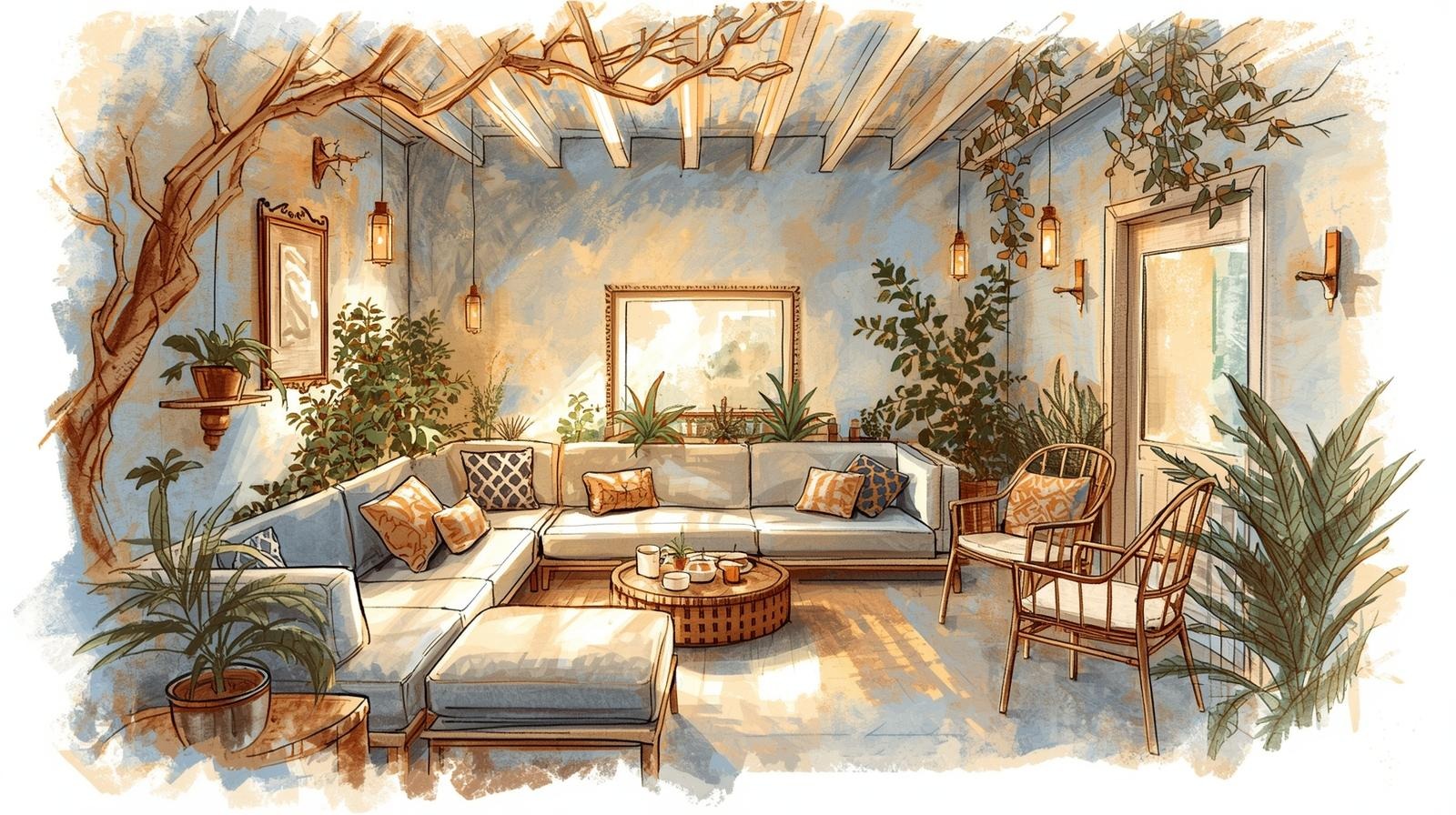
In practical terms, this means using multiple small, warm sources—table lamps, shaded floor lamps, candles placed safely—rather than a single bright overhead. If you have tunable bulbs, glide them toward warm whites as the night unfolds. Invite the dusk in; tame glare on glossy surfaces; let pockets of shadow create depth so eyes rest as much as minds do. Your guests’ pupils will thank you, and their nervous systems will follow.

Visual quiet and micro-biophilia
Visual noise—busy patterns, cluttered surfaces, aggressive color palettes—can be as fatiguing as sound. Biophilic design research offers an antidote: natural materials, greenery, daylight, and gentle views reliably support calm and cognitive ease. Even small indoor plantings are associated with improved perceived privacy and workspace satisfaction, along with fewer minor complaints—a quiet sign that the body is settling. Bringing biophilia to your table isn’t a luxury; it’s a low-tech way to help everyone breathe.
Try this: place a few living elements within soft sightlines where eyes can land between sentences. A single branch in water, a fern by the tea tray, a trailing vine along a bookshelf—nothing fussed, everything alive. The aesthetic is not “styled to death” but “invitation to soften.” When nature is present in the room, conversation becomes less effortful.
Scent, if any, should be a whisper
Scent is potent—and polarizing. Evidence for aromatherapy’s anxiolytic effects is promising but mixed across delivery methods and populations. Systematic reviews and meta-analyses suggest that inhaled lavender and certain citrus oils can modestly reduce state anxiety for some people, while oral preparations like standardized lavender capsules show more consistent outcomes in clinical contexts. For hospitality, subtlety and consent are the watchwords.
If you use scent, think trace, not trail. A small, brief diffusion before guests arrive or a single drop warmed near the entry can create a welcoming cue without saturating the air. Always disclose what you’re using; offer fresh-air zones; and be ready to switch it off. Low-stimulus gatherings prioritize souveraineté of the senses—guests should never have to “push through” a smell to enjoy your home.
Music that breathes with the room
Music can help the evening gather itself—if it participates rather than dominates. Recent work highlights tempo’s role in modulating physiological arousal, with slower pieces often nudging heart rate and blood pressure down. The trick is to keep volume below conversation, choose tempos that feel like resting pulse rather than a treadmill, and welcome intervals of silence. Calm hosting lets the soundtrack expand and contract with the mood.
If in doubt, pick recordings that sound like air moving: instrumental, sparse, warm, with no sudden dynamic spikes. Make the playlist a gentle seam running through the night rather than a center of gravity. You’ll know you got it right when nobody notices the music until they notice how easy it is to talk.
Phones down, presence up
Digital devices siphon attention in ways we underestimate. A growing literature suggests that even a silent, face-down phone on the table can reduce available cognitive capacity, with meta-analyses and replications refining the effect and its boundary conditions. Separate lines of research on “phubbing”—snubbing someone in favor of a phone—link habitual device engagement during shared time with reductions in perceived responsiveness and relationship satisfaction. None of this is a moral indictment; it’s just a recognition that presence is fragile. Hosting as calm protects it.
Give your guests an easy off-ramp from their screens. A basket by the door with chargers, a gentle note in the invitation about creating a “present-moment pocket,” or a small tray on the sideboard labeled “phones napping”—these are hospitality, not rules. Many guests will feel relief the moment the expectation shifts from “always reachable” to “allowed to arrive.
The flow of a low-stimulus evening
Think of your gathering as a tide rather than a timeline. Start with a soft arrival buffer, fifteen to thirty minutes where nothing is demanded. Offer water or tea first to cue the nervous system that it can downshift. Sit people in small constellations rather than rows; resist the urge to orchestrate. After the first natural swell of talk, introduce a quiet, centering moment—a shared breath, a question offered to the room without expectation of answers, or a slow walk to the balcony or garden. Let the evening exhale again. You’re not filling a program; you’re tending an arc.
When conversation thins, don’t panic. In low-stimulus spaces, silence is not failure; it’s an invitation. Keep the room’s sensory floor low and the social ceiling gentle. People will find each other when they’re ready. You can trust the physics of safety: in rooms where nobody has to defend themselves from their environment, connection emerges without effort.
Invitations that lower pressure before guests arrive
Calm hosting begins long before the door opens. Your invitation sets expectations and grants permissions that neurodivergent, introverted, or simply overstretched friends may need to feel safe saying yes. Write like a person, not a promoter. Name the sensory tone (“soft lighting, low music, quiet corners”), clarify that participation is opt-in, and normalize early departures. If you’re serving alcohol, say what sober alternatives you’ll offer; if you’re using scent, disclose it and invite preferences. Consent culture is just good hospitality in a nervous-system age.
Offer specifics about time windows rather than fixed starts, and cap numbers below the point where the room begins to shout. Even in a small apartment, twelve bodies and one subwoofer can feel like a club. Six humans, warm lamps, and a kettle can feel like a sanctuary.
Inclusive design as a baseline, not a bonus
A low-stimulus philosophy dovetails naturally with sensory-friendly design. Think seat choice variety, access to fresh air, soft textures, and clear sightlines that let guests orient quickly. Provide a truly quiet nook—not a hallway where the blender lives—where someone can sit without being “out of the party.” Keep pathways wide and hazards obvious to reduce background vigilance. Make captions available if you share media, and check dietary constraints like you would check for chairs. This is not fussy; it’s the infrastructure of welcome.
Research on autistic adults and sensory processing underscores how visual, auditory, and tactile overload can constrain participation in community settings; small environmental adjustments dramatically expand access. You don’t need to be a clinician to use this insight—only a host who cares enough to reduce unnecessary input.
Food and drink that comfort without spiking
The nervous system notices what’s on the table. Smooth textures, moderate temperatures, and steady energy beat culinary fireworks for most low-stimulus contexts. Begin with hydration—sparkling water with citrus, mint, or cucumber; herbal infusions in a thermos; a decaf option that feels celebratory. If you serve alcohol, keep it unshowy and situate equally appealing zero-proof choices right next to it so abstaining isn’t a performance. Think foods that don’t crackle, drip, or stain, and that can be eaten without cutting or explaining. The goal is pressure-free nourishment that keeps arousal steady rather than swinging.
The host as a nervous-system instrument
Hosts set the room’s regulatory tone. Calm speech, unhurried movement, prosody with warmth—these are not personality traits but practices. Polyvagal research makes this concrete: your facial expressivity, vocal cadence, and genuine curiosity are cues of safety that help guests access their own social engagement systems. When you soften your shoulders, your room often follows. When you greet people at the threshold with quiet enthusiasm instead of a camera flash and a shout, their body gets the message: it’s safe to be here, exactly as you are.
Connection then becomes self-reinforcing. Reviews on the mechanisms of social connection and co-regulation show how shared rhythms and supportive presence can dampen stress cascades. In a practical sense, it means that a host’s calm is contagious, and so is a guest’s comfort. Build your evening around that generous feedback loop.

Five non-standard formats for low-stimulus gatherings
The One-Conversation Dinner. Instead of several parallel chats competing across a table, intentionally slow the format: one conversation at a time, with natural gaps and gentle facilitation. The soundscape becomes human-scale, and nobody has to strain to chase a thread. You’ll notice that people who usually opt out of group talk begin to enter when they aren’t fighting physics. Speech intelligibility research in multi-talker contexts explains why this works: lowering noise and simultaneity reduces cognitive load and frees nuance.
Companionable Solitude Salon. Invite people to bring something quietly absorbing—mending, a book, a puzzle, a sketch—and simply share space for an hour before conversation finds you. The room whispers instead of performs. For many, this is the most intimate form of community because nobody has to audition to belong.
Threshold Tea. Host an early-evening, ninety-minute tea with dimmed lights and a single warm lamp per cluster of chairs. Introduce a small, optional sensory ritual—listening to the kettle, warming cups with water, noticing steam curls—then let the night drift. Think of it as a decompression chamber between the workday and home, especially in winter when circadian signals need the help of warmth and amber tones. Studies on color temperature and mood give you permission to lean into warm light here.
Quiet Games Night. Games without timers, buzzers, or shouting. Choose cooperative or contemplative play that lets conversation meander around it. If you feel called to add music, keep it barely there and slower than resting heart rate so bodies don’t rev just to keep up.
Micro-Retreat at Home. Two hours on a Saturday morning. Begin with a short nature exposure—five minutes on a balcony or under a tree—then come inside to warm drinks, soft seating, and silent reading or journaling. Close with optional sharing, never forced. The mix of green time and quiet sociality leverages what we know about attention restoration and the stress-reducing effects of biophilic cues.
A note on accessibility and consent around scent and sound
Even gentle stimuli can be too much for some bodies. Make silence available without making it a spectacle. Let people know before they arrive if you’ll be diffusing anything aromatic, and be prepared to not use it. Offer earplugs in a pretty bowl and treat them like a party favor. Consider a “first hour quiet” experiment where voices stay under café level and music, if any, is barely audible. Noise-related anxiety in dining spaces is real for many; the difference between 55 and 75 dB is the difference between possibility and overwhelm. When in doubt, soften.
The digital boundary as a kindness
Because phones erode attention even when they’re not in use, consider creating a social agreement that protects presence. You don’t need a manifesto—just a gentle line in the invitation and an easy, visible place for devices to rest. Guests will often report afterward that the evening felt unusually rich, even if they can’t say why. Your boundary gave them back their mind.
What to do when energy dips or spikes
Low-stimulus doesn’t mean flat. Energy will rise and fall. If it dips into sleepiness, bring the room outdoors for a moment or add a slightly more present track for one song before easing back to near-silence. If it spikes—laughter booms, voices stack—match the joy, then gradually lower your own volume and pace. Rooms entrain to leaders; you’re the drum. The aim is never to pin the mood to the mat but to keep it from overwhelming nervous systems.
Measuring success in a calm-first gathering
Don’t use decibel meters and questionnaires like a lab. Instead, listen to the afterglow. Are goodbyes unhurried? Do guests linger without clinging? Do you feel more resourced than depleted? These are your outcomes. Over time, you’ll notice that the people who most needed a gentler social world keep showing up, and the friends who once dominated the room begin to soften. That’s regulation moving through a community, one evening at a time.
The calm-host manifesto
Choose presence over performance. Choose cues of safety over spectacle. Choose the long, deep talk over the clever interruption. Let the kettle be the loudest thing in the room. Let silence be welcome. Keep the door easy to walk through—and just as easy to leave. Make your home a place where bodies unclench on contact. This is not about being serious; it is about making joy sustainable for more kinds of nervous systems.
When we design gatherings to be low-stimulus and high-care, we heal something quiet and important together. Hospitality becomes what it was always meant to be: a way to restore each other to ourselves.
Related posts You’ll love
- Wintering well: Private joy—practicing delight no one can grade. With FREE PDF workbook!
- The zen of having fewer choices: How trimming options restores calm, clarity, and joy
- Yin practices for Women in a hyper-Yang world: Reclaim soft power, nervous system safety, and deep rest
- The worry journal that actually works: An evidence-based, gentle guide for calmer days and softer nights
- Calm motivation for perfectionists: Progress over aesthetic
- Kind, short, firm motivation scripts for low-energy days: Science-backed micro-coaching You can use in 60 seconds. Plus FREE PDF!
- Why You get irritated when someone needs You: Nervous system overload, caregiver burnout, and boundaries that actually help
- The cortisol culture detox: A 14 day nervous system reset for real relief (no tracking, no perfection) FREE PDF!

FAQ: Hosting as calm — Low-stimulus gathering ideas
-
What is a low-stimulus gathering?
A low-stimulus gathering is a sensory-friendly, calm hosting format that intentionally reduces noise, harsh lighting, visual clutter, and social pressure. The goal is to help guests’ nervous systems settle so connection feels restorative, not draining.
-
Who benefits from calm hosting?
Everyone does, especially neurodivergent guests (including autistic and ADHD folks), introverts, highly sensitive people, and anyone recovering from stress or burnout. A regulated environment makes social time feel safer and more enjoyable.
-
How many people should I invite for a sensory-friendly night?
Keep the guest list under the point where the room starts to feel loud—often 4–8 in a small apartment and 6–12 in a home. Smaller groups support one-conversation flow and reduce competing sound sources.
-
What lighting works best for low-stimulus events?
Use multiple warm, dimmable light sources (lamps, candles used safely) instead of a single bright overhead. Aim for cozy, glare-free pools of light that tell the body it can relax.
-
How quiet should the room be?
Set music below voice level and soften echo with textiles. If you have to lean in to hear a sentence across a coffee table, turn the volume down; conversation should feel effortless.
-
Which music fits a calm hosting vibe?
Choose slow-tempo, low-dynamic, mostly instrumental tracks that breathe with the room. Let silence appear between songs—sound should support, not lead, the evening.
-
Should I use scent or aromatherapy?
If you use scent, keep it subtle and ask for preferences. A brief pre-event diffusion or a single drop warmed safely can be welcoming; strong, persistent fragrance can overwhelm sensitive guests.
-
How do I design invitations for a low-stimulus gathering?
Name the sensory tone (“soft lighting, low music, quiet corners”), set a flexible arrival window, normalize early exits, and offer zero-proof drinks. Clear expectations reduce social pressure before guests arrive.
-
What food and drink feel calming?
Serve hydrating, easy-to-eat options with stable energy: herbal teas, sparkling water with citrus, simple bowls or small plates that don’t crackle, stain, or demand attention. Place zero-proof choices at the center, not the edge.
-
How can I make my home more sensory-friendly without remodeling?
Add soft textures to tame echo, clear visual clutter from key sightlines, and place a few living elements (a plant, a branch in water) where eyes can rest. Create a true quiet nook away from traffic.
-
What are engaging but low-arousal formats?
Try a one-conversation dinner, companionable-solitude salon (reading, mending, puzzles), threshold tea at dusk, cooperative “quiet games,” or a two-hour micro-retreat with a short nature moment.
-
How do I handle phones respectfully?
Offer a gentle “present-moment pocket” in the invite and a tray with chargers for optional device rest. Framing it as a kindness—rather than a rule—protects attention without shaming.
-
Is calm hosting child-friendly?
Yes. Offer a soft-play corner with tactile toys, floor cushions, and warm light. Keep noise low, avoid strong scents, and provide a quiet room for regulation breaks.
-
What if energy dips or spikes?
If it dips, step outside for two minutes or raise light gently; if it spikes, enjoy it, then lower your voice and pace to guide the room back to ease. Rooms entrain to the host’s nervous system.
-
Can I host low-stimulus gatherings outdoors?
Absolutely. Choose wind-sheltered spots, reduce glare at sunset, and keep sound simple. Nature’s biophilic cues—greenery, birdsong—do half the calm-hosting work for you.
-
What accommodations support neurodivergent guests?
Offer seating choice, quiet nooks, clear schedules without forced activities, captioned media, and consent-based participation. Ask about sensory preferences in advance when possible.
-
How long should a calm gathering last?
Ninety minutes to two and a half hours is often ideal. End before fatigue sets in so guests leave soothed, not spent.
-
Can calm hosting work on a tight budget?
Yes. Borrow lamps, use candles safely, lean on water and tea, tidy visual clutter, and curate music thoughtfully. The most impactful changes—sound, light, pacing—are nearly free.
Sources and inspirations
- World Health Organization. Environmental Noise Guidelines for the European Region. 2018.
- Brungart DS, Objective assessment of speech intelligibility in crowded public spaces. J Acoust Soc Am. 2020.
- Williams G, Effects of noise on anxiety related to the experience of dining in restaurants. 2022.
- Jimenez MP, Associations between nature exposure and health: A review and future directions. Int J Environ Res Public Health. 2021.
- Rhee J-H, Effects of nature on restorative and cognitive benefits in outdoor field studies. Scientific Reports. 2023.
- Yin J, Effects of biophilic indoor environment on stress and anxiety. Environment International. 2020.
- de Vries S, Effects of indoor plants on office workers: a field study. Frontiers in Psychology. 2023.
- Porges SW. Polyvagal Theory: a science of safety. Frontiers in Integrative Neuroscience. 2022.
- Delgado MR, Characterizing the mechanisms of social connection. Neuron. 2023.
- Skowronek J, The mere presence of a smartphone reduces basal attentional performance. Scientific Reports. 2023.
- Böttger T, Does the Brain Drain effect really exist? A meta-analysis of smartphone presence. 2023.
- Donelli D, Effects of lavender on anxiety: systematic review and meta-analysis. Phytomedicine. 2019.
- Tan L, Essential oils for treating anxiety: systematic review and network meta-analysis. Frontiers in Public Health. 2023.
- Mostafavi A, Effects of illuminance and correlated color temperature on mood by age group. Building and Environment. 2024.
- Li Z, Meta-analysis of correlated color temperature effects on thermal and visual perception. Building and Environment. 2025.


Leave a Reply