Table of Contents
Every era invents a woman it can punish.
Once, she was punished for wanting too much: too much education, too much money, too much authority, too much life beyond the front door. Now she can also be punished for appearing to want too little of the approved modern dream. Say that you do not fantasize about becoming a CEO. Say that you want marriage, children, a slower home, perhaps years of part-time work. Say that you like being courted, that you would welcome a partner who provides more financially, or that building a beautiful domestic life sounds meaningful rather than embarrassing.
Watch how quickly a preference becomes a confession.
Suddenly, people are no longer listening to what a woman wants. They are calculating what her desire means. Is she liberated or brainwashed? Feminist or regressive? Soft, privileged, lazy, submissive, sensible, romantic, dangerous? Before she has chosen the man, counted the cost or lived a single day of the arrangement, she has been turned into evidence in somebody else’s argument.
I keep noticing how rarely women are permitted to be literal. A loaf of homemade bread becomes a referendum on feminism. An engagement ring becomes evidence of female surrender. A woman enjoying a quiet day with her children becomes either the final proof that modern work has failed women or the opening scene of a patriarchal horror story.
I want to make room for a third possibility.
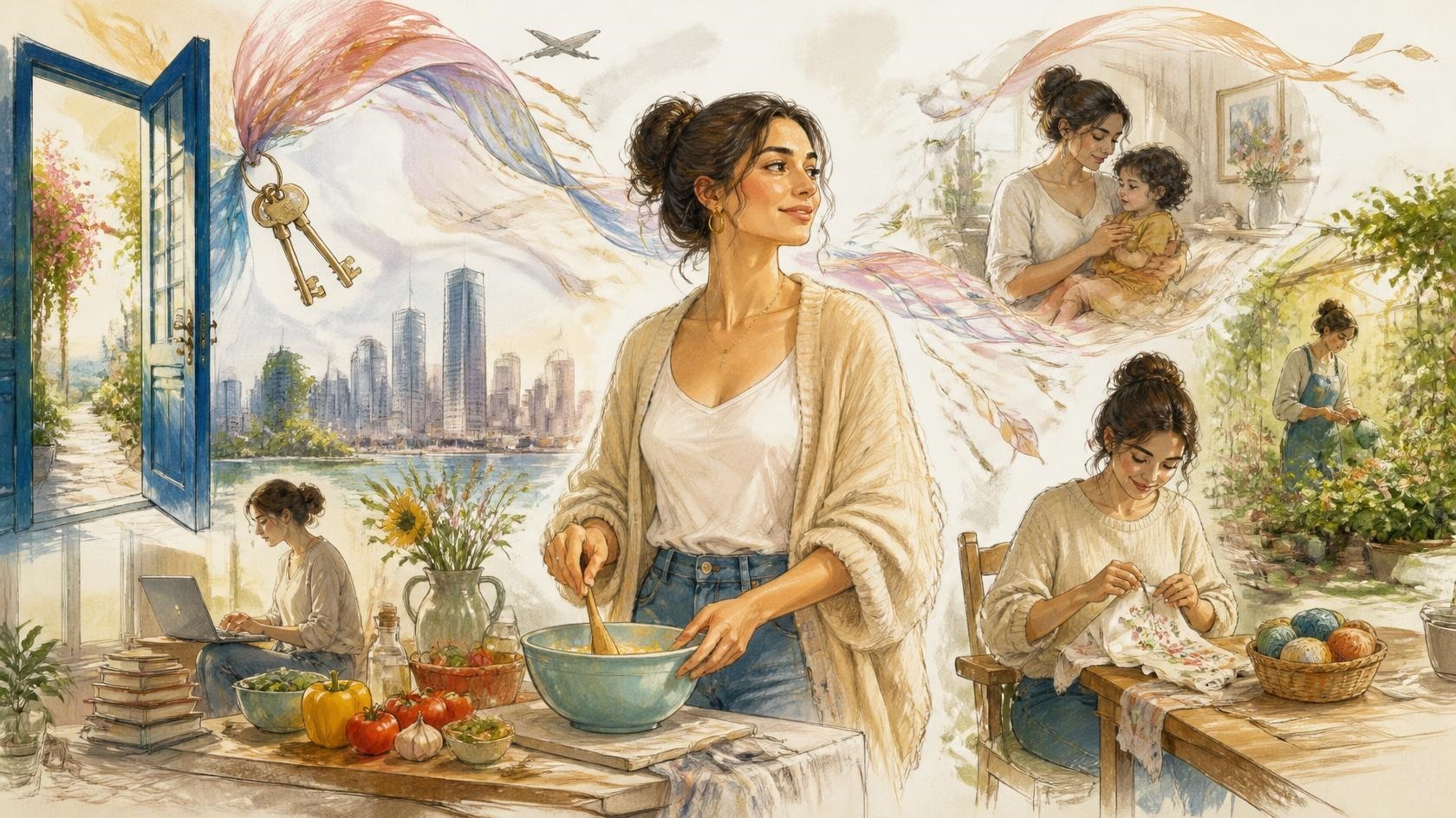
Perhaps she made the bread because she wanted bread.
Perhaps she wants marriage because permanence matters to her. Perhaps she wants motherhood because she feels a real pull toward raising children. Perhaps she wants to be cared for because she is tired of being praised for surviving without care. Perhaps she likes femininity not because she is incapable of power, but because power has never required her to dislike silk, tenderness, ceremony or romance.
None of this proves that her desire appeared in a social vacuum. No desire does. The career woman was shaped by culture too. So was the radically independent woman, the “cool girl,” the wellness entrepreneur, the perfect mother, the child-free traveler and the woman who insists she needs nobody. Modernity has scripts of its own; they simply arrive with better lighting and newer vocabulary.
Here is the sentence I wish women did not need permission to say:
I may want a familiar kind of life. I still expect to remain a full person inside it.
That is the argument of this article.
I do not believe equality should operate as an audition in which a woman must continuously prove that she is modern enough. I also do not believe the phrase “her choice” is magic dust that makes unequal power disappear. A choice can be sincere and socially influenced. A life can be deeply wanted and poorly protected. A traditional arrangement can be loving and still contain risks that love alone cannot solve.
So I am not offering a sentimental defense of every custom labeled traditional. I will not romanticize invisible labor, economic dependence, compulsory motherhood or male authority disguised as protection. I am defending something both simpler and more demanding: a woman’s right to want marriage, motherhood, homemaking, courtship, femininity or provision without being forced to purchase those things with her voice.
To me, the key distinction is not between a traditional woman and a modern woman. That division is too crude to be useful. The real distinction is between a life a woman can help author and a role she is required to inhabit.
A wedding can be chosen. Obedience can be imposed.
Care can be meaningful. Self-erasure can be demanded.
Provision can be generous. Money can also become a leash.
Femininity can be expression. Femininity can also be a disciplinary code.
I want us to become intelligent enough to tell the difference.
Modern women should be allowed to want traditional things because freedom was never meant to replace one mandatory female life with another. It was meant to expand women’s authorship. That authorship includes the right to choose a recognizable life, negotiate unfamiliar terms, protect one’s future and change one’s mind.
The question I ask is therefore not, “Does this look traditional?”
I ask: Can she choose it, shape it, question it, renegotiate it—and leave it if it stops being safe or true?
Why should modern women be allowed to want traditional things?
My short answer is this: modern women should be allowed to want traditional things because freedom includes the right to choose familiar forms of love, family and femininity—not only visibly unconventional ones. I do not see marriage, children, a home-centered life or a generous partner as evidence that a woman is weak, unintelligent or anti-feminist.
The important distinction is between a traditional preference and a restrictive power structure. A preference becomes dangerous when it is imposed, when one person receives all the authority, when unpaid work is treated as worthless, when money becomes a tool of control or when changing one’s mind carries an impossible cost.
In other words: the object of a woman’s desire may be traditional; the terms do not have to be.
A traditional thing is not the same as a traditional contract
This is the distinction I return to throughout the entire argument: a traditional thing is not the same as a traditional contract.
A wedding is a traditional thing. A husband having the final word because he is the husband is a traditional contract.
Motherhood is a traditional thing. Treating a mother’s time, body and ambition as family property is a traditional contract.
Homemaking is a traditional thing. Expecting a woman to perform endless domestic labor without rest, recognition, financial protection or negotiating power is a traditional contract.
Femininity may include dresses, softness, beauty rituals, romantic gestures or being cared for. None of those things logically requires obedience, helplessness or intellectual smallness.

I think this table matters because public arguments constantly collapse these two columns. Some critics see a sourdough loaf and imagine submission. Some traditionalists see the same loaf and imagine proof that all women belong at home. Both groups turn an activity into a command.
The loaf is not the problem. The command is.
Modern Women are being judged by two opposing tribunals
For generations, women were judged for failing to be traditional enough. Now I see another test emerging: women are also judged for failing to be modern in the approved way.
The first tribunal asks: Are you agreeable enough, maternal enough, modest enough, self-sacrificing enough?
The second asks: Are you ambitious enough, independent enough, resistant enough, visibly emancipated enough?
Both can make a woman feel that her life is public evidence in somebody else’s ideological case. Both can turn personal decisions into a performance review.
Research helps explain why this pressure is not imaginary. The United Nations Development Programme’s 2023 Gender Social Norms Index, covering countries representing 85% of the global population, reported that close to nine in ten people held at least one fundamental bias against women. These norms do not merely describe behavior; they help define what women are expected to be and which choices are considered legitimate.
At the same time, women can experience strain when they feel they are not living up to culturally feminine expectations. Daily- and weekly-life research linked feminine gender-role discrepancy strain with lower self-esteem, showing that gender policing can operate internally as well as socially.
I read these findings as evidence of a peculiar double bind. A woman may be criticized for wanting domesticity, then feel inadequate if she is not effortlessly good at it. She may be told she is wasting her education if she pauses her career, then blamed for insufficient devotion if she works long hours after having children.
My answer is not to invent a third, supposedly perfect woman. It is to stop treating women’s lives as ideological uniforms.
Equality should expand the menu, not dictate the order
There is a lazy version of empowerment that I do not trust. It assumes that the more a woman’s life resembles the life historically available to powerful men, the freer she must be.
By that logic, paid work is always liberation, care is always regression, individualism is always strength and dependence of any kind is always failure. But real lives are not so clean. A prestigious job can be exploitative. A marriage can be deeply reciprocal. A woman can feel most alive building a company, raising children, caring for animals, writing novels at midnight, managing a home—or combining these in different seasons.
I consider financial independence enormously important, but “having a job” is not a complete theory of freedom. Plenty of women work because survival requires it, not because paid labor expresses their deepest identity. Conversely, I can take a woman’s love of homemaking seriously while also insisting on legal, financial and relational protections.
The point of equality is not to assign a moral ranking to work and care. It is to increase a person’s real options and reduce the punishment attached to using them.
Not every choice is feminist—and Women still deserve respect
I resist the sentence “a woman chose it” when it is used to end every analysis. Choices are made inside cultures, relationships, economies and algorithms. We absorb ideas about love, beauty, success, family and gender long before we can name them.
One study of a Spanish sample found that stronger internalization of feminine roles was associated with fear of negative evaluation, which in turn related to regret in decision-making and lower well-being. The study does not prove that feminine preferences are false. It shows why examining pressure and fear matters when we talk about choice.
So no, I do not think a choice becomes feminist simply because a woman made it. A woman can choose something that preserves an unequal norm, harms her or limits other women. She can also choose something ordinary, imperfect or politically neutral.
But here is the part that disappears in online debates: a woman does not have to prove that every personal preference advances the movement before she is entitled to basic respect.
Buying lipstick is not a policy platform. Wanting a husband is not a referendum on single women. Enjoying childcare is not an argument that mothers belong at home. Taking a partner’s surname is not a demand that everyone else do the same.
I believe we can analyze social patterns without cross-examining every individual woman as if she personally designed patriarchy.
The three conditions of a meaningful choice
When someone says, “It is her choice,” I listen for three missing pieces.
1. A meaningful alternative
Could she realistically choose something else? If refusing marriage means losing her community, if working outside the home would trigger retaliation, or if being child-free makes her socially disposable, then the available options are not equal.
The same applies in the other direction. If a woman would lose all respect in her social circle for becoming a stay-at-home mother, her “modern” environment is also enforcing a script.
2. A tolerable cost for saying no
Every decision has costs, but coercion hides inside disproportionate ones. Can she decline sex, pregnancy, housework, relocation or financial dependence without facing threats, humiliation, abandonment or punishment?
3. The right to revise
Consent is not a fossil. A woman who wanted to stay home with a baby may want paid work three years later. A woman who loved being the primary earner may need rest. A couple who once preferred sharply divided roles may discover that illness, money or resentment has changed the equation.
A choice is more trustworthy when it remains discussable.

This is a better test than asking whether an arrangement looks traditional from the outside. A conventionally married homemaker may have substantial negotiating power, assets and freedom. A high-earning professional may be monitored, coerced and financially abused by a partner. Aesthetic appearance is a poor measurement of agency.
Wanting care is not the same as wanting to be controlled
I think many women are tired in a way our arguments about gender do not adequately name. They do not secretly want fewer rights; they want fewer relentless demands.
When a woman says she wants a man to provide, the desire may contain many things: relief from economic precarity, evidence of commitment, generosity, protection during pregnancy, shared investment in family life or a wish not to carry paid work and domestic management simultaneously.
I find nothing shameful about wanting care. Human beings are interdependent. The fantasy of needing nobody is not freedom; it is often exhaustion wearing good branding.
But provision and control are not synonyms.
A provider says, “What I earn helps create security for us.” A controller says, “Because I earn, I decide.”
A provider makes financial information transparent. A controller keeps it mysterious.
A provider wants the other person protected if the relationship ends. A controller makes leaving materially terrifying.
This distinction matters because benevolent sexism often presents itself as admiration, protection and complementary partnership while placing men closer to authority and women closer to dependence. A major review describes benevolent and hostile sexism as related systems: one idealizes women who fit traditional expectations, while the other punishes those who resist them.
My answer is not to ridicule women for wanting generosity. It is to give them a more accurate sentence:
“You can take care of me without taking authority over me.”
Homemaking is real work, and I refuse to let love erase its price
Cooking, cleaning, planning, remembering appointments, buying clothes for growing children, noticing an empty refrigerator, arranging care for older relatives and carrying the emotional weather of a household all take time and skill.
Whenever I hear this work described as simply “natural,” I notice what the word accomplishes: it makes labor disappear while keeping the laborer busy.
Women still do more unpaid work, and the consequences accumulate. The OECD reports that gender gaps in paid and unpaid work shape earnings, career prospects and social protection across the life course, including pension income later in life. Research has also connected women’s disproportionate unpaid workload with poorer well-being and mental-health pressures.
This is why “I love taking care of my family” and “this arrangement must protect me” belong in the same sentence.
If one partner reduces paid employment to support the household, sensible questions include:
- Will retirement contributions continue in her name?
- Does she have equal access to money rather than an allowance granted at somebody else’s discretion?
- Is her name on relevant property and accounts?
- Does she maintain personal credit and emergency savings?
- What happens to her standard of living if the relationship ends?
- When is she off duty?
- Who takes over when she is ill?
- How will the couple support career re-entry if she later wants it?
I do not believe these questions make love transactional. The exchange already exists: time, income, opportunity and risk are moving between two people. Clarity simply stops one person from carrying the invisible side of the bargain alone.
Economic control deserves particular attention. A 2024 population-based study of ever-partnered women in New Zealand found economic abuse was associated with adverse financial and mental-health outcomes. This does not mean dependence always becomes abuse. It means romantic arrangements should be designed with the possibility of human fallibility in mind.
My rule is simple:
If a traditional arrangement cannot survive a calm conversation about assets, labor, retirement and exit, it is not too romantic to question; it is too under-negotiated to trust.
I believe motherhood can be a calling without becoming a disappearance
I believe some women feel a deep and genuine calling toward motherhood. Some want to spend long stretches of early childhood at home. Others want paid work, shared leave or a life without motherhood. I do not need to degrade one woman to validate another.
The problem, as I see it, begins when motherhood is inflated into a total moral identity. Intensive-mothering ideology treats the mother as primarily responsible for maximizing the child’s outcomes through extraordinary time, knowledge, emotional availability and self-sacrifice. Mixed-method research has linked this ideology with the perpetuation of gender inequality. Qualitative research with mothers has also documented pressure surrounding the image of the “good mother” and its effects on partner relationships.
A woman can love motherhood without agreeing that:
- she is the default parent every hour of every day;
- her paid work is optional while her partner’s is essential;
- rest must be earned through collapse;
- knowing more about the children makes every task permanently hers;
- needing solitude is evidence of insufficient love;
- a child’s difficulty is proof of maternal failure.
Motherhood should add a relationship to a woman’s life. It should not cancel the person who entered it.
I also refuse to discuss motherhood as if it had no measurable economic cost. A meta-analysis drawing on hundreds of estimates found an average wage penalty associated with motherhood, although the size varied across contexts and research designs. For a woman who wants time away from paid work, acknowledging that cost is not an argument against her desire. To me, it is an argument for sharing the cost rather than quietly storing it inside her future.
I watch the internet sell a costume and call it a life
I think the online “tradwife” aesthetic deserves separate treatment because it repeatedly confuses three different things:
- enjoying domestic activities;
- choosing a gendered division of labor;
- promoting a political hierarchy between men and women.
They are not interchangeable.
A woman can bake bread, wear vintage dresses and adore her husband without believing women should submit to male authority. She can be a stay-at-home mother without becoming an influencer for compulsory heterosexual roles. She can also earn money from content that presents domestic withdrawal as an escape from capitalism—which is one of the genre’s more fascinating contradictions.
Ethnographic work on “trad” women’s social-media networks shows how online performances of traditional femininity can connect personal identity, political narratives and platform dynamics. The feed is therefore not a neutral window into private domestic life. It is a curated product.
When I look at this content, I try to remember what the camera cannot show. It does not show the pension forecast. It does not show whose name is on the deed, who edits the video, who receives the advertising income, whether childcare happens off-screen or what would happen after divorce. It shows warm bread in afternoon light.
I like warm bread. I simply refuse to mistake it for a financial plan.
Traditional femininity should be a language, not a law
I find femininity spacious when it is a form of expression. I find it restrictive when it is treated as proof of female worth.
Softness can be beautiful when a woman can also be direct. Receptivity can feel intimate when it does not forbid initiative. Being cared for can be healing when it does not require performed helplessness. Beauty can be playful when it is not the admission price for dignity.
I do not want to rescue femininity by insisting that every feminine practice is secretly radical. Sometimes a dress is simply a dress. Sometimes a woman enjoys making dinner. Sometimes she loves ceremony, family rituals, romantic pursuit or a partner opening the door.
For me, the freedom lies in not having to translate every pleasure into approved political language.
Words of power: How to defend a traditional desire without apologizing
Women are often pushed into one of two verbal positions: defensiveness or preaching. They either over-explain why their preference does not make them foolish, or they universalize it and imply that other women should want the same.
There is a third option: calm ownership.

Notice what these sentences do not do. They do not beg permission. They do not insult career-focused, child-free, single, queer or less conventionally feminine women. They do not turn preference into destiny.
That is the tone I would like more women to have available: specific, non-apologetic and non-converting.
How to negotiate a traditional arrangement in modern language
I believe a beautiful shared life is built in sentences that are often less photogenic than the life itself.
Before one partner leaves paid employment, reduces hours, relocates for the other’s career or becomes the primary caregiver, discuss the following.
Money
What counts as shared money? Which accounts will each person access? Will both have personal spending money with no permission process? How will retirement savings be funded? What debt and credit obligations exist? Who can see every relevant document?
Ownership
Whose name is on the home, car, business, insurance and investments? If local law treats marital property in a surprising way, what agreement is needed? Legal advice should be independent, not supplied by the partner who holds more resources.
Labor
What does each person actually do in a normal week? “Home” is too vague a job description. List cooking, cleaning, nighttime parenting, school communication, family gifts, appointments, travel planning, elder care and emotional coordination.
Rest
Paid workers have weekends, holidays, sick leave and a defined end to the workday—at least in principle. What is the homemaker’s equivalent? Being physically inside the home is not the same as being off duty.
Children
Who becomes the default parent? Who learns the routines? Who takes leave when a child is ill? Who protects the primary caregiver from becoming the only competent adult in the system?
Career continuity
Will the at-home partner keep professional credentials, study, freelance, volunteer or maintain a portfolio? How much money and time will be set aside for re-entry? This is not an admission that the arrangement will fail. It is respect for an adult whose future cannot be perfectly predicted.
Decision-making
Does the higher earner have more power? Can either partner veto major spending, relocation or family expansion? What happens when values change?
Exit
What would a fair separation look like? Is each person capable of accessing money, housing, documents and support independently? A safe exit route does not weaken commitment. It helps ensure that staying remains a choice.
A private agency audit: Is this my desire or my assigned role?
I do not believe any questionnaire can purify a preference of every social influence. That is not my goal. I use the following questions for something more realistic: hearing one’s own voice more clearly beneath admiration, fear, aesthetics and expectation.
Try these questions away from your partner, parents, audience and algorithm.
The empty-room question
If nobody could admire, reward or criticize this choice, what part of it would I still want?
The substitution question
Do I want the activity itself, or the promise attached to it? For example, do I want to stay home, or do I want relief from a punishing workplace? Do I want a provider, or do I want evidence that I will not be abandoned with all the family costs?
The symmetry question
Would the arrangement still seem fair if I occupied the other role? If I earned all the money, would I believe that gave me final authority? If my partner did the invisible labor, what protection would I think he deserved?
The bad-year question
How does this life operate during illness, unemployment, burnout, infertility, disability, conflict or grief—not only in its most beautiful season?
The resentment question
Which part of the arrangement am I already afraid I will not be allowed to complain about?
The audience question
Am I constructing a life or a recognizable identity? Would I still want it if I could never post it, name it or receive approval for it?
The revision question
What would I need in place today so that changing my mind in five years would be painful but possible?
I would not judge the answer by how impressive it sounds. I would judge it by whether it is honest and usable.
Red flags: When “traditional” is becoming a euphemism for control
I know tradition can offer rhythm, meaning and continuity. I also know it can be used to make hierarchy sound sacred and therefore unavailable for discussion.
Pay attention if a partner or community:
- treats male leadership as exempt from female consent;
- praises women mainly for obedience, purity or sacrifice;
- discourages you from understanding money, law or property;
- frames personal savings as betrayal;
- wants you isolated from friends, work, study or outside perspectives;
- romanticizes dependence but refuses to formalize your protection;
- expects domestic excellence without sharing resources or responsibility;
- calls disagreement masculine, disrespectful or unfeminine;
- celebrates your lack of options as proof of commitment;
- uses your earlier desire—“You said you wanted this”—to cancel your present voice;
- insists that one model of womanhood should govern every woman.
I want to be unequivocal here: economic restriction, intimidation and isolation are not romantic preferences. If you are afraid to ask about money, disagree or leave, the issue is no longer aesthetic or ideological; it is safety.
Green flags: What chosen tradition looks like in practice
I would look for a partner who does not merely support the traditional thing a woman wants. A healthy partner supports the chooser inside it.
They can hear, “I want to be home with our child,” without translating it into, “I surrender authority.” They can value domestic labor without assuming it appears by magic. They can provide financially without turning gratitude into obedience. They can be disappointed by a change of plan without treating revision as fraud.
Chosen tradition usually contains:
- transparent money;
- reciprocal sacrifice;
- respect for unpaid labor;
- preserved outside relationships;
- access to education and information;
- shared parental competence;
- legal and financial protection;
- room for anger, ambition and contradiction;
- dignity for women who choose differently;
- a real ability to renegotiate.
The best sign, in my view, is not that a woman never doubts her arrangement. It is that doubt can enter the room without destroying her safety.
What feminism owes Women who want traditional things
I do not need feminism to declare every traditional preference emancipatory. I need it to remain capable of analyzing power, unpaid work, heterosexual norms, reproductive pressure and economic inequality.
But I also need it not to confuse critique with contempt.
Mocking a woman’s domestic desire does not redistribute care work. Calling her brainwashed does not increase her bargaining power. Treating motherhood as intellectually embarrassing does not make mothers freer. If the goal is women’s agency, humiliation is a strange instrument.
The serious feminist response I want is more demanding and more useful:
“You are allowed to want this. Let us make sure the structure around your desire does not consume your money, voice, health or future.”
That response respects both the woman and the evidence.
What traditional communities owe Women
I think the responsibility runs in the other direction too.
Communities that value marriage, family, homemaking or gendered partnership should stop using women’s voluntary devotion to justify women’s compulsory service. They should stop praising female sacrifice while declining to protect the sacrificer. They should stop treating a woman’s economic vulnerability as a feature of moral order.
If a traditional life is truly good, I see no reason it should require censorship, fear or a closed exit.
It should be able to coexist with educated women, female property ownership, informed consent, legal equality, shared caregiving, sexual boundaries and the possibility that one woman’s calling is another woman’s nightmare.
In my view, tradition earns trust when it can be chosen without trapping the chooser.
The words I would keep
If I had to reduce this entire argument to a handful of sentences, I would keep these:
I can want commitment without wanting captivity.
I can value care without volunteering for erasure.
I can enjoy femininity without performing incompetence.
I can welcome provision without selling my vote.
I can choose a familiar life on unfamiliar terms.
I do not need every woman to want what I want in order to trust my own desire.
These are not slogans against tradition. They are boundaries around authorship.
Let Women want ordinary things in fully human ways
A modern woman should be able to say she wants a husband, children, a beautiful home, romantic courtship, time away from paid work or a partner who provides—and remain recognizable as an intelligent adult.
She should also be able to reject every one of those things.
Freedom is not proven by selecting the least traditional option. Nor is authenticity proven by returning to an idealized past. The strongest life is not the one that looks most rebellious or most respectable from the outside. It is the one whose terms a woman can understand, influence and revise.
So I am not interested in replacing “women belong at home” with “empowered women should never want home.” Both sentences make women answer to a template.
I am interested in a woman who can make dinner because she loves it, order takeout because she is tired, earn the money, spend shared money without asking permission, raise children, remain child-free, wear silk, wear work boots, take a surname, keep her own, cherish a marriage, leave an unsafe one and change her mind without being told that her change invalidates every earlier version of herself.
That is not ideological inconsistency. That is personhood.
Women do not need permission to want traditional things. But many do need better language for protecting the freedom inside those wants.
The most powerful sentence may be the simplest:
“This is the life I want. I will still have a voice inside it.”
Related posts You’ll love
- Why modern news makes Women feel helpless
- Attachment styles in Women: How they show up in modern dating (and how to build secure love in the age of apps)
- Why modern adulthood feels like one endless monthly payment—and what it is doing to Our minds
- Why Women sit in Their cars before going inside: What happens in the minutes no one sees
- 7 quiet social practices for Women who want company but not conversation (FREE PDF)
- Why meaningless pleasure feels so radical for Women: The quiet power of joy that does not need to be useful
FAQ
-
Is it anti-feminist for a woman to want a traditional marriage?
No. Wanting marriage is not inherently anti-feminist. The relevant questions concern power: Can both partners make decisions, control their own bodies, access money, disagree safely and revise the arrangement? A traditional-looking marriage can be egalitarian, while a modern-looking relationship can still be controlling.
-
Can a feminist choose to be a stay-at-home wife or mother?
Yes. A feminist can choose home-centered work while recognizing the structural risks attached to unpaid labor. A robust arrangement should address shared assets, retirement savings, personal credit, time off, legal rights, career re-entry and what happens after separation or a partner’s death.
-
What is the difference between traditional femininity and submission?
Traditional femininity may include aesthetic preferences, softness, nurturing, domestic interests or receptive romantic dynamics. Submission assigns superior authority to somebody else. A woman can enjoy feminine expression while keeping equal decision-making power, firm boundaries and the right to refuse.
-
Is wanting a provider husband a red flag?
Not by itself. Wanting generosity, stability or support during caregiving is understandable. The red flag appears when financial provision is exchanged for obedience, when information is hidden, when the non-earning partner lacks assets or when access to money can be withdrawn as punishment.
-
Are traditional choices ever completely free from social conditioning?
Probably not—and neither are nontraditional choices. Human preferences form within families, cultures, peer groups, economies and media environments. The useful goal is not a socially untouched choice; it is a reflective choice made with meaningful alternatives, information, negotiating power and room to change.
-
Why do some modern women feel drawn to traditional lifestyles?
Motives vary. Some value family continuity, religion, domestic creativity, slow living, romantic structure or intensive time with children. Others may be reacting to burnout, insecure work, loneliness or the unequal “double shift” of paid work plus domestic management. It is worth identifying which need sits beneath the image.
-
What financial protections should a stay-at-home partner have?
At minimum, she should understand all household finances, have reliable access to shared money, maintain personal credit and identification, participate in major decisions, build retirement security and have emergency funds. Depending on local law, independent legal advice, property arrangements and a prenuptial or postnuptial agreement may also be appropriate.
-
Does choosing homemaking reinforce harmful gender stereotypes?
One person’s homemaking does not automatically harm other women. The choice becomes prescriptive when it is presented as women’s natural duty, evidence of moral superiority or the only route to fulfillment. A helpful sentence is: “This arrangement fits me; it should not be imposed on anyone else.”
-
How can couples make a traditional division of labor fair?
They can name the full workload, value paid and unpaid contributions, share financial authority, schedule genuine rest, maintain transparency, fund long-term security for the lower earner and revisit the arrangement regularly. Fair does not always mean identical; it does mean that one person is not carrying invisible costs without power.
-
Can a Woman change her mind after choosing a traditional role?
Absolutely. An earlier choice can have been sincere and still become unsuitable. People change, children grow, finances shift and relationships evolve. Designing for reversibility—through savings, skills, networks and legal protection—allows a woman’s continued participation to remain meaningful.
-
What should I say when people judge my traditional preferences?
Try: “This is a personal preference, not a rule I am setting for other women.” If the concern is genuine, add: “I have thought carefully about money, labor, power and what happens if our needs change.” You do not owe everyone a full defense of your life.
Sources and inspirations
- Barreto, M., & Doyle, D. M. (2023). Benevolent and hostile sexism in a shifting global context. Nature Reviews Psychology.
- Cukrowska-Torzewska, E., & Matysiak, A. (2020). The motherhood wage penalty: A meta-analysis. Social Science Research.
- Deem, A. (2023). “Feminine, not feminist”: Trad truth-making on social media. Ethnologia Europaea.
- Harrington, A. G., Overall, N. C., & Maxwell, J. A. (2022). Feminine gender role discrepancy strain and women’s self-esteem in daily and weekly life: A person × context perspective. Sex Roles.
- Mellar, B. M., Fanslow, J. L., Gulliver, P. J., & McIntosh, T. K. D. (2024). Economic abuse by an intimate partner and its associations with women’s socioeconomic status and mental health. Journal of Interpersonal Violence.
- Organisation for Economic Co-operation and Development. (2025). Gender equality in a changing world: Taking stock and moving forward. OECD Publishing.
- Seedat, S., & Rondon, M. (2021). Women’s wellbeing and the burden of unpaid work. BMJ.
- United Nations Development Programme. (2023). 2023 Gender Social Norms Index (GSNI): Breaking down gender biases—Shifting social norms towards gender equality.
- Verniers, C., Bonnot, V., & Assilaméhou-Kunz, Y. (2022). Intensive mothering and the perpetuation of gender inequality: Evidence from a mixed methods research. Acta Psychologica.
- Villanueva-Moya, L., & Expósito, F. (2023). Are gender roles associated with well-being indicators? The role of femininity, fear of negative evaluation, and regret in decision-making in a Spanish sample. Current Psychology.
- Williamson, T., Wagstaff, D. L., Goodwin, J., & Smith, N. (2023). Mothering ideology: A qualitative exploration of mothers’ perceptions of navigating motherhood pressures and partner relationships. Sex Roles.


Leave a Reply