Table of Contents
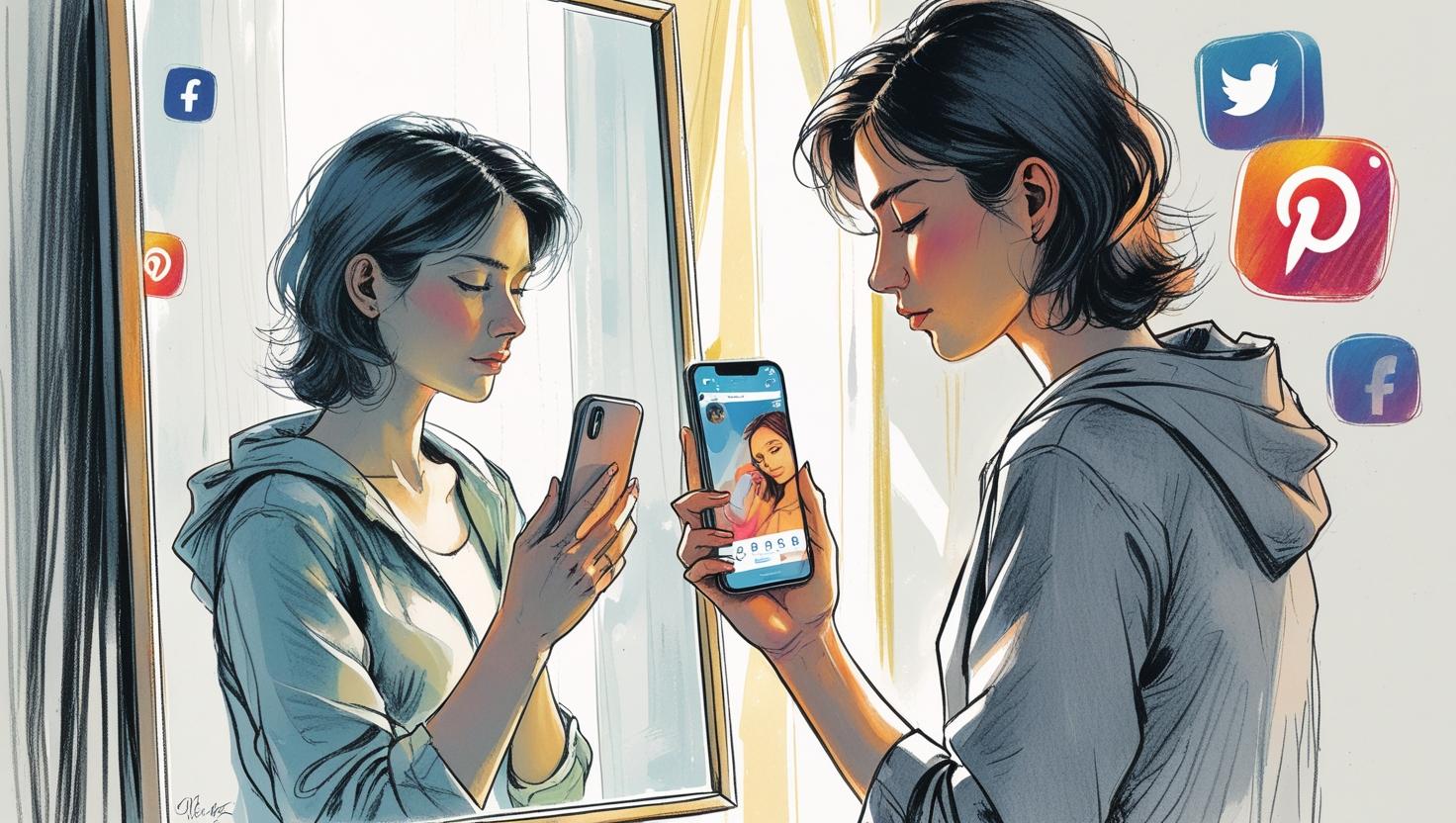
Every morning starts the same. You wake up, grab your phone, and within seconds you’re knee-deep in other people’s curated perfection. Flawless bodies, luxury vacations, career wins — and suddenly your life feels… inadequate.
Welcome to the age of social media comparison, where Instagram and TikTok don’t just entertain — they quietly erode your self-worth.
But here’s the truth: You can learn to love yourself again, even in a digital world obsessed with perfection!
Here, you’ll discover the science behind social comparison, how it affects your mental health, and 7 powerful ways to break the cycle — without giving up social media entirely, stop hating yourself!
What is social comparison — and why it hurts so much
Back in the 1950s, psychologist Leon Festinger introduced social comparison theory, which explains our natural tendency to evaluate ourselves by comparing to others. It once helped humans survive. Today, it’s making many of us feel like we’re failing.
On platforms like Instagram and TikTok, the comparisons are rarely fair. We compare our behind-the-scenes to someone else’s highlight reel. And it’s not just frustrating — it’s damaging.
The dark side of social media: What science tells us
More time online = lower self-esteem
A 2014 study found that college students who spent more time on Facebook compared themselves more and felt worse about their own lives (Vogel, 2014).
Instagram and body image
Young women who frequently use Instagram are more likely to experience body dissatisfaction (Tiggemann & Slater, 2014). All those edited bikini pics? They’re hurting us more than we think.
Retouched photos = warped self-perception
Photo-editing apps and filters reinforce impossible beauty standards, leading to a distorted sense of self (McLean, 2015).
Anxiety and depression on the rise
A 2017 meta-analysis confirmed that heavy social media use is linked to increased depression and anxiety (Huang, 2017).
Why social media feels so addictive (and painful)
It’s not just you — social media is designed to hijack your brain. Platforms reward engagement with likes and comments, triggering your brain’s dopamine system (Sherman, 2016). Over time, you crave validation from others and lose connection with your inner worth.
Plus, we only see the glamour, not the struggles. And that distorted view makes us think we’re falling behind in life.
7 ways to break free and build real self-love
1. Awareness is the first step
When you catch yourself comparing, pause and ask:
- Am I seeing the full picture — or just a curated version?
- Does this person also show vulnerability or just perfection?
Just asking these questions helps weaken the illusion.
2. Practice digital hygiene
Reduce your exposure to toxic content. Research from Hunt (2018) showed that limiting social media to 30 minutes a day significantly reduced depression and loneliness.
Try this:
- Set screen time limits.
- Schedule app-free weekends.
- Turn off non-essential notifications.
3. Clean up Your feed
Unfollow or mute:
- Fitness models who make you feel ashamed.
- Influencers who promote perfection over authenticity.
- Toxic positivity accounts.
Follow instead:
- Creators who show vulnerability.
- Body neutrality advocates.
- Mental health professionals.

4. Write Yourself back into the story
Instead of reaching for your phone, reach for your journal.
Try:
- Writing 3 things you’re proud of each morning.
- Listing things you love about yourself that aren’t physical.
- Tracking moments when you compared yourself — and rewriting them with compassion.
5. Connect IRL
Offline relationships are the true antidote to online insecurity. Coffee with a friend or a walk with a loved one provides a deeper sense of belonging than 100 likes ever could.
6. Celebrate progress, not perfection
Start noticing your growth — emotionally, spiritually, professionally. Compare yourself to your past self, not to influencers with lighting crews.
7. Seek therapy when needed
If self-comparison is ruining your daily life, don’t go it alone. Cognitive Behavioral Therapy (CBT) is a proven method to challenge negative self-beliefs and create a more supportive inner voice (Beck, 2011).
Remember: You’re not behind — You’re just online
Comparison is part of being human. But social media takes it to an unhealthy extreme. The good news? You don’t have to log off forever to protect your self-worth.
By becoming intentional about how you use social media — and how you speak to yourself — you can build a healthier, more loving relationship with YOU.
So the next time you scroll… scroll wisely.
Related posts You’ll love:
- Why You keep procrastinating (even when You know it hurts You) — and how to finally stop
- Are You secretly sabotaging Your own life? Discover what self-sabotage is and how to stop it before it’s too late (5 strategies)
- Is perfectionism destroying You? Here’s how to beat it without losing Your ambition (and finally find peace)
- Toxic relationships: 10 warning signs You’re in one — and how to break free before it’s too late
- Attachment styles in relationships – and how they affect You (and Your love life)
- From anxious to anchored: A 7-day texting tolerance reset for modern dating
- The “wrongness” detox: 7 considerate, research guided practices to unlearn beauty shame without forcing body positivity
FAQ: Self-love and social media comparison
-
Why does social media make me feel worse about myself?
Social media often shows idealized, curated content — making you compare your real life to someone else’s highlight reel. This constant comparison can lower self-esteem and create feelings of inadequacy, especially when you’re already vulnerable.
-
Is it possible to use social media and still love myself?
Yes! You don’t need to quit entirely. By curating your feed, limiting screen time, and following authentic, empowering accounts, you can turn your social media experience into one that supports self-love and emotional health.
-
What is digital hygiene and how does it help?
Digital hygiene means setting boundaries with your devices—like limiting time on apps, turning off notifications, or unfollowing toxic content. These simple habits reduce anxiety, boost mindfulness, and protect your mental well-being.
-
How do I stop comparing myself to influencers?
Shift your focus to personal growth. Track your own emotional and mental progress, practice gratitude, and remind yourself that most influencers only show curated moments—not their full, unfiltered lives.
-
What should I do if social media is affecting my mental health?
If you’re feeling overwhelmed or depressed, it’s important to seek support. Talking to a therapist or counselor can help you reframe negative thoughts and build resilience. CBT is especially effective for this.
-
Are there any positive sides to social media?
Absolutely. Social media can offer community, inspiration, and education when used mindfully. Follow creators who promote self-acceptance, realness, and emotional well-being to create a healthier digital space.
-
How can journaling help with social media comparison?
Journaling helps reconnect you with your authentic self. Write down what you’re proud of, what you’re grateful for, and moments when you caught yourself comparing. This builds awareness and emotional strength over time.
Sources and inspirations
- Beck, J. S. (2011). Cognitive Behavior Therapy: Basics and Beyond. Guilford Press.
- Festinger, L. (1954). A theory of social comparison processes. Human Relations.
- Fardouly, J., Diedrichs, P. C., Vartanian, L. R., & Halliwell, E. (2015). Social comparisons on social media: The impact of Facebook on young women’s body image concerns and mood. Body Image.
- Huang, C. (2017). Time spent on social network sites and psychological well-being: A meta-analysis. Cyberpsychology, Behavior, and Social Networking.
- Hunt, M. G., Marx, R., Lipson, C., & Young, J. (2018). No more FOMO: Limiting social media decreases loneliness and depression. Journal of Social and Clinical Psychology.
- McLean, S. A., Paxton, S. J., Wertheim, E. H., & Masters, J. (2015). Photoshopping the selfie: Self photo editing and photo investment are associated with body dissatisfaction in adolescent girls. International Journal of Eating Disorders.
- Sherman, L. E., Payton, A. A., Hernandez, L. M., Greenfield, P. M., & Dapretto, M. (2016). The power of the like in adolescence: Effects of peer influence on neural and behavioral responses to social media. Psychological Science.
- Tiggemann, M., & Slater, A. (2014). NetGirls: The Internet, Facebook, and body image concern in adolescent girls. International Journal of Eating Disorders.
- Vogel, E. A., Rose, J. P., Roberts, L. R., & Eckles, K. (2014). Social comparison, social media, and self-esteem. Psychology of Popular Media Culture.



Leave a Reply