Table of Contents
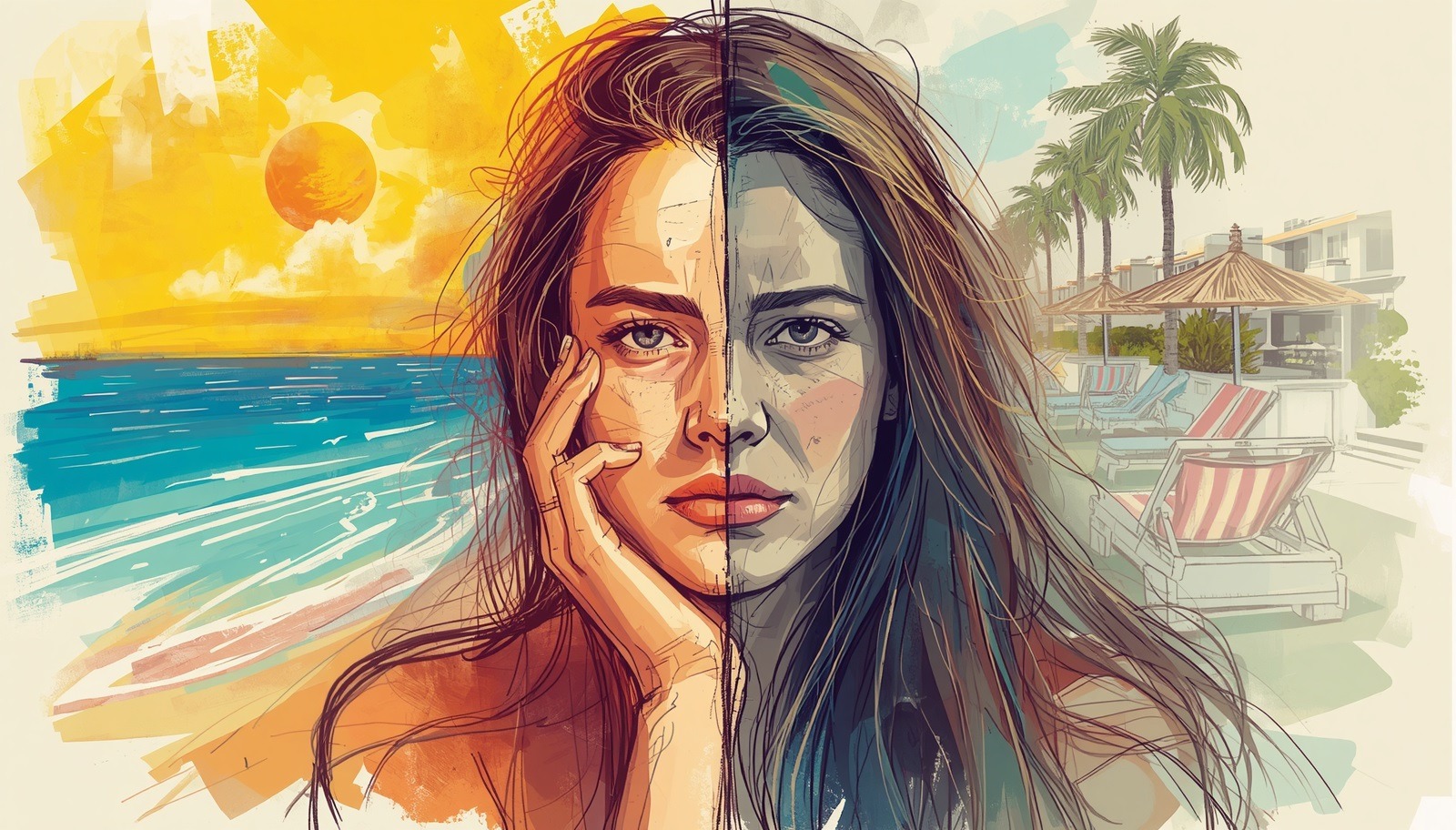
Summer is supposed to look like freedom. At least, that is what the internet tells us. Golden beaches. Iced drinks sweating gently in expensive-looking glasses. Friends laughing in linen outfits. Bodies glowing in swimwear. Spontaneous trips. Sunset dinners. Soft skin. Long weekends. “Living my best life” captions.
And then there is the quieter version of summer that many people do not post.
The version where your apartment is too hot, your sleep is broken, your body feels more visible than you want it to, your social calendar looks emptier than everyone else’s, and the pressure to be carefree makes your sadness feel almost embarrassing. The version where you scroll through someone’s vacation photos while eating dinner alone, and instead of feeling inspired, you feel behind. The version where the season looks bright outside but something inside you feels strangely heavy.
I want to say this clearly at the beginning: if summer feels emotionally harder than it “should,” you are not broken, ungrateful, antisocial, dramatic, or failing at happiness. Summer can genuinely intensify stress, loneliness, body comparison, sleep disruption, financial pressure, and seasonal mood changes. Summer-pattern seasonal affective disorder is less common than winter-pattern SAD, but it exists, and symptoms may include insomnia, poor appetite, agitation, anxiety, and restlessness, according to the National Institute of Mental Health.
This article is not here to romanticize sadness or turn every difficult summer day into a diagnosis. It is here to make room for a more honest question: What if summer feels worse not because your life is wrong, but because the season exposes things that winter helped you hide?
Why can summer feel worse than it looks on Instagram?
Summer can feel worse than it looks on Instagram because the season creates a collision between outer brightness and inner pressure. Social media often shows curated images of travel, friendship, beauty, romance, and freedom, while real summer may involve heat-related sleep loss, body image stress, loneliness, financial limits, disrupted routines, and fear of missing out. Research on social media suggests that the relationship between online activity and mental health is complex, and a 2024 longitudinal study of UK adults found that frequent posting, and frequent viewing combined with posting, were associated with more mental health problems one year later.
Summer can also affect the nervous system physically. Higher temperatures are associated with worse sleep quality and quantity, and heat has been linked in systematic reviews to adverse mental health outcomes. When you add Instagram comparison to heat, disrupted rest, visible-body culture, and social pressure, summer can become less of a carefree season and more of an emotional amplifier.
The “instagram summer” is not a season. It is a performance
Instagram does not simply show summer. It edits summer into a symbol.
On social media, summer often becomes shorthand for desirability. You are not just seeing a beach; you are seeing someone appear relaxed, wanted, financially free, socially included, physically confident, and emotionally light. The image may last one second on your screen, but your brain can translate it into an entire story: They are chosen. They are beautiful. They have friends. They are living. I am missing something.
That story is often incomplete. But incomplete stories can still hurt.
A summer photo rarely shows the credit card bill, the argument before the group picture, the insecurity before posting, the 40 failed selfies, the lonely night after the party, the anxiety hidden behind the sunglasses, or the pressure to make the moment look effortless. Social media is not necessarily fake, but it is selective. And selective joy can become emotionally confusing when you are comparing it to your unedited life.
This is especially powerful because summer content is sensory. It is not only “people having fun.” It is warm skin, blue water, glowing faces, food, movement, romance, bodies, laughter, and belonging. The comparison lands in the body before it becomes a thought. One minute you are scrolling; the next, your chest feels tight.

The danger is not that other people are posting happiness. People are allowed to share beauty. The danger is that your mind may start treating other people’s highlights as evidence against your own life.
That is why I think of summer comparison as a mirror trap. Instagram holds up a mirror, but it does not reflect you accurately. It reflects your current vulnerability through someone else’s curated moment.
Summer sadness is not just “winter blues in reverse”
Most people associate seasonal depression with winter: darkness, cold, isolation, low energy, and long evenings. But seasonal mood patterns can also happen in spring and summer. The National Institute of Mental Health describes summer-pattern SAD as less common and notes symptoms such as trouble sleeping, poor appetite, restlessness, agitation, anxiety, and, in some cases, aggressive behavior.
This matters because summer sadness often does not look like the stereotype of depression. It may look more like being irritated by everything. It may look like staying up too late because the evenings feel overstimulating. It may look like wanting connection but canceling plans because your nervous system feels cooked. It may look like anxiety, body discomfort, appetite changes, or feeling trapped by heat and brightness.
Winter sadness is often imagined as heaviness. Summer sadness can feel like emotional static.
There is also a social problem: people tend to validate winter sadness more easily. If someone says, “I always feel low when it gets dark early,” most people understand. But if someone says, “I feel worse in summer,” the response is often disbelief: “But the weather is beautiful!” That reaction can make summer sadness feel lonelier, because now you are not only struggling; you are struggling in a season that supposedly gives you no excuse.
I have noticed that many people do not feel allowed to be sad in beautiful weather. They interpret their pain as ingratitude. But emotions are not weather reports. A sunny day does not cancel grief. Warm air does not erase anxiety. Blue skies do not automatically regulate a burned-out nervous system.
Heat is emotional weather, too
One of the most underrated reasons summer can feel emotionally worse is simple: heat changes the body.
When the body is too hot, it has to work harder to regulate itself. Sleep may become lighter or shorter. Irritability may rise. Concentration may drop. Your window of tolerance may shrink. A conversation that felt manageable in April may feel unbearable in July. A small inconvenience can become the final straw.
This is not just poetic language. A 2024 systematic review in Sleep Medicine Reviews found that higher indoor or outdoor temperatures are generally associated with degraded sleep quality and quantity worldwide. Another global study published in One Earth found that warmer temperatures reduce sleep and increase the risk of insufficient sleep, with older adults, women, and residents of lower-income countries affected most.
Poor sleep does not stay politely in the bedroom. It follows you into your thoughts, your appetite, your patience, your self-image, your relationships, and your ability to cope with comparison. When sleep is disrupted, Instagram can hit harder because the brain has less emotional buffer.
Heat and mental health are also connected more broadly. Systematic reviews have found positive associations between elevated temperatures, heatwaves, and adverse mental health outcomes. This does not mean every hot day causes mental distress, but it does mean we should stop treating summer mood struggles as purely psychological. Sometimes your sadness has a thermostat.
The phrase I keep coming back to is this:
Summer is not only a season. It is a sensory load.
There is more light, more heat, more noise, more exposed skin, more social invitations, more travel content, more alcohol-centered gatherings, more disrupted routines, more pressure to be spontaneous, and often less privacy. For a nervous system that is already tired, summer can feel like being asked to smile while standing under a spotlight.
The body becomes public property in summer culture
Summer has a way of making the body feel visible.
Clothes get smaller. Events move outdoors. Swimsuits return. Fitness ads become louder. “Summer body” language resurfaces, even when people pretend we have collectively moved past it. The body is no longer just something you live in; it becomes something you feel expected to present.
For people with body image struggles, eating disorder history, trauma, chronic illness, scars, weight changes, gender dysphoria, sensory sensitivities, or simply a complicated relationship with being seen, summer can feel exposing. Not because the body is wrong, but because the culture around bodies becomes more demanding.
Social media intensifies this. A recent systematic review and meta-analysis found that higher online social comparison was significantly associated with greater body image concerns and eating disorder symptoms. This does not mean Instagram is the sole cause of body distress. It means online comparison can become part of the emotional ecosystem that makes summer feel heavier.
And here is the cruel part: when you are already feeling uncomfortable in your body, you may isolate. But when you isolate, you may scroll. And when you scroll, you may see more bodies that make you feel worse. Then the cycle tightens.
Body discomfort → avoidance → scrolling → comparison → shame → more avoidance.
A more compassionate approach begins with refusing the premise that your body has to become “summer-ready.” Your body is not a seasonal project. It is not late. It does not need to audition for sunlight.
FOMO gets louder when the days get longer
Summer creates more visible opportunities to feel left out.
In winter, staying home can look cozy. In summer, staying home can feel like evidence that everyone else is living more fully. Even if you genuinely need rest, your mind may whisper, “You are wasting your life.” That whisper is not random. It is culturally trained.
Fear of missing out, or FoMO, has been studied in relation to internet and social media use. A comprehensive systematic review and meta-analysis published in the Journal of Behavioral Addictions examined FoMO and internet use, showing how FoMO is intertwined with problematic online engagement and emotional distress patterns.
Summer adds fuel to FoMO because it has a deadline. It feels temporary. There are only so many warm weekends. Only so many chances to swim, travel, flirt, dance, picnic, host, glow, disappear, reinvent yourself. The season comes with a countdown, and countdowns create urgency.
That urgency can make ordinary life feel like failure.
You are not just sitting at home on a Saturday. You are “missing summer.” You are not just unable to afford a trip. You are “falling behind.” You are not just tired. You are “wasting the best months of the year.”
But the idea that summer must be maximized is emotionally violent for many people. It turns a season into a productivity challenge. Rest becomes suspicious. Quiet becomes failure. Privacy becomes proof that something is wrong.
A healthier question is not, “Am I making the most of summer?”
A healthier question is, “What kind of summer can my nervous system actually afford?”
The loneliness of looking happy enough
Summer loneliness has a particular sting because it often happens in contrast.
You may be lonely in January, too, but January does not usually show you endless images of rooftop parties and group vacations. Summer loneliness can feel sharper because the season is socially coded as communal. Everyone is supposed to be outside, together, glowing.
The World Health Organization describes loneliness as the painful feeling that arises when there is a gap between desired and actual social connection. WHO’s Commission on Social Connection reported in 2025 that loneliness affects about 1 in 6 people worldwide and has serious health and well-being consequences. The CDC also notes that social isolation and loneliness are widespread and pose serious threats to mental and physical health, with about 1 in 3 U.S. adults reporting loneliness.
This matters because loneliness is not simply “being alone.” You can be surrounded by people at a barbecue and feel lonely. You can be in a relationship and feel lonely. You can have unread messages and still feel unseen. Summer can intensify loneliness when the connections around you feel performative, shallow, inaccessible, or mismatched with what your heart actually needs.
Sometimes summer hurts because it reveals a gap:
The life you are performing → versus the care you are craving.
That gap can be painful, but it can also be informative. It may show you that you need more intimate friendships, not more social events. It may show you that your body needs rest, not another plan. It may show you that your relationship needs honesty, not another smiling photo. It may show you that your inner life has been asking for attention, and summer finally made the silence loud enough to hear.
The “reverse postcard effect”
Here is an unconventional way to understand why summer can feel worse than it looks online: I call it the Reverse Postcard Effect.
A postcard is designed to compress a place into a fantasy. Blue sea. Perfect sky. Beautiful architecture. No sweat, no conflict, no loneliness, no stomach ache, no logistical stress, no awkward silence. Instagram does the same thing, except with human lives.
The Reverse Postcard Effect happens when you compare your full, complicated, embodied reality to someone else’s postcard version of a moment.
It works like this:
Their image → your imagination fills in the perfect story → your nervous system treats the story as evidence → your life feels deficient.
But the pain is often not caused by the image itself. It is caused by the meaning your mind attaches to it.

The reframe is not meant to dismiss your feelings. It is meant to interrupt the false courtroom in your mind where Instagram is the prosecutor and your life is always on trial.
The financial pressure nobody wants to caption
Another reason summer can feel emotionally heavy is money.
Summer often costs more than it admits. Travel, weddings, festivals, outdoor dining, childcare, new clothes, beauty appointments, transportation, air conditioning, social events, and “quick weekend trips” can quietly become a financial burden. But because summer spending is wrapped in joy, people may feel ashamed to name the stress.
It can be painful to say, “I cannot afford that,” especially when the invitation is framed as fun. It can also be painful to watch people online casually access experiences that would require planning, debt, or sacrifice from you.
Financial comparison is not shallow. Money affects freedom, rest, safety, options, and belonging. If your summer feels worse when you scroll past luxury travel or effortless-looking leisure, it may not be envy in the simplistic sense. It may be grief. It may be exhaustion. It may be the ache of living in a world where rest and beauty are often easier to access when you can pay for them.
A more honest summer self-care practice is learning to separate desire from shame.
- You can want travel without shaming your current budget
- You can want beauty without pretending money is irrelevant
- You can want spaciousness without blaming yourself for economic limits
- You can create small rituals without forcing them to compete with someone else’s vacation
Summer disrupts routine, and routine is emotional scaffolding
A lot of people underestimate how much routine protects mental health.
During the rest of the year, your schedule may provide structure: work rhythms, school calendars, predictable evenings, regular meals, consistent sleep cues. Summer can loosen all of this. Longer daylight may push bedtime later. Social plans may interrupt meals. Travel may disrupt exercise, therapy, medication routines, quiet time, or solitude. Children may be home from school. Work may feel slower but less focused. Everything may feel more flexible, yet somehow more chaotic.
For some nervous systems, flexibility feels like freedom. For others, flexibility feels like falling.
This is especially true if you grew up in emotionally unpredictable environments. A lack of structure can activate old feelings of instability. You may not consciously think, “I am unsafe,” but your body may respond as if the familiar walls have moved.
That is why summer self-care should not only be aesthetic. It should be structural.
- A morning walk is lovely, but what time are you sleeping?
- A beach day can be beautiful, but are you eating enough?
- A social plan can be meaningful, but do you have recovery time?
- A digital detox sounds good, but what will replace the scrolling?
Self-care becomes more powerful when it is less about performing wellness and more about creating emotional scaffolding.
The summer nervous system budget
I want to offer a different way to plan summer: not by maximizing fun, but by budgeting nervous system energy.
Imagine every summer activity has a cost and a return. Some activities nourish you. Some drain you. Some do both. The goal is not to avoid everything difficult; the goal is to stop pretending all “fun” is automatically restorative.

This kind of planning may not look glamorous, but it is deeply loving. It says, “I do not have to earn rest by collapsing first.”
A bore humane way to use instagram in summer
I do not think everyone needs to delete Instagram. For some people, social media is connection, creativity, work, humor, education, community, and inspiration. The issue is not whether Instagram is good or bad. The issue is whether your current way of using it supports the person you are trying to become.
A 2024 longitudinal study of UK adults found that the relationship between social media use and mental health is complex. It found no evidence that frequency of viewing alone predicted later mental health problems after full adjustment, but frequent posting and frequent viewing combined with posting were associated with more mental health problems one year later. That nuance matters. It suggests we should move beyond simplistic advice like “social media is toxic” and ask better questions.
Try asking:
- What do I feel in my body after I scroll?
- Which accounts make my life feel smaller?
- Am I posting to share, or posting to prove?
- Do I feel connected after using this app, or just visually overstimulated?
- Am I consuming summer, comparing summer, or living summer?
The goal is not to become morally superior to social media. The goal is to become less available for self-abandonment.
One practical experiment is the Three-Second Body Check. Before you open Instagram, pause for three seconds and notice your state: tired, lonely, bored, anxious, restless, numb, curious, inspired. Then ask, “Is Instagram likely to help this state or intensify it?” Sometimes the answer will be yes, it helps. Sometimes the answer will be no, I am walking into a comparison storm.
Replace “summer goals” with “summer permissions”
A lot of summer advice is built around goals: get fit, travel more, be social, glow up, make memories, say yes, be spontaneous. But if you are emotionally tired, more goals may become another way to fail.
So I prefer summer permissions.
Permission to enjoy small beauty without documenting it.
Permission to leave early.
Permission to wear the comfortable thing.
Permission to protect sleep.
Permission to spend less money.
Permission to have a quiet summer.
Permission to be sad on a sunny day.
Permission to make memories that would look boring online but feel safe in your body.
Permission to stop calling rest “wasted time.”
This is not about lowering your standards for life. It is about raising your standards for inner safety.
The most healing summer might not be the one that looks best in photos. It might be the one where you stop betraying your needs to match the season’s marketing campaign.
Nature can help, but it should not become another performance
Nature is often recommended for mood, and there is research suggesting that short-term exposure to natural environments may reduce depressive mood, although the evidence quality varies and should be interpreted with caution.
But even nature can become performative in summer. Hiking, swimming, traveling, outdoor yoga, sunrise walks — all of it can become another aesthetic standard. If your nervous system is exhausted, you do not need a cinematic nature experience. You may need five minutes under a tree. You may need to sit near an open window with a cold drink. You may need evening air without your phone. You may need to watch the sky change color and not turn it into content.
Nature does not have to be impressive to be regulating.
A small moment of contact can still count:
Bare feet on cool floor → nervous system signal: here.
Cold water on wrists → body signal: relief.
One plant on the windowsill → attention signal: life continues.
A slow walk after sunset → rhythm signal: I can return to myself.
This is where summer can become gentle again. Not because you force it to become magical, but because you stop demanding that it rescue you.
What to do when summer feels emotionally heavy
When summer feels worse than it looks on Instagram, the first step is not to shame yourself into gratitude. The first step is to identify what kind of heaviness you are carrying.
- Is it physical heaviness from heat and poor sleep?
- Is it social heaviness from loneliness or exclusion?
- Is it body heaviness from visibility and comparison?
- Is it financial heaviness from pressure to participate?
- Is it emotional heaviness from grief, trauma, burnout, or unmet needs?
Is it digital heaviness from consuming too many curated lives?
Dfferent heaviness needs different care.
If heat is the problem, your first intervention may be cooling and sleep protection, not journaling. If loneliness is the problem, your first intervention may be one honest message, not a gratitude list. If body shame is the problem, your first intervention may be reducing mirror checking and unfollowing triggering accounts, not forcing body positivity. If burnout is the problem, your first intervention may be fewer plans, not better plans.
And if symptoms are persistent, intense, or interfering with daily life, it is worth speaking with a mental health professional. NIMH notes that seasonal affective disorder is a type of depression with a recurrent seasonal pattern, and treatment options can include psychotherapy and antidepressant medication, depending on the person and clinical situation.
You deserve support that matches the seriousness of what you are feeling.
The quiet summer reset: A non-instagrammable practice
Here is a simple practice I would give to anyone who feels emotionally behind in summer.
For seven days, choose one non-postable act of care each day. Not impressive. Not aesthetic. Not optimized. Something that would not necessarily make a good photo but would make your real life feel more livable.
Day one: change your sheets before the room gets too hot.
Day two: drink water before coffee.
Day three: unfollow three accounts that make your body feel like an apology.
Day four: sit outside for ten minutes without taking a photo.
Day five: send one honest message: “I miss you. Want to catch up soon?”
Day six: make a budget-honest joy plan: something free or low-cost that still feels sensory and alive.
Day seven: go to bed at a time that supports tomorrow’s mood, not tonight’s scrolling spiral.
This is not a glow-up. It is a return.
And sometimes returning to yourself is the most radical thing you can do in a season that keeps asking you to perform.
Your real summer is allowed to be real
Summer can be beautiful. Summer can also be lonely, overstimulating, expensive, sweaty, anxious, disappointing, exposing, and emotionally complicated. Both can be true.
You are allowed to love the sunlight and still feel sad. You are allowed to enjoy warm evenings and still struggle with your body. You are allowed to be grateful for good weather and still need support. You are allowed to want connection without wanting constant plans. You are allowed to build a summer that would not impress Instagram but would feel like peace to your nervous system.
The internet may keep showing you the postcard version of summer. But you do not live in a postcard. You live in a body, in a nervous system, in a history, in a budget, in relationships, in weather, in private longings, in real limitations, and in real possibilities.
So maybe the question is not, “Why doesn’t my summer look like theirs?”
Maybe the better question is:
What would summer feel like if I stopped using someone else’s highlight reel as the measurement of my aliveness?
Your summer does not have to be photogenic to be meaningful.
It does not have to be full to be worthy.
It does not have to be impressive to be healing.
It only has to become honest enough that you can finally breathe inside it.
Related posts You’ll love
- Why summer romance feels so intense so fast: The hidden psychology of sunlight, novelty, chemistry, and emotional acceleration
- Unmet needs and bitterness: Why You hate when someone is happy
- Your mood isn’t broken — It’s just seasonal: How to use nature’s rhythm to feel balanced all year
- Joy guilt explained: Why You feel guilty when You are happy and how to unlearn permission to thrive shame
- The emotional outsourcing trap: Why so many Women use podcasts, advice, and content to feel their feelings for them
- Camera culture is quietly damaging how Women experience themselves
FAQ
-
Why do I feel sad in summer when everyone else seems happy?
You may feel sad in summer because the season can intensify comparison, loneliness, body image pressure, heat stress, disrupted sleep, financial pressure, and social expectations. Other people may seem happy because social media usually shows selected moments, not full emotional reality. Summer sadness is more common than many people admit, and for some people it may be connected to summer-pattern seasonal affective symptoms.
-
Is summer depression real?
Yes. Seasonal affective disorder can occur in summer, although it is less common than winter-pattern SAD. NIMH describes summer-pattern SAD symptoms as including insomnia, poor appetite, restlessness, agitation, and anxiety. If your symptoms are persistent or interfere with daily life, consider speaking with a qualified mental health professional.
-
Why does Instagram make summer feel worse?
Instagram can make summer feel worse because it compresses other people’s lives into curated images of beauty, friendship, travel, romance, and freedom. When you compare those highlights to your full reality, your brain may create a false story that you are behind, unwanted, unattractive, or missing out.
-
Why do I compare my body more in summer?
Summer often involves more body visibility through lighter clothing, swimwear, outdoor events, fitness messaging, and vacation photos. Social media can intensify this because online social comparison has been associated with body image concerns and eating disorder symptoms in recent meta-analytic research.
-
Can heat affect my mood?
Yes. Heat can affect mood indirectly through sleep disruption, irritability, fatigue, dehydration, and physiological stress. Reviews have linked higher temperatures and heatwaves with poorer sleep and adverse mental health outcomes.
-
Why do I feel lonely even when I have summer plans?
You can feel lonely even with plans if the connection does not meet your emotional needs. Social events are not the same as emotional intimacy. Summer can make this more painful because the season is culturally associated with friendship, romance, and shared experiences.
-
Should I delete Instagram during summer?
Not necessarily. A better first step may be to notice how Instagram affects your body and mood. You might mute triggering accounts, limit scrolling when tired or lonely, avoid checking Instagram first thing in the morning, or take short breaks during emotionally vulnerable weeks.
-
How can I enjoy summer without spending much money?
Create a “budget-honest joy list.” Include low-cost sensory experiences such as evening walks, homemade iced drinks, library books, free local events, phone-free park time, picnics, journaling outside, or watching the sunset. The goal is to create real pleasure without financial self-abandonment.
-
What if I hate summer?
You are allowed not to love summer. Some people feel better in cooler, quieter, more structured seasons. Instead of forcing yourself to enjoy summer, focus on making it more tolerable: protect sleep, reduce heat exposure when possible, plan recovery time, lower social pressure, and create cooling rituals.
-
How do I stop feeling like I am wasting summer?
Replace “making the most of summer” with “meeting my real needs this summer.” A quiet, regulated, financially realistic summer is not wasted. Rest, healing, stability, and honest connection count as meaningful experiences, even if they do not look exciting online.
-
When should I seek professional help?
Seek professional support if your sadness, anxiety, irritability, sleep changes, appetite changes, hopelessness, or loss of interest lasts for more than two weeks, worsens, or interferes with daily life. If you have thoughts of self-harm or suicide, contact emergency services or a crisis line in your country immediately.
Sources and inspirations
- Akbari, M., Seydavi, M., Palmieri, S., Mansueto, G., Caselli, G., & Spada, M. M. (2021). Fear of missing out (FoMO) and internet use: A comprehensive systematic review and meta-analysis. Journal of Behavioral Addictions.
- Bonfanti, R. C., Melchiori, F., Teti, A., Albano, G., Raffard, S., Rodgers, R. F., & Lo Coco, G. (2024). The association between social comparison in social media, body image concerns and eating disorder symptoms: A systematic review and meta-analysis. Body Image.
- Centers for Disease Control and Prevention. (2024, May 15). Health effects of social isolation and loneliness.
- Chevance, G., Minor, K., Vielma, C., Campi, E., O’Callaghan-Gordo, C., Basagaña, X., Ballester, J., & Bernard, P. (2024). A systematic review of ambient heat and sleep in a warming climate. Sleep Medicine Reviews.
- Liu, J., Varghese, B. M., Hansen, A., Xiang, J., Zhang, Y., Dear, K., Gourley, M., Driscoll, T., Morgan, G., Capon, A., & Bi, P. (2021). Is there an association between hot weather and poor mental health outcomes? A systematic review and meta-analysis. Environment International.
- Minor, K., Bjerre-Nielsen, A., Jonasdottir, S. S., Lehmann, S., & Obradovich, N. (2022). Rising temperatures erode human sleep globally. One Earth.
- National Institute of Mental Health. (2023). Seasonal affective disorder (NIH Publication No. 23-MH-8138). National Institutes of Health.
- Plackett, R., Sheringham, J., & Dykxhoorn, J. (2024). The impact of different types of social media use on the mental health of UK adults: Longitudinal observational study. Journal of Medical Internet Research.
- Roberts, H., van Lissa, C., Hagedoorn, P., Kellar, I., & Helbich, M. (2019). The effect of short-term exposure to the natural environment on depressive mood: A systematic review and meta-analysis. Environmental Research.
- Thompson, R., Lawrance, E. L., Roberts, L. F., Grailey, K., Ashrafian, H., Maheswaran, H., Toledano, M. B., & Darzi, A. (2023). Ambient temperature and mental health: A systematic review and meta-analysis. The Lancet Planetary Health.
- World Health Organization. (2025). From loneliness to social connection: Charting a path to healthier societies. WHO Commission on Social Connection.



Leave a Reply