Table of Contents
The quiet mask of grace
For decades, women have been told that the highest virtue in aging is composure. Be graceful. Stay strong. Don’t complain. Don’t call attention to what hurts. Smile through the soft collapse of everything familiar.
It’s a cultural script passed from generation to generation like a secret code of survival. Our mothers and grandmothers learned to perform it — not because they wanted to, but because silence was often the only form of dignity society allowed them. We were taught that to age “gracefully” meant to stay relevant but invisible; to carry sorrow without letting it show; to transform grief into gratitude before it fully had the chance to breathe.
Yet something happens inside us when we live that way too long. Beneath the polished composure, a quiet grief grows. Not the grief of getting older, but the grief of not being seen in our becoming. The grief of erasure — of watching our authenticity dissolve beneath the smooth surface of “grace.”
This practice is not about rejecting grace itself — but about untangling it from performance. Grace, as we’ve been taught, is a performance of containment. But true grace is a current — it moves, it breathes, it trembles, it releases.
To age authentically is to allow that current to flow freely again. It means giving up the act of being the “ageless woman” and instead becoming the honest woman — one who wears time not as a disguise, but as evidence.
In this Practice Corner, you’re invited into that process: a rewilding of your relationship to aging, emotion, and the self you’ve been taught to hide. There are no checklists here, no five-step methods, no promises of youth disguised as wisdom. Only invitations — to feel, to soften, to listen, and to exist in a world that often prefers your quietness.
This is not an article to read. It’s an experience to enter.
Facing the mirror without defense
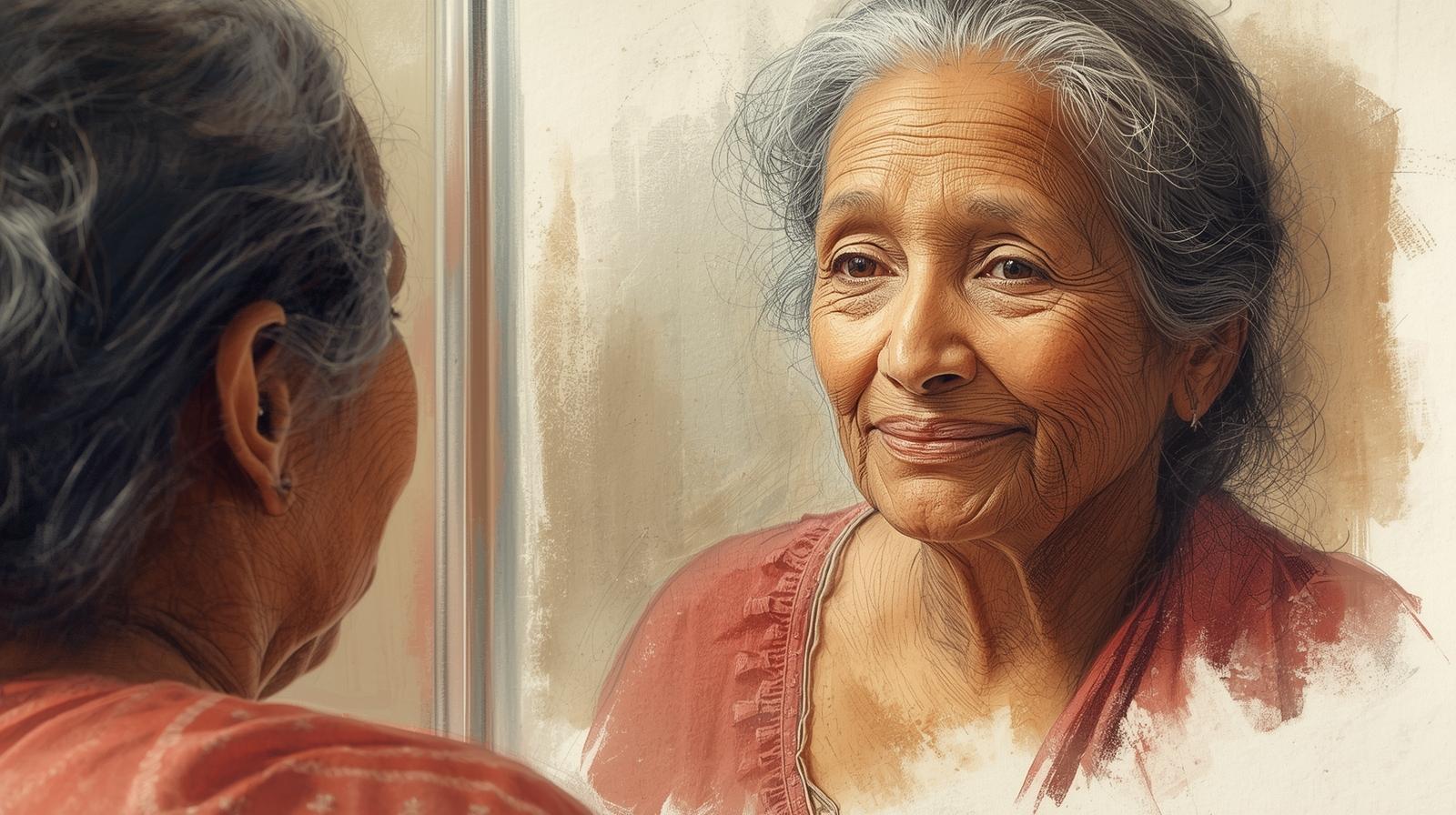
Standing in front of a mirror is often an act of confrontation. The reflection is honest — sometimes brutally so. The lines that were once faint now carry definition. The skin, once smooth, tells a thousand tiny stories of laughter, sunlight, heartbreak, and resilience. And still, the first impulse for many women is not reverence, but resistance.
We touch our faces the way an editor touches a draft — looking for flaws to correct, spaces to tighten, lines to smooth. But what if the mirror was never meant for critique? What if it was meant for communion?
In The Beauty of Aging (Waddell, 2025), researchers found that the way women relate to their reflections directly affects their emotional health. Those who viewed their aging faces with compassion — even when discomfort arose — showed higher resilience and lower levels of body-related anxiety. The mirror, they wrote, “becomes a mirror of consciousness.”
So, for this practice, approach your reflection not as an aesthetic object, but as a living archive. Stand before it in morning light. Breathe slowly. Let your eyes meet your own.
Notice what arises. Maybe it’s grief for the woman you used to be, or surprise at the wisdom in your eyes, or even resistance — a tightening, a wish to look away. Whatever comes, do not edit it. Simply say, quietly, “I see you.”
If tears come, let them. They are not weakness — they are the body’s way of softening what has long been held in rigidity.
Over time, this daily act becomes a reprogramming of perception. Your mind begins to associate your reflection not with judgment but with presence. And presence — not perfection — is the foundation of real grace.
You are not an aging face; you are an entire cosmos of memory, desire, and endurance looking back at itself.
Look until you recognize the miracle.
Reclaiming the right to feel
Grace, as culture defines it, is often the refusal to feel publicly. It’s emotional containment — the art of making discomfort invisible. But emotional invisibility is not maturity; it’s suppression.
In many ways, the command to “age gracefully” is a command to feel less. Don’t be angry — it looks bitter. Don’t be sad — it makes others uncomfortable. Don’t be afraid — it makes you look weak.
But emotion, when repressed, doesn’t disappear. It goes underground, quietly shaping the nervous system, the breath, the muscles. You can see it in the tension around the jaw, the tightness in the chest, the constant need to “manage.” The body keeps the grace act alive — even when the soul is asking for release.
To reclaim emotional authenticity, you must begin by acknowledging that every feeling has dignity. Anger is not a lack of control — it is the body’s protest against erasure. Grief is not indulgence — it is love stretching into absence. Fear is not regression — it’s the nervous system’s way of saying, “I still care.”
So, sit with yourself and ask: What emotions has the world told me are ungraceful?
Write them down, one by one. Then ask: When did I learn that these were unacceptable? Who taught me to silence them?
This is not blame — it’s clarity. When you can trace the origins of silence, you can begin to undo it.
Now, choose one emotion — perhaps the one that feels least safe — and meet it as a companion rather than an intruder.
If it’s sadness, let your body sink. If it’s anger, breathe until you feel its pulse rather than its story. If it’s fear, hold your own hand.
Somatic therapists often describe emotion as “energy in motion.” That means the body must participate in the healing.
Cry. Stretch. Sigh. Make sound. Let your nervous system complete the loop that silence interrupted.
In the 2022 Journal of Gerontological Psychology, researchers found that older adults who practiced emotional disclosure — through journaling or mindful conversation — reported improved memory and immune function. The conclusion was striking: “To express emotion is to strengthen aliveness.”
So, when culture tells you to stay calm, to “take it gracefully,” you can answer quietly: I am — by allowing myself to feel.
Because there is no greater grace than emotional truth.
The body as archive of a life lived
The modern world treats the body as a project — something to maintain, fix, and optimize. But the body is not a task. It is a record.
Every cell carries history. Every wrinkle is a map of experience. The hips that ache remember the weight of children, the steps of dance, the work of survival. The spine curves not from weakness, but from the act of carrying. The hands that tremble once created, cooked, wrote, or comforted.
If you listen closely, your body will tell you stories that no photograph can.
To practice authentic aging is to begin listening again.
Find a quiet space. Close your eyes. Bring awareness to your body as if visiting an old friend. Where do you feel tightness? Where do you feel warmth? What sensations are asking to be witnessed?
Now, imagine your body as an elder itself — wise, experienced, forgiving. Ask it: What do you need from me now?
This question is sacred because it reverses the hierarchy of control. Instead of forcing the body to meet your expectations, you allow it to lead. This is a radical act of love in a culture that trains us to dominate ourselves in the name of health.
Scientific studies echo this shift. In a 2023 Frontiers in Public Health paper, researchers found that older adults who engaged in “embodied mindfulness” (practices that involve attention to bodily sensation) showed lower levels of inflammation, reduced cortisol, and increased vitality. The body literally responds to being listened to.
So, each morning, instead of scanning for flaws, scan for communication. If your body says rest, rest. If it says move, move. If it says cry, cry.
The body is the truest historian of who you are. When you make peace with it, you make peace with time itself.
Place your hands over your heart and whisper, “You have done enough.” Feel the echo of that phrase ripple through your chest. It is not a resignation — it is an absolution.
Because the truth is, your body has never failed you. It has adapted, endured, carried, and healed. It deserves to be treated as sacred text, not as a problem to be rewritten.
And when you finally begin to live in friendship with your own form, you’ll discover something extraordinary: the body that once felt like evidence of decline becomes proof of devotion.

The courage of visibility
There is a quiet rebellion in being seen.
In a culture that worships youth and productivity, visibility in aging becomes a political act. It’s easier — even encouraged — to retreat from view, to fade softly into respectability. But the truth is: the world needs to see what age really looks like. It needs the unfiltered faces of those who’ve survived, adapted, and continued.
Many women begin to disappear in midlife — not because they want to, but because they’ve been conditioned to. Visibility becomes risky. You are told you’ve lost “relevance,” that you should “let the young shine.” And yet, invisibility is a wound that festers. It starves the psyche of recognition.
Psychotherapist Marion Woodman, in her writings on the embodied feminine, once said that “aging women carry the consciousness of the tribe.” When they go unseen, a whole culture loses its reflection.
So, visibility is not vanity. It is stewardship. To allow yourself to be seen — gray hair, soft belly, laughter lines, and all — is to offer the world a mirror of its own future.
Begin simply. Wear the color that makes you feel alive again. Speak your opinion in a room that expects your silence. Laugh loudly in public. These are not trivial gestures. They are declarations of existence.
Research supports the psychology of this rebellion. A 2022 Nature Human Behaviour study found that social exclusion and invisibility trigger the same brain regions as physical pain. Being unseen literally hurts. Visibility, on the other hand, activates the brain’s reward system — generating feelings of belonging and safety.
So when you show up in your truth, you are not being self-centered. You are regulating your nervous system toward wholeness.
And there’s more: when one person becomes visible, others find permission to do the same. It’s contagious courage.
In practical terms, make visibility a daily devotion. Post an unfiltered photo. Tell your story without self-editing. Attend a gathering not to blend in, but to arrive.
Visibility says, “I am still part of the conversation.”
And perhaps even more radically, “I am still becoming.”
Because authenticity doesn’t grow in isolation. It grows in the light.
Reframing grace
We often misunderstand grace. We confuse it with control, politeness, or silence — with keeping our emotions contained so that others are comfortable. But true grace has nothing to do with appearance. It’s not the absence of pain; it’s the ability to stay open in the middle of it.
When we talk about “aging gracefully,” we usually mean aging without making others uneasy. Grace has been turned into a code word for suppression. Yet grace, in its original spiritual sense, meant something else entirely. In Latin, gratia means “gift.” Grace was never about restraint; it was about flow — an unearned gift of presence, love, or beauty that moves through you, not something you manufacture.
That means the real grace of aging cannot be performed. It can only be received.
Imagine standing in the rain, arms open. You cannot control the rain, you can only let it wash over you. That’s what authentic grace feels like — surrender without defeat.
Redefining grace this way changes everything. It allows tears to be graceful, rest to be graceful, anger to be graceful, truth to be graceful. It reframes every human expression as worthy of reverence.
Try this: the next time you feel the pressure to “keep it together,” pause and ask, Who taught me that falling apart was the opposite of grace?
Let that question unravel your conditioning.
When your voice shakes, it’s still grace. When you say “I don’t know,” that’s grace. When you show up with raw honesty instead of rehearsed serenity, that is grace.
One of the most beautiful examples of this came from a workshop I once attended for women in their seventies and eighties exploring embodiment. A participant named Ruth stood up and said, “I used to think grace was a clean white dress and quiet composure. Now I know it’s mud on my knees and tears on my face.”
Everyone in the room nodded through tears — because they knew. They had lived long enough to understand that what looks messy from the outside is often the truest form of grace on the inside.
So, from this moment on, let’s reclaim grace not as performance but as presence.
When you drop the act, when you breathe instead of smile, when you admit you’re tired instead of pretending you’re fine — that is grace manifesting as truth.
The irony is that once you stop trying to appear graceful, you begin to embody something infinitely more beautiful: peace.
The ritual of remembering
If authenticity is the art of returning to oneself, then remembering is its sacred ritual.
Modern life disconnects us from lineage, from the deep time that lives beneath our skin. We’re told to move forward, optimize, forget. But aging isn’t about moving forward — it’s about deepening downward, rooting into continuity. You are not separate from those who came before you; you are their continuation, their unfinished prayer.
Creating rituals of remembering grounds your aging in meaning. It reminds your nervous system that you are part of something bigger than decline. You are part of life’s unfolding intelligence.
Begin with something simple: set aside one evening a week for what I call “the ancestor hour.” Turn off distractions. Sit in silence. Light a candle for those who made your life possible — not just blood relatives, but chosen ancestors: teachers, artists, writers, friends, even strangers whose courage shaped you.
Say their names aloud. Let them echo in the room. If tears come, they are part of the offering. This is not nostalgia — it’s continuity.
Neuroscientist Lisa Feldman Barrett’s 2021 research on emotional meaning shows that rituals of remembrance reduce stress and increase the brain’s production of serotonin and oxytocin — the chemistry of safety and belonging. When we remember, we soothe the biological loneliness that aging can bring.
You can also create a physical altar of remembrance. Place objects that symbolize your evolution: a childhood photo, a journal, a seashell from a meaningful trip, a letter you wrote to yourself years ago. Let it evolve with you — add new symbols as your story unfolds.
This space becomes a mirror that reflects not youth or loss, but continuity. It says, “I am still part of a living story.”
And as you sit before it, you might whisper:
I am not the woman I was, and that is grace. I am all the women I have ever been, and that is home.
This ritual does not belong to any religion. It belongs to the human need for coherence — to weave the fragments of self into one whole fabric. Aging authentically means realizing that your identity is not shrinking; it’s becoming layered, textured, multidimensional.
In many Indigenous and Eastern cultures, this awareness of lineage is central to emotional well-being. To age without remembering one’s ancestry, they say, is to lose your compass. To remember is to reclaim your direction.
So each time you feel irrelevant, lost, or unseen, light that candle again. Let the flame remind you that visibility is not always public. Sometimes it is spiritual — a steady glow that says, I am still here, holding the memory of my life with open hands.
That is the truest visibility of all.
Writing Your manifesto of authentic aging
At some point, authenticity needs a language — a way to make its presence known. For many, that language begins on the page.
Writing a manifesto of authentic aging isn’t about self-promotion; it’s about self-remembrance. It’s a written act of resistance against the silent scripts you’ve inherited. It is how you reclaim authorship of your own story.
When you sit to write, don’t plan. Don’t censor. Begin with the words:
“As I age, I choose…”
Let the sentence unfold like a river, carrying you through the truths that want to surface. You might write:
“As I age, I choose presence over perfection.”
“As I age, I choose curiosity over control.”
“As I age, I choose tenderness for the body that stayed.”
“As I age, I choose to be loud, visible, and kind.”
Let each line become a declaration — not of what you should be, but of who you already are.
Neuroscientific studies on expressive writing (Pennebaker & Smyth, 2019) show that articulating emotions in language creates neural coherence between the prefrontal cortex and limbic system. In simpler terms: writing helps the body and mind agree on what is true. It transforms chaos into clarity.
When you finish, don’t rush to edit. Read your manifesto aloud. Notice how your voice sounds when you say it — does it tremble, strengthen, soften? That sound is your authenticity taking shape in real time.
Some women like to turn their manifesto into ritual. One wrote hers in gold ink and placed it in her mirror, reading it each morning as an invocation. Another buried hers under a rose bush, offering it back to the earth as a vow of peace.
How you keep it is up to you. The point is to give your truth a place to live outside your body — where it can be witnessed, reread, and reaffirmed.
You can revisit your manifesto every year — not to measure progress, but to listen for evolution. The voice of a 55-year-old woman and that of a 75-year-old woman may speak different languages, but they will both be fluent in courage.
Writing your manifesto is not an ending. It’s a threshold — the moment where grace ceases to be a performance and becomes your natural rhythm.
When you put your truth into words, you stop waiting for permission to live it.

The art of becoming
Aging authentically is not a task to master. It’s an unfolding — a slow softening into truth, an art form that requires unlearning as much as it does learning. It is less about control and more about conversation: between who you were, who you are, and who you are still becoming.
In the end, to age authentically is to live in full dialogue with time.
Time is not your enemy. It is your collaborator — the sculptor shaping the texture of your wisdom, the rhythm of your patience, the tenderness of your compassion. Aging does not strip away beauty; it concentrates it.
Imagine yourself as a coastline. The waves of time come, again and again, reshaping your edges. Some days they erode, some days they polish. But each tide reveals something new — stones smoothed into pearls of memory, shells cracked open to reveal light.
To age authentically is to stop resisting the waves and instead stand barefoot in them, letting them write their soft language across your skin.
Authenticity, at its heart, is intimacy with reality. It is the willingness to live in full contact with what is — not what was, not what should be.
The performance of grace asks you to hold still and smile. The practice of authenticity asks you to breathe, to move, to feel. One hides; the other reveals.
So perhaps the real question is not how do I age gracefully? but how do I stay alive in my own truth?
You stay alive by feeling everything — the ache, the joy, the relief of letting go. You stay alive by telling your story in your own words. You stay alive by letting your laughter wrinkle your face without fear.
You stay alive by refusing to disappear.
When you live this way, aging stops being something that happens to you and becomes something you participate in. You are not the object of time — you are its co-creator.
And that changes everything.
Grace, now, is no longer a quiet mask. It’s a dance. It’s the rhythm of a woman who has stopped apologizing for existing.
As you finish reading, take a moment to breathe deeply. Feel the weight of your years — not as burden, but as evidence of your aliveness. Whisper softly, as a prayer or a promise:
I will not perform grace. I will live it.
Because to live your truth, visibly, courageously, and tenderly, is the most graceful thing you will ever do.
Affirmations for integration
You can carry these phrases as quiet reminders throughout your week — to anchor the inner work of authentic aging:
“I am allowed to be seen.”
“My body is my biography.”
“I release the need to be graceful for others.”
“My emotions are sacred data.”
“I am not fading; I am unfolding.”
“Grace lives in my honesty.”
Repeat them not as magic spells, but as gentle returns to self. Each time you speak one, you undo a thread of silence woven by generations before you.
Because this is how the healing continues — not through perfection, but through presence.
The ongoing practice
If there’s one truth that defines this path, it’s that authentic aging isn’t linear. Some days, you’ll feel free and radiant, laughing at the absurdity of trying to “defy age.” Other days, you’ll ache, grieve, or long for your younger self. Both are holy.
This practice isn’t about eliminating struggle. It’s about giving struggle somewhere soft to land.
When you return to this work — whether through writing, meditation, community, or art — remind yourself that authenticity is seasonal. There will be days of blooming and days of pruning. Both belong.
And when you forget, as we all do, come back to the simplest truth of all: you are still here. You are still becoming. And that — in its quiet, imperfect radiance — is grace.
Related posty You’ll love:
- When “aging gracefully” becomes a silent demand: The cultural pressure to grow old quietly
- Breaking cycles practice: A deep guide to parenting differently
- Practice corner: From last place to self-priority — A healing guide
- 8 exercises to overcome the fear of being labeled ‘too ambitious’ as a Woman
- Practice corner: 12 exercises to reclaim Your voice and stop hiding power in everyday conversations
- 10 powerful exercises to release the hidden stress of multitasking and reclaim Your focus
- Truths for Women who are becoming more themselves with age: 11 powerful lessons on authenticity, self-worth, and confidence
- Emotional changes in Your 30s: The powerful truth no one tells Women

FAQ: Aging authentically — letting go of the performance of grace
-
What does “aging authentically” mean?
Aging authentically means allowing yourself to grow older without performing perfection or silence. It’s living truthfully — embracing your body, emotions, and evolution as sacred parts of being alive.
-
How is authentic aging different from aging gracefully?
“Aging gracefully” often implies staying composed and youthful for others’ comfort. Authentic aging is about honesty. It welcomes imperfection, voice, and visibility instead of restraint or disguise.
-
Why do so many women feel pressure to age gracefully?
Cultural systems — from the beauty industry to patriarchy — link a woman’s worth to youth and appearance. The expectation to age “gracefully” is a disguised demand for silence and conformity.
-
How can I start aging authentically in my daily life?
Start with awareness. Notice where you hide emotion or judge your body. Practice speaking your truth, even when it trembles. Let presence, not perfection, guide your choices.
-
What role does the body play in authentic aging?
Your body is an archive — not an enemy. Every line, scar, and sensation carries memory. Treating your body as a living record of experience transforms shame into reverence.
-
Can emotional expression really make aging easier?
Yes. Studies show that expressing emotions mindfully reduces stress and improves resilience. Feeling sadness, anger, or fear with compassion deepens peace rather than disrupting it.
-
How can I deal with feeling invisible as I age?
Visibility begins from within. Share your stories, use your voice, and show up as you are. Being seen — even by yourself — restores belonging and rewires the brain toward self-worth.
-
What simple practices support authentic aging?
Mirror meditation, journaling, mindful movement, and creative rituals like building an aging altar or writing your manifesto reconnect you to self-acceptance and lineage.
-
Is wanting to look good a form of inauthenticity?
No. Authentic aging isn’t about rejecting beauty but redefining it. The key question is: Am I doing this from love or from fear? Self-expression nourishes; self-erasure wounds.
-
How can I redefine grace for myself?
Grace is not control — it’s flow. It’s the courage to cry, rest, and tell the truth. When grace becomes presence rather than performance, aging turns into art.
Sources and inspirations
- American Psychological Association. (2023). Redefining Resilience and Well-Being in Later Life. APA Monitor.
- Applewhite, A. (2025). The Thing About Ageing Gracefully: Whatever You Call It, I’ll Do It My Way. The Guardian, July 7, 2025.
- Barrett, L. F. (2021). How Emotions Are Made: The Secret Life of the Brain — New Insights on Aging and Emotional Meaning. Frontiers in Psychology.
- Bone, J. K., (2024). Does Arts and Cultural Group Participation Influence Older Adults’ Social Support? BMJ Public Health.
- Füstös, J., Gramann, K., & Pollatos, O. (2020). Embodied Emotion Regulation: The Role of Body Awareness in Well-Being Among Older Adults. Frontiers in Psychology.
- Gullette, M. M. (2022). Ending Ageism, or How Not to Shoot Old People. University of Chicago Press.
- Ji, L. J., (2022). Culture, Aging, Self-Continuity, and Life Satisfaction. Frontiers in Psychology.
- Levy, B. R. (2019). Positive Age Beliefs Protect Against Dementia Even Among Older Individuals. PLoS ONE.
- Nature Human Behaviour. (2022). The Neural Correlates of Social Inclusion and Visibility Across the Lifespan.
- Pennebaker, J. W., & Smyth, J. M. (2019). Opening Up by Writing It Down: The Healing Power of Expressive Writing. 3rd Edition. Guilford Press.
- Tamariz, M., & De la Fuente, M. J. (2024). Mindful Aging: The Intersection of Emotional Regulation, Body Awareness, and Meaning. Journal of Gerontological Psychology.
- Viola, E., (2024). The Effects of Cultural Engagement on Health and Well-Being. Frontiers in Public Health.
- Waddell, C. (2025). From Successful Aging to Aging Well: A Narrative Review. The Gerontologist.



Leave a Reply