
Table of Contents
Many women feel emotionally different in their 30s because this decade often brings a powerful mix of greater self-awareness, heavier responsibility, less recovery time, changing relationships, invisible care work, sleep disruption, monthly hormonal sensitivity, and in some cases late-30s reproductive transitions. Research suggests something important and paradoxical: psychological distress can rise from early adulthood into midlife, yet emotional clarity and emotional well-being can also improve with age. That is why your 30s can feel both more intense and more honest at the same time.
Why Your 30s can feel so emotionally different
There is a particular kind of emotional shift many women describe in their 30s, and it does not always look like a dramatic breakdown. Often, it feels quieter and stranger than that. You may notice that you cry more easily, but tolerate less nonsense. You may feel more grounded in your values, but less emotionally available for superficial relationships. You may love your life and still feel unexpectedly restless inside it. You may also feel more exhausted by people, more sensitive to poor sleep, less willing to over-function, and more aware of the emotional cost of always being “the reliable one.”
That does not automatically mean something is wrong with you. In many cases, it means your inner world is becoming harder to ignore.
Large longitudinal research has found that psychological distress tends to increase from early adulthood into midlife, with a notable rise across the years between about ages 30–36 and 42–43 in British birth cohort data. At the same time, adulthood research also shows that emotional well-being can improve with age, and that adults often gain more clarity about their emotions and goals over time. Put simply: your 30s may not just make you “more emotional”; they may make you less disconnected from what you truly feel.
That distinction matters. A woman in her 30s is not necessarily becoming unstable. She may be becoming less split from herself.
What this emotional shift can look like in real life

Table note: The patterns above are consistent with current evidence on adult emotional development, menstrual symptoms, friendship and well-being, women’s sleep vulnerability, and the mental-health effects of burdened unpaid labor.
It’s not “just hormones” — but hormones can matter
One of the most frustrating things women hear when they talk about emotional change is, “It’s probably just hormones.” The phrase is dismissive, simplistic, and often used to shut down curiosity instead of opening it up.
The truth is more nuanced.
For many women in their 30s, especially early 30s, perimenopause is not the main explanation, because the menopausal transition usually begins later. According to the National Institute on Aging, most women begin the menopausal transition between ages 45 and 55, and the average age of menopause in the United States is 52. Other NIH resources note that some people may begin perimenopause as early as 40, and symptom timing varies widely. That makes reproductive transition more relevant for some women in their late 30s and 40s than for most women in their early 30s.
At the same time, it is equally inaccurate to pretend biology never matters before midlife. Menstrual cycles can affect mood, concentration, irritability, appetite, sleep, and energy. NIH and ACOG materials both note that PMS-related symptoms can include mood swings, irritability, anxiety, trouble concentrating, and sleep disruption. So while “everything is hormones” is false, “hormones play no role” is false too.
The better question is not, “Is it hormones or stress?”
The better question is:
How are biology, psychology, and life load interacting in this woman’s actual life?
Because for many women, the real pattern looks more like this:
more responsibility → less rest → poorer sleep → lower emotional buffer → stronger emotional reactions
And sometimes it also looks like this:
cyclical hormonal sensitivity → worse sleep and concentration → relationship friction → guilt and self-criticism → emotional exhaustion
That is not “being dramatic.” That is a system under load.
A clearer way to think about the causes

Table note: Menstrual mood symptoms are well recognized by ACOG and NIH sources; sleep problems and mood changes are linked in women’s health research; burdened unpaid labor has measurable mental-health effects; and perimenopause-related mood symptoms are real for some women, though timing varies.
The hidden pressure of role compression
One of the least discussed reasons women feel emotionally different in their 30s is something I would call role compression.
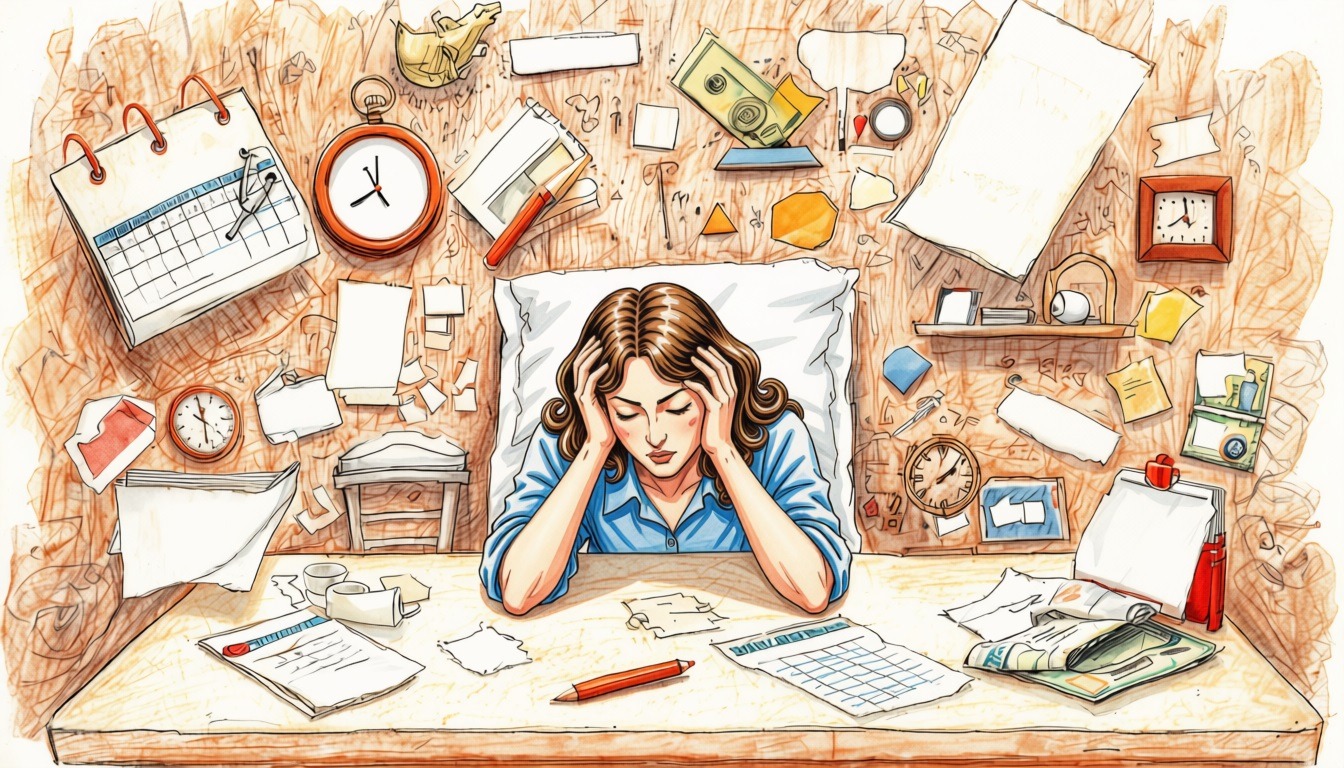
Role compression is what happens when too many meaningful roles stack on top of each other with not enough emotional recovery space in between. You are not just one thing anymore. You may be a partner, mother, daughter, worker, manager, helper, planner, emotional anchor, fertility decision-maker, financial contributor, social organizer, and the person who remembers birthdays, prescriptions, school forms, appointments, and who is upset with whom.
This is not just anecdotal. Research on adult social roles shows that the intersection of employment, partnership, and parenthood matters for mental health across the life course. Broader evidence from the WHO and ILO also shows that women continue to shoulder a disproportionate share of care work. WHO reported in 2024 that women perform an estimated 76% of all unpaid care activities, and the ILO reported that 708 million women worldwide were outside the labor force because of unpaid care responsibilities in 2023. Among women aged 25 to 54, the proportion citing care as the reason for being out of the workforce rises to about two-thirds.
Even when women remain employed, the emotional cost does not disappear. A 2025 Swedish population study of employed adults aged 30–49 found that burdensome domestic work explained a substantial share of diagnosed depression prevalence in women and was also associated with anxiety. The authors concluded that unpaid labor is an important contributor to poor mental health in the working population, especially among women.
Now bring that back into ordinary life.
It means that many women in their 30s are not “randomly more sensitive.” They are often carrying too many roles that all demand emotional competence at once.
And unlike physical overwork, emotional overwork often receives praise.
You get called mature. Strong. Selfless. Reliable. Capable. Amazing.
Meanwhile, your nervous system may be whispering something very different:
I cannot keep being everybody’s regulator.
The motherhood and career collision
For many women, the 30s are also the decade when motherhood, career development, and identity expansion collide. A 2024 scoping review on motherhood and career progression found both negative and positive impacts, but also documented discrimination, wage penalties, interrupted trajectories, changing work conditions, and relational strain. That means the emotional shift many mothers feel is not just “personal overwhelm”; it often reflects structural pressure too.
This is why the sentence “I don’t feel like myself anymore” can be misleading.
Sometimes the deeper truth is:
I have been forced to function so efficiently that I can barely hear myself anymore.
Why friendships and relationships start feeling different
Another reason women often feel emotionally different in their 30s is that relationships begin sorting themselves more clearly.
In your 20s, it is easier to maintain broad, loose, convenience-based connection. There is more flexibility, more social experimentation, and often more tolerance for inconsistent reciprocity. By your 30s, life gets fuller, time gets tighter, and your emotional resources become more expensive. That changes the math of friendship.
A 2023 systematic review on adult friendship and well-being found that adult friendship is generally positively associated with well-being. Friendship quality, mattering, effort, and the satisfaction of psychological needs help explain why some friendships feel nourishing while others feel quietly draining. Long-term research has also linked more positive friendships to better later health outcomes.
This helps explain a common 30s experience: you are not becoming “meaner” or “antisocial”; you are becoming more able to feel the difference between connection and access.
That emotional difference is profound.
You may notice that you no longer want to maintain friendships built on one-sided emotional dumping. You may feel less available for relationships where you are always the planner, the listener, the peacemaker, or the one who keeps the whole thing alive. You may also feel more grief about losing old versions of closeness that no longer fit who you are becoming.
That grief is real. So is the relief.
Many women in their 30s start saying things like:
- I want deeper friendships, not more friendships.
- I don’t want to explain basic empathy anymore.
- I can’t keep being close to people who only know the high-functioning version of me.
- I’m tired of being emotionally intimate with people who are not emotionally responsible.
Those are not signs of emotional failure. Often, they are signs of emerging emotional standards.
The relationship shift no one prepares Women for
Here is the non-obvious truth: sometimes emotional change in your 30s is not mainly about becoming more fragile. It is about becoming less willing to abandon yourself to stay connected.
That can make life feel emotionally louder for a while. Boundaries often do that.
old pattern: self-abandonment → temporary peace
new pattern: honesty → discomfort → deeper self-trust
That middle stage can feel raw, but it is often growth.
Sleep, burnout, and the shorter fuse problem
One of the fastest ways to feel emotionally different is to stop sleeping well.
And many women in their 30s are not sleeping well.
Sometimes the reason is obvious: work stress, young children, anxiety, caregiving, shift work, relationship strain, or doom-scrolling after everyone else has finally gone to bed. Sometimes the reason is cyclical, with sleep quality changing across the menstrual cycle. Sometimes it is connected to reproductive transitions later on. But whatever the cause, the emotional effects are real.
NIH and NICHD menopause resources note that mood changes and sleep problems often interact during menopausal transition, and broader sleep research shows that women face distinctive sleep-health challenges across the lifespan. A 2024 review in Frontiers in Sleep describes the overlapping relationship between insomnia, anxiety, depression, trauma exposure, and women’s health disparities.
You do not need to be in perimenopause for sleep loss to affect your emotional world. Sleep debt makes small disappointments feel bigger. It lowers frustration tolerance. It can intensify self-criticism, reduce concentration, increase irritability, and make your nervous system react as if everything is urgent.
A lot of women interpret that as, “Why am I suddenly so emotional?”
But often the body is saying something simpler:
I am under-rested, under-recovered, and overexposed.
Burnout does not always look like collapse
Burnout in women often presents in subtle, socially acceptable ways before it becomes obvious. It may look like functioning. It may even look like competence.
You still show up. You still answer messages. You still remember everything. You still do what needs to be done.
But underneath, you may notice symptoms like emotional numbness, resentment, a shrinking social battery, reduced libido, dread before small tasks, less patience for noise, and the eerie sense that even nice things feel like work.
That is why many women in their 30s say some version of this:
“Nothing is terribly wrong, but I don’t feel emotionally spacious anymore.”
That sentence deserves to be taken seriously.
The emotional bandwidth theory of Your 30s
Here is a framework that may help readers understand this decade in a fresh way.
Your 30s are often not an “emotional instability” decade.
They are an emotional bandwidth decade.
Emotional bandwidth is the amount of inner space you have to process feelings, tolerate stress, stay kind under pressure, and respond instead of react.
In your 30s, three things often happen at once:
1. Your self-knowledge goes up.
You know yourself better than you did before. You recognize patterns faster. You are less impressed by appearances and less seduced by fantasy. Research on adult development suggests that emotional well-being and clarity can improve with age, which means you may actually be perceiving your life more accurately now.
2. Your life load goes up.
Career demands, care demands, financial pressure, relationship decisions, body changes, fertility questions, household labor, and social maintenance often intensify during this decade. Multiple-role research and global care-work data both point in that direction.
3. Your tolerance for emotional waste goes down.
You become less willing to spend precious inner energy on avoidable chaos, one-sided relationships, fake urgency, or chronic self-betrayal.
When those three things collide, the result can feel like this:
more insight + more pressure + less tolerance = “Why do I feel so different?”
That is why the emotional shift of the 30s is often not a regression. It is a recalibration.
You are not necessarily becoming worse at coping. You may be becoming more aware of what coping has been costing you.
What actually helps
There is no single fix, because the emotional shift of the 30s is usually multi-layered. But there are ways to respond that are more useful than simply telling yourself to “toughen up.”
1. Stop treating every feeling as a flaw
When a woman starts crying more easily, feeling more irritated, or needing more solitude, her first instinct is often self-correction. She assumes the goal is to become less affected.
But not every feeling is a malfunction. Some feelings are information.
Irritability can be a boundary signal. Sadness can be a signal of accumulated self-neglect. Numbness can be a sign of overload. Restlessness can mean a version of your life no longer fits. Stronger emotional reactions do not always mean you are weak; sometimes they mean your inner system has stopped suppressing reality on your behalf.
2. Look for the pattern, not just the mood
A much better question than “What is wrong with me today?” is:
What pattern is this emotion part of?
Does the shift show up after poor sleep? Before your period? After several days of over-functioning? Around certain people? After long stretches without alone time? During periods of invisible care work? When you say yes too often? When you have no emotionally equal relationships to lean on?
Patterns are kinder than shame because they turn chaos into information.
3. Audit Your invisible labor
Many women in their 30s are not simply doing a lot. They are mentally holding a lot. Planning, anticipating, remembering, monitoring, smoothing, caretaking, preventing conflict, maintaining connection, and thinking ahead all consume emotional energy.
If your inner life feels cramped, ask yourself:
- What am I carrying that nobody sees?
- What emotional labor have I mistaken for personality?
- What would fall apart if I stopped over-managing everything?
- Why do I believe it all belongs to me?
This is not laziness. This is emotional accounting.
4. Protect sleep like it is mental health care
Because it is.
Sleep is not a decorative wellness habit. For many women, it is a major emotional threshold variable. When sleep worsens, emotional resilience often worsens with it. NIH and women’s sleep research both support the close relationship between sleep problems, mood changes, and cognitive strain.
That means “I need rest” is not a weak sentence. It is a psychologically intelligent one.
5. Let Your friendships mature or end
Not every friendship is meant to survive every version of you. Adult friendship quality matters more than sheer number, and research suggests it is the quality of friendship that is strongly tied to well-being.
You do not need to become ruthless. But you may need to become more honest.
Some friendships belong to your history. Some belong to your healing. Some belong to your next decade. They are not always the same people.
6. Do not dismiss cycle-related emotional changes
If your moods predictably intensify around certain times of the month, that is worth noticing rather than minimizing. ACOG and NIH resources recognize that menstrual symptoms can include mood swings, irritability, anxiety, concentration problems, fatigue, and sleep disruption. If symptoms are severe, cyclical, or disruptive, it may be worth tracking them and discussing them with a qualified clinician.
7. Consider whether this is a transition, not just a problem
Sometimes women interpret the emotional shift of their 30s as proof that they are “not coping well.” But another possibility is that they are in a transition phase between a highly adaptive old self and a more honest future self.
Transitions feel messy because they involve loss.
You may be losing your old ease, your old tolerance, your old illusions, your old performance of being fine, your old identity as the one who can always absorb everything. That can feel destabilizing. But it can also be the beginning of a much truer life.
The heart of it
So, why do so many women feel emotionally different in their 30s?
Because this decade often asks for a level of emotional labor, identity negotiation, care work, sleep sacrifice, relational discernment, and internal honesty that previous years did not demand in the same way. Research supports the idea that distress can rise into midlife, especially as responsibilities accumulate, while emotional clarity and deeper self-understanding can also strengthen with age. That combination can make your 30s feel less emotionally simple, but more emotionally real.
If you feel more sensitive, more selective, more tired of emotional noise, more affected by lack of rest, more aware of one-sided relationships, or more unwilling to keep abandoning yourself, that does not necessarily mean you are falling apart.
It may mean your inner life is asking to be treated as important.
And maybe that is the real shift of the 30s:
not that women become too emotional,
but that many finally become too awake to keep living disconnected from what they feel.
Related posts You’ll love
- “Is this all there is?” Understanding the mid-20s and 30s existential crisis no one prepared You for
- Practice corner: A practical toolkit for surviving Your 20s and 30s existential crisis
- How to protect Your mental health in a world that feels like one long crisis
- Chatbots aren’t enough: The 3-layer safety method for crisis thoughts (proven, human-first)
- Why time alone can feel both peaceful and painful: The psychology of solitude, loneliness, and emotional healing
- When a personal obsession helps You heal: 8 reflective exercises for emotional healing and self-discovery, FREE PDF
- When Your 30s feel emotionally heavy: 10 soothing practices that truly help

FAQ
-
Is it normal to feel more emotional in your 30s?
Yes, for many women it is normal to feel emotionally different in their 30s. That can include stronger reactions, lower tolerance for stress, deeper self-reflection, and more sensitivity to poor sleep, relationship imbalance, or life overload. Longitudinal research suggests distress can increase from early adulthood into midlife, while emotional clarity can also improve with age.
-
Why do I feel less tolerant of people than I used to?
Often because emotional bandwidth becomes more limited and more valuable. As responsibilities increase, many women become less willing to spend energy on superficial, one-sided, or chaotic relationships. Research on adult friendship suggests quality matters strongly for well-being, which helps explain why low-quality connection starts feeling more draining with age.
-
Can stress really change your personality in your 30s?
Chronic stress can change how you feel, react, and relate, even if it does not change your core identity. Under long-term strain, many women become more irritable, numb, anxious, or emotionally exhausted. What looks like a personality change is often an overloaded nervous system plus too little recovery time.
-
Is this emotional shift always hormonal?
No. Hormones can matter, especially with menstrual mood symptoms and for some women in late-30s reproductive transition, but emotional change in your 30s is usually multi-causal. Stress, sleep, invisible labor, role overload, caregiving, friendship changes, and identity development all matter too.
-
Can perimenopause start in your 30s?
For most women, the menopausal transition begins later, typically between ages 45 and 55, and the average age of menopause is around 51–52 in U.S. sources. Some people may begin perimenopause as early as 40, and timing varies. So it is possible for late-30s symptoms to matter for some women, but it is not the main explanation for most women in their early 30s.
-
Why do I feel emotionally worse when I am tired?
Because sleep and mood are tightly connected. Poor sleep lowers frustration tolerance, worsens concentration, increases emotional reactivity, and can intensify anxiety or low mood. Women’s health research and NIH resources both support this overlap.
-
Why do friendships feel harder in my 30s?
Usually not because you suddenly became difficult, but because your standards, time constraints, and emotional needs changed. Adult friendship research shows that friendship quality, not just quantity, is closely tied to well-being. As life gets fuller, emotionally low-return relationships stand out more clearly.
-
Can unpaid care work affect mental health?
Yes. Strongly. WHO and ILO data show that women continue to shoulder a disproportionate amount of care work globally. A 2025 Swedish study also found that burdensome unpaid labor made a meaningful contribution to poor mental health, especially among women aged 30–49.
-
Why does my period seem to affect my emotions more now?
Menstrual symptoms can include mood swings, irritability, anxiety, fatigue, and sleep problems. For some women, emotional sensitivity becomes more noticeable when life stress is already high, so cycle-related shifts feel more intense in the 30s than they used to.
-
How do I know if this is stress or something I should get help for?
If the changes are persistent, worsening, cyclical and severe, affecting work or relationships, or making daily life feel hard to manage, it is worth seeking support from a qualified mental-health or medical professional. That is especially true if you notice ongoing depression, intense anxiety, extreme mood changes, major sleep disruption, or symptoms linked to your cycle or reproductive health.
-
What is the healthiest way to respond to emotional changes in your 30s?
The healthiest response is curiosity, not self-judgment. Track patterns. Protect sleep. Reassess invisible labor. Strengthen emotionally reciprocal relationships. Respect cycle-related changes. And stop assuming every feeling is a flaw. Many women do not need harsher self-control in their 30s; they need better recovery, clearer boundaries, and a more honest relationship with themselves.
Sources and inspirations
- Benge, E., Pavlova, M., & Javaheri, S. (2024). Sleep health challenges among women: Insomnia across the lifespan. Frontiers in Sleep.
- Charles, S. T., Rush, J., Piazza, J. R., Cerino, E. S., Mogle, J., & Almeida, D. M. (2023). Growing old and being old: Emotional well-being across adulthood. Journal of Personality and Social Psychology.
- Eckland, N. S., & Berenbaum, H. (2023). Clarity of emotions and goals: Exploring associations with subjective well-being across adulthood. Affective Science.
- Engels, M., Wahrendorf, M., Dragano, N., McMunn, A., & Deindl, C. (2021). Multiple social roles in early adulthood and later mental health in different labour market contexts. Advances in Life Course Research.
- Gondek, D., Bann, D., Patalay, P., & Goodman, A. (2022). Psychological distress from early adulthood to early old age: Evidence from the 1946, 1958 and 1970 British birth cohorts. Psychological Medicine.
- International Labour Organization. (2024, October 29). Unpaid care work prevents 708 million women from participating in the labour market.
- Molarius, A., Granström, F., & Ervin, J. (2025). The contribution of unpaid labour to poor mental health in the Swedish working population. SSM – Population Health.
- National Institute on Aging. (2024). What is menopause?
- Pezirkianidis, C., Galanaki, E., Raftopoulou, G., Moraitou, D., & Stalikas, A. (2023). Adult friendship and wellbeing: A systematic review with practical implications. Frontiers in Psychology.
- Torres, A. J. C., Barbosa-Silva, L., Oliveira-Silva, L. C., Miziara, O. P. P., Guahy, U. C. R., Fisher, A. N., & Ryan, M. K. (2024). The impact of motherhood on women’s career progression: A scoping review of evidence-based interventions. Behavioral Sciences.
- World Health Organization. (2024). Fair share for health and care: Gender and the undervaluation of health and care work.

Leave a Reply