Table of Contents
There is a strange compliment we give exhausted people.
We say, “You’re so busy,” as if busyness is proof of importance. We say, “I don’t know how you do it,” as if surviving on fumes is a talent. We admire the person who answers messages at midnight, skips lunch, cancels rest, postpones joy, and still says, “I’m fine, just busy.”
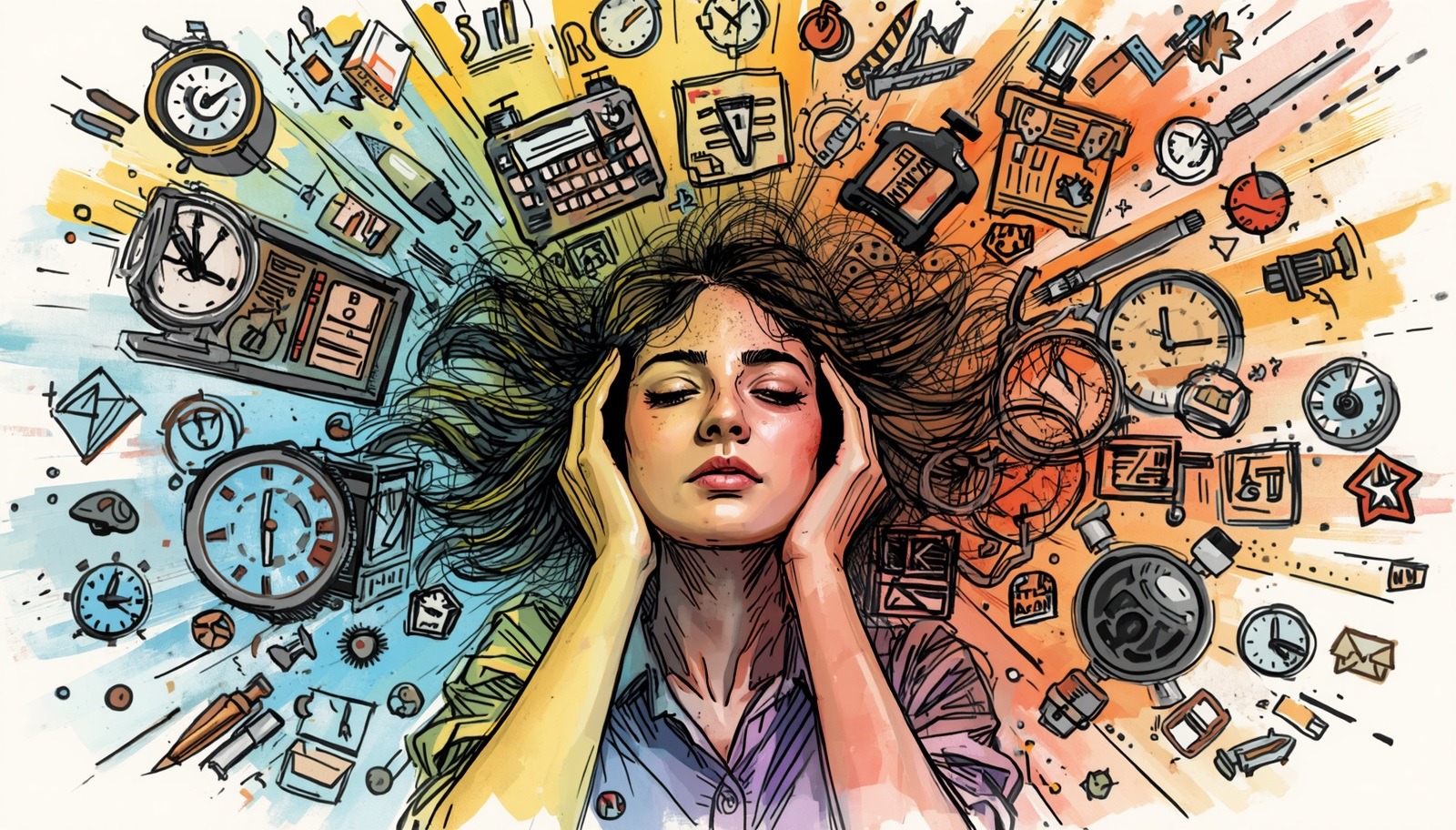
But what if having no spare time is not a quirky personality trait? What if it is not simply “how you are”? What if chronic busyness is a mental health issue hiding in plain sight?
In a culture that rewards constant availability, many people have learned to describe their distress as efficiency. They do not say, “I feel overwhelmed.” They say, “My schedule is packed.” They do not say, “I am emotionally depleted.” They say, “I just need to get through this week.” They do not say, “I have no space to be a person.” They say, “I’m productive.”
Yet the body often tells a more honest story. Irritability. Sleep trouble. Brain fog. Emotional numbness. A sense that even enjoyable things feel like obligations. A quiet grief for a life that contains everything except actual living.
The World Health Organization recognizes that poor working environments — including excessive workloads, low control, job insecurity, inflexible hours, and conflicting home/work demands — can pose risks to mental health. It also estimates that depression and anxiety cost the global economy about 12 billion lost working days every year. This means time pressure is not just a lifestyle inconvenience. It is part of a much larger public health conversation about how modern life is organized.
This article is not here to shame you for being busy. Many people are overloaded because of very real responsibilities: work, caregiving, financial pressure, school, family demands, health struggles, emotional labor, survival. The point is not that you should magically “make time” by becoming more disciplined.
The point is this: when a person consistently has no spare time, the question should not be “What is wrong with their personality?” The better question is, “What is happening to their nervous system, their relationships, their sense of self, and their ability to recover?”
Author’s note: Why this topic matters
I used to think that having no spare time was simply a sign of being responsible. Like many people, I associated a packed schedule with discipline, usefulness, and ambition. But the more I studied emotional exhaustion, burnout, nervous system regulation, and the psychology of over-functioning, the clearer it became: a life with no room to breathe is not just “busy.” It can become emotionally unsafe.
When someone has no time to rest, reflect, move slowly, process feelings, or reconnect with themselves, their mind does not simply adapt forever. It begins to send signals. Irritability, brain fog, numbness, resentment, insomnia, anxiety, and emotional shutdown are often not random personality flaws. They are messages from a system that has been overloaded for too long.
This article is written from a trauma-informed and mental-health-conscious perspective, not as a diagnosis or replacement for therapy. Its purpose is to help readers recognize when constant busyness has crossed the line from lifestyle into emotional strain — and to offer a more compassionate way to understand the need for spaciousness.
Because needing spare time does not make you weak.
It makes you human.
How this article was created
This article was developed using a research-informed approach that combines current mental health guidance, workplace well-being research, and trauma-informed emotional health education. The goal is to make complex psychological ideas easier to understand without oversimplifying them.
The article draws on reputable sources such as the World Health Organization, peer-reviewed research on time poverty and well-being, and recent studies on burnout, long working hours, sleep, stress, and recovery. It is written for educational purposes and is intended to support self-reflection, not to diagnose or treat any mental health condition.
Where possible, the language has been shaped to be practical, compassionate, and accessible. Many readers who experience chronic busyness do not need another productivity lecture. They need language for what their body and mind may already be trying to tell them.
The myth of the “always busy” personality
Some people genuinely enjoy full days. They like momentum, projects, deadlines, learning, family life, social plans, and ambition. There is nothing inherently unhealthy about being active or driven.
The problem begins when busyness stops being a choice and becomes a condition of belonging.
You may start to believe that rest has to be earned. You may feel guilty when nothing is scheduled. You may measure your worth by how much you can carry without asking for help. You may confuse being needed with being loved, being exhausted with being successful, and being unavailable with being important.
This is where busyness becomes psychologically complicated. It can turn into an identity. And once busyness becomes an identity, free time can feel threatening.
A quiet evening may not feel peaceful. It may feel suspicious. A canceled meeting may not feel relieving. It may feel like proof that you are falling behind. A slow morning may not feel nourishing. It may feel like laziness wearing soft clothes.
But “I have no spare time” is often not an identity statement. It is a distress signal.
The WHO defines burnout as an occupational phenomenon resulting from chronic workplace stress that has not been successfully managed, characterized by exhaustion, mental distance or cynicism toward one’s job, and reduced professional efficacy. Burnout is specifically work-related, but its emotional texture can spread into the rest of life: the feeling that everything asks too much and gives too little back.
A healthy personality has preferences. An overwhelmed nervous system has patterns of survival.
There is a difference.
Time poverty: The invisible mental load nobody sees
When we talk about poverty, we usually think about money. But there is another kind of poverty that deeply affects mental health: time poverty.
Time poverty means not having enough discretionary time — time that is not already claimed by work, caregiving, commuting, chores, emotional labor, survival tasks, or other obligations. It is not simply “being busy.” It is the absence of usable, self-directed time.
This distinction matters because mental health does not only depend on what happens to you. It also depends on whether you have enough room to metabolize what happens to you.
You need time to process conversations. Time to digest disappointment. Time to return to your body after stress. Time to laugh without multitasking. Time to do nothing and slowly remember what you want. Time to feel like a human being outside of your usefulness.
Without spare time, life becomes a chain of demands with no emotional exhale.
Research on discretionary time and well-being suggests that having too little free time is linked with lower subjective well-being, partly because it increases stress. Interestingly, the research also suggests that endless unstructured time is not automatically ideal either; people tend to thrive when they have enough free time for autonomy, restoration, and meaningful activity, not when their lives are either overpacked or empty.
So the goal is not to escape all responsibility. The goal is to have enough space in your life to remain psychologically alive inside your responsibilities.
Table 1: Busy personality or mental health warning sign?

The uncomfortable truth is that many people do not have a time management problem. They have a permission problem. They do not feel allowed to be unavailable. They do not feel allowed to disappoint others. They do not feel allowed to need recovery.
And sometimes, they are embedded in systems that punish rest: unstable jobs, understaffed workplaces, financial pressure, caregiving gaps, gendered expectations, or workplace cultures that praise “flexibility” while quietly expecting constant access.
That is not a personality flaw. That is a mental health environment.
The nervous system does not understand Your calendar app
Your calendar may divide life into clean blocks: meeting, commute, errands, dinner, emails, sleep.
Your nervous system does not experience life that neatly.
To the nervous system, a packed day is not just a list of tasks. It is a sequence of activation. Decision. Performance. Social monitoring. Emotional regulation. Noise. Pressure. Transition. Anticipation. Recovery denied. Repeat.
Even small tasks can become psychologically expensive when there is no space between them. The issue is not always the task itself; it is the absence of transition.
A five-minute email may be simple. But five-minute emails scattered across an entire evening can prevent your body from ever receiving the message: the day is over. You are safe now. You can soften.
This is why “spare time” matters. It is not wasted time. It is nervous system repair time.
The National Institute for Occupational Safety and Health has emphasized that work-related psychosocial hazards can cause stress, strain, interpersonal problems, and physical or psychological harm. These hazards include high demands, low control, work-family conflict, and difficulty taking time off when needed.
That means the absence of spare time is not merely personal. It is often structural. A person’s schedule can become a map of their stress exposure.
The “recovery debt” model
Here is a more useful way to think about spare time:
Stress creates a debt. Recovery pays it down. No spare time means the debt compounds.
You can handle a demanding day if recovery follows. You can survive a difficult season if repair is built in. You can give deeply to others if you also receive space, support, and rest.
But when demand rises and recovery disappears, your system starts borrowing from the future.
At first, you borrow from sleep. Then from patience. Then from creativity. Then from pleasure. Then from connection. Then from your body.
Eventually, you may still be functioning, but you are no longer fully living.
This is the hidden danger of “I’m fine, just busy.” Many people can remain outwardly functional while inwardly depleted. They answer messages. They meet deadlines. They keep showing up. They may even look successful.
But their inner world becomes narrower.
They stop reading for pleasure. Stop noticing music. Stop making spontaneous plans. Stop feeling desire. Stop feeling anger until it explodes. Stop knowing what they need. Stop imagining the future beyond the next obligation.
This is not laziness. It is not weakness. It is what happens when the mind has no unclaimed space in which to breathe.
Why no spare time can make You feel emotionally numb
One surprising effect of chronic busyness is emotional numbness.
People often expect stress to feel dramatic: panic, crying, breakdowns. Sometimes it does. But long-term overload can also feel like nothing. You are not sad exactly. Not happy either. Just muted. Functional. Flat. Strangely distant from your own life.
This can happen because feelings require space. Emotions rise when the body senses it is safe enough to process them. If every hour is occupied, your system may postpone emotional processing because there is nowhere to put it.
So instead of feeling grief, you feel tired. Instead of feeling resentment, you feel “busy.” Instead of feeling loneliness, you scroll. Instead of feeling fear, you plan harder.
The body adapts by reducing emotional volume.
This is why some people break down on vacation or during a rare quiet weekend. It is not because rest caused the pain. Rest removed the noise that was covering it.
Spare time is not only for hobbies. It is where unprocessed life catches up with you.
That may sound frightening, but it is also hopeful. When you make room for yourself, buried emotions can finally move. You may cry. You may feel angry. You may realize you are lonely. You may notice how much you miss yourself.
This is not failure. This is contact.
Table 2: What Your “no spare time” pattern may be protecting You from

This table is not meant to diagnose you. It is meant to help you become curious.
Because curiosity is the beginning of change. Shame says, “I am bad at life.” Curiosity says, “Something in me learned this pattern for a reason.”
The modern trap: Productivity without arrival
One reason having no spare time is so psychologically dangerous is that modern productivity rarely offers a true finish line.
There is always another email, another article, another bill, another notification, another improvement, another health habit, another unread message, another thing to optimize. Even self-care can become a project. Even healing can become a checklist.
This creates what we might call productivity without arrival.
You work, but you do not arrive. You clean, but the home gets messy again. You answer messages, but more appear. You finish one task, but ten are waiting. You improve yourself, but the algorithm shows you another flaw.
The nervous system needs completion signals. It needs moments that say: done for now. Enough for today. You may stop.
Without those signals, the mind remains in open-loop stress. It keeps scanning for unfinished business. It treats rest as unsafe because there is always something unresolved.
This is one reason boundaries matter. Boundaries are not just social tools. They are completion rituals.
- “Work ends at six.”
- “I do not answer non-urgent messages after dinner.”
- “I keep one evening unscheduled.”
- “I need time to think before I commit.”
- “I am not available for that.”
Each boundary tells the nervous system: this demand has an edge.
And mental health needs edges.
The psychological cost of being always available
Being constantly available can feel kind. Responsible. Professional. Loving.
But permanent availability slowly erases the self.
If everyone can reach you at any time, your attention stops belonging to you. If every spare minute is open to interruption, your rest becomes fragile. If your phone is always near, part of your mind remains on call.
This is not just about work. Family systems can create emotional on-call roles too. Friendships can. Romantic relationships can. Online communities can. Even personal goals can become demanding inner managers.
The cost is not only time. It is self-trust.
When you repeatedly abandon your own need for quiet, your body learns that your needs are negotiable. When you repeatedly override fatigue, your body learns it must shout louder. When you repeatedly say yes while resenting it, your relationships begin to carry hidden anger.
No spare time often means no protected self.
And when the self is never protected, mental health suffers.
WHO guidance on mental health at work recommends organizational interventions that directly target working conditions and environments, not only individual stress-management efforts. That matters because telling overwhelmed people to meditate while leaving harmful workloads untouched is not enough.
A healthier life is not built only by calming down. Sometimes it is built by changing what keeps activating you.
Why “just manage Your time better” is often bad advice
Time management advice can be helpful when the problem is disorganization. But when the problem is overload, time management can become another form of self-blame.
A planner cannot fix chronic understaffing.
A morning routine cannot fix financial insecurity.
A productivity app cannot fix a relationship where your boundaries are punished.
A better checklist cannot fix the belief that you must earn rest through exhaustion.
Sometimes the problem is not that you are managing time poorly. Sometimes the problem is that too many demands have been placed on too little human capacity.
The U.S. Surgeon General’s workplace well-being framework identifies five essentials for workplace mental health and well-being: protection from harm, connection and community, work-life harmony, mattering at work, and opportunity for growth. Importantly, the framework includes adequate rest and worker voice as part of healthy organizations.
This is a more humane framework than “try harder.” It recognizes that mental health is shaped by environments.
You are not a machine with a scheduling problem. You are a human being with biological, emotional, relational, and spiritual needs.
Table 3: The new spare-time framework — from empty time to repair time

The goal is not to create a perfect slow life. Most people cannot simply delete their obligations. The goal is to reclaim enough protected time that your mind stops experiencing your life as an emergency.
A nonconventional idea: Your calendar has an emotional climate
Most people look at their calendar and ask, “Can I fit this in?”
A better question is, “What emotional climate will this create?”
Because a calendar is not neutral. It has weather.
Some calendars create constant thunder: back-to-back meetings, no transition time, emotionally intense conversations, errands stacked after work, social plans made from guilt, sleep squeezed at the edges.
Some calendars create fog: too many unfinished tasks, unclear expectations, vague commitments, open loops everywhere.
Some calendars create drought: no pleasure, no solitude, no creativity, no intimacy, no movement, no nature, no silence.
And some calendars create oxygen: effort followed by recovery, people followed by solitude, output followed by input, responsibility followed by meaning.
Instead of asking only whether something fits, ask what it costs.
- Does this commitment cost sleep?
- Does it cost resentment?
- Does it cost your one quiet evening?
- Does it cost the patience you need for your child, partner, friend, or yourself?
- Does it cost your ability to feel like a person?
This is not selfish. It is honest accounting.
A life can be full and still be mentally healthy if it contains rhythm. Expansion and contraction. Giving and receiving. Focus and wandering. Noise and silence. Obligation and choice.
But a life that only expands eventually tears.
The role of gender, caregiving, and emotional labor
It would be incomplete to talk about spare time without talking about inequality.
Not everyone loses spare time in the same way. Many women, caregivers, parents, lower-income workers, immigrants, disabled people, and people in insecure jobs experience time poverty not as a mindset but as a structural reality. They may carry paid work, unpaid domestic work, emotional labor, invisible planning, family coordination, and social expectations all at once.
For some people, “take more time for yourself” is not empowering. It is insulting unless paired with real support.
That support may include affordable childcare, fair wages, predictable scheduling, flexible work, shared household labor, accessible healthcare, paid leave, safe workplaces, and relationships where care is mutual rather than extracted.
Mental health advice becomes shallow when it ignores power.
So yes, individual boundaries matter. But so do systems. A person should not need heroic self-advocacy just to have an evening, a lunch break, a sick day, or enough sleep.
The WHO lists excessive workloads, understaffing, long or inflexible hours, low control, harassment, discrimination, job insecurity, inadequate pay, and conflicting home/work demands among risks to mental health at work. These are not personality traits. They are conditions.
And conditions can be changed.
The emotional signs that “no spare time” is becoming a mental health issue
You may be crossing from “busy season” into mental health risk when your lack of spare time begins changing your inner life.
Look for these signs:
→ You feel guilty whenever you rest.
→ You cannot enjoy free time because you are mentally rehearsing tasks.
→ You become irritated by small requests.
→ You feel disconnected from people you love.
→ You fantasize about disappearing, getting sick, or having an excuse to stop.
→ You feel numb, cynical, or strangely hopeless.
→ You sleep but do not feel restored.
→ You avoid checking in with yourself because you are afraid of what you will feel.
→ You no longer know what you enjoy.
→ You resent people who need you.
→ You feel like your life belongs to everyone except you.
That last one is especially important.
A life with no spare time can become a life with no felt ownership. You may be doing many things “right” while privately feeling absent from your own existence.
Mental health is not only the absence of symptoms. It is the presence of aliveness, agency, connection, meaning, and enough internal space to meet yourself.
The “three doors” back to time
When someone has no spare time, the solution is not always to find three extra hours. Sometimes that is impossible. Instead, begin with three doors:
1. The door of reduction
This is the most obvious door, but often the hardest. Reduction asks: what can be removed, postponed, delegated, simplified, renegotiated, or allowed to be imperfect?
Many people skip this door because reduction triggers guilt. But a life cannot become healthier if every demand remains sacred.
Ask:
→ What am I doing only because I fear someone’s disappointment?
→ What standard am I maintaining that nobody actually asked for?
→ What task could be done at “good enough” instead of beautifully?
→ Where am I rescuing people from consequences that belong to them?
→ What commitment belongs to an old version of me?
Reduction is not quitting life. It is removing what is quietly consuming it.
2. The door of protection
Protection asks: where does my time leak?
Time leaks are not always large. They are often tiny cracks: checking messages constantly, saying yes too quickly, letting meetings run over, scrolling when exhausted, answering non-urgent requests immediately, keeping notifications on, leaving every evening socially available.
Protection creates edges.
→ A no-phone first 20 minutes of the morning.
→ A weekly evening with no plans.
→ A 24-hour pause before accepting new commitments.
→ A clear end to work communication.
→ A visible household labor agreement.
→ A boundary around emotional dumping.
→ A lunch break that is treated as health maintenance, not a luxury.
Protection says: my attention is not public property.
3. The door of restoration
Restoration asks: what kind of spare time actually repairs me?
Not all free time is restorative. Sometimes we spend “free” time in ways that numb us but do not nourish us. This is understandable. When you are depleted, your brain reaches for low-effort relief. There is nothing morally wrong with that.
But restoration usually includes at least one of these qualities:
→ Slowness
→ Embodiment
→ Emotional honesty
→ Play
→ Nature
→ Creativity
→ Connection without performance
→ Solitude without punishment
→ Sleep
→ Meaning
→ Spiritual or reflective space
The point is not to optimize rest. The point is to stop treating your inner life as an afterthought.
Micro-recovery: When You truly cannot take a break
Sometimes life is genuinely overloaded. A caregiver cannot always disappear for a weekend. A parent cannot always sleep eight uninterrupted hours. A person working multiple jobs may not have the luxury of a slow morning.
This is where micro-recovery matters.
Micro-recovery is not a replacement for systemic change or deep rest. It is a small act of nervous system protection inside imperfect conditions.
Examples:
→ Take three slow breaths before opening a stressful message.
→ Put one hand on your chest and unclench your jaw before entering the house.
→ Step outside for two minutes and look at something farther away than a screen.
→ Drink water without multitasking.
→ Stretch your neck between tasks.
→ Let one non-urgent message wait.
→ Sit in silence in the car for one full song.
→ Say, “I need to check my capacity before I answer.”
→ Choose one evening chore to do imperfectly.
→ Name your feeling: “This is overwhelm,” instead of “I’m failing.”
These are tiny acts, but they matter because they interrupt the message that you are only a machine for output.
They say: I am still here.
Why spare time helps You remember who You are
One of the deepest harms of chronic busyness is identity thinning.
You become the worker, the parent, the helper, the partner, the problem-solver, the responsible one, the strong one, the one who handles it.
But who are you when nobody needs anything?
At first, that question may feel uncomfortable. That discomfort is useful. It may reveal how long you have been living through roles rather than from selfhood.
Spare time allows identity to widen again.
You remember that you like certain songs. You notice that your body wants to move. You realize you miss painting, reading, cooking slowly, learning, flirting, praying, hiking, laughing, doing nothing with someone safe. You hear your own opinions again. You feel desire return in small sparks.
This is why spare time can feel almost rebellious.
In a world that profits from your constant attention, unclaimed time is a form of self-return.
The difference between rest and collapse
Many people think they are resting when they are actually collapsing.
Collapse is what happens when your body forces you to stop because you ignored earlier signals. It often looks like scrolling for hours, binge-watching without pleasure, sleeping at odd times, avoiding everyone, eating without tasting, or lying down while feeling emotionally absent.
Collapse is not bad. It is the body’s emergency brake.
But it is not the same as restoration.
Rest feels like returning. Collapse feels like disappearing.
Rest has some quality of nourishment, even if subtle. Collapse has a quality of shutdown. Rest helps you feel more like yourself. Collapse helps you survive not feeling yourself.
If your only “spare time” is collapse time, that is a clue: your system is not getting enough recovery soon enough.
The answer is not to shame yourself for collapsing. The answer is to create smaller recovery points before collapse becomes the only available option.
A better question than “Do I have time?”
The question “Do I have time?” is too narrow.
You can technically have time and still not have capacity.
A better set of questions is:
→ Do I have emotional capacity for this?
→ Do I have recovery time after this?
→ Am I choosing this freely or from fear?
→ What will this cost my body?
→ What will this cost my relationships?
→ What will this cost my sleep?
→ What will this cost my sense of self?
→ Does this align with the life I say I want?
When you ask these questions, you begin treating time as mental health territory.
Because it is.
How to start reclaiming spare time without burning Your life down
You do not need to make a dramatic life change overnight. In fact, sudden change can feel threatening if busyness has been your safety strategy for years.
Start with one protected pocket.
One morning hour. One evening. One lunch break. One Sunday afternoon. One commute without calls. One no-response window. One small ritual after work that marks the transition from performance to personhood.
Then observe what comes up.
You may feel guilty. You may feel restless. You may feel grief. You may feel bored. You may feel the urge to fill the space immediately. That does not mean the space is wrong. It means your system is learning a new pattern.
Spare time is not only something you schedule. It is something you build tolerance for.
At first, quiet can feel unfamiliar. Later, it can become home.
You were not made to be available forever
Having no spare time is not a badge of honor if it costs you your inner life.
It is not a personality trait if it leaves you anxious, numb, resentful, disconnected, or unable to rest. It is not ambition if it requires self-abandonment. It is not strength if the only way to keep going is to stop feeling.
You are allowed to question a life that only praises you when you are useful.
You are allowed to protect time that does not produce anything obvious. Time to breathe. Time to wander. Time to be slow. Time to feel. Time to remember what your own voice sounds like beneath the noise of everyone else’s needs.
The world may call that unproductive.
Your nervous system may call it safety.
Your heart may call it coming home.
And maybe the real measure of a healthy life is not how much you can fit into it, but whether there is still room inside it for you.
Related posts You’ll love
- Why Women so often want opposite things at the same time: The hidden psychology of ambivalence
- The phrases Women need when every choice feels judged: 17 powerful scripts for self-trust, boundaries and peace
- Why AI chatbots can worsen mental health – and how to stay safe
- The fairness reset: 7 couples exercises to fix money imbalance without fighting
- Why the gender pay gap becomes a relationship issue at home: The hidden economics of love, power, and everyday choices
- Why Women pay $150,000 for matchmakers in 2026: The quiet luxury of opting out of swipe culture, and what that price tag really buys
FAQ
-
Is having no spare time always a mental health issue?
Not always. Some seasons are temporarily demanding, and some people genuinely enjoy active lives. It becomes a mental health concern when lack of spare time is chronic, non-negotiable, emotionally draining, or linked with symptoms such as irritability, numbness, anxiety, sleep problems, resentment, or burnout.
-
What is time poverty?
Time poverty means not having enough discretionary time for rest, recovery, relationships, self-care, reflection, or meaningful personal activities. It often happens when work, caregiving, commuting, household labor, emotional labor, or financial survival consume most of a person’s available hours.
-
Can being too busy cause burnout?
Chronic overload can contribute to burnout, especially when high demands are combined with low control, inadequate recovery, poor support, or unclear boundaries. Burnout is specifically associated with chronic workplace stress, but the emotional effects of overextension can influence the whole person.
-
Why do I feel guilty when I rest?
Rest guilt often comes from learned beliefs such as “I must be useful to be valuable,” “rest is lazy,” or “other people’s needs matter more than mine.” It can also come from environments where productivity is rewarded and boundaries are criticized.
-
Is spare time really important for mental health?
Yes. Spare time allows emotional processing, nervous system recovery, pleasure, connection, creativity, and identity beyond roles. Without it, stress can accumulate and make life feel like a constant chain of demands.
-
What if I genuinely cannot reduce my responsibilities?
Start with protection and micro-recovery. You may not be able to remove major responsibilities immediately, but you may be able to create small boundaries, reduce unnecessary availability, ask for support, simplify standards, or insert brief recovery moments throughout the day.
-
Why do I collapse instead of enjoying my free time?
Collapse often happens when your body has been running beyond capacity for too long. By the time free time arrives, your nervous system may choose shutdown rather than enjoyment. This is a sign that recovery may need to happen earlier and more regularly.
-
Can mindfulness help with time pressure?
Mindfulness can help some people relate differently to time pressure by increasing awareness, slowing automatic reactions, and improving perceived time affluence. However, mindfulness should not be used as a substitute for addressing unhealthy workloads, poor boundaries, or structural stressors.
-
How do I know whether I am ambitious or just avoiding myself?
Healthy ambition usually feels connected to meaning, growth, and choice. Avoidant busyness often feels compulsive, guilt-driven, fear-based, or empty. A useful question is: “If nobody praised me for being busy, would I still choose this pace?”
-
What is one simple boundary I can start with?
Try a pause boundary: “Let me check my capacity and get back to you.” This protects you from automatic yeses and gives your nervous system time to respond instead of perform.
-
When should I seek professional help?
Consider professional support if lack of spare time is connected with persistent anxiety, depression, emotional numbness, panic, sleep disturbance, hopelessness, relationship breakdown, substance misuse, or thoughts of self-harm. Support is especially important if you feel unable to stop even when your body is clearly suffering.
Sources and inspirations
- American Psychological Association. (2024). 2024 Work in America survey: Psychological safety in the changing workplace. American Psychological Association.
- Pega, F., Náfrádi, B., Momen, N. C., Ujita, Y., Streicher, K. N., Prüss-Üstün, A. M., & Woodruff, T. J. (2021). Global, regional, and national burdens of ischemic heart disease and stroke attributable to exposure to long working hours for 194 countries, 2000–2016: A systematic analysis from the WHO/ILO Joint Estimates. Environment International.
- Schaupp, J., & Geiger, S. M. (2022). Mindfulness as a path to fostering time affluence and well-being. Applied Psychology: Health and Well-Being.
- Schulte, P. A., Sauter, S. L., Pandalai, S. P., Tiesman, H. M., Chosewood, L. C., Cunningham, T. R., Swanson, N. G., Wurzelbacher, S. J., & Reissman, D. B. (2024). An urgent call to address work-related psychosocial hazards and improve worker well-being. American Journal of Industrial Medicine.
- Sharif, M. A., Mogilner, C., & Hershfield, H. E. (2021). Having too little or too much time is linked to lower subjective well-being. Journal of Personality and Social Psychology.
- U.S. Department of Health and Human Services, Office of the Surgeon General. (2022). The U.S. Surgeon General’s framework for workplace mental health & well-being.
- World Health Organization. (2019). Burn-out an “occupational phenomenon”: International Classification of Diseases.
- World Health Organization. (2022). Guidelines on mental health at work.
- World Health Organization. (2024). Mental health at work.



Leave a Reply