Table of Contents
You may remember a time when curiosity mattered more than approval, mistakes felt less revealing, and enjoying something was enough reason to try it. Adult responsibilities, perfectionistic expectations, and fear of evaluation can make that freedom harder to access. However, childhood is not universally more confident, and research does not show an inevitable decline in self esteem with age.
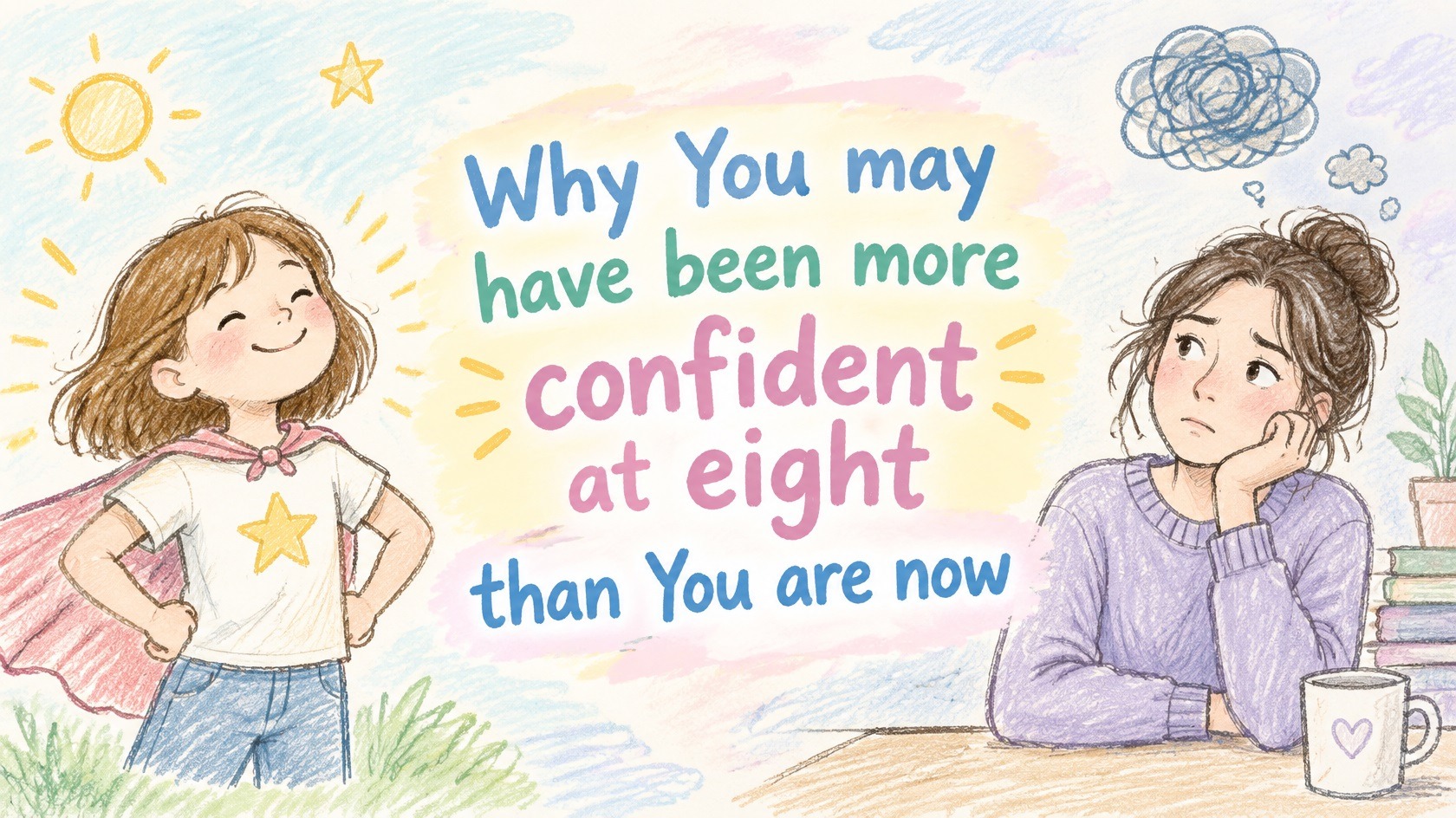
Perhaps you once announced that you were an artist because you liked drawing. You did not need a portfolio, a recognisable style, or strangers willing to pay for your work. There were crayons. There was paper. You had something to make.
Now you can spend twenty minutes deciding whether an ordinary message sounds embarrassing.
That contrast can hurt. You know more, have survived more, and can handle things your younger self could not have imagined. Yet the simplest acts of being visible can feel strangely expensive.
I want to approach that contradiction carefully. The question is not whether eight was your perfect age. It is whether some of the rules you now follow have made participation feel conditional.
Perhaps you have not lost every trace of confidence. Perhaps you have started demanding more evidence before allowing yourself to use it.
Were You actually more confident as a child?
Possibly. But your personal story and the average developmental pattern are different things.
A major meta analysis of longitudinal research found that average self esteem increased across childhood, remained relatively stable in early adolescence, and generally rose through much of adulthood. The findings do not support the familiar claim that growing older inevitably makes people feel worse about themselves. They describe group averages, however, and cannot tell us what happened in your particular life.
That distinction matters because nostalgia can turn into another accusation: I was better before life happened to me.
You do not need that accusation. You need a more useful description.
Maybe you were outspoken at eight but frightened of being left out. Maybe you loved performing but hated school. Maybe you were never confident at all, and the childhood you miss is the one you wish you had experienced.
There is room for each version here.
For this article, eight is a point of reflection, not a scientifically established confidence peak. The practical question is: What did you once feel permitted to do that now seems to require permission?
Confidence, self esteem, and freedom to participate are different
Confidence usually concerns an expectation about your ability in a situation. Self esteem concerns your broader evaluation of your worth. Neither is identical to being talkative, spontaneous, or willing to look silly.
You might trust your professional skills while doubting your attractiveness. You might value yourself while feeling nervous about public speaking. You might appear fearless because you are performing a role that feels familiar.
Research on specific areas of self evaluation also shows that different domains follow different developmental patterns. Feeling less capable in one area does not establish that your entire sense of self has deteriorated. The relevant meta analysis also notes that its evidence came largely from Western and White or European samples, which limits universal conclusions.
I find this a more generous starting point: instead of saying, “I have no confidence,” try naming the situation in which confidence becomes difficult.
Specificity gives you somewhere to begin.
You may have changed the question from “Do I enjoy this?” to “Am I impressive?”
Imagine a child drawing a house with a purple roof. The drawing is an activity. It gives the afternoon somewhere to go.
Imagine the same person years later, opening a sketchbook and immediately wondering whether the result could be posted online.
Nothing has been drawn, but an audience has already arrived.
This is an illustrative contrast, not a claim that all children create freely or all adults seek approval. Still, it offers a useful question: when did an activity become an audition?
You may recognise that shift in writing, dancing, cooking, speaking another language, or choosing clothes. The pleasure of doing something becomes entangled with whether doing it proves something favourable about you.
A hobby must reveal talent. A conversation must reveal charm. A photograph must reveal that your life is going well.
That is a lot of work for one ordinary afternoon.
Give one activity a smaller job
Choose something you enjoy and define its purpose narrowly.
The walk is for noticing the neighbourhood. The drawing is for using colour. The song is for singing along while making dinner.
You can still pursue excellence elsewhere. This experiment simply gives one part of your life permission to exist without becoming evidence of your quality.
Try this sentence → “I can enjoy this without turning it into proof.”
Notice what happens when you remove the question of whether the activity makes you interesting. Does your preference become easier to hear? Do you actually like it, or did you mainly like the identity attached to it?
Either answer is useful.
Being good at something may have become the price of beginning
An adult beginner can feel caught in an impossible agreement: you are willing to learn, provided nobody sees you needing to learn.
You would join the class if you already knew the steps. You would speak the language if your pronunciation were already smooth. You would share the idea if you could guarantee that nobody would improve it.
That agreement prevents the very experiences that might make the task more familiar.
Perfectionism is relevant here, although it does not explain every confidence problem. A meta analysis of college student samples from the United States, Canada, and Britain found increases in several dimensions of perfectionism across cohorts from 1989 to 2016. This was a comparison across groups and historical periods, not proof that each individual becomes more perfectionistic with age.
The useful personal question is simpler than the cultural debate: What standard am I requiring before I allow myself to start?
If the answer is “I must already be good,” the standard needs examining.
Replace an identity test with a task
“I need to be a confident person” is difficult to act on.
“I will ask one question in the beginner class” is clearer.
Likewise, “I must become creative again” carries the weight of an entire identity. “I will write one scene badly enough that I can finish it” gives you something concrete to do.
This is an original practice suggestion, not a validated treatment protocol. Its purpose is to help you distinguish a manageable action from a demand to become a different person first.
You are allowed to prepare. You are allowed to care about doing well. The experiment is to stop making competence a condition of receiving instruction.
You may be treating an imagined audience as a reliable witness
Consider the silence after you say something in a group.
One interpretation is that everyone thinks you sounded foolish. Another is that someone is tired, someone is considering their answer, and someone did not hear the final sentence.
The silence is observable. The unanimous verdict is not.
In research on the “liking gap,” people tended to underestimate how much their conversation partners liked them and enjoyed their company. This pattern appeared across several settings, including conversations between strangers and relationships developing among college dorm mates. It does not mean everyone likes you, but it does challenge the assumption that your least generous interpretation is necessarily accurate.
I would not replace “They disliked me” with “They definitely loved me.” Both can be guesses.
A more honest sentence is: “I do not know their full impression, and my discomfort cannot tell me.”
That leaves room for reality to be less punishing than your prediction.
Separate observation from commentary
After a difficult interaction, write two short sentences.
First: “What happened was…”
Second: “The meaning I added was…”
For example: “My colleague asked me to explain my suggestion. I added the meaning that my suggestion must have been stupid.”
An explanation request could indicate confusion, interest, disagreement, or a need for detail. You may need further information. You do not need an immediate verdict on your intelligence.
Useful distinction → A feeling can be real while its explanation remains uncertain.
Your comparison group may have become impossibly large
At eight, perhaps you compared your drawing with a few drawings on a classroom wall. Today, before breakfast, you can encounter professional artists, wealthy entrepreneurs, athletes, interiors, bodies, relationships, and careers presented at their most compelling angles.
That does not mean social media damages everyone equally. A study of adolescents found substantial differences between individuals in the relationship between social media experiences and self esteem. The findings concern adolescents and cannot simply be applied to every adult, but they caution against treating all online experiences as psychologically identical.
For your own reflection, the useful distinction may be between information that expands your possibilities and information that makes your existing life seem unacceptable.
An account can be beautiful and still be unhelpful for you at a particular moment. A person can be admirable without being an appropriate benchmark for your current circumstances.
Ask whether the comparison gives you anything usable
After viewing something that leaves you feeling smaller, ask:
“Did I learn an action I could realistically take?”
“Am I comparing the same resources, experience, and constraints?”
“Do I even want the life I am using to judge mine?”
You do not have to turn these questions into a permanent monitoring project. Try them once, with one recurring comparison.
A photograph of a stunning kitchen cannot tell you whether you are a good friend. A stranger’s promotion cannot settle whether your quieter work matters. Keep each piece of information within the boundaries of what it actually reveals.
Your hesitation may contain practical knowledge
There is a tempting story in which the fearless child is authentic and the cautious adult is damaged.
I do not think that story is fair.
Adults have responsibilities. A mistake can affect income, housing, a relationship, or someone who depends on them. You may also have learned that a particular person responds badly to disagreement.
In those circumstances, caution deserves examination rather than automatic correction.
The question is not always, “How do I become brave enough to speak?” Sometimes it is, “What would make speaking safer, clearer, or better supported?”
You might need preparation, a private conversation, a written record, a different audience, or help from someone with relevant expertise. You might decide that this is not the right moment.
Confidence does not require pretending consequences are imaginary.
Distinguish discomfort from a reason to change the plan
Before a small act of visibility, ask what you are protecting.
Are you protecting yourself from a moment of awkwardness? Are you protecting a job on which you depend? Are you dealing with someone whose previous behaviour gives you reason to be careful?
These deserve different responses.
The following table is a reflection aid, not a diagnostic assessment. Its examples describe possible patterns rather than universal stages of growing up.

Being seen trying may feel more exposing than failing privately
There is a particular discomfort in letting someone know you want something.
If you say you do not care, disappointment can remain hidden. If you admit that the opportunity matters, another person can see where you are vulnerable.
That can make indifference feel like a convenient costume.
Research on the “beautiful mess effect” found that people sometimes evaluate another person’s vulnerability more positively than their own. Across seven studies, the researchers examined situations such as asking for help and revealing personal imperfections. The findings offer a reason to question harsh predictions about how vulnerability will be received, not a guarantee that disclosure is safe with every person.
You do not owe everybody access to the things that matter most to you.
But with a trustworthy person, you might experiment with replacing protective indifference with a proportionate truth.
“I would like to try.”
“I am disappointed because it mattered.”
“I need some help with this part.”
These are ordinary statements. They do not require a dramatic confession or a complete account of your history.
Let interest be visible before success is certain
Imagine saying, “I have started learning photography,” without immediately adding, “Obviously, I am terrible.”
The second sentence may feel socially convenient. It gets your criticism in before anyone else can offer theirs.
But what happens if you leave it out?
You have not claimed to be an expert. You have simply described something you are doing. The listener can ask a question. You can answer it. The conversation can remain about photography rather than becoming a negotiation about whether you deserve to try.
The words that quietly turn uncertainty into a character flaw
Words matter here because they specify what you believe is happening.
“I am learning this” and “I am embarrassing myself” can describe the same moment from very different angles.
The aim is not to decorate a difficult experience with positive language. It is to choose a sentence accurate enough to guide your next action.
“I always ruin things” is broad, emotionally charged, and difficult to investigate. “I interrupted twice in that meeting” is specific. It allows an apology, a different approach, or a reminder to pause.
I prefer language that leaves a person with responsibility and room to move.
Borrow a sentence you can actually believe
The phrases below are original writing prompts. They are not a tested affirmation programme, and you do not need to repeat any sentence that feels false.

Choose one row, not seven. Use it in the situation it describes. Then ask whether it helped you see the next step more clearly.
A sentence has done useful work when it helps you respond with greater accuracy. It does not have to make you feel wonderful immediately.
Confidence also depends on how You respond after an imperfect attempt
Before trying something, you may be asking two questions at once.
“What if this goes badly?”
“And what will I say to myself if it does?”
That second question deserves attention. An ordinary mistake becomes a heavier prospect when you expect to follow it with hours of personal condemnation.
Self compassion offers a relevant perspective. Neff’s review describes responding supportively to suffering, including pain connected with mistakes, through kindness, awareness, and recognition of shared humanity. The review also discusses evidence challenging the idea that compassion necessarily undermines motivation, while acknowledging limitations and debates in the research.
For this article, I would translate that into a modest commitment: after an attempt, describe what needs attention without putting your whole character on trial.
Perhaps your presentation lacked structure. Perhaps your joke did not land. Perhaps you need more practice before doing the task independently.
You can take those facts seriously.
You can also eat lunch, answer a friend, and continue being a person whose life is larger than that event.
Write the review you would find useful
Try three lines after a manageable challenge:
What happened → “I asked the question, and my voice shook.”
What I learned → “The instructor answered normally. I understood the next step.”
What I will try next → “I will write my question down beforehand if that helps.”
This is an editorial exercise rather than a clinical intervention. It does not require you to label the experience a success. It simply keeps your review attached to observable details and possible adjustments.
A seven day experiment in giving Yourself permission
You do not need to reconstruct your entire childhood to begin. Nor do you need to complete a perfect week of personal development.
The following experiment offers seven small invitations. They are optional, adaptable, and intended for everyday situations with manageable consequences. Skip any that do not fit your circumstances. There is no promised confidence transformation by day seven.

If you do only one exercise, let that be enough information for now. You can discover that something helps without turning it into a daily obligation.
Also notice what does not help. Perhaps private practice is useful, but sharing early work is not. Perhaps you need a more welcoming class rather than a stronger affirmation.
The point is to learn something about your circumstances, not to prove that you are exceptionally committed to improvement.
If You were never a confident child
Some readers will have reached this point thinking, “There was no fearless version of me.”
You do not need to invent one.
Perhaps you learned to watch adults closely, avoid attention, or make yourself easy to manage. Perhaps school was lonely. Perhaps being unusual brought consequences you still remember clearly.
A childhood metaphor should never become a requirement for belonging in a conversation about confidence.
You can replace “What would my younger self do?” with “What would make participation feel possible now?”
That might involve a patient teacher, a supportive friendship, accessible equipment, a quieter setting, or professional help. It may involve recognising that the environment needs to change, too.
If fear or self criticism is persistently restricting your relationships, work, or everyday choices, consider discussing it with a qualified mental health professional. An article can offer reflection; it cannot assess your history or provide individual care.
You deserve more than an instruction to act fearless.
You do not have to become eight again
The child you remember did not know everything you know now.
They did not carry your responsibilities. They did not have your vocabulary for difficult relationships, your understanding of consequences, or the practical knowledge you have earned.
You do not need to discard those things to become more at ease with yourself.
What you might borrow is smaller: the willingness to let interest count. The right to make something before deciding whether it is impressive. The freedom to ask a question without attaching an apology to your intelligence.
I would rather offer you that than another demand to become fearless.
Choose one ordinary thing you have been keeping outside your life until you feel sufficiently qualified to enjoy it. Make the next step small, appropriate, and real. Open the sketchbook. Ask about the class. Tell a trusted person what you would like to learn.
You may still feel awkward. You may discover that the activity is not for you. You may surprise yourself.
None of those outcomes cancels your permission to participate.
You do not have to be the most confident person in the room to stop excluding yourself from it.
Related posts You’ll love
- The 7-day Women’s sports energy reset: How to borrow confidence from the athletes You admire (FREE PDF)
- Words of power for Women who are done softening every sentence: Strong phrases for boundaries, confidence, and self-respect
- The calm confidence glow: Why peace makes Women look more powerful (and why people believe it before You speak)
- Quiet confidence: 12 practices that make You feel internally steady (even on hard days)
- Healing silence: 15 daily practices for Women to speak with confidence
- Harnessing the power of words: How to use language to collapse self-doubt and build unshakeable confidence
FAQ
-
Why was I more confident as a child?
You may have felt freer to participate, had fewer responsibilities, or experienced less pressure in the situations you remember. Your surroundings may also have been more supportive. Those are possibilities to explore, not a diagnosis. Being spontaneous as a child does not necessarily mean your overall self esteem was higher.
-
Does confidence naturally decrease with age?
There is no universal decline. Research on global self esteem finds average increases across much of adulthood, although individuals have different experiences. Confidence in a particular task can also change independently of overall self worth.
-
Is eight a special age for confidence?
The evidence cited here does not establish eight as a universal peak. It is a relatable age around which some people remember greater freedom, curiosity, or willingness to try. Use the comparison as a reflection prompt, not a developmental rule.
-
Can I value myself and still feel nervous?
Yes. Feeling worthy does not require feeling comfortable in every situation. You can respect yourself and still need preparation, support, or experience with an unfamiliar task. Nervousness alone does not tell you that your self esteem is low.
-
How can I rebuild confidence without pretending?
Choose a specific, manageable action and describe your current ability honestly. “I am learning” may fit better than “I am amazing.” Afterward, assess what happened and what would help next time. Avoid demanding a complete emotional transformation before taking an ordinary step.
-
Does social media make everyone less confident?
No. Effects differ between people and experiences. Research cited here concerns adolescents, so it should not be treated as a universal account of adult behaviour. Examine the particular content and interactions that affect you, rather than assuming all online activity has the same meaning.
-
What if I really do lack the skill I need?
Then learning is part of the answer. Confidence cannot replace competence, instruction, or appropriate supervision. Define the skill, find a suitable way to practise, and set a realistic next step. Being honest about a limitation is compatible with treating yourself respectfully.
-
Should I force myself to speak up whenever I feel afraid?
No. Consider the setting, the likely consequences, and the people involved. A manageable moment of awkwardness differs from a situation involving hostility or meaningful risk. You may need support, preparation, or a different approach rather than immediate disclosure.
-
Can quiet people be confident?
Yes. Confidence is not a volume setting. Someone can listen carefully, speak selectively, and remain comfortable with their preferences. The relevant question is whether your quietness reflects choice or prevents you from doing things you want or need to do.
-
How long does rebuilding confidence take?
There is no dependable timetable for everyone. The task, your history, available support, and present environment all matter. Look for concrete changes, such as asking a question you previously avoided or recovering more readily from an imperfect attempt, rather than expecting constant certainty.
-
What if comparing myself with childhood makes me sad?
You can stop using the comparison. You do not need childhood nostalgia to build a more workable relationship with yourself. Focus on one present need: a skill, a boundary, a supportive person, or permission to enjoy something. The past does not have to supply your next step.
Sources and inspirations
- Boothby, E. J., Cooney, G., Sandstrom, G. M., & Clark, M. S. (2018). The liking gap in conversations: Do people like us more than we think? Psychological Science.
- Bruk, A., Scholl, S. G., & Bless, H. (2018). Beautiful mess effect: Self–other differences in evaluation of showing vulnerability. Journal of Personality and Social Psychology.
- Curran, T., & Hill, A. P. (2019). Perfectionism is increasing over time: A meta-analysis of birth cohort differences from 1989 to 2016. Psychological Bulletin.
- Neff, K. D. (2023). Self-compassion: Theory, method, research, and intervention. Annual Review of Psychology.
- Orth, U., Dapp, L. C., Erol, R. Y., Krauss, S., & Luciano, E. C. (2021). Development of domain-specific self-evaluations: A meta-analysis of longitudinal studies. Journal of Personality and Social Psychology.
- Orth, U., Erol, R. Y., & Luciano, E. C. (2018). Development of self-esteem from age 4 to 94 years: A meta-analysis of longitudinal studies. Psychological Bulletin.
- Valkenburg, P. M., Pouwels, J. L., Beyens, I., van Driel, I. I., & Keijsers, L. (2021). Adolescents’ social media experiences and their self-esteem: A person-specific susceptibility perspective. Technology, Mind, and Behavior.


Leave a Reply