Table of Contents
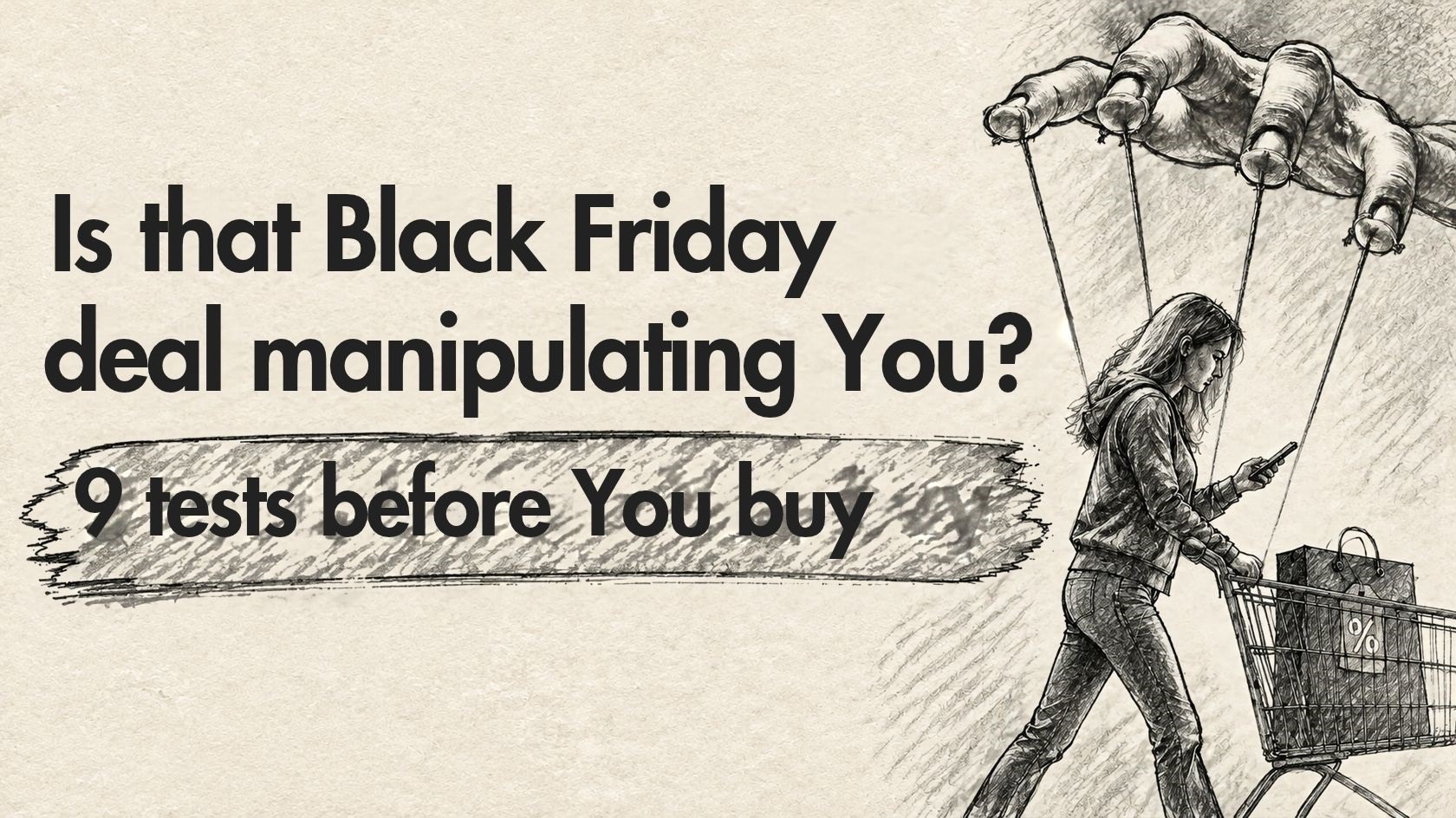
You can spend $140 you never intended to spend and leave feeling financially responsible.
That is the strange achievement of a persuasive Black Friday offer.
The checkout says you saved $86. Your bank account says you spent $140. Somewhere between those two numbers, a purchase you had not planned begins to feel like a sensible financial decision. Leaving without it starts to feel wasteful.
I want to begin in that uncomfortable little gap, because it is where the most useful question lives:
When did keeping your money start to feel like losing something?
Picture a $140 pair of boots beneath a crossed out price of $226. You had not been looking for boots. Now you are explaining to yourself that passing them up would mean throwing away an $86 saving. Yet nobody offered to put $86 into your account if you bought nothing. The saving exists inside a transaction you are still free to decline.
That does not make the boots a bad purchase. You might love them, wear them for years, and comfortably afford them. But I want the decision to begin with the boots and your life, before the discount starts writing the explanation.
A Black Friday deal may be manipulating you when misleading prices, artificial urgency, hidden commitments, or emotional pressure interfere with an informed choice. Check the actual total, the credibility of the discount, and the conditions of buying. Then remove the promotional language and ask whether the purchase still makes sense.
In this Practice Corner guide, I will walk you through nine tests you can apply to one real offer. Bring a product page, a blank note, and a willingness to let the answer be something other than the one you expected.
You do not need to become suspicious of everything. You need to be able to hear your own reasoning over the promotion.
First, distinguish a persuasive offer from a manipulative one
An attractive photograph can help you understand what you are buying. A genuine deadline can communicate useful information. A clearly explained bundle can offer good value.
I draw the line at information or design that makes your choice harder to understand or exercise: a misleading comparison price, an undisclosed recurring charge, or a refusal option that is deliberately difficult to find. The OECD’s review describes dark commercial patterns as practices that can steer, deceive, or manipulate consumers toward choices that may work against their interests.
You cannot determine a retailer’s intent from every pushy message. You can, however, decide that you will not accept an offer until its terms make sense.
There is another distinction worth keeping: the price can be good while the selling method is manipulative. A real reduction does not excuse a hidden commitment. Equally, an irritating popup does not prove that the underlying discount is fake.
The exercises below separate those questions. They are original editorial tools informed by the research, not validated assessments or guarantees of a good purchase.
Test 1: Put the money back into the sentence
The practice: Rewrite “I saved” as “I spent”
Choose the item that is making you hesitate. Write what the promotion encourages you to say:
“I am saving $86.”
Underneath it, write the complete transaction:
“I am spending $140 on one pair of boots.”
Read both sentences. Which one have you been using to justify the purchase?
I would start here because it takes less than a minute and exposes a common accounting confusion. A reduction from a reference price and a reduction in your actual spending are different things.
If you already intended to buy the same boots for $180, paying $140 could reduce that planned expense by $40. If you would otherwise buy nothing, the offer creates a $140 expense. The fact that the product is discounted does not change that comparison.
Now add a third sentence:
“If I do not buy this, the money will remain available for…”
You might name groceries, a future purchase, a trip, or simply flexibility. You do not have to assign every dollar a serious purpose. Leaving money unspent is also an available choice.
The Competition and Markets Authority’s evidence review discusses reference pricing and anchoring as influences on consumer decisions. My practical response is to write the actual payment before evaluating the advertised saving.
Try it → “I am spending ___ on ___ because ___.”
If you can only complete the final blank with “it is on sale,” move to the next test.
Test 2: Make the discount survive a plain page
The practice: Remove the crossed out price
Imagine the product on an ordinary page with a white background. No “exclusive access.” No percentage. No suggestion that somebody else is about to claim it.
The page displays the product and its current total price.
Would you still open the details?
I like this question because it allows desire to remain in the decision. You may still want the lamp because you enjoy its design. You may still want the headphones because your current pair is failing. Those are reasons you can examine without needing a dramatic discount story.
Next, check the exact product elsewhere. Match the model, size, condition, quantity, and included accessories. A new device and a refurbished device are different offers. A familiar product name does not guarantee identical specifications.
Suppose headphones are advertised as “$200 reduced to $110.” Delivery costs $10. Another credible seller offers the same model for $128 delivered.
Your saving against that alternative is $8.
The headline may be comparing against a different reference price. For your decision, I would give the available $128 alternative more weight than an unexplained $200 figure.
Credible alternative total − Offer total = Savings against that alternative.
Check price history when available, while recognising that it may omit particular sellers, coupons, or membership prices. If the advertised original price remains unverified, call it unverified. You do not need to turn uncertainty into an accusation to reduce its influence.
Test 3: Separate the deadline from the prediction
The practice: Write what the timer does not know
A timer can tell you that a stated period is ending. It cannot tell you how often you will use the product, whether it fits, or what else you will want that money for next month.
On your note, make two entries:
The information on the page: “This coupon expires tonight.”
The conclusion in my head: “I will regret this forever if I do not buy.”
These are not equivalent statements.
Research by Mathur and colleagues documented deceptive countdown timers on shopping websites, including offers that remained available after the timers expired. That is evidence that artificial urgency exists, without establishing that every deadline is dishonest.
Find out what actually expires. The product price? A coupon? A delivery guarantee? Access to a particular bundle?
If the condition is unclear, I would treat that as missing information. I would not let the shrinking numbers answer on the retailer’s behalf.
Then ask a more difficult question:
“Am I willing to miss this offer if I cannot evaluate it properly?”
Sometimes a genuine deal will disappear. I will not promise that everything comes back cheaper. This practice asks you to accept a possible missed discount as one reasonable outcome, rather than treating it as a mistake you must prevent at any cost.
Unclear deadline → Check the terms → Decide whether you have enough information.
The clock does not get to set your standard of understanding.
Test 4: Remove the extra items and calculate what changes
The practice: Build the basket you originally wanted
An offer can change the question so quietly that you barely notice.
You begin with “Should I buy this moisturiser?” and end with “Which three products should I add to unlock the best value?” The first decision has slipped into the background. You are now optimising a larger purchase.
I would open the basket and remove every item added to unlock a reward. Write down the total, including delivery. Then restore the promotional version and compare the totals.
Table 1. What the promotion costs in three hypothetical baskets

In the final example, the unit price genuinely falls from $15 to $12. The total amount spent also rises. Both can matter.
If the extras replace purchases you would otherwise make, the bundle may work. Check whether you will use them, store them comfortably, and finish anything perishable in time.
If you selected them only to make an annoying delivery charge disappear, compare that relief with the additional expense.
My question here is simple: “What am I paying to feel that I got something free?”
A clear answer does not automatically mean decline. It means you can choose with the arithmetic in view.
Test 5: Ask the product to fit your actual Tuesday
The practice: Give the purchase a real appointment
I want you to imagine the product after the excitement has become ordinary.
It is Tuesday. The packaging is gone. Nobody is watching you use it. Your schedule, home, energy, and responsibilities are roughly as they are now.
Where does the purchase belong?
For a reading lamp, you might write: “Beside the sofa, while I read after dinner.” For a coat: “On the walk to work.” For an online course: “Saturday morning, replacing an activity I am willing to give up.”
If the answer requires an entirely different life, slow down.
A camera may be wonderful, but owning it does not create weekends you have already committed elsewhere. A planner can hold a schedule; it cannot create room in one. A skincare set cannot guarantee the confidence suggested by its campaign.
Research on impulse buying considers motives, resources, marketing stimuli, and emotional processes together. I find that broader perspective more useful than treating every spontaneous purchase as a personal failure. It leaves room to examine what the object represents as well as what it does.
Write:
“I expect this product to help me do…”
“I hope this product will make me feel…”
Pleasure is allowed in both answers. A beautiful object does not need to solve a problem to be worth choosing. I simply want its promised role to be one it can plausibly fulfil.
Test 6: Translate the emotional pressure before answering it
The practice: Rewrite the popup in your own words
Some promotions make refusing sound like a confession.
“Yes, I deserve to feel good.”
“No, I will keep putting myself last.”
That is a strangely intimate judgment for a company trying to sell a candle.
I would not answer the question as written. I would translate it into: “Do I want this candle, at this price, under these conditions?”
Now the choice is easier to recognise.
The literature on dark patterns discusses emotionally loaded refusal wording, often called confirmshaming. Experimental research also shows that some interface tactics can change purchasing or enrollment decisions, although their effects differ across tactics and contexts.
You do not need to disprove the emotional claim before closing the popup. Your need for care can be real while the product remains optional.
Table 2. Translate pressure into a usable question

These are illustrative phrases, not proof that any particular advertisement is unlawful.
Choose one sentence to keep in your note:
“I can care about myself and leave this offer unanswered.”
I prefer that to arguing with every message. You are allowed to stop participating in a conversation the retailer has written entirely for you.
Test 7: Give popularity a smaller job
The practice: Ask what the crowd can establish
Suppose a product page says that thirty people are viewing the item.
For a moment, assume the number is accurate. What does it prove?
It may tell you something about attention. It does not tell you whether the chair will fit your room, whether the trousers will fit your body, or whether the course includes the material you need.
Mathur and colleagues documented fabricated activity messages on some shopping websites. Authenticity is therefore a legitimate concern. But I would also challenge the relevance of a message even when it is genuine.
Write one personal requirement that popularity cannot answer. Then find evidence about that requirement.
For reviews, look beyond enthusiasm. Search for the exact model, length of ownership, practical limitations, and repeated concerns across different sources. A detailed middling review may be more useful than an excited rating that explains nothing.
The FTC’s 2024 announcement of its review rule addressed specified deceptive practices, including fake reviews and certain undisclosed insider testimonials. That supports checking the circumstances behind recommendations, rather than assuming all praise represents independent experience.
Popularity → A reason to investigate.
Relevant evidence → A reason to decide.
I would give the second much more authority over the purchase.
Test 8: Read the future payment before the first payment
The practice: Reconstruct the whole agreement
An introductory price can make a continuing commitment look like a small purchase.
Before paying, write down what happens today and what happens afterward. For a subscription, that means the initial charge, renewal amount, renewal date, and cancellation process.
For a physical product, check quantities, optional protection, delivery choices, and anything that appeared in your basket without a deliberate selection.
The FTC’s dark patterns report describes hidden costs, unwanted cart additions, and barriers to cancellation. These examples are why I would inspect the final agreement independently of the advertisement that brought you there.
If installment payments are offered, put the full amount first. Four payments of $35 mean a $140 commitment before any applicable additional charges.
Then put the due dates beside your existing obligations. Another payment can look small when it is displayed alone.
The CFPB’s 2022 market report describes both benefits and risks of buy now, pay later arrangements, including convenience and potential borrower overextension. The presence of a payment option does not settle whether it suits your circumstances.
I would finish this test with: “I understand the amount, the timing, and what continues unless I act.”
If you cannot honestly write that, there is still something to clarify.
Test 9: Practise declining before you decide to buy
The practice: Write the ending in advance
Here is the test I would save for an offer that has become unusually difficult to leave.
Write this sentence:
“I did not buy it, and the consequence was…”
Be specific. Perhaps you will keep using a device with a cracked screen. Perhaps you will need a different birthday gift. Perhaps the consequence is simply that you will not own a particular jumper.
Some consequences matter. If an essential appliance has failed, waiting carries a real inconvenience. This exercise should not dismiss that.
But you may discover that the frightening consequence is mostly emotional: feeling that somebody else got a better bargain, or having to tolerate an unfinished decision.
Now write the other ending:
“I bought it, and next month I will…”
Include the practical reality. You will use it, store it, pay for it, maintain it, or make time for it.
I want both outcomes to become concrete enough to compare. An imagined purchase can otherwise contain all the excitement of buying and very little of the experience of owning.
Close the product page and read the two endings somewhere else. If buying still makes sense, you have a reason that survives leaving the sales environment. If it does not, you have learned something without needing to complete the transaction.
The mindful shopping workbook, FREE PDF
Bring Your answers together before reopening the offer
You do not need to perform nine exercises every time you buy a familiar household item. I would use the full process for a purchase that feels pressured, expensive, confusing, or unexpectedly personal.
For smaller decisions, the following note may be enough.
Table 3. Your Black Friday decision note

Do not turn the table into a score. Several reassuring answers cannot cancel out a hidden cost you still do not understand.
I would rather see one clear unresolved question than a row of optimistic guesses. “I do not know the renewal amount” is useful information. It tells you exactly why the purchase is not ready.
What to do when the urge stays strong
Sometimes the practical checks are complete and the urge still feels louder than the answers. That does not mean the exercises failed.
Try taking the product out of your immediate view and doing something unrelated before deciding. You can choose a brief pause or revisit it another day, depending on the cost, importance, and available time.
I would not present twenty four hours as a scientifically established threshold. There is no universal waiting period that guarantees a sensible purchase.
During the pause, avoid replacing one promotion with an hour of enthusiastic product videos. That may keep you surrounded by the same reasons to buy.
When you return, ask: “What information changed?” If nothing changed except that you are tired of thinking about it, recognise that. Relief from deciding is different from a new reason to own the item.
You can also make a reasonable purchase without proving that it is the cheapest possible offer. Careful shopping should not become an endless assignment that consumes the evening you hoped to enjoy.
If you already bought it, make the next step practical
I would begin with the order confirmation rather than a verdict about your self control.
Check whether cancellation or return is available, along with the deadlines, conditions, and charges. These vary by seller, product, and location. Keep relevant records, especially for subscriptions or disputed amounts.
If something differs from what you understood, contact the seller with the specific discrepancy and supporting information. Depending on the issue, your payment provider or local consumer protection service may be an appropriate next contact.
After the practical step, write one sentence describing what happened:
“I added products to avoid delivery costs.”
“I did not notice the renewal terms.”
“I treated a possible missed discount as an emergency.”
Each sentence points toward a change you can make. A broad insult about being bad with money gives you much less to work with.
Pick one adjustment for the next purchase. I would keep it small enough to repeat: compare basket totals, record the full commitment, or leave the page before answering a guilt based message.
You do not have to turn one regretted purchase into a permanent description of yourself.
Let the offer end without deciding what you are worth
Return to those boots from the beginning.
They may still be a lovely purchase. You may have checked the fit, compared the total, and decided that $140 is money you are happy to spend. If so, the discount has helped you make a purchase you can explain.
Or you may realise that you never particularly wanted the boots. You wanted to avoid feeling foolish for missing the saving.
I want you to have room to notice that difference before money changes hands.
Your ability to walk away does not make you ungrateful for a discount. Taking time does not mean you lack confidence. Declining a product promoted as self care does not say anything final about how well you care for yourself.
A retailer can put an expiry date on an offer. It cannot put one on your right to understand what you are agreeing to.
The next time a checkout congratulates you on how much you saved, pause long enough to ask what you chose.
You do not have to buy the bargain to prove you recognised it.
Related posts You’ll love
- Self-love became a marketplace: Why You feel worse after buying “healing” (and what that says about the system, not You)
- Doom spending: The psychology behind buying things when You’re anxious, and how to break the cycle without shame
- How cozy gaming became a powerful comfort ritual for Women who never called themselves gamers
- 7 quiet social practices for Women who want company but not conversation (FREE PDF)
- Why meaningless pleasure feels so radical for Women: The quiet power of joy that does not need to be useful
- Words of power for Women with creative hunger They keep delaying: 33 affirmations to finally begin before You feel ready
FAQ
-
How can I tell if a Black Friday deal is manipulating me?
Check whether urgency, unclear prices, emotional pressure, or hidden commitments are interfering with your ability to understand the purchase. Compare the exact product’s full cost with credible alternatives and examine the terms. A warning sign warrants checking; it does not establish a retailer’s intent by itself.
-
Can a genuine discount still be manipulative?
Yes. The reduction can be real while the selling process conceals information or pressures you into a larger commitment. Evaluate the price, the terms, and the presentation separately. A good answer to one of those questions does not automatically resolve the others.
-
How do I check whether the original price is credible?
Look for an explanation of the comparison price, available price history, and current offers for the exact product. Historical records may be incomplete. If the original price remains uncertain, judge the present total against realistic alternatives instead of relying on the advertised percentage.
-
Are all countdown timers fake?
No. Some communicate genuine deadlines. Be more cautious when the timer’s meaning is unclear or the same offer continues after it expires. You can decline an uncertain offer without proving the countdown is deceptive. A real deadline also does not establish that the purchase suits you.
-
Is free shipping worth adding something to my basket?
Compare the complete totals. If adding a $16 item removes a $6 delivery charge, you spend $10 more overall. That may be worthwhile if you want the item independently. It is not automatically a saving merely because delivery becomes free.
-
Should I wait twenty four hours before buying?
You can adopt that as a personal rule for optional purchases, but it is not a universal scientific threshold. Match the pause to the expense and uncertainty. The useful part is having room to check the decision outside the immediate promotion.
-
Does buy now, pay later make the product cheaper?
Splitting payments does not itself lower the price. Check the whole amount, payment dates, and applicable charges. An installment arrangement changes when money is due, while the purchase remains a commitment. Consider it alongside obligations you already have.
-
Is buying something for emotional reasons always a mistake?
No. Enjoyment, beauty, comfort, and celebration can be valid reasons to buy. The useful question is whether the item can reasonably provide what you expect and whether you accept the cost. A purchase does not need to be essential to be deliberate.
-
How can I assess influencer recommendations?
Look for relevant commercial disclosures, specific product knowledge, limitations, and independent evidence. A sponsorship does not automatically make an opinion false. Equally, enthusiasm does not prove that the product fits your needs. Check the requirement that matters to you.
-
What should I do after a purchase I regret?
Review cancellation or return options promptly, including conditions and costs. Keep relevant records and address unclear charges with the seller. Then identify one specific feature of the decision you would handle differently. A repeatable change is more useful than continuing to blame yourself.
-
What is the simplest question to ask before checkout?
Ask: “Would I choose this exact item at this complete price if the promotional language disappeared?” Then check for any continuing commitment. This question does not guarantee a good outcome, but it helps you evaluate the purchase rather than the feeling of winning a deal.
Sources and inspirations
- Competition and Markets Authority. (2022, April 5). Evidence review of online choice architecture and consumer and competition harm. GOV.UK
- Consumer Financial Protection Bureau. (2022, September 15). Buy now, pay later: Market trends and consumer impacts.
- Federal Trade Commission. (2022, September). Bringing dark patterns to light.
- Federal Trade Commission. (2024, August 14). Federal Trade Commission announces final rule banning fake reviews and testimonials.
- Iyer, G. R., Blut, M., Xiao, S. H., & Grewal, D. (2020). Impulse buying: A meta-analytic review. Journal of the Academy of Marketing Science.
- Luguri, J., & Strahilevitz, L. J. (2021). Shining a light on dark patterns. Journal of Legal Analysis.
- Mathur, A., Acar, G., Friedman, M. J., Lucherini, E., Mayer, J., Chetty, M., & Narayanan, A. (2019). Dark patterns at scale: Findings from a crawl of 11K shopping websites. Proceedings of the ACM on Human-Computer Interaction, 3(CSCW).
- Organisation for Economic Co-operation and Development. (2022). Dark commercial patterns (OECD Digital Economy Papers No. 336).


Leave a Reply