Table of Contents
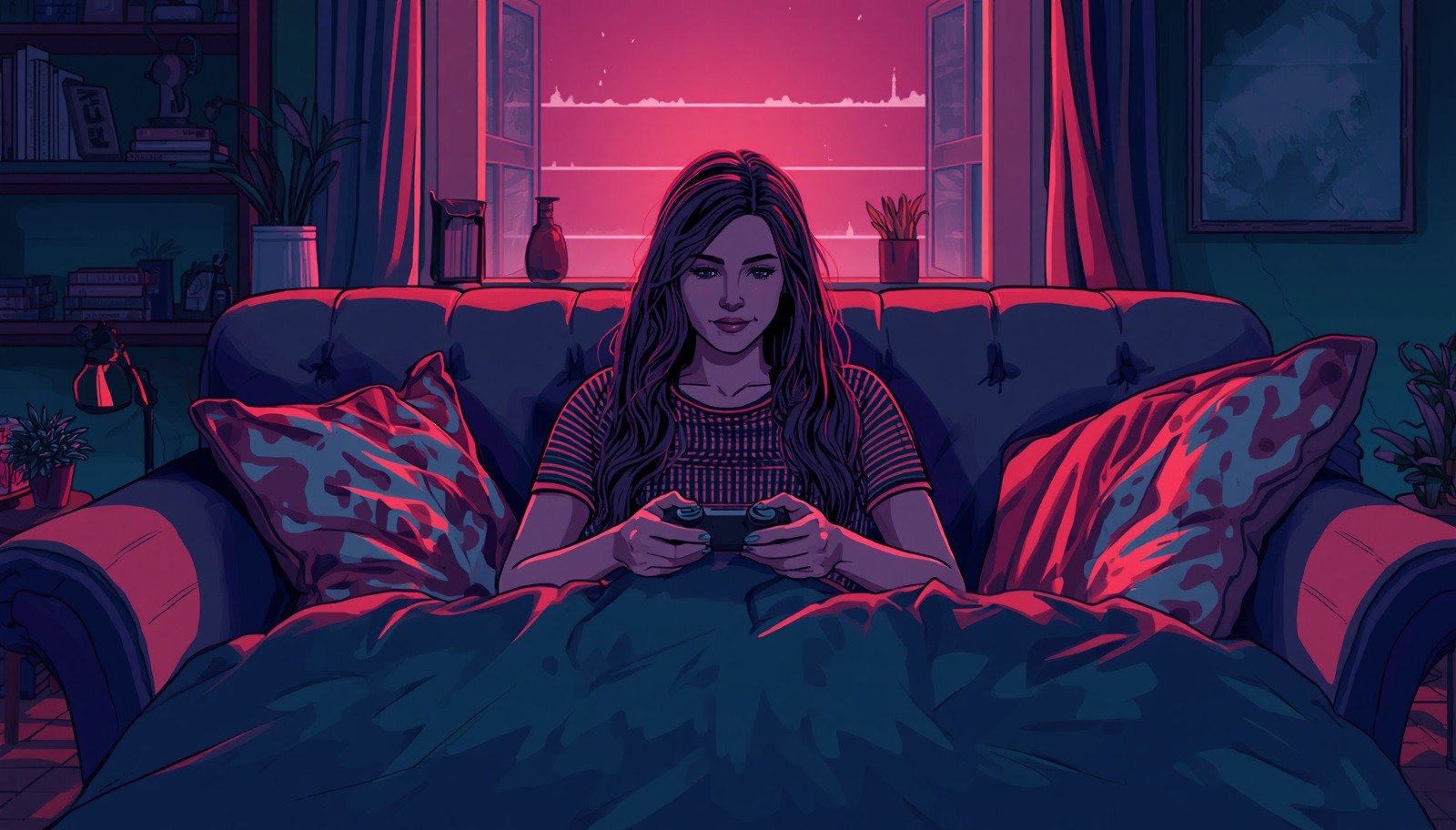
She still insists she is not a gamer.
She just checks on her crops before bed. She rearranges a tiny kitchen after a difficult meeting. She catches imaginary fish while listening to a podcast. She spends twenty minutes placing paths around a digital village, then closes the game feeling slightly more like herself.
Ask her what she played, and she may say Animal Crossing, Stardew Valley, Unpacking, The Sims, Disney Dreamlight Valley, Dorfromantik, Tiny Glade, or PowerWash Simulator. Ask whether she games, and she may laugh: “Not really.”
That contradiction tells us something important. Millions of women have not suddenly discovered play. Many have discovered a form of play that does not ask them to enter through the old cultural doorway marked GAMER—a doorway historically guarded by competition, technical expertise, expensive equipment, masculine stereotypes, and the expectation that a “real” game must be difficult enough to prove something.
Cozy gaming offers another entrance.
It asks: Would you like to make this room warmer? Grow this garden? Help this character? Restore this neglected place? Wander without being hunted? Complete one small thing in a world where completion is actually possible?
For women whose real lives may contain work, caregiving, emotional management, invisible planning, unfinished domestic tasks, social expectations, and a near-constant stream of decisions, that invitation can feel surprisingly intimate.
In short, cozy gaming became comfort for many women because it combines low-stakes agency, predictable feedback, sensory softness, manageable accomplishment, and temporary escape. It creates a world that needs attention without demanding the whole self.
That does not make cozy games therapy. It does not mean all women naturally prefer gentle games, or that every soft-looking game is relaxing. It means that a particular style of interactive play has made rest more accessible to people who never recognized themselves in traditional gaming culture.
And perhaps the most interesting part is this: cozy gaming does not always feel like escaping life. Sometimes it feels like practicing a kinder version of being alive.
What is cozy gaming, exactly?
Cozy gaming is a flexible category of video games designed—or used by players—to produce feelings such as safety, warmth, softness, familiarity, belonging, and low-pressure enjoyment. Common activities include decorating, farming, collecting, cooking, cleaning, exploring, crafting, nurturing characters, restoring environments, or building communities.
There is no universal checklist. A game does not become cozy simply because it contains pastel colors, animals, or a vegetable garden. Researchers Agata Waszkiewicz and Martyna Bakun argue that coziness can emerge from the relationship between aesthetics, mechanics, functionality, and the situation in which the game is played. In other words, cozy is partly inside the game and partly inside the experience of the person holding the controller.
A game can look adorable and still feel stressful because of strict timers, demanding resource systems, daily obligations, or punishing mistakes. Meanwhile, a game about cleaning dirty buildings or organizing furniture may feel deeply calming despite lacking the usual cottage, café, or woodland imagery.
This is why cozy gaming is better understood as an emotional design language than as one rigid genre.
Its vocabulary often includes:
- Forgiving consequences
- Familiar routines
- Gentle or adjustable pacing
- Repetition without severe punishment
- Pleasant soundscapes
- Small, visible improvements
- Player-directed goals
- Creative customization
- Care-based interactions
- Environments that become safer or more beautiful through attention
- The freedom to pause, wander, experiment, or stop
The essential question is not “Does this game contain farming?” It is “What kind of relationship does this game create between the player, the task, and time?”
Women were already playing—the “gamer” label simply did not fit
The image of the typical gamer has always been narrower than the reality of gaming.
The Entertainment Software Association’s 2026 U.S. report estimates that 212.3 million Americans play video games weekly. The population of players remains close to evenly divided by gender, with 53% identifying as male and 46% as female. The average player is now 37 years old—not the teenage boy who still dominates many cultural assumptions about gaming.
Yet participation and identity are not the same thing.
A woman may have played puzzle games on her phone for ten years, built houses in The Sims, helped her children in Minecraft, or maintained a Stardew Valley farm through several fictional winters without ever describing herself as a gamer. The label may have seemed too serious, too masculine, too competitive, or simply unrelated to the kind of play she enjoyed.
A qualitative study involving adult women gamers found that participants negotiated exactly this tension: whether to accept, reject, or qualify the “female gamer” identity. Their stories included connection, skill development, mental-health benefits, stigma, unhealthy escape, and difficult encounters with gendered gaming culture.
Cozy gaming did not solve every problem women encounter in gaming communities. What it did was reduce the importance of the old admission test.
You did not have to know the language. You did not need to prove that your game was difficult. You could begin because a friend showed you a beautiful island, because you saw someone organizing a digital house online, because your child left a console on the sofa, or because tending an imaginary garden looked more appealing than another hour of scrolling.
The activity came before the identity.

The rise of cozy gaming therefore represents more than a market trend. It exposes how limited our definition of legitimate play had become.
Why cozy games feel so comforting
Comfort is not one feeling. Sometimes it means quiet. Sometimes it means competence. Sometimes it is the relief of being somewhere that makes sense.
Cozy games can offer several kinds of comfort at once, which may explain why they become emotionally important even to women who begin playing casually.
1. They create completion inside lives full of open loops
Much of adult life does not provide clean endings.
The laundry returns. Messages regenerate. A job well done produces more work. Parenting offers few progress bars. Emotional labor is often noticed only when it is not performed. You can spend an entire day maintaining a household, relationship, team, or family and still struggle to identify one visibly finished thing.
Cozy games make progress tangible.
You collect six pieces of wood and repair a bridge. You clean one room and it stays clean. You deliver an item, receive thanks, and watch the task disappear from a list. A neglected corner becomes a garden. A dim house becomes warm.
The achievement may be fictional, but the experience of completion is real.
This does not mean women are unable to tolerate complexity. It means that finite tasks can feel restorative when ordinary responsibilities are structurally infinite. A digital room that remains organized may offer a strange but genuine relief to someone whose real environment is continuously used by other people.
The game says: You did this. It changed something. You may stop now.
2. They offer micro-agency rather than total control
“Taking control” is common self-help advice, but total control is neither realistic nor especially soothing. It can become one more impossible standard.
Cozy games offer something smaller: micro-agency.
You choose which path to take. You decide whether the virtual sofa belongs beside the window. You can plant pumpkins instead of tomatoes, ignore a quest, change your character’s clothes, or spend the entire session collecting shells.
These choices are meaningful enough to create participation but usually safe enough not to create serious fear. This balance matters. Too little agency feels passive; too much responsibility can reproduce the pressure the player was trying to leave.
A 2025 survey of 277 cozy-game players identified agency, safe escapism, narrative interest, moral reflection, social motives, and emotionally meaningful experiences among the reasons people were drawn to these games.
I think of this as the small kingdom effect: for a little while, you are responsible for a world small enough to respond to you.
Not the entire future. Not everyone’s feelings. Just this path, this lamp, this cup of digital coffee.
3. They turn rest into an active experience
When people are exhausted, they often reach for the easiest available form of relief: scrolling, watching, refreshing, or letting an algorithm choose the next piece of content.
Passive media can be enjoyable. But it can also leave attention half-occupied and half-exposed. You are resting, yet still available to bad news, comparison, advertising, messages, and novelty.
A game creates a boundary around attention.
Your hands are doing something. Your eyes are following a contained environment. The activity asks enough of you to interrupt rumination without necessarily overwhelming you with new demands.
Research comparing a digital puzzle game, a mindfulness app, and a nonmedia activity found that the game could support post-work recovery, although results varied between the laboratory and real-world portions of the study. Enjoyment, personal preference, routine, and scheduling appeared important—not merely the fact that a screen was involved.
More recent research involving employees also suggests that evening gaming may support next-morning recovery through psychological detachment and feelings of mastery. Importantly, benefits were stronger when gaming reflected harmonious enjoyment rather than obsessive involvement.
Cozy gaming can therefore occupy an unusual space between activity and rest. You are not doing nothing, but you are temporarily released from the demands that usually define doing something.
4. They provide care without the full cost of caregiving
Many cozy games are built around care. You feed animals, remember birthdays, prepare meals, repair homes, revive landscapes, or help fictional neighbors.
At first, this sounds like a digital copy of the responsibilities many women already carry. Why would more care feel restful?
Because the emotional structure is different.
Real caregiving is ambiguous. People may reject help, misunderstand it, require more than you can give, or fail to recognize what you have done. The consequences can be serious, and the responsibility rarely pauses neatly.
Care inside a cozy game is usually more legible. The flower grows. The animal responds. The character accepts the gift. The polluted space becomes green. Effort is translated into visible change.
This is not necessarily an escape from caring. It can be an escape from uncertain care.
Waszkiewicz and Tymińska describe cozy games through the politics and ethics of care, exploring how games centered on gentleness, maintenance, and connection can resist cultural systems that treat competition and domination as more valuable forms of action.
The fantasy is not always “Nobody needs me.” Sometimes it is “What I give is enough, and I can see where it went.”
5. They create companionship without social exposure
A cozy game can make a room feel inhabited without requiring a woman to perform sociability.
There may be familiar characters, ambient conversation, letters, shopkeepers, neighbors, animals, or other players’ creations. Yet there is no need to dress, travel, answer immediately, explain your mood, maintain eye contact, or produce the correct emotional energy.
This can be valuable after a socially saturated day. A person may feel lonely and unavailable at the same time—wanting the atmosphere of company without the obligations of interaction.
Researchers have described cozy games such as Stardew Valley, Coffee Talk Episode 2, and Kinder World as potential digital “third places”: environments that sit emotionally between private home and formal public life, offering familiarity and a sense of social presence.
The relationship is limited, of course. A fictional village cannot replace reciprocal human connection. But emotional comfort does not become meaningless simply because it is mediated.
Sometimes a familiar game character saying, “It’s good to see you,” reaches the part of us that does not have the energy for a real conversation.
6. They make repetition feel safe rather than stagnant
Repetition has a poor reputation in a culture obsessed with optimization. We are encouraged to seek novelty, growth, transformation, and measurable improvement.
But the nervous system often appreciates what the internet economy does not: familiarity.
The same path. The same musical cue. The same shop opening. The same small ritual at the beginning of each in-game day.
Predictability reduces the amount of information that must be evaluated. The player knows what matters, where to go, and what kind of event is likely to happen next. Even when surprises occur, they usually arrive inside a recognizable structure.

Repetition in cozy games is not automatically healthy. Daily streaks, real-time events, and endless maintenance can become another source of pressure. But when repetition remains chosen, it can work like a familiar song or a reread novel: not exciting because it is unknown, but comforting because it is known.
What does the science actually say?
There is promising evidence that some forms of gaming can support stress reduction, psychological detachment, positive mood, and recovery. But the evidence does not justify describing cozy games as a universal mental-health treatment.
In one study, 80 undergraduate students either played the casual game Flower or completed a mindfulness body-scan exercise for 20 minutes. Both groups showed reductions across psychological and physiological stress measures. Mindfulness had a slight advantage for self-perceived stress, while the game produced similar reductions across physiological measures.
A much larger natural experiment used Japanese game-console lotteries to examine the relationship between console ownership, gaming, and mental well-being. Researchers found that console ownership and increased play improved life satisfaction and reduced psychological distress on average, although effects varied between people and console types.
Other large-scale research has found little evidence that the amount of time spent playing, by itself, causes meaningful changes in well-being. Motivation and the quality of the playing experience may matter more than raw hours.
This distinction is essential.
The question is not simply:
How many minutes did you play?
Better questions are:
- Did you choose to play, or feel compelled to?
- Did the game provide enjoyment or increase pressure?
- Did it help you detach from work?
- Did you feel calmer, more capable, or more connected afterward?
- Did playing support sleep and daily life—or displace them?
- Was it affordable, or designed to provoke uncontrolled spending?
- Could you stop when you intended to?
Cozy games do not insert calm into every player like a medication. Comfort emerges from the fit between a person, a game, a moment, and a need.
The five forms of comfort hidden inside cozy gaming
A woman may say, “This game relaxes me,” but relaxation can conceal several more precise experiences.
Containment
The world has borders. The rules are understandable. Problems arrive in recognizable forms. This may be especially soothing after exposure to news, social media, workplace conflict, or emotionally unpredictable relationships.
Competence
The game offers tasks that can be learned. Improvement appears through smoother movement, a better-designed home, a completed collection, or a restored environment.
Competence here does not have to be public. There may be no leaderboard, manager, audience, or person waiting to judge whether the result is impressive enough.
Companionship
The world feels populated. Characters remember you. Music and environmental sound create presence. You are alone, but not necessarily in emotional emptiness.
Creative permission
Many adults stop making things unless the result is useful, sellable, shareable, or good enough to display. Cozy games provide a low-risk place to experiment with color, arrangement, clothing, architecture, and identity.
Nothing has to become content.
Temporal mercy
You can spend fifteen minutes on an unnecessary task. You can wander. You can choose an inefficient route because it is prettier.
In a productivity-centered culture, this may be the most radical comfort of all: time that is not required to justify itself.
Why this comfort resonates with Women—without reducing Women to a stereotype
It would be lazy to conclude that women enjoy cozy games because women are naturally gentle, domestic, or less competitive.
Women play every kind of game. Many love horror, shooters, strategy games, difficult role-playing games, and competitive multiplayer experiences. Men and nonbinary players also find profound comfort in cozy games.
The more convincing explanation is cultural rather than biological.
For years, activities coded as masculine—competition, conquest, technical mastery—were treated as the serious center of gaming. Activities associated with domesticity, decorating, relationships, emotional storytelling, fashion, care, and everyday maintenance were more likely to be described as casual, childish, or not “real gaming.”
Cozy games did not invent women’s interest in play. They gave greater cultural visibility to forms of play that had often been devalued.
They also arrived at a moment when many women were tired of turning every free hour into another self-improvement project. A cozy game could be engaging without becoming a side business, exercise plan, beauty routine, healing assignment, or public identity.
You could simply enjoy it.
That simplicity should not be underestimated.
When a cozy game does not feel cozy
The label “cozy” is not a guarantee.
A farming game may create anxiety through short in-game days. A life simulation may trigger perfectionism. A decorating game may offer so many choices that it worsens decision fatigue. A mobile game may use attractive visuals while building its entire economy around waiting, scarcity, advertising, and microtransactions.
Even an apparently peaceful game can become a second shift:
- Every crop must be optimized.
- Every character must receive the perfect gift.
- Every collection must be completed.
- Every room must look good enough to share.
- Every event must be attended before it disappears.
At that point, the player may no longer be inhabiting a comforting world. She may be managing another system that is never satisfied.
The farm should not become another woman you are afraid of disappointing.
Real coziness depends less on the game’s advertising and more on what happens inside you while playing.
Choosing a cozy game for Your emotional weather
The most popular game is not automatically the right one. Start with the feeling you need, not the title everyone else recommends.

No game is universally calming. Stardew Valley can feel like a warm home to one player and a time-management emergency to another. Unpacking may feel satisfying to someone craving order and emotionally heavy to someone navigating a move or breakup.
Your response is not a review of the game’s quality. It is information about the fit.
How to begin cozy gaming when You have never felt like a gamer
Choose the feeling before the platform
Do not begin by asking which console you should buy. Ask what you want the experience to provide.
Do you want quiet, companionship, creativity, order, discovery, nostalgia, or a sense of completion? Once the emotional goal is clearer, it becomes easier to select both a game and a device.
Use the device with the least friction
A handheld console can make gaming feel like reading on the sofa. A laptop may work if you already own one. A phone is accessible, although mobile games require extra attention to advertising, subscriptions, timers, and in-app spending.
You do not need an elaborate setup to qualify.
Change the settings
Turn combat off if the game allows it. Use relaxed mode. Increase text size. Lower the music. Slow the camera. Look for accessibility options, difficulty settings, and community-created modifications where appropriate.
The default setting is not a moral challenge.
A game is a designed object. You are allowed to adjust that object until it serves the experience you want.
Stop before comfort becomes depletion
One more in-game day can easily become five. Try ending while the experience still feels pleasant rather than waiting until you are exhausted, irritated, or ashamed of the time.
A useful stopping ritual might be:
- Finish one small task.
- Save the game.
- Notice how your body feels.
- Decide intentionally whether to continue.
This creates a choice point between enjoyment and automatic continuation.
Refuse skill shame
You may forget which button opens the inventory. You may walk into walls. You may need to search for an answer. None of this means games are not for you.
Gaming literacy is learned through exposure, just like the conventions of cooking, fitness, fashion, or social media. Experienced players often forget how many invisible rules they have absorbed.
Being new is not evidence that you do not belong.
My before–during–after cozy game test
When I evaluate whether a game is genuinely comforting for a particular person, I do not focus only on the artwork or genre label. I use three checkpoints.
Before: What am I seeking from this session?
If the answer is “I want twenty minutes of quiet,” that intention creates a different relationship with the game than “I cannot bear to feel anything tonight.”
During: What is the game asking me to become?
Am I curious, absorbed, playful, and gently focused? Or am I becoming hurried, perfectionistic, financially impulsive, or afraid of missing an event?
After: What does the game return me to?
Do I feel softer, clearer, and more willing to re-enter my life? Or do I feel agitated, numb, guilty, sleep-deprived, and unable to stop?
The after-feeling is often more revealing than the game’s description.
Comfort or avoidance? The difference is what happens next
Escapism is not automatically unhealthy. Humans have always entered stories, music, art, gardens, rituals, and imaginary worlds to gain temporary distance from reality.
Distance can create perspective. It can interrupt rumination. It can give depleted attention somewhere safer to land.
The problem begins when escape consistently makes life smaller rather than more manageable.
Cozy gaming is more likely to function as supportive comfort when:
- You choose it intentionally.
- You can stop without intense distress.
- It does not repeatedly damage sleep.
- Spending remains planned and affordable.
- Responsibilities are postponed occasionally rather than chronically abandoned.
- You feel more available to life afterward.
- The game is one source of comfort among several.
It may be becoming less supportive when:
- You regularly sacrifice sleep, work, meals, hygiene, or relationships.
- You hide the amount of time or money involved.
- Missing a daily event creates disproportionate anxiety.
- Playing no longer feels pleasurable but still feels compulsory.
- The game is the only environment in which you feel safe or capable.
- You use it continually to avoid a problem that is becoming more serious.
A game can be meaningful support, but it cannot negotiate a harmful relationship, treat depression, change unsafe working conditions, or replace professional care. If distress is persistent or daily functioning is deteriorating, gaming can remain part of a comfort plan—but it should not have to carry the entire plan.
The quiet cultural power of cozy gaming
Cozy gaming makes an unusual proposal: perhaps a meaningful game does not need a world to save.
Perhaps arranging a bedroom can matter. Perhaps maintenance can be a form of action. Perhaps kindness can be a mechanic rather than a decorative message. Perhaps an experience does not become trivial because its stakes are small.
For women, this can carry a deeper form of permission.
You may participate without performing expertise. You may enjoy softness without defending it. You may pursue pleasure that is not educational, profitable, physically transformative, or socially impressive. You may care for a fictional world without becoming permanently responsible for it.
And you may call yourself a gamer—or never use the word at all.
The comfort remains yours.
A small world that answers back
Cozy gaming became comfort for women who never called themselves gamers because it arrived without demanding a new identity first.
It offered a chair by a digital fire. A garden that responded to care. A task with an ending. A village that remembered you. A room that stayed arranged. A form of solitude that did not feel empty.
The appeal is not that these worlds are perfect. It is that they are responsive.
In real life, effort and outcome are often painfully disconnected. You can care deeply and still fail to fix what hurts. You can work all day and see no finish line. You can give people love and receive ambiguity in return.
Then, for half an hour, you enter a world where a seed becomes a flower because you watered it.
That may be fictional.
The relief is not.
Related posts You’ll love
- How silent reading clubs reveal a new kind of female social need: Quiet belonging without performance
- Why meaningless pleasure feels so radical for Women: The quiet power of joy that does not need to be useful
- Why Women need hobbies that don’t turn into content or income
- Words of power for Women with creative hunger They keep delaying: 33 affirmations to finally begin before You feel ready
- When a personal obsession helps You heal: 8 reflective exercises for emotional healing and self-discovery, FREE PDF
- The “I don’t know who I am” phase is often a growth signal: How identity fog can become Your calm, quiet rebuild
FAQ
-
What is cozy gaming?
Cozy gaming is a style of video-game play centered on comfort, low-pressure interaction, familiarity, creativity, care, or gentle exploration. Cozy games often include decorating, farming, collecting, cleaning, cooking, building, or forming relationships.
The category is subjective. A game is cozy when its mechanics, atmosphere, pacing, and playing context create a comforting experience for that particular player. -
Why are cozy games so popular with women?
Cozy games remove many barriers associated with traditional gaming culture, including high difficulty, aggressive competition, technical gatekeeping, and pressure to prove expertise. They also provide flexible play, creativity, manageable goals, and emotional connection.
This does not mean women are biologically inclined toward gentle games. Their popularity reflects broader access to games and growing recognition of play styles that were historically dismissed as casual or feminine. -
Do I have to call myself a gamer if I play cozy games?
No. “Gamer” is an optional identity, not a qualification you must accept before enjoying a game.
If you play a video game, you are participating in gaming. Whether you incorporate that activity into your identity is entirely personal. -
Can cozy games help with anxiety?
A cozy game may temporarily reduce anxious rumination by giving attention a structured, predictable, and engaging task. Familiar routines and forgiving mechanics can also feel safer than highly competitive or unpredictable games.
However, cozy games are not a treatment for an anxiety disorder. If anxiety is persistent, severe, or interfering with daily life, consider seeking professional support. -
Can playing cozy games reduce stress?
Some studies suggest that casual gaming can support stress reduction and post-work recovery. The effect depends on personal preference, motivation, game design, session length, and whether the player feels able to stop.
A game that comforts one person may frustrate another, so your physical and emotional response is more useful than the game’s “cozy” label. -
What are the best cozy games for complete beginners?
Beginner-friendly possibilities include Animal Crossing: New Horizons, Unpacking, A Short Hike, Townscaper, Dorfromantik, Tiny Glade, and Disney Dreamlight Valley.
The best choice depends on whether you prefer decorating, stories, collecting, exploration, puzzles, or repetitive tasks. Check platform availability, accessibility settings, and gameplay videos before buying. -
Is Animal Crossing a cozy game?
Yes. Animal Crossing is widely considered a defining example of cozy gaming because it combines gentle routines, collecting, decorating, familiar characters, and low-stakes community building.
Its real-time clock and limited-time events can nevertheless create pressure for some players. You do not have to complete every collection or play every day. -
Is Stardew Valley actually relaxing?
It can be, but not for everyone. Some players find farming, exploration, relationships, and gradual improvement deeply soothing. Others experience the short in-game days and numerous possible tasks as stressful.
Playing without optimization goals—and accepting that you cannot do everything in one day—usually produces a calmer experience. -
Are cozy games only farming simulators?
No. Cozy games can involve decorating, cleaning, puzzles, exploration, cooking, storytelling, photography, building, collecting, or running a small shop.
Examples outside traditional farming include Unpacking, PowerWash Simulator, Coffee Talk, A Little to the Left, Tiny Glade, and Townscaper. -
Can cozy gaming become unhealthy?
Yes. Any pleasurable activity can become unbalanced if it repeatedly interferes with sleep, work, relationships, finances, physical needs, or emotional functioning.
The central issue is not simply the number of hours played. Look at control, motivation, consequences, spending, and whether gaming supports or gradually replaces the rest of your life. -
How do I choose a cozy game for my emotional needs?
Begin by naming the experience you want: quiet, order, companionship, creativity, control, meaningful storytelling, or uncomplicated completion.
Then watch unedited gameplay rather than relying only on trailers. Pay attention to timers, combat, dialogue, resource systems, microtransactions, and difficulty settings. Choose according to how the game feels—not how popular it is.
Sources and inspirations
- Collins, E., Cox, A., Wilcock, C., & Sethu-Jones, G. (2019). Digital games and mindfulness apps: Comparison of effects on post work recovery. JMIR Mental Health.
- Daneels, R., & Maes, K. (2025). Curled up with a good game: A survey study on personality traits and game motives of cozy game players. Eludamos: Journal for Computer Game Culture.
- Desai, V., Gupta, A., Andersen, L., Ronnestrand, B., & Wong, M. (2021). Stress-reducing effects of playing a casual video game among undergraduate students. Trends in Psychology.
- Egami, H., Rahman, M. S., Yamamoto, T., Egami, C., & Wakabayashi, T. (2024). Causal effect of video gaming on mental well-being in Japan 2020–2022. Nature Human Behaviour.
- Entertainment Software Association. (2026). 2026 essential facts about the U.S. video game industry.
- Gunderman, H. C. (2024). Cosy video games as digital third places for emotional well-being: Case studies of Stardew Valley, Coffee Talk Episode 2 and Kinder World. Journal of Gaming & Virtual Worlds.
- Koçak, Ö. E., Gorgievski, M., & Bakker, A. B. (2024). Recovery from work by playing video games. Applied Psychology.
- Kuss, D. J., Kristensen, A. M., Williams, A. J., & Lopez-Fernandez, O. (2022). To be or not to be a female gamer: A qualitative exploration of female gamer identity. International Journal of Environmental Research and Public Health.
- Vuorre, M., Johannes, N., Magnusson, K., & Przybylski, A. K. (2022). Time spent playing video games is unlikely to impact well-being. Royal Society Open Science.
- Waszkiewicz, A., & Bakun, M. (2020). Towards the aesthetics of cozy video games. Journal of Gaming & Virtual Worlds.
- Waszkiewicz, A., & Tymińska, M. (2024). Cozy games and resistance through care. Replay: The Polish Journal of Game Studies.




Leave a Reply