
Table of Contents
The strange pressure to make every beautiful thing useful
A woman takes up pottery, and someone says, “You should sell those.”
She starts baking again, and someone says, “You should make a TikTok.”
She learns calligraphy, and someone says, “You could open an Etsy shop.”
She gardens, paints, sews, reads, dances, restores old furniture, learns photography, decorates cakes, makes jewelry, or starts walking at sunrise — and almost immediately, the world tries to convert her pleasure into proof.
Proof that she is talented.
Proof that she is disciplined.
Proof that she is building something.
Proof that she is not “wasting time.”
Proof that her joy can justify itself through content, attention, usefulness, or money.
But here is a sentence many women need to hear as words of power:
You are allowed to do something beautiful without turning it into a performance.
Not every interest has to become a brand. Not every skill has to become a service. Not every private joy has to be photographed, packaged, explained, monetized, optimized, or made searchable.
This matters because hobbies are not just cute extras in a woman’s life. They are psychological territory. They are where the self gets to exist without being evaluated. They are where the nervous system learns, “I can do something because I want to, not because I owe the world a result.” Research on self-determination theory emphasizes that human well-being is strongly connected to autonomy, competence, and relatedness — the feeling that we have choice, can grow, and can connect meaningfully. A hobby can feed all three. But when a hobby becomes content or income too quickly, autonomy often becomes strategy, competence becomes comparison, and relatedness becomes audience management.
That is the hidden loss.
The hobby does not simply become “productive.”
It becomes watched.
And many women are already watched enough.
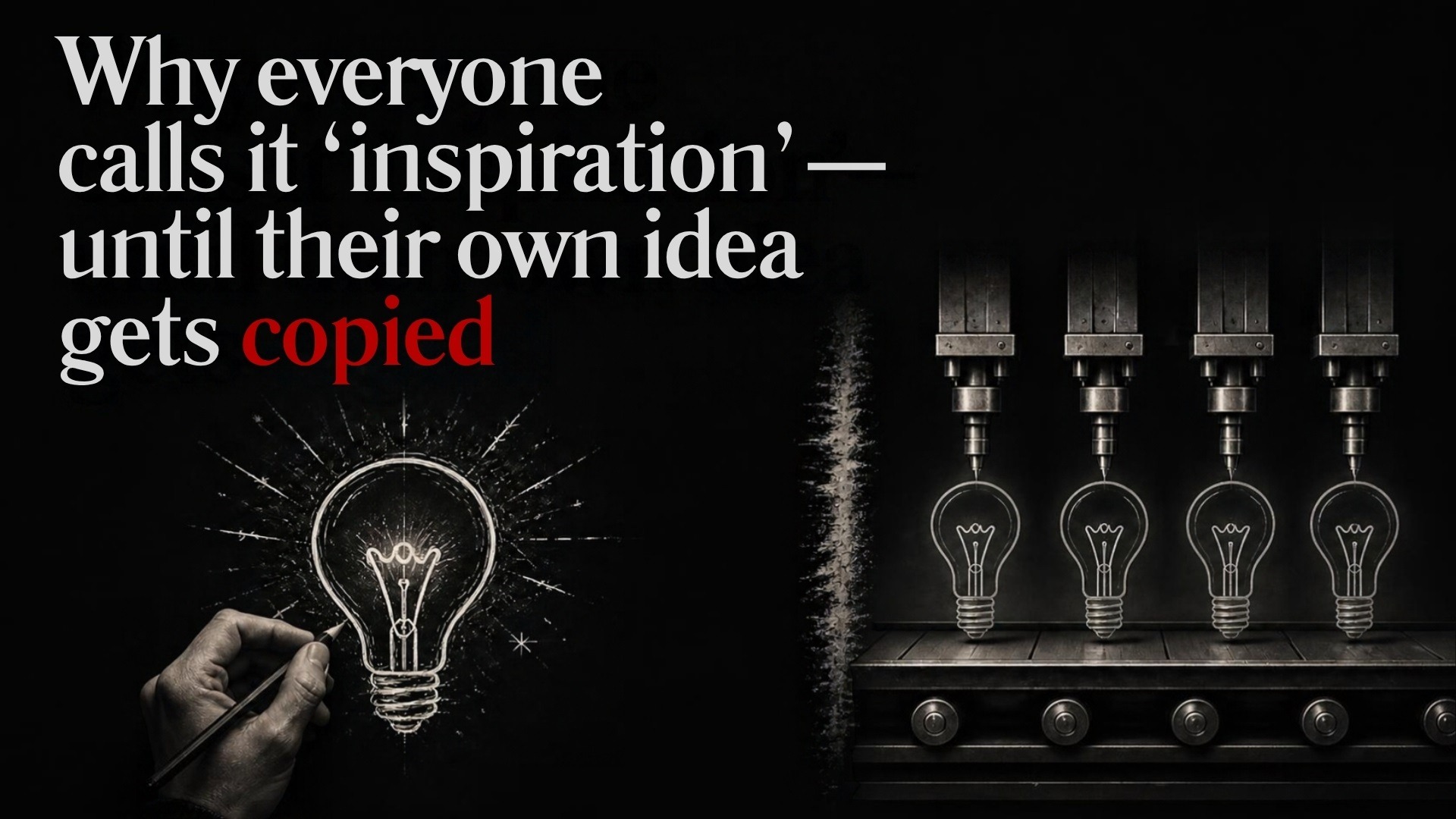
The hobby-to-content pipeline
There is a modern pipeline that looks innocent from the outside:
interest → skill → compliment → content → consistency → audience → monetization → pressure → burnout
At first, it feels exciting. Someone notices your work. Someone says you have an eye. Someone asks where you bought it. Someone says, “You could really do something with this.” That sentence feels flattering because it recognizes possibility.
But possibility can quietly become possession.
The thing that started as yours becomes something you now owe to others. You owe the algorithm a posting schedule. You owe customers a delivery time. You owe followers a tutorial. You owe friends a discount. You owe your future self a business plan. You owe the hobby a return on investment.
The problem is not making money from creativity. Money can be empowering. Women deserve to be paid well for their skills, ideas, emotional labor, aesthetic intelligence, and creative work. The problem is when money becomes the only socially acceptable reason for a woman to keep doing something.
That is a different thing.
A paid creative business can be wonderful when chosen consciously. But a hobby should not have to become a business in order to be respected.
Words of Power:
“My joy does not need a business model.”
Why this pressure lands differently on Women
The pressure to monetize hobbies affects many people, but it often lands with a special force on women because women’s time has historically been treated as available, flexible, and morally responsible.
Women are often expected to be productive at work, emotionally available at home, aesthetically pleasing in public, socially responsive online, and endlessly self-improving in private. Even rest can become another project: the perfect morning routine, the perfect nervous-system reset, the perfect clean-girl hobby, the perfect healing journey.
On top of that, women still carry a disproportionate share of unpaid care and domestic work globally. Seedat and Rondon (2021) argue that unpaid domestic and care work is associated with greater mental health burden and negative effects on quality of life. The OECD also continues to document gender gaps in paid and unpaid work, including persistent wage gaps and time-use differences. In other words, many women are not starting from a neutral place of abundant free time.
So when a woman finally finds one private thing that belongs to her, it matters.
A hobby that does not become content or income can become a rare protected space where she is not managing anyone’s needs, impressions, feelings, schedule, or expectations.
It can become the hour where she is not a worker, partner, mother, daughter, friend, caregiver, creator, helper, performer, or brand.
She is simply a person.
And for many women, that is revolutionary.
Table 1: When a hobby stays alive vs. when it becomes another job

The difference is not the activity itself. Baking can be healing or exhausting. Painting can be sacred or strategic. Gardening can be grounding or content-driven. Photography can reconnect you to beauty or trap you in constant posting.
The difference is the relationship.
Does the hobby return you to yourself?
Or does it pull you into another version of being evaluated?
That question is the whole article.
The deeper issue: Women are taught to earn their aliveness
Many women are raised with a silent rule: if you are taking up time, space, money, attention, or energy, you should make it worth it.
So even pleasure becomes suspicious.
A woman may think:
“I should not buy these paints unless I get good.”
“I should not spend Saturday morning at a dance class unless it improves my body.”
“I should not crochet unless I can gift the pieces.”
“I should not read fiction unless it makes me smarter.”
“I should not learn photography unless I can sell prints.”
“I should not do something just because it feels good.”
This is not simply productivity culture. It is a self-worth wound.
When a woman believes she must earn the right to enjoy herself, hobbies become tests. The question changes from “What gives me life?” to “What can I justify?”
That shift is subtle but damaging. A hobby should not have to become useful to become legitimate. Some activities are useful precisely because they refuse usefulness. They interrupt the constant translation of female life into output.
This is why private hobbies are not childish. They are a boundary.
Words of Power:
“I do not need to earn my aliveness by making it profitable.”
Hobbies protect intrinsic motivation
Self-determination theory gives us a helpful language for why non-monetized hobbies feel so restorative. Ryan and Deci describe intrinsic motivation as doing something because the activity itself is interesting or satisfying. This matters because intrinsic motivation is not just “fun.” It is deeply connected to psychological wellness, learning, growth, and vitality.
A hobby can provide:
Autonomy → “I choose this.”
Competence → “I can learn and improve.”
Relatedness → “I can connect, share, or belong without performing.”
But when a hobby becomes content, autonomy can shrink.
Instead of asking, “What do I want to make today?” you may start asking:
- “What will get engagement?”
- “What angle is trending?”
- “What will people save?”
- “What will make me look consistent?”
- “What can I sell from this?”
- “What would prove I am good?”
The activity may still look creative from the outside, but inside it has changed. It is no longer guided by curiosity. It is guided by surveillance.
That does not mean content creation is bad. It means the inner source matters. A hobby that becomes content by choice, with boundaries, can remain meaningful. A hobby that becomes content because you feel guilty being unproductive becomes another cage with prettier lighting.
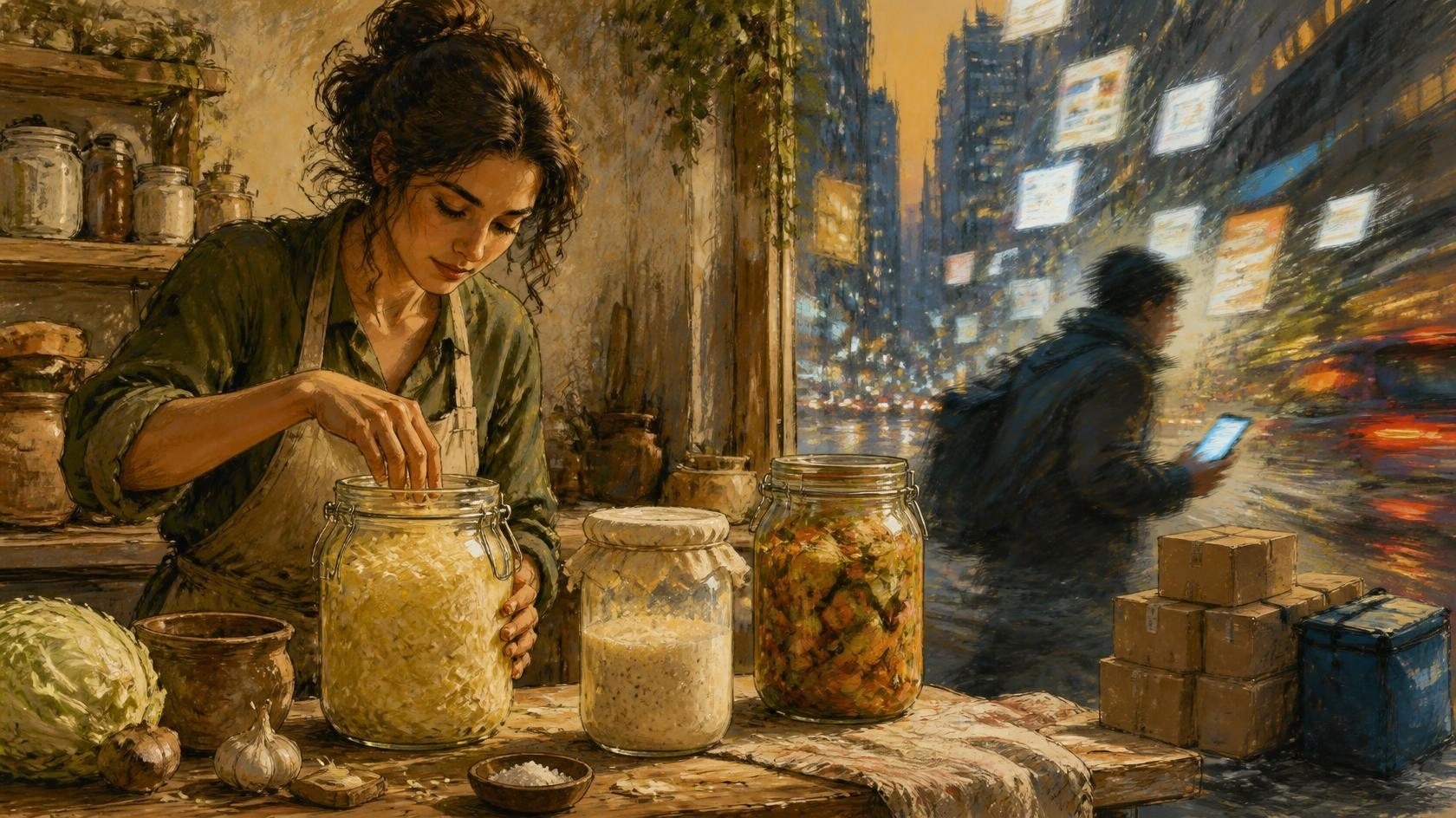
The algorithm does not know what Your soul needs
The algorithm can measure watch time. It can measure clicks. It can measure saves, shares, comments, impressions, and conversion. It can tell you which version of your creativity keeps people scrolling.
But it cannot measure whether the hobby helped you feel like yourself again.
It cannot measure the quiet relief of making something ugly and not caring.
It cannot measure the softness of singing badly in your kitchen.
It cannot measure the dignity of learning slowly.
It cannot measure the private satisfaction of finishing a puzzle no one will ever see.
It cannot measure the nervous-system exhale that comes from doing something without explaining it.
Digital platforms can offer creative opportunity, but the ILO’s 2024 working paper on creative platforms also highlights instability, irregular income, platform control, and the tension between autonomy and gatekeeping in digital creative work (Gardiner, 2024). This is important because once a hobby becomes platform-dependent, it enters a system that is not designed primarily for your well-being.
The platform wants activity.
The audience wants novelty.
The market wants differentiation.
The algorithm wants retention.
But your inner life may want slowness.
That conflict is not small.
The monetization trap: When “You’re so talented” becomes pressure
One of the most confusing parts of this topic is that the pressure often arrives as praise.
“You’re so good at this.”
“You could sell these.”
“You should start a page.”
“People would pay for this.”
“You’re wasting your talent if you don’t do something with it.”
At first, it sounds supportive. But hidden inside that praise can be a demand: prove that your talent has market value.
Research on passion exploitation is useful here. Kim, Campbell, Shepherd, and Kay found that people may view poor treatment as more acceptable when they believe someone is passionate about the work. In plain language: when people think you love something, they may assume you will tolerate more, charge less, work longer, or sacrifice boundaries because “you enjoy it anyway.”
Women know this pattern intimately.
- A woman who loves organizing becomes the unpaid planner
- A woman who loves baking becomes the default cake maker
- A woman who loves listening becomes the emotional support system
- A woman who loves design becomes the free branding helper
- A woman who loves beauty becomes expected to beautify everything
The sentence “but you’re so good at it” can become a trap.
So the boundary is not anti-talent. It is pro-sovereignty.
You are allowed to protect your talent from becoming endlessly available.
Table 2: Words of power for keeping a hobby private

These phrases matter because women often need language before they can hold a boundary. A boundary without language can feel rude. A boundary with language becomes calm, clear, and repeatable.
Why “bad” hobbies can be good for Women
One of the healthiest things a woman can have is a hobby she is allowed to be mediocre at.
This may sound small, but it is not.
Many women live under constant competence pressure. Be good at work. Be emotionally intelligent. Be attractive but not vain. Be ambitious but not threatening. Be kind but not weak. Be informed but not intense. Be nurturing but not depleted. Be independent but not cold. Be successful but still accessible.
In that kind of atmosphere, mediocrity becomes medicine.
A hobby you are bad at teaches the body a different lesson:
I can exist without impressing.
I can learn without being watched.
I can enjoy without winning.
I can be new without shame.
I can make something imperfect and still be safe.
Effortful leisure may also offer meaning. Campbell and colleagues found that effortful leisure can feel meaningful, even when it is not always the easiest or most instantly pleasurable. That is an important distinction. A good hobby does not always feel relaxing in the shallow sense. Sometimes it stretches you. It asks you to focus. It lets you wrestle with a small, chosen challenge.
But because you chose it, the effort feels different.
Chosen effort can restore dignity.
Forced effort drains it.
The difference between sharing and performing
It is not wrong to share your hobby. Sharing can be joyful. It can create community. It can help other women feel inspired, less alone, or more courageous. The issue is not visibility itself.
The issue is when sharing becomes performance.
Sharing says: “Here is something I enjoyed.”
Performing says: “Here is something I hope proves my worth.”
Sharing says: “This connected me to myself.”
Performing says: “Please validate that this was worth doing.”
Sharing can happen occasionally, lightly, and without obligation. Performing demands repetition, optimization, and self-monitoring.
A woman can post a painting and still keep painting private. She can sell a few knitted pieces and still have a non-commercial relationship with knitting. She can write online and still keep a journal no one sees. The boundary is not about never sharing. It is about refusing to let the gaze become the owner.
Ask:
- Can I still enjoy this if no one sees it?
- Can I still make it if no one buys it?
- Can I still practice if I never become known for it?
- Can I still stop without feeling like I failed publicly?
If the answer is yes, the hobby is still yours.
Private hobbies rebuild identity after over-functioning
Many women do not lose themselves dramatically. They lose themselves through usefulness.
They become the reliable one.
The one who answers.
The one who remembers.
The one who notices tension.
The one who plans birthdays.
The one who anticipates needs.
The one who makes things easier for everyone else.
Over time, the self can become organized around function. “Who am I?” becomes “What do people need from me?”
A private hobby interrupts that.
It gives you a self that is not relationally assigned. You are not doing it because someone needs it. You are not doing it because it prevents conflict. You are not doing it because it makes you more lovable. You are doing it because something in you says yes.
That yes is important.
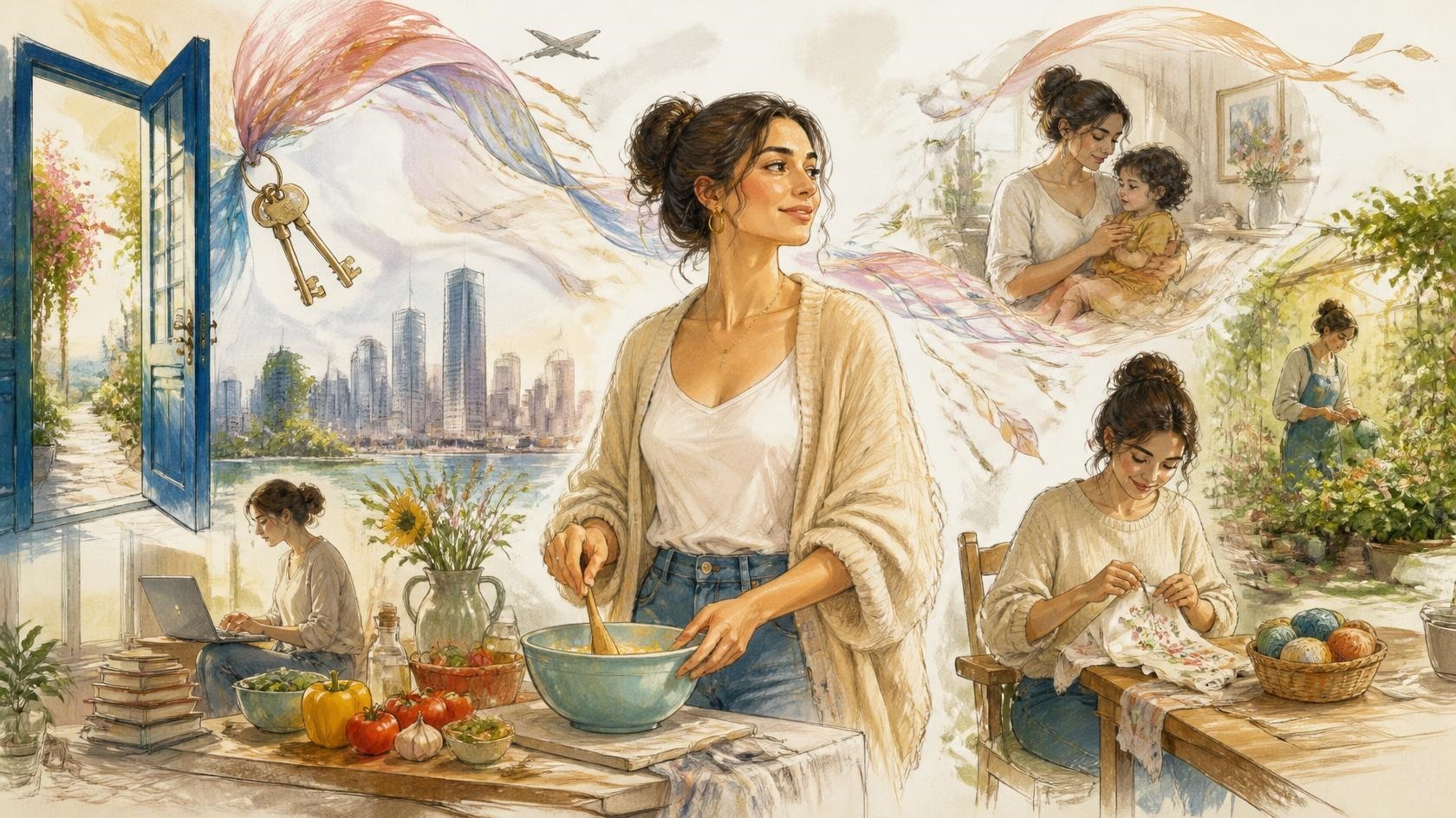
It may be tiny at first. A color. A song. A class. A book. A plant. A recipe. A trail. A language. A clay mug. A dance step. A camera. A sketch. A chess puzzle. A tiny balcony garden.
But every yes that is not built around usefulness strengthens identity.
Words of Power:
“I am allowed to have an inner life that does not serve anyone.”
The “soft rebellion” of doing something without documenting it
There is a quiet rebellion in leaving the phone in another room.
Not because phones are evil. Not because social media is always shallow. But because documentation changes experience. When you document, part of you steps outside the moment and starts managing how the moment will look later.
The cake becomes lighting.
The hike becomes angles.
The painting becomes progress shots.
The book becomes a quote graphic.
The coffee becomes aesthetic evidence.
The hobby becomes a content asset.
Sometimes that is fun. Sometimes it is creative. Sometimes it is business.
But sometimes, it steals the center.
A hobby that is not documented teaches presence. It lets the moment complete itself inside your body before it becomes material for anyone else. It lets beauty remain unextracted.
That is rare now.
And rare things are worth protecting.
Table 3: The private hobby audit

Use this audit gently. The goal is not to judge yourself. The goal is to notice when a joy has been quietly turned into another system of pressure.
The economics of “just monetize it”
There is also an economic layer we need to name honestly.
For many women, monetizing a hobby is not vanity. It is survival, ambition, or a rational response to financial pressure. Wages, caregiving responsibilities, inflation, unstable work, and gendered income gaps can make “extra income” feel necessary. The OECD reported that, across OECD countries, the median full-time working woman still earned less than the median full-time working man in 2023. So it is understandable that women look at their skills and ask, “Could this help me?”
There is nothing wrong with that.
The danger is when the culture pretends monetization is always liberation.
Sometimes monetization gives women freedom. Sometimes it gives them another underpaid job. Sometimes it turns rest into labor. Sometimes it makes creativity dependent on platform volatility. Sometimes it moves a woman from private joy into public evaluation before she has had time to build internal safety.
So the question should not be, “Can I monetize this?”
A better question is:
“Would monetizing this increase my freedom, or would it consume the only free place I have left?”
That question changes everything.
When monetizing a hobby can be healthy
To be clear: this article is not anti-business. It is anti-compulsion.
A hobby can become income in a healthy way when:
- You actively choose it, not because you feel guilty
- You keep some part of the activity private
- You set prices that respect your time
- You do not rely entirely on one algorithm
- You have boundaries around orders, posting, and communication
- You can still make things that are not for sale
- You can stop or pivot without losing your identity
- You do not confuse sales with worth
The healthiest creative businesses often have a protected root system. Public work grows from private nourishment. If all creativity goes outward, there is eventually nothing left underground.
This is why even professional creators, writers, artists, coaches, designers, and entrepreneurs need non-monetized spaces. The more public your work becomes, the more private play you may need.
A woman who earns money from creativity does not need fewer private hobbies.
She may need more.
The nervous-system reason Women need unpaid joy
A hobby that stays unpaid can become a signal of safety.
It tells the nervous system:
No one is grading this.
No one is waiting for this.
No one needs this from me.
No one is disappointed if I stop.
No one gets to decide whether this was worth it.
That kind of signal is powerful for women who live with chronic responsibility.
Many women do not simply feel tired. They feel claimed. Claimed by work, family, beauty standards, emotional labor, financial anxiety, social comparison, and the constant digital pressure to be visible. A private hobby gives the body an experience of unclaimed time.
Not empty time.
Not lazy time.
Not wasted time.
Unclaimed time.
That is different.
Unclaimed time is where desire can speak without immediately being assigned a task.
The identity sentence every Woman needs
Try this:
“I am not a content machine. I am a living person.”
This sentence may sound dramatic until you notice how often modern life asks women to turn themselves into a feed.
Your breakfast can become content.
Your healing can become content.
Your grief can become content.
Your body can become content.
Your relationship can become content.
Your home can become content.
Your hobbies can become content.
Your lessons can become content.
Your transformation can become content.
But a woman is not more real because she is visible.
Some parts of life become more real when they are protected.
How to choose a hobby that does not become content
Choose something that gives you a bodily yes, not just an identity upgrade.
Instead of asking, “What hobby would make me look interesting?” ask:
- What do I keep noticing?
- What did I love before I cared about being impressive?
- What activity makes time feel different?
- What would I do badly but happily?
- What would I still enjoy if no one praised me?
- What feels like play, not personal branding?
- What does my body want to repeat?
Some women need tactile hobbies: clay, gardening, knitting, cooking, painting, woodworking, flower arranging.
Some need movement hobbies: dance, hiking, swimming, skating, climbing, martial arts, long walks, cycling.
Some need mental hobbies: puzzles, languages, chess, reading, astronomy, genealogy, birdwatching, history, learning an instrument.
Some need social hobbies: choir, community theater, book clubs, board games, local volunteering, beginner classes.
Some need solitary hobbies because their life is already overstimulating. Some need group hobbies because their life is already too isolated. The right hobby is not the one that looks best online. It is the one that repairs something true.
How to protect a hobby from becoming another obligation
Start with rules that sound almost too simple.
Do not post it for the first 30 days.
Do not buy a domain for it.
Do not open a shop for it.
Do not compare yourself to experts.
Do not announce a challenge.
Do not turn it into a transformation project.
Do not make it part of your identity too fast.
Do not pressure yourself to be consistent.
Let it be small. Let it be messy. Let it breathe.
You can also create a “private shelf” rule: some creations are not photographed, sold, gifted, or explained. They stay with you. They are evidence not of productivity, but of presence.
Another helpful rule:
Keep one hobby with no outcome.
No before-and-after.
No progress tracker.
No monetization plan.
No audience.
No self-improvement goal.
No aesthetic standard.
Just the doing.
This may feel uncomfortable at first. That discomfort is information. It shows how deeply productivity has entered the nervous system.
What to say when people pressure You
You do not need to overexplain.
Try:
- “I’m keeping this one private.”
- “I like having something that is not a project.”
- “I’m not turning this into work.”
- “This is just for pleasure.”
- “I already have enough things that need to perform.”
- “I’m protecting the part of this that feels free.”
- “I may share later, but I’m not building anything from it right now.”
If someone keeps pushing, repeat yourself.
“I hear you. I’m still keeping it private.”
That is enough.
The fear underneath: “What if I waste my potential?”
Many women are afraid that if they do not monetize a skill, they are wasting potential.
But potential is not only economic.
There is emotional potential.
Creative potential.
Relational potential.
Spiritual potential.
Sensory potential.
Identity potential.
Nervous-system potential.
Joy potential.
A hobby may never make money and still make you more alive. It may never become content and still make you more observant. It may never become impressive and still make you more patient, playful, courageous, and connected.
That is not wasted.
That is development.
We need to stop measuring women’s potential only by what can be extracted from them.
Some potential is meant to remain intimate.
A personal note
I think this topic matters because I have seen how quickly women turn their own relief into another responsibility. A woman finally finds something that lights her up, and before she has even had time to enjoy it, she is researching equipment, niches, pricing, posting schedules, and whether the market is saturated.
I understand the impulse. It can feel smart. It can feel ambitious. It can feel like not wasting an opportunity.
But I also think there is a grief in it.
The grief of never letting joy stay joy long enough to nourish you.
So I want to say this clearly: the world will always find ways to use a woman’s gifts. She has to be the one who decides which gifts are public, which are paid, which are shared, and which are kept warm in the private room of her own life.
That decision is power.
Keep one beautiful thing unbought
Women need hobbies that do not turn into content or income because women need spaces where they are not being converted into value for someone else.
A private hobby is not a failure of ambition. It is a form of self-protection. It preserves intrinsic motivation. It rebuilds identity. It gives the nervous system unclaimed time. It lets women experience competence without comparison, creativity without branding, beauty without documentation, and effort without exploitation.
Make money from your skills if you want to. Share your gifts if you want to. Build the business, post the tutorial, sell the prints, teach the class, launch the shop — if it truly expands your freedom.
But keep something.
Keep one hobby that is not for the algorithm.
Keep one pleasure that is not for the marketplace.
Keep one skill that grows slowly in the dark.
Keep one joy that does not need applause.
Keep one beautiful thing unbought.
Because not everything sacred has to scale.
Final Words of Power:
“This is mine because I love it, not because it performs.”
Related posts You’ll love
- Words of power for Women with creative hunger They keep delaying: 33 affirmations to finally begin before You feel ready
- When a personal obsession helps You heal: 8 reflective exercises for emotional healing and self-discovery, FREE PDF
- Why the gender pay gap becomes a relationship issue at home: The hidden economics of love, power, and everyday choices
- The “I don’t know who I am” phase is often a growth signal: How identity fog can become Your calm, quiet rebuild
- Micro-rebellions: 21 tiny acts to break up with a life that no longer fits You. FREE PDF!
- If You only feel relaxed on vacation, this article is for You!
FAQ
-
Why do women need hobbies that do not become content or income?
Women need non-monetized hobbies because they provide a rare space free from performance, care work, social evaluation, and productivity pressure. These hobbies protect autonomy, identity, rest, and intrinsic motivation.
-
Is it bad to monetize a hobby?
No. Monetizing a hobby can be empowering when it is chosen freely, priced fairly, and supported by boundaries. The problem begins when monetization is driven by guilt, pressure, financial desperation, or the belief that joy must become productive to be valid.
-
Can posting a hobby online ruin it?
Posting does not automatically ruin a hobby. But if posting changes the purpose from enjoyment to validation, comparison, or algorithmic performance, the hobby may start to feel like work.
-
What is the hobby-to-content pipeline?
The hobby-to-content pipeline is the process where a private interest becomes a public performance: interest → skill → praise → posting → consistency → audience → monetization → pressure. It can be exciting, but it can also drain the original joy.
-
Why does this issue affect women so strongly?
Women often carry more unpaid care work, emotional labor, appearance pressure, and social responsibility. Because of that, private time that does not serve others can be especially psychologically important.
-
What are signs my hobby has become another job?
Signs include guilt when you pause, anxiety about posting, constant comparison, pressure to improve quickly, feeling watched, resentment toward the activity, or measuring the hobby by engagement, sales, or praise.
-
How can I protect a hobby from becoming content?
Try not posting it for the first month, keeping some creations private, avoiding early monetization plans, refusing comparison, and reminding yourself: “I am practicing presence, not building a portfolio.”
-
What if people keep telling me to sell what I make?
You can say: “Thank you, but I’m keeping this one for joy right now.” This lets you receive the compliment without turning your hobby into an obligation.
-
Are private hobbies still useful if they do not make money?
Yes. Private hobbies can support mental health, creativity, identity, emotional regulation, meaning, and resilience. Their value does not depend on income.
-
What hobbies are good for women who feel burned out?
Good options include low-pressure, sensory, or slow hobbies: gardening, walking, painting, pottery, reading fiction, puzzles, swimming, dancing, birdwatching, knitting, baking, or learning a language privately.
-
What is the most powerful mindset shift?
The most powerful shift is this: a hobby does not need to become impressive to be worth doing. Joy is not a weak reason. Joy is information.
Sources and inspirations
- Campbell, A. V., O’Brien, E., & Woolley, K. (2025). Effortful leisure is a source of meaning in everyday life. Communications Psychology.
- Fancourt, D., & Finn, S. (2019). What is the evidence on the role of the arts in improving health and well-being? A scoping review. World Health Organization Regional Office for Europe.
- Gardiner, D. (2024). Balancing act: The role of digital platforms in shaping the conditions of creative work (ILO Working Paper 123). International Labour Organization.
- Jourdain, A., & Naulin, S. (2026). Cooking and crafting in a digital economy: The effects of online commodification on leisure activities. Journal of Consumer Culture.
- Keyes, H., Gradidge, S., Forwood, S. E., Gibson, N., Harvey, A., Kis, E., Mutsatsa, K., Ownsworth, R., Roeloffs, S., & Zawisza, M. (2024). Creating arts and crafting positively predicts subjective wellbeing. Frontiers in Public Health.
- Kim, J. Y., Campbell, T. H., Shepherd, S., & Kay, A. C. (2020). Understanding contemporary forms of exploitation: Attributions of passion serve to legitimize the poor treatment of workers. Journal of Personality and Social Psychology.
- OECD. (2025). Gender gaps in paid and unpaid work persist. Organisation for Economic Co-operation and Development.
- Ryan, R. M., & Deci, E. L. (2020). Intrinsic and extrinsic motivation from a self-determination theory perspective: Definitions, theory, practices, and future directions. Contemporary Educational Psychology.
- Seedat, S., & Rondon, M. (2021). Women’s wellbeing and the burden of unpaid work. BMJ.
- Takiguchi, Y., Matsui, M., Kikutani, M., & Ebina, K. (2023). The relationship between leisure activities and mental health: The impact of resilience and COVID-19. Applied Psychology: Health and Well-Being.

Leave a Reply