Table of Contents
Smart glasses could change public safety by making recording less obvious and ordinary encounters easier to preserve, analyse, and share. They can also support accessibility and communication. The central question is whether people around the wearer can understand what is happening and have a meaningful say in it.
Imagine telling a stranger where the nearest station is. You hesitate, laugh at your terrible directions, and point towards the wrong street before correcting yourself. It is a forgettable exchange, the kind that makes a city feel human. Now imagine discovering that the conversation has become a video, complete with a caption, comments, and an audience you never agreed to meet.
The original interaction has not changed. Its destination has. What felt like helping one person has become performing for thousands, and the unsettling part is that you never knew there was a performance.
That is the question I find most interesting about smart glasses. Beyond what these devices can do for their owners, what might they ask everyone else to tolerate? A camera worn near the eyes could alter something more intimate than our relationship with technology: the freedom to be ordinary around strangers.
This article examines that possibility through research, current product information, and ethical analysis. The everyday scenes are hypothetical, and the reflections about future behaviour are possibilities rather than established psychological effects.
What are smart glasses, and why does their design matter?
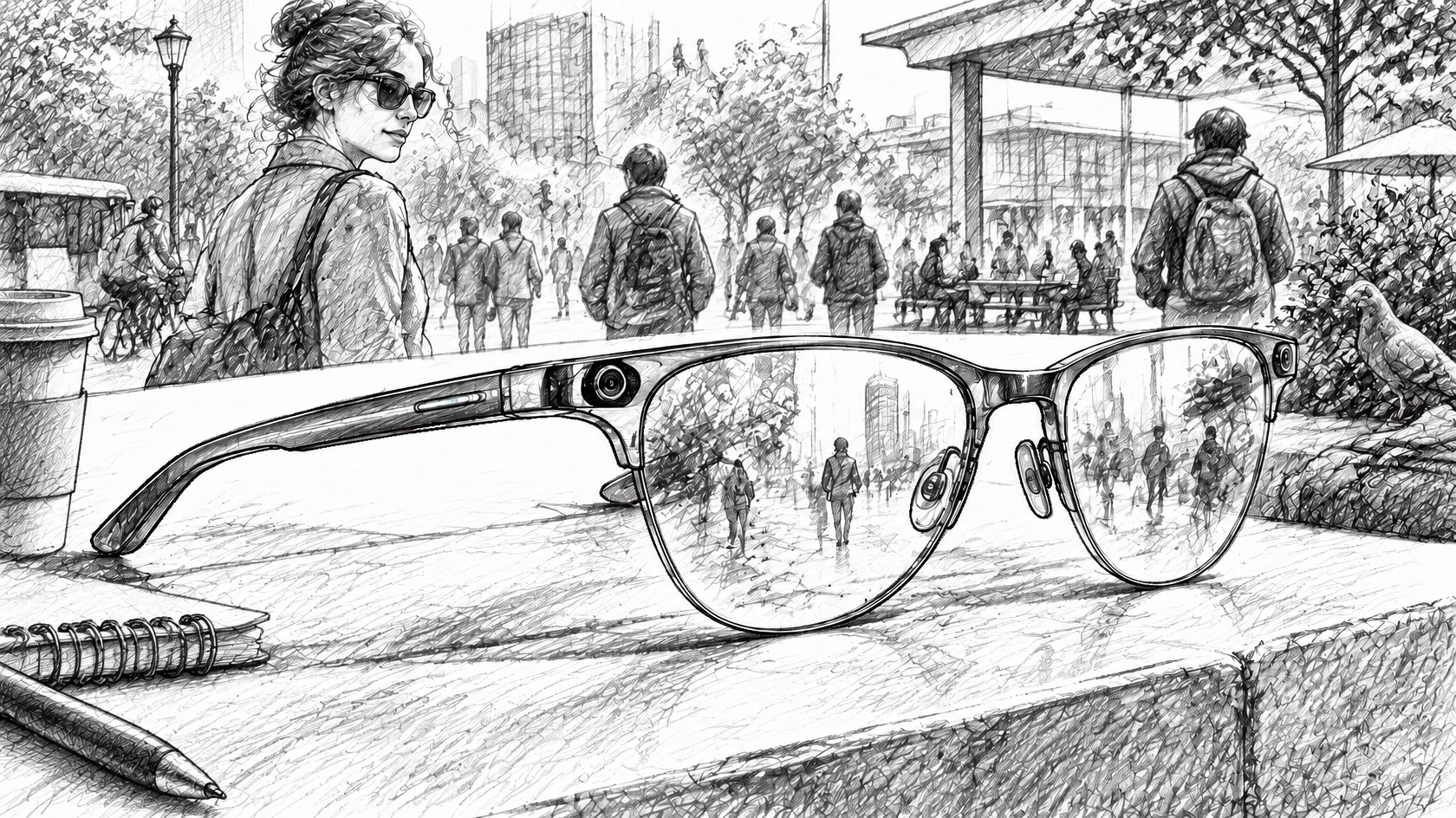
Smart glasses are eyewear with electronic functions, which may include audio, cameras, microphones, displays, or access to an AI assistant. These features vary considerably. For example, Meta’s 2025 announcement for Ray-Ban Meta Gen 2 describes photography, video, translation, and audio functions, but this should not be treated as a specification for every device sold as smart glasses.
For this discussion, the relevant category is glasses equipped with cameras or microphones. Their importance is partly social: someone can maintain a conversational posture while using a recording device. Raising a phone often gives others a visible cue, although phones can also record discreetly. With glasses, looking towards a person and pointing a camera towards them can become the same physical movement.
A 2024 study involving 15 participants who used camera glasses over two weeks found that wearers considered existing privacy indicators ineffective and believed the design could conceal the technology from people unfamiliar with it. Participants also described a burden of responsibility for protecting others’ privacy. This small qualitative study identifies tensions; it does not establish how every wearer behaves or how common misuse is.
I would describe the resulting challenge as a loss of shared clarity. The wearer may know exactly which feature is active. The person across the table may not even know that there is a feature to ask about.
Public safety includes the freedom to be unremarkable
We usually discuss safety through visible events: an accident, a threat, an assault, or a successful call for help. Those are essential concerns. Yet a public place can be physically uneventful while still feeling uncomfortable because the terms of participation are unclear.
Consider a woman eating alone after a difficult morning. She is not hiding anything. She simply does not want her expression turned into a stranger’s commentary about loneliness, attractiveness, or attitude. Her wish is modest: to have lunch without becoming someone else’s material.
I find it useful to distinguish three dimensions of safety here. This is an editorial framework for thinking through the issue, rather than a clinical assessment or a validated measurement tool.

These dimensions can pull in different directions. Someone might feel physically safer because they can document a troubling encounter, while another person feels socially exposed by the same camera. A serious discussion must make room for both positions without pretending that every conflict has an effortless solution.
The standard I would propose is practical: a useful technology should make everyday participation easier for more people. If the wearer gains convenience while everyone nearby must continually investigate whether they are being recorded, part of the cost has simply been moved out of the purchase price and into public life.
Being visible is different from becoming searchable
Walking through a station means accepting that other people can see you. It does not necessarily mean expecting a durable record of your face, voice, route, and conversation. Visibility during a moment and the later reuse of that moment are different questions.
The European Data Protection Board highlighted precisely this transparency problem in October 2026: smart glasses can make it difficult for bystanders to know that personal data is being processed, by whom, and for what purpose. Its guidance calls for clearer signals and shared responsibility among users, manufacturers, and service providers.
To understand the stakes, consider a possible sequence: an encounter → a recording → a saved file → a public post → a new interpretation. None of those steps automatically requires the next one. Each is a decision, and each can change what the original interaction means to the person in it.
Suppose a shop assistant declines a customer’s request. A recording might document an accurate exchange, or a short excerpt might omit the explanation that made the refusal reasonable. The problem is not only whether the camera captured reality. It is who gets to decide where reality begins, where it ends, and what title goes above it.
This is why “you were in public” feels like an incomplete ethical answer. It describes the location of the encounter but says little about the fairness of its later use. I would want a separate justification for turning a passing person into the subject of a searchable story.
A recording light is useful, but it cannot answer every question
Meta’s July 2026 explanation says its glasses use a white capture LED to indicate photos and videos being captured for the gallery. It also describes safeguards intended to disable the camera when obstruction or tampering is detected. These are manufacturer statements about specific products and safeguards, rather than proof that every nearby person will notice or understand the signal.
The distinction matters because a signal has several jobs. It must be visible, recognisable, and relevant to what someone needs to know. Even a clearly noticed recording light cannot explain whether a clip will remain private, be uploaded tomorrow, or be paired with a misleading caption.
I would also avoid treating any single indicator as a universal explanation of all device activity. A claim about gallery capture should not be extended into a promise about every camera assisted feature, every model, or every software version. The sensible question is what the indicator means for the particular function being used.
Imagine a restaurant introducing a small symbol that means “your conversation may be broadcast.” Management could argue that the symbol was visible, yet customers might reasonably say they never understood it. Privacy communication should be judged by what people can comprehend in the real setting, not simply by whether a notice technically exists.
Could smart glasses identify strangers?
A camera, an AI assistant, and a facial identification system are different components. Capturing a face does not by itself reveal a person’s name. Identifying someone would require additional processing and information against which to compare the image, and a possible connection between systems is not evidence that every retail product includes it.
This distinction protects the discussion from two mistakes. One is assuming that any pair of camera glasses can instantly discover everything about you. The other is assuming that a recording’s future use is limited to the features built into the original camera.
Facial recognition also has an accuracy problem that deserves precise wording. NIST’s 2019 evaluation found demographic differences in the performance of many tested algorithms, with results depending on the system and task. Those findings are important evidence about identification errors, but they are not a current accuracy score for an unspecified pair of smart glasses.
My concern is therefore broader than identification alone. An accurate match could expose someone who wanted distance from a past relationship, while an inaccurate match could attach a stranger’s history to the wrong person. These are hypothetical harm scenarios, but they show why accuracy and permission deserve separate attention.
Knowing who someone is does not settle whether you should identify them. Being able to attach a label to a person is not the same as having a good reason to do so.
Why the same glasses can feel different to different people
It is tempting to call discomfort with wearable cameras a generational divide or a fear of new technology. That explanation is too easy. The meaning of being recorded depends partly on what a person might lose if the footage travels beyond the original setting.
For one person, an unexpected appearance online may be an annoyance. For someone trying to keep a workplace, routine, or new location private, it could feel far more consequential. Neither reaction tells us what the camera actually captured, but the difference helps explain why a universal reassurance can miss the point.
University of Sydney researchers reported emerging findings in August 2026 from an analysis of 350 public Instagram videos associated with the practice of men recording approaches to women. They described concerns about covert capture, persistent interaction, and online circulation. This was a selected sample and an account of emerging research, not an estimate of misconduct among all smart glasses owners.
The ethical issue becomes particularly clear when we imagine a person who cannot easily leave. A receptionist, cashier, or server may be expected to remain friendly while dealing with a customer. If that customer is filming, professional politeness should not be casually interpreted as enthusiasm about becoming content.
I would want workplace policies to recognise that imbalance. An employee should have a clear route to assistance rather than being left to negotiate a recording dispute while also protecting customer satisfaction scores. That is a proposal about fair workplace design, not a claim that a single rule already applies everywhere.
Accessibility belongs at the centre of this conversation
There is another person we should imagine: someone who benefits from receiving visual assistance without holding a phone. For that person, camera glasses may represent greater independence rather than a desire to record strangers. Treating the device itself as evidence of bad intentions would be both unfair and unhelpful.
Be My Eyes began rolling out its service on Ray-Ban Meta glasses in November 2024, initially in five countries. Its announcement described hands free access for blind and low vision users. That is a concrete accessibility use, although the announcement alone does not establish that the glasses prevent accidents or replace other mobility supports.
I do not think accessibility and bystander privacy should be presented as opposing values. The design question is whether a helpful task can be completed with less incidental capture, clearer explanation, and fewer opportunities for unrelated reuse. A person seeking assistance should not have to defend the entire wearable technology industry before receiving it.
For venues, this suggests a more careful approach than either unrestricted recording or a blanket assumption that all electronic eyewear is inappropriate. Staff could explain the concern, establish which activity is occurring, and explore a workable accommodation. The important thing is to address the use and the setting without demanding that someone disclose private medical details to a roomful of strangers.
The quiet risk: turning everyday life into an audition
Imagine knowing that an ordinary conversation might be saved, edited, and posted. Would you become slightly more careful about your face? Would you stop making jokes with unfamiliar people? Would you answer a question more briefly because you could not tell who else might eventually hear the answer?
These are questions, not established findings about widespread behavioural change. The sources reviewed here do not demonstrate that smart glasses cause a particular mental health condition or that public life has already become less spontaneous because of them. Still, the questions identify outcomes that research and public policy should take seriously.
I think the potential loss is easy to underestimate because it would look so small. One fewer conversation on a train. One less playful answer at a café. One more person deciding that silence is the safest way to remain in control of their image.
The issue is not that everyone should be endlessly open to strangers. Boundaries are valuable. The concern is whether people would choose distance because ordinary interaction had acquired an invisible audience, rather than because distance was what they actually wanted.
There is also a subtle problem of effort. If every social encounter requires checking the glasses, checking the light, and deciding whether to ask a question, the bystander has acquired a new unpaid task. I would rather see products and public norms reduce that work than congratulate people for becoming better at monitoring it.
What to do if you think someone is recording you
Start with what you can observe. Glasses alone do not prove that recording is happening, and uncertainty does not require an immediate confrontation. You can decide whether asking, moving, or seeking support makes most sense in the particular setting.
If the interaction feels safe enough, a short question is usually clearer than an accusation. You might say, “Are those camera glasses, and are you recording this conversation?” The answer can help you choose your next step, although it cannot independently verify what a device has already captured.
The following suggestions are communication options, not guarantees of cooperation or a statement of your legal rights. If a person is threatening, following, or blocking you, prioritise distance and appropriate assistance over winning an argument about technology.

A useful sequence is notice → ask if appropriate → state a boundary → choose support or distance. It does not require you to prove malicious intent before changing seats or ending a conversation. It also leaves room for the possibility that the wearer is doing something entirely unrelated to you.
If footage later appears online, keep the post URL and relevant screenshots before reporting it through the platform. Depending on the circumstances, workplace staff, a data protection authority, or a local legal adviser may help explain the available options. Avoid amplifying the footage simply to prove that it exists.
If you wear smart glasses, make trust part of the feature set
The simplest improvement is often an ordinary sentence offered before a camera becomes part of an interaction. “These glasses can record, but I’m only using the audio” gives someone more useful context than expecting them to decode the frame. It should, of course, accurately describe what you are doing.
When you want to capture a conversation, explain both the recording and the intended audience. A friend might welcome a private memory while declining a public post. Those preferences are compatible, and asking separately prevents agreement to one activity from being stretched into agreement to another.
I would also build a pause into publication. Before sharing, look for people who have become an unintended subject, details that reveal more than expected, and edits that change the apparent meaning of an exchange. A clip can be technically impressive while still being unfair to the person in it.
Think carefully about moments when someone is paid to be agreeable or socially pressured to stay pleasant. A smile is not a dependable way to determine whether they understand the recording. A direct, low pressure question gives them a better opportunity to express a preference.
Finally, let “no” remain a complete answer. Requiring a stranger to explain a painful history before respecting a recording boundary turns courtesy into an interrogation. The person who controls the camera is usually well placed to make the interaction less demanding.
What better smart glasses privacy could look like
Researchers are exploring alternatives to a system that makes bystanders responsible for opting out. A 2026 CHI paper described a protocol involving initial face protection and restoration with consent, alongside interviews with 18 participants. Bystanders valued stronger protection, while wearers raised concerns about visual limitations and the effort of consent. This is a research approach, not a feature that should be assumed available in ordinary retail glasses.
What interests me about that work is the change in starting point. Instead of asking how quickly someone can object, we can ask how little exposure should happen before they have a choice. That approach still requires careful testing, especially where visual assistance or documenting an incident matters.
The following table sets out design questions I would use to evaluate future systems. It is a proposal for accountability, not a list of existing product guarantees.

Face blurring alone would not answer every question. A voice, a name badge, or the context of a location might still make someone recognisable. The broader design aim should be reducing unnecessary exposure throughout the interaction, rather than treating one edited feature as proof that privacy has been solved.
Is recording with smart glasses legal in public?
There is no universal answer that applies to every country, setting, and recording. Audio, video, publication, workplace use, and identification can raise different issues. An ethical preference for asking first should also not be confused with a claim that consent is the only possible legal basis in every situation.
The European Data Protection Board’s October 2026 explanation distinguishes personal activities that may fall within the household exemption from uses such as public social media sharing or professional activity that can create data controller responsibilities. It also notes that other laws may apply even where the GDPR does not.
A September 2026 review by Hamburg’s data protection authority took a particularly critical view of recording people outside a close personal circle with the examined Ray-Ban Meta Gen 1 model. Its assessment concerned that product and legal context, and should not be presented as a worldwide ban on smart glasses. For a specific dispute, local advice is more useful than a confident slogan about being in public.
A public life where we can still let our guard down
The most important question about smart glasses may be what kind of strangers we want to be to one another. Do we want every exchange to carry the possibility of extraction, or can we develop habits that preserve the ordinary generosity of sharing space? Technology will influence that answer, but product settings will not settle it alone.
I want a future in which someone can receive visual assistance, preserve a meaningful memory, or call for help without making everyone around them feel like raw material. That requires understandable design, proportionate rules, and the willingness to treat another person’s hesitation as meaningful. It also requires resisting the idea that whatever can be captured automatically deserves an audience.
When I imagine feeling safe in public, I think of being able to give imperfect directions, look tired, change my mind, or laugh awkwardly without managing a future audience. There is dignity in those unpolished moments. A thoughtful technological future should leave room for them.
Before an ordinary encounter becomes a recording, there is an opportunity to ask a better question: does this help someone participate in the world, and what does it ask of everyone else? If we keep both sides of that question visible, smart glasses can be judged by more than what they let us capture. They can be judged by how much freedom they leave other people to live.
Related posts You’ll love
- AI companionship: Why talking to bots can feel safer than people (and how to keep it healthy)
- Why AI chatbots can worsen mental health – and how to stay safe
- Rage bait content: Why it hooks You so fast (and how to break the outrage loop without losing Your voice)
- Why You take things personally in certain environments
- The deepfake fear Women don’t say out loud: A calm space guide to synthetic sexual abuse, nervous system safety, and staying visible without shrinking
- Cortisol culture: When “wellness” becomes another way to feel not enough
FAQ
-
How could smart glasses change the feeling of safety in public?
They could make it harder to tell whether an ordinary encounter is being captured or might later be shared. At the same time, useful assistance and communication features may give wearers more confidence. The effect depends on the device, its use, and the choices available to people nearby.
-
Do all smart glasses contain cameras?
No. Smart glasses is a broad product category, and a model’s actual specifications matter more than its label. Avoid assuming that someone is recording merely because their eyewear looks unfamiliar or contains electronics.
-
Does a recording light mean I have agreed to being filmed?
A light can provide information, but it does not express your agreement. It also does not explain every later use of the recording. The legal significance of notice and consent depends on the applicable rules and circumstances.
-
Can I ask someone to stop recording me?
Yes, you can express that preference and ask them to stop. Whether you can legally require them to comply depends on the situation and jurisdiction. If asking feels unsafe, seek support or create distance instead of trying to take control of the device.
-
Can smart glasses recognise my face and reveal my name?
Do not assume that a camera automatically provides facial identification. Identification requires additional processing and information, and capabilities differ. It is useful to distinguish a device’s advertised functions from other ways that an exported recording might later be used.
-
Are smart glasses a proven solution to harassment?
The evidence reviewed here does not establish them as a reliable way to prevent harassment. A recording might document an encounter, but documentation and prevention are different outcomes. Choosing distance or assistance can matter more than obtaining footage.
-
Why might women be particularly concerned?
Some women may be concerned about unwanted approaches becoming recordings for an online audience. Emerging research has examined this specific practice, but it does not justify treating every wearer as a harasser. The relevant concern is the behaviour and the unequal consequences of exposure.
-
Could restrictions harm people who use glasses for accessibility?
Poorly designed restrictions could create unnecessary obstacles. A better policy would consider the actual activity, the sensitivity of the setting, and possible accommodations. Respectful discussion should not require a person to announce private health information to strangers.
-
Does blurring my face fully protect my privacy?
Not necessarily. Other details could still make a person recognisable, including their voice, clothing, or surroundings. Evaluate the complete recording and its context rather than assuming one visual edit removes every concern.
-
What should I do if an unwanted recording is posted online?
Preserve the link and relevant evidence, then use the platform’s reporting options. The appropriate next step may involve a venue, employer, regulator, or legal adviser, depending on the circumstances. Avoid reposting the material unnecessarily, since that can increase its reach.
-
How can I think about this without becoming suspicious of everyone?
Focus on specific behaviour and choices available to you rather than trying to identify every possible camera. You can ask a question, set a boundary, or move on without deciding that every wearer means harm. A useful boundary gives you options; it does not require constant vigilance.
Sources and inspirations
- Be My Eyes. (2024, November 13). Be My Eyes is rolling out on Ray Ban Meta glasses starting today!
- Bhardwaj, D., Ponticello, A., Tomar, S., Dabrowski, A., & Krombholz, K. (2024). In focus, out of privacy: The wearer’s perspective on the privacy dilemma of camera glasses. In Proceedings of the 2024 CHI Conference on Human Factors in Computing Systems (Article 577, pp. 1–18). Association for Computing Machinery.
- European Data Protection Board. (2026, October 13). EDPB publishes statement on the data protection challenges of smart glasses.
- Grother, P., Ngan, M., & Hanaoka, K. (2019). Face recognition vendor test (FRVT) part 3: Demographic effects (NISTIR 8280). National Institute of Standards and Technology.
- Hamburg Commissioner for Data Protection and Freedom of Information. (2026, September 10). Ray-Ban Meta AI glasses: HmbBfDI presents technical and data protection review.
- Khawaja, Y., Rehman, S., Ponticello, A., Bhardwaj, D., Krombholz, K., Alizai, M. H., & Bhatti, N. A. (2026). See me if you can: A multi-layer protocol for bystander privacy with consent-based restoration. In Proceedings of the 2026 CHI Conference on Human Factors in Computing Systems. Association for Computing Machinery.
- Meta. (2025, September 17). Ray-Ban Meta (Gen 2) now with up to 2X the battery life and better video capture.
- Meta. (2026, July 7). Meta’s AI glasses: Your questions answered.
- University of Sydney. (2026, August 11). Smart glasses pose new harassment risks, new research suggests.



Leave a Reply