Table of Contents
The quiet pressure you can’t quite name
You wake up and before your feet touch the floor, you’re already scanning your body like a dashboard. Sleep quality. Energy. Mood. Hunger. Bloating. Face. Motivation. The “vibe” of your nervous system. The check is so fast it barely feels like a check, more like a reflex. Then you open your phone and get hit with a flood of certainty.
- Your fatigue is “high cortisol.”
- Your cravings are “hormones.”
- Your anxiety is “dysregulation.”
- Your softness is “inflammation.”
- Your lack of motivation is “dopamine.”
- Your messy human feelings are “a nervous system problem.”
Some of that language started as real science. Some of it started as therapy concepts. Some of it started as marketing. But once it mixes together online, it becomes something else entirely: a culture where wellness doesn’t soothe you, it evaluates you.
That’s cortisol culture.
Not just talking about cortisol. Not just learning about stress. Cortisol culture is the moment “taking care of yourself” starts sounding like “fix yourself.” It’s the moment your body becomes evidence that you’re behind. It’s when you can’t relax because relaxing feels like another task you’re failing at.
If you recognize yourself in this, you are not weak. You are not “too sensitive.” You are living inside a modern system that sells relief while quietly increasing pressure. This article is here to give you something better: an expert-level explanation that stays readable, and a way back to calm that doesn’t require you to become a full-time self-improvement project.
What cortisol actually is, without the internet drama
Cortisol is a hormone involved in essential survival functions: energy regulation, immune activity, blood pressure, metabolism, and the body’s ability to respond to challenge. It follows daily rhythms, changes across the day, and responds to context. One of the most important points stress researcher Bruce McEwen has emphasized is that cortisol isn’t only about “bad stress.” It plays diverse roles, including circadian rhythms, and we literally would not survive without it.
That alone should soften the fear. Cortisol is not a moral verdict. It is not a character flaw. It is not proof you’re “failing at healing.” It’s part of the body’s adaptive system.
In healthy humans, cortisol typically rises after awakening and peaks around 30–60 minutes later. This is often called the cortisol awakening response, and it’s tied to circadian biology, not simply “you’re stressed.”
So why does cortisol become a villain online? Because cortisol is easy to blame. It gives people a single culprit for complex suffering. And in a culture that loves simple villains, nuance doesn’t go viral.
Here’s the deeper truth: the problem is rarely cortisol itself. The problem is sustained stress without enough recovery, safety, agency, and support.
The real issue behind the buzzwords: Chronic load
Stress science often talks about allostasis, meaning the body’s active process of adapting to demands. When demands are frequent, intense, or prolonged and recovery is insufficient, the “cost” of adaptation accumulates. That cumulative wear and tear is often discussed through concepts like allostatic load. A 2021 review on allostatic load highlights how chronic stress exposure across multiple systems becomes biologically costly over time, especially when we study stress as a multisystem process rather than a single hormone story.
Cortisol culture flattens this into a simpler, more shame-friendly story: “Your cortisol is high because you’re doing life wrong.”
Which is exactly backwards.
Many people aren’t doing life wrong. They’re carrying too much with too little support.
They’re parenting, caregiving, working, dealing with heartbreak, managing chronic uncertainty, processing trauma, surviving financial pressure, living in a world that is loud and fast and always asking for more. And then they’re told they should also have a perfect nervous system routine.
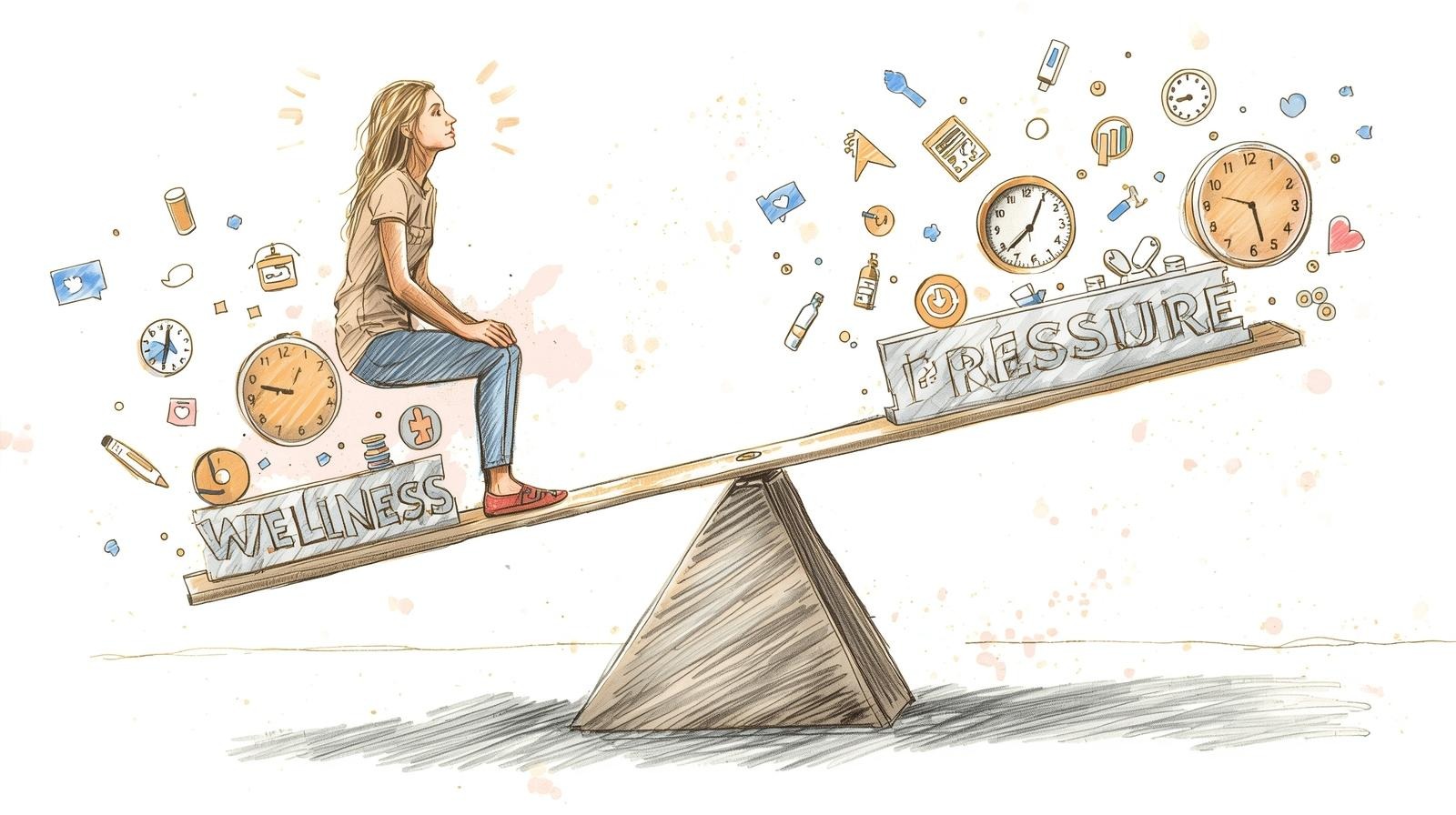
That’s not wellness. That’s pressure dressed in soft lighting.
When “wellness” becomes a status system, not a support system
It helps to say this out loud: wellness is an industry, not just an idea.
The Global Wellness Institute’s 2025 Global Wellness Economy Monitor reports the wellness economy reached a new peak of $6.8 trillion in 2024, with continued growth projections.
When a market is that large, it does not thrive on the message “you’re basically okay.” It thrives on the message “you’re almost okay, but not quite.” It thrives on a specific kind of insecurity: the sense that your body and your life are one purchase away from being acceptable.
McKinsey describes wellness as a massive market (often discussed as around $2 trillion) and notes that, for many consumers, wellness has become a daily, personalized practice rather than occasional activities or purchases.
Daily practice can be beautiful. Personalized care can be powerful. But cortisol culture twists those ideas into something harsher: daily monitoring becomes daily self-judgment. Personalized becomes “you’re responsible for fixing every uncomfortable feeling alone.”
Why cortisol culture feels so convincing when You’re exhausted
If you’re depleted, your brain wants certainty. It wants a single explanation that makes the chaos feel solvable. That’s why cortisol content can feel like relief at first. It gives your suffering a name. It gives you an action plan. It gives you the illusion of control.
But relief that depends on constant self-correction doesn’t stay relief. It becomes a loop.
Here is the cortisol culture loop, in plain language:
Pressure rises → You monitor yourself harder → You find “problems” → You try a protocol → You feel brief relief → Life stays demanding → Pressure rises again
And because you’re now monitoring yourself, every normal fluctuation becomes a threat.
A tired day becomes “dysregulation.”
A stressful season becomes “hormone imbalance.”
A human moment becomes “my nervous system is broken.”
This isn’t health literacy. It’s anxiety wearing the costume of education.

The social media amplifier: Education mixed with comparison
Social media is not neutral for the nervous system. It’s a comparison engine. And cortisol culture feeds on comparison because comparison creates urgency.
A systematic review on the impact of social media influencers on health outcomes concludes influencers can have both positive and negative impacts, with negative impacts seen consistently in areas like body image dissatisfaction, and with many studies showing methodological weaknesses.
Even when content is “informational,” it often lands inside a context of performative perfection: the creator who wakes up calm, drinks the right drink, eats the perfect breakfast, works out, journals, meditates, and smiles through it all. You try it. Your life doesn’t fit. You conclude you’re doing wellness wrong.
A 2023 scoping review on social comparison on social media and mental health maps how comparison processes show up in social media contexts and links them to mental health indicators.
So cortisol culture is not only about misinformation. It’s about a psychological environment where your baseline self begins to feel insufficient.
Self-tracking: When data turns into a verdict
Wearables and tracking tools can be useful. But in cortisol culture, they become moral instruments.
- Your sleep score becomes a prophecy.
- Your readiness score becomes your worth.
- Your resting heart rate becomes a reason to panic.
- Your HRV becomes proof you’re failing at rest.
A 2025 paper on healthism and digital self-tracking examines how self-tracking practices can reinforce an individualistic “health as personal responsibility” ideology, reshaping how people relate to health and accountability.
The problem is not data. The problem is data without compassion.
When numbers become a judge, the nervous system never gets the cue that it’s safe. It stays in performance mode.
Self-optimization: The “best version of yourself” trap
Cortisol culture often presents itself as healing, but it behaves like self-optimization: the endless project of upgrading your body, mind, habits, and identity.
A sociological analysis of self-optimisation describes it as a central contemporary trend, driven by discourses and practices that encourage individuals to pursue an “optimal imaginable version” of the self.
That “optimal version” sounds inspiring until you notice what it does in daily life.
It makes rest feel guilty.
It makes normal emotions feel like problems.
It makes your body feel like a project you can never finish.
And that creates the most painful irony of all: you begin chasing calm in a way that keeps you activated.
A table You can actually see: Pressure language vs care language
Below is a translation table you can return to when your brain starts speaking in cortisol-culture dialect. It’s not a diagnosis tool. It’s a gentleness tool.
| Cortisol-culture thought | What it’s really expressing | A care-based reframe you can live with |
|---|---|---|
| “My body is dysregulated.” | “I feel overwhelmed or unsafe.” | “My system is signaling for support, not perfection.” |
| “I need to fix my cortisol.” | “I want relief and control.” | “I need more recovery and fewer ongoing threats.” |
| “If I do the routine perfectly, I’ll heal.” | “I’m scared this will last forever.” | “Healing is nonlinear. Small steps still count.” |
| “I’m failing at self-care.” | “I’m carrying too much alone.” | “I deserve support, rest, and shared load.” |
| “I should be calmer by now.” | “I’m tired of feeling tense.” | “Calm comes from safety cues, not self-criticism.” |
If you felt your shoulders drop while reading the right column, that’s your nervous system recognizing a safer story.
Burnout gets misused in cortisol culture, and that matters
Online, burnout is often used as shorthand for “I’m exhausted.” But the World Health Organization defines burnout in ICD-11 as an occupational phenomenon resulting from chronic workplace stress that has not been successfully managed, characterized by exhaustion, mental distance or cynicism about the job, and reduced professional efficacy.
This definition matters for two reasons.
First, it reminds us that exhaustion is often tied to context, not personal failure. Second, cortisol culture frequently pulls experiences out of context and turns them into personal biological blame. It tells you to buy a supplement when you actually need workload changes, boundaries, or systemic support.
Stress isn’t only inside You. Sometimes it’s in the world.
If your body feels tense lately, it might not be because you “aren’t regulating hard enough.” It might be because the world feels unstable.
The American Psychological Association’s Stress in America 2024 report highlights major societal stressors reported by participants, including the future of the nation, the economy, and the presidential election as top stressors.
Naming reality is not negativity. Naming reality is regulation. When you stop blaming yourself for responding to a stressful world, you remove a layer of threat.
And removing threat is one of the most direct routes to calming the stress system.
The cortisol culture myth that keeps people stuck: “If I fix my body, my life will feel safe”
This is the hidden promise behind so many wellness protocols: “Do the right things and you’ll finally feel safe.”
But safety is not only a biological state. Safety is also a relational state, an environmental state, a financial state, a workload state, a nervous system state shaped by memory and meaning.
- If your schedule is punishing, your body will keep responding.\
- If your relationship is unstable, your body will keep responding.
- If you are lonely, your body will keep responding.
- If you are constantly comparing yourself, your body will keep responding.
Cortisol culture tells you to correct symptoms while ignoring the architecture of your life.
So let’s shift the focus.
Not “How do I lower cortisol?”
Instead: “How do I build a life that gives my body more reasons to exhale?”
A second table: Wellness as pressure vs wellness as support
| Wellness that increases “not enoughness” | Wellness that supports real calm |
|---|---|
| Rigid rules you fear breaking | Flexible rhythms that adjust to real life |
| Content that triggers fear and urgency | Education that reduces shame and panic |
| Tracking used to judge yourself | Tracking used gently, or paused when harmful |
| Self-care as consumption | Self-care as boundaries, rest, and help |
| Healing as an identity performance | Healing as a relationship with yourself |
| “Optimize everything” thinking | “Support what matters” thinking |
If your current wellness habits resemble the left side, you don’t need more discipline. You need a kinder strategy.
What actually helps, according to evidence (and why it works)
The goal here is not to drown you in studies. It’s to anchor you in approaches that repeatedly show benefits in research and feel human in practice.
Self-compassion: The opposite of cortisol culture
Cortisol culture runs on self-criticism: the constant internal message that you should be better, calmer, healthier, more healed, more optimized.
Self-compassion interrupts that message at the source.
A 2019 meta-analysis of randomized controlled trials found self-compassion interventions improved psychosocial outcomes across multiple measures.
A 2023 meta-analysis examining self-compassion-focused interventions found small to medium effects on reducing depressive symptoms, anxiety, and stress at posttest, with smaller effects at follow-up, while also noting risk of bias issues across studies.
Here’s the practical translation: self-compassion doesn’t magically erase stressors, but it reduces the secondary stress created by shame. It turns your inner voice from threat into support. And threat vs support is not just poetic language; it’s nervous system language.
Try this in a way that doesn’t become another task.
When you notice yourself spiraling into “I’m not enough,” pause and say, quietly: “Of course this feels hard.” Then add: “What would help me feel five percent safer right now?”
Five percent is deliberate. Cortisol culture demands transformation. Nervous systems trust increments.
Stress management interventions can influence cortisol, but the best ones don’t feel like punishment
A 2024 systematic review and meta-analysis on stress management interventions and cortisol levels concludes that interventions can positively influence cortisol levels, with mindfulness and relaxation interventions showing effectiveness, and with differences across cortisol measures.
Notice what this does and doesn’t mean.
It doesn’t mean you should chase cortisol numbers. It means practices that create genuine recovery cues can shift physiological stress patterns over time.
The keyword is genuine.
If meditation becomes something you “must do correctly,” it stops being a recovery cue and becomes performance. Sometimes the most regulating practice is the one you can do without trying to be impressive.
A slower exhale while waiting for the kettle.
A walk without tracking it.
A shower where you stop narrating your flaws.
A meal where you chew like you deserve to eat in peace.
Understanding daily cortisol rhythms reduces unnecessary fear
Remember that cortisol naturally fluctuates. It rises in the morning as part of normal circadian biology, and peaks after waking in many people. PMC
If you’ve been scared every time you hear “high cortisol,” this matters. A lot of fear online comes from treating normal physiology like pathology.
When your nervous system stops interpreting normal bodily variation as danger, calm becomes more accessible.

The “enoughness” approach: Rebuild calm by changing the architecture, not just the habits
Cortisol culture is obsessed with habits. The enoughness approach is obsessed with architecture.
Because the nervous system doesn’t only respond to what you do for ten minutes in the morning. It responds to what your life feels like all day.
Think of your life as a building with four rooms. If one room is on fire, a scented candle in another room won’t fix the building. It might help, but it can’t carry the whole structure.
Here are the four rooms.
Room 1: Load (what you carry)
Load includes tasks, responsibilities, emotional labor, deadlines, caretaking, decision fatigue, financial pressure, and the invisible effort of staying “fine.”
Allostatic load research helps frame why this matters: when chronic stress exposure persists across systems, the cumulative physiological burden grows.
So an enoughness question is: what can be reduced, delegated, delayed, simplified, or shared?
Not in one dramatic life overhaul. In one small structural change at a time.
Room 2: Safety cues (what tells your body it can exhale)
Safety cues are signals your nervous system reads as “I am not under immediate threat.” They can be sensory, relational, or behavioral.
A consistent bedtime.
Warm light at night.
Predictable meals.
A calmer tone in your self-talk.
A home environment with fewer alarms, fewer open tabs, fewer constant pings.
This is where cortisol culture gets it wrong: it assumes safety is earned through performance. In reality, safety is communicated through repetition and kindness.
Room 3: Connection (who helps regulate You)
Nervous systems regulate in relationship. This is not a weakness. It is biology.
Cortisol culture often isolates people because it frames wellness as a solo project: “Fix yourself. Heal yourself. Optimize yourself.”
But many people do not need more solo routines. They need more co-regulation: safe friendships, honest conversations, a therapist, a support group, a community, or simply one person they can be real with.
Room 4: Meaning (why Your life feels worth the effort)
When meaning is thin, the body experiences life as grind. When meaning is present, stress becomes more tolerable because it’s attached to something that matters.
This is one reason self-optimization can feel so empty: it focuses on improving the self as a product, not building a life as a home.
A third table: Signs Your wellness is helping vs signs it’s becoming another pressure system
| If wellness is helping | If wellness is becoming cortisol culture |
|---|---|
| You feel more spacious, even if life is still hard | You feel more monitored, tense, and behind |
| You can miss a day without spiraling | Missing a day triggers guilt or panic |
| Habits adapt to your real life | Your life is forced to adapt to habits |
| You feel kinder toward your body | You feel more critical toward your body |
| You seek support when needed | You try to fix everything alone |
| You’re learning nuance | You’re chasing certainty and quick fixes |
If you’re on the right column, treat that as information, not shame. It simply means your current approach needs to become more human.
The nonconventional part: Stop trying to “regulate” and start trying to “lower the stakes”
A lot of modern wellness language tells you to regulate your nervous system, as if your job is to become calm no matter what is happening.
But what if the real goal is not regulation as performance?
What if the real goal is lowering the stakes of your daily life?
Lowering the stakes looks like this:
- Fewer urgent commitments.
- More honest boundaries.
- Less comparison exposure.
- Less self-surveillance.
- More recovery built into ordinary moments.
- More help.
That might not sound glamorous, but it’s often what actually works.
Influencer wellness: Why it so often makes You feel worse, even when it’s “positive”
Influencers can share genuinely helpful content. The issue is structural: online systems reward certainty, urgency, and emotional hooks.
The systematic review on social media influencers and health outcomes notes both potential benefits and consistent negatives in areas like body image dissatisfaction.
Add social comparison dynamics on top, and you get a potent mix: you don’t just learn information, you absorb a ranking system.
In cortisol culture, even calm becomes competitive.
Who has the cleanest diet.
Who has the most aesthetic morning routine.
Who has the best supplements.
Who has the softest life.
The antidote is not to become skeptical of everything. The antidote is to become loyal to your own nervous system.
If content consistently makes you feel inferior, urgent, or defective, it’s not education for you. It’s activation for you.
A short, visible reset plan presented as a table (not a checklist)
This is designed to be doable without turning into another job. Read it like an experiment, not a rulebook.
| Focus | What you practice | What you’re teaching your nervous system |
|---|---|---|
| Notice pressure | Catch one “I should…” thought daily and replace it with “I’m allowed to be human.” | “I’m not under judgment.” |
| Add one recovery cue | Choose one tiny cue you can repeat: slower exhale, warm drink, short walk, music, sunlight. | “Safety can be small and consistent.” |
| Subtract one stressor | Remove one nonessential drain this week: one extra scroll, one obligation, one people-pleasing yes. | “My needs matter in the design.” |
| Choose self-compassion in a hard moment | Respond to one mistake with a supportive tone instead of correction. | “I won’t add threat to threat.” |
| Prioritize connection | Have one honest exchange with someone safe, even if brief. | “I don’t have to hold everything alone.” |
| Redefine wellness | Write one sentence you can live by: “Wellness is support, not self-punishment.” | “My worth isn’t a metric.” |
If you do none of it perfectly and still feel slightly softer, that counts. The goal is not achievement. The goal is relief.
A final truth that cortisol culture doesn’t want You to know
Cortisol culture makes you think calm is something you earn by doing everything right.
Real calm is something your body receives when life becomes safer and kinder, even in small ways.
If your wellness routine is making you feel like you’re never enough, it’s not evidence that you’re failing. It’s evidence the routine is not aligned with your humanity.
You do not need to become a perfectly regulated person to deserve peace.
You are allowed to build wellness that feels like a home, not a performance review.
Related posts You’ll love
- The cortisol culture detox: A 14 day nervous system reset for real relief (no tracking, no perfection) FREE PDF!
- Self diagnosis spiral: When mental health content makes You more anxious
- AI companionship: Why talking to bots can feel safer than people (and how to keep it healthy)
- Doom spending: The psychology behind buying things when You’re anxious, and how to break the cycle without shame
- Why You feel weird around “effortless” Women: The social comparison science behind that reaction
- The friendship audit: When Your circle is built on stress, not support (a research informed reset that feels like relief)
- Why online advice makes You feel worse sometimes: The hidden psychology of information overload, comparison, and “instant therapy” culture
- The hidden stress in multitasking culture: Why doing it all is quietly draining Your mind and body

FAQ: Cortisol culture
-
What is “cortisol culture”?
Cortisol culture is the modern pattern where wellness language turns everyday stress into a personal defect and makes you feel like you must constantly “fix” your body to be acceptable. It often thrives in large wellness markets that reward urgency and certainty, not nuance.
-
Is cortisol always bad for you?
No. Cortisol is essential for life and supports many normal functions, including circadian rhythm and adaptive responses to challenges. The confusion is that cortisol has many roles, so it’s easy to label it “the bad stress hormone” even when it’s doing normal, necessary work.
-
What is the cortisol awakening response, and why does it matter?
The cortisol awakening response (CAR) is the typical rise in cortisol after waking, often peaking around 30–60 minutes after awakening for many people. It’s tied to circadian biology and remains robust even when accounting for sleep variables, which is why “morning cortisol” isn’t automatically a sign something is wrong.
-
What are “high cortisol symptoms,” and can you tell from how you feel?
Many symptoms people blame on “high cortisol” (fatigue, anxiety, poor sleep, cravings, brain fog) are real but nonspecific, meaning they can come from many causes. If you truly need to evaluate cortisol medically, clinicians use validated tests (blood, saliva, or urine) rather than guessing from symptoms alone.
-
How do doctors actually test cortisol?
A cortisol test measures cortisol in blood, saliva, or urine and is used to help diagnose specific adrenal-related disorders. The right test and timing depend on the clinical question, which is why DIY testing based on trends often creates more fear than clarity.
-
Is “adrenal fatigue” real?
Most mainstream medical sources do not recognize “adrenal fatigue” as a legitimate diagnosis, even though the symptoms people describe are real and deserve attention. If you’re exhausted, it’s better to rule out common medical issues with a clinician and address chronic stress and recovery needs without chasing a label.
-
Can smartwatches or wearables measure cortisol?
Most consumer wearables do not directly measure cortisol. They typically estimate stress using proxies like heart rate variability (HRV), which reflects autonomic nervous system activity but is not the same thing as cortisol and is not a standalone “stress truth machine” in real-world settings.
-
Do stress-management practices actually lower cortisol?
Evidence suggests stress-management interventions can influence cortisol measures, with mindfulness and relaxation interventions often showing beneficial effects in meta-analytic research. The key is consistency and fit: practices work best when they feel supportive, not like another performance test.
-
Why does wellness content on social media make me feel more stressed?
Because it can mix education with comparison, urgency, and subtle shame. Systematic review evidence finds influencers can have both positive and negative impacts on health outcomes, with negative effects consistently appearing in body image-related studies. Social comparison processes on social media are also linked with mental health outcomes in the broader research landscape.
-
Is burnout the same as “high cortisol”?
Not exactly. Burnout is defined by the World Health Organization as an occupational phenomenon related to chronic workplace stress that hasn’t been successfully managed, and it’s not classified as a medical condition. Cortisol may be discussed in stress biology, but burnout is fundamentally about context, load, and recovery, not a single hormone score.
-
What’s the most evidence-supported mindset shift if wellness makes me feel “not enough”?
Self-compassion is one of the most strongly supported shifts: meta-analyses of randomized controlled trials show self-compassion interventions improve psychosocial outcomes and can reduce distress (including depression, anxiety, and stress), though study quality varies. It’s a direct antidote to cortisol culture’s self-criticism loop.
-
What should I do if I suspect my stress is becoming a health problem?
Start with basics that reduce fear and increase support: talk to a healthcare professional if symptoms are persistent or severe, rule out common medical contributors, and prioritize sustainable recovery cues (sleep consistency, nourishment, gentle movement, boundaries, and social support). If your stress is fueled by societal uncertainty, know you’re not alone—large surveys report political and economic concerns as major stressors.
Sources and inspirations
- McEwen, B. S. (2019). What Is the Confusion With Cortisol?
- Bowles, N. P., . (2022). The circadian system modulates the cortisol awakening response.
- Obradović, J., (2021). Allostatic load: Developmental and conceptual considerations in a multi-system physiological indicator of chronic stress exposure.
- World Health Organization. (2019). Burn-out an “occupational phenomenon” (ICD-11 definition and scope).
- American Psychological Association. (2024). Stress in America 2024: A nation in political turmoil.
- Global Wellness Institute. (2025). 2025 Global Wellness Economy Monitor (wellness economy at $6.8T in 2024).
- McKinsey & Company. (2025). The $2 trillion global wellness market gets a millennial and Gen Z glow-up.
- Powell, J., (2024). The impact of social media influencers on health outcomes: Systematic review.
- Arenz, A., Meier, A., & Reinecke, L. (2023). Social comparison on social media and mental health: A scoping review.
- De La Fabián, R., (2025). Healthism and Digital Self-Tracking.
- Nehring, D., & Röcke, A. (2024). Self-optimisation: Conceptual, discursive and historical perspectives.
- Rogerson, O., (2024). Effectiveness of stress management interventions to change cortisol levels: Systematic review and meta-analysis.
- Ferrari, M., (2019). Self-Compassion Interventions and Psychosocial Outcomes: A Meta-Analysis of RCTs.
- Han, A., (2023). Effects of self-compassion interventions on reducing depressive symptoms, anxiety, and stress: Meta-analysis.


Leave a Reply