Table of Contents
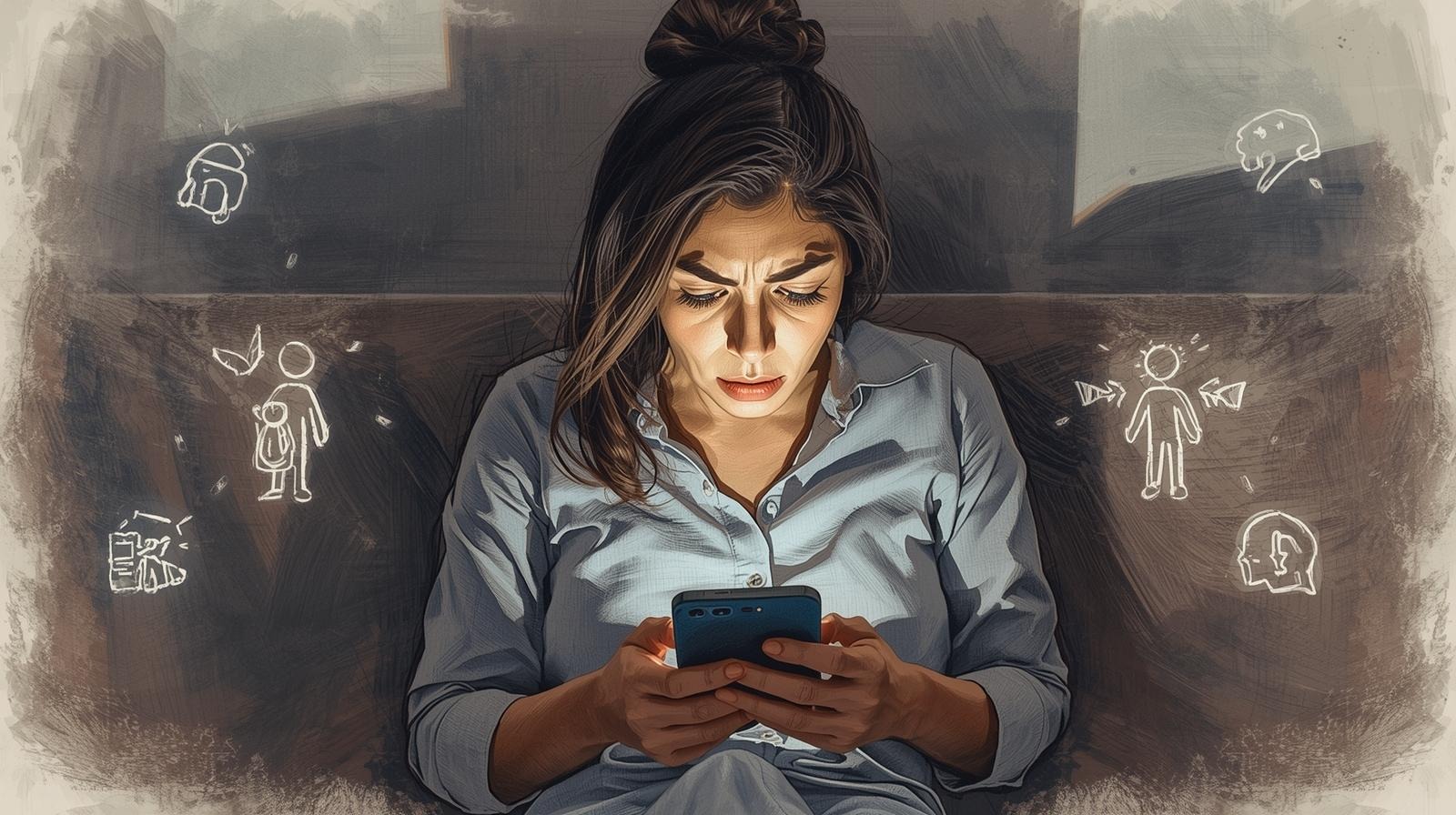
You open Your phone for relief, and somehow You leave with heavier thoughts
You are not scrolling because you are bored. You are scrolling because you are trying to care for yourself.
Maybe you had a hard conversation and you want to understand what just happened. Maybe your chest feels tight and you want reassurance. Maybe you keep thinking, “Is this normal?” and your brain reaches for the fastest path to clarity: search.
At first it can feel genuinely helpful. You hear language that finally fits. You see someone describe a feeling you have never been able to explain. You save a post and think, “This is it. This is the missing piece.”
And then the shift happens.
Your body is tense. Your mind is louder. You have five tabs open and none of them feel like an answer. You start questioning your relationships, your past, your personality, your entire nervous system. You might even feel embarrassed that you feel worse after “doing something good” like learning and self reflecting.
If this is you, nothing about it is silly. Online advice can make you feel worse for reasons that are psychological, predictable, and deeply human. The internet does not only deliver information. It delivers volume, speed, emotional tone, and social comparison, all at once. Your nervous system experiences that mix in a very particular way.
This article is here to give you a map that feels practical, not preachy. Not a moral lecture about screen time. Not a dramatic “delete every app” ultimatum. A map.
The central paradox: Advice looks like clarity, but Your brain often experiences it as uncertainty
Most people think the problem is “bad advice.” Sometimes it is. But even good advice can make you feel worse if the way you consume it creates overload and threat.
Your brain does not measure help by how confident the content sounds. It measures help by whether the content reduces uncertainty in a way that feels safe and usable in your real life.
Online advice often increases uncertainty because it stacks inputs without integration:
- You hear ten explanations for one symptom.
- You recognize yourself in seven different labels.
- You learn twenty coping tools and cannot choose one.
- You watch a clip that resonates, and the next clip contradicts it, and now you distrust your own perception.
When uncertainty rises, the nervous system often responds with urgency. Urgency feels like “I need more information now.” So you search again. The loop tightens.
In research on repeated online health information searching, a systematic review and meta analysis found positive associations between health anxiety, online health information seeking, and cyberchondria, which is a pattern where repeated searching increases distress instead of soothing it.
Even if your searches are about emotions rather than physical symptoms, the mechanism can be similar: reassurance seeking that accidentally trains your brain to treat uncertainty as danger.
The online advice spiral, explained in one line
Here is the pattern many people get trapped in, even when they are smart, self aware, and genuinely motivated to heal:
Discomfort → Search → Overload → Comparison → Self doubt → More searching
Or if you want the nervous system version:
Activation → “I need certainty” → too many inputs → confusion and shame → more activation → “I need certainty”
This is not a personal failure. It is a feedback loop.
And because algorithms tend to feed you more of what you linger on, the loop can become self sustaining.
A quick self check: What kind of “worse” is it?
Sometimes you feel worse because you learned something true that is emotionally heavy, but grounding. Other times you feel worse because your system is overloaded, dysregulated, or pulled into compulsive checking. These two experiences feel different in the body.
Use this table like a mirror, not a test.
| After consuming advice, you feel… | This “worse” might be… | What helps next |
|---|---|---|
| Emotional but clearer, like something clicked | Integrative insight | Pause, write one sentence of what you learned, take one small action |
| Activated, restless, unable to stop searching | An advice spiral starting | Soothe first, reduce inputs, return to one trusted source |
| Ashamed, like you are failing at healing | Comparison contamination | Step away from transformation content, focus on context based support |
| Foggy, overwhelmed, contradictory thoughts | Information overload | Choose one question only, one resource only, then stop |
| Obsessive checking of symptoms or labels | Reassurance seeking loop | Shift from content to assessment, support, or a structured plan |
If your pattern looks like overload, compulsion, or shame, the solution is rarely “find the perfect creator.” The solution is almost always “change the relationship you have with advice.”
Why online advice can backfire: The psychology underneath the scroll
1. Information overload does not feel like “too much info,” it feels like internal pressure
When you take in more inputs than your brain can integrate, your attention fragments. You start feeling behind, like you need to catch up to your own life. The body can interpret that as threat because unfinished cognitive loops are uncomfortable and arousing.
In studies of social media overload, researchers have found links between overload and anxiety, including pathways where overload increases information strain and risk perception.
So the reason you feel worse might be simple: you are trying to heal while your brain is drowning in open loops.

2. Algorithms are not designed to calm You, They are designed to keep You engaged
A caring friend will notice you getting anxious and slow down with you. An algorithm will notice you getting anxious and show you more content that holds your attention.
That matters because emotional arousal is sticky. The more activated you are, the more “important” content feels, and the harder it is to stop.
This is one reason you can finish a scrolling session feeling like you did a lot, but also feeling strangely dysregulated. Your system worked hard, but it did not land anywhere safe.
3. Social comparison turns advice into a verdict
A lot of online advice is packaged as transformation: healed era, glow up, “I stopped doing this and everything changed.” Even when the message is kind, your nervous system might translate it into a silent accusation: “Other people can fix themselves. Why can’t I?”
A systematic review of Instagram use and mental health indicators highlights that exposure and patterns of use can relate to wellbeing, anxiety, depression, stress, and body image outcomes, and social comparison is a frequently discussed mechanism in this space.
When advice becomes comparison, it stops being guidance and starts being a scoreboard.
4. Doomscrolling can happen in “healing content,” not only in news
Doomscrolling is repetitive consumption that increases distress, even when the topic is “self improvement.” If you are watching clip after clip about trauma signs, narcissism, attachment wounds, and “red flags,” you might be learning, but you might also be training your nervous system to expect danger everywhere.
Research developing and testing a Doomscrolling Scale found associations with psychological distress, and analyses suggested distress mediates relationships between doomscrolling and wellbeing indicators.
A key clue is how your body feels after. If you feel more suspicious, more urgent, more helpless, you are not learning, you are spiraling.
5. Self diagnosis content creates relief first, then fear
There is a particular emotional whiplash that happens with symptom based content:
First: relief, because a label finally gives shape to your experience.
Then: hyper vigilance, because your brain starts scanning for proof.
Then: fear, because everything starts looking like proof.
This is close to what cyberchondria researchers describe in health searching contexts: repeated searching that increases anxiety rather than soothing it.
Even if a label is accurate, the process of arriving at it through short form content can be destabilizing because it skips assessment, nuance, and containment.
6. Misinformation and overgeneralization create confusion that feels like self betrayal
Not all harmful advice is obviously false. Some of it is half true and delivered with confidence. That is what makes it persuasive.
A review on mental health misinformation on social media suggests misinformation is common, though prevalence varies across disorders and treatment types, and it highlights how personal experience is often presented in ways that blur the line between story and fact.
When you realize advice is inconsistent, your brain rarely concludes calmly, “Some content is inaccurate.” It often concludes, “I can’t trust my judgment.” That loss of internal trust is deeply anxiety producing.
7. Context collapse: Advice for “people” might not fit Your life
Online advice often assumes a generic person with stable time, stable safety, stable money, stable support, stable sleep. You are not a generic person. You are a full context.
When advice ignores context, it can create a painful double bind:
If you try it and it fails, you blame yourself.
If you do not try it, you fear you are avoiding growth.
This is one of the quiet ways advice becomes shame.
8. Choice overload turns coping into decision paralysis
When you are already stressed, too many options can make you freeze. The internet offers hundreds of tools: breathwork, tapping, vagus nerve hacks, inner child journaling, somatic shaking, exposure therapy, supplements, routines, affirmations, scripts, boundaries.
It is not that options are bad. It is that your nervous system cannot digest them all at once. So you keep looking for the perfect choice, which keeps you stuck in consumption.
9. The internet blurs the difference between structured support and random content
This is important: online mental health resources can help. But the helpful ones tend to be structured, guided, paced, and designed with safety in mind.
A meta analytic review of online guided self help interventions found evidence that guided programs can reduce depressive symptoms among college students, while also noting evidence quality varies and more rigorous research is needed.
At the same time, a systematic review on the safety of digital mental health interventions emphasizes that safety assessment and reporting can be inconsistent and needs standardization.
And a 2024 systematic review and meta analysis on adverse events in clinical trials of mental health apps found that only a subset of trials reported adverse events, highlighting underreporting and the need for better monitoring.
Random advice content feels like care because it uses therapeutic language, but it often lacks the structure that makes care stabilizing.
Table: “Advice Types” and how they land in Your nervous system
This table helps you notice the difference between content that informs you and content that hijacks you.
| Advice style you consume | What it often does to your nervous system | What to do with it |
|---|---|---|
| Quick fix clips that promise fast healing | Creates urgency, then disappointment | Treat as inspiration only, not instruction |
| Symptom lists and “signs you have…” content | Triggers scanning and hyper vigilance | Limit to one trusted source, avoid repeated checking |
| Transformation stories and glow up narratives | Activates comparison and shame | Replace with process based education or real support |
| Deep psychoeducation with nuance | Can calm through understanding | Read slowly, take notes, stop after one section |
| Structured programs with guidance | Supports pacing and integration | Use as a “meal,” not endless snacks |
| Community comment sections | Can soothe or intensify depending on tone | Leave if it increases fear, stay if it increases groundedness |
A nonconventional framework: The advice nutrition label
Imagine every piece of advice came with a label. Not calories, but psychological ingredients.
When you start feeling worse, it often means the label is full of stimulants: urgency, certainty, identity hooks, fear, and comparison.
Use this table as a mental “nutrition label” you can apply in real time.
| Ingredient on the label | If it’s high, you might feel… | Green flag version sounds like… |
|---|---|---|
| Certainty without nuance | pressured, small, wrong | “This is one possibility, context matters” |
| Urgency and fear | activated, compulsive | “Take what fits, slow is allowed” |
| One size fits all rules | ashamed when it doesn’t work | “Different tools work for different people” |
| No sources, only confidence | confused later | “Here’s where this idea comes from” |
| Identity hooks and labels | stuck, overly self focused | “A label can guide, but it’s not your whole self” |
| Comparison bait | behind, defective | “Your pace is not a problem to solve” |
If you want one sentence to keep: Advice that calms is usually slower. Advice that hijacks is usually louder.

The “Soothe → Choose → Apply → Stop” protocol
Most advice spirals are not solved by smarter research. They are solved by a better sequence.
Here is a sequence that respects how your nervous system learns:
Soothe → Choose → Apply → Stop
Notice the last step. Stop. Integration requires stopping.
Soothe
Before you search, bring your body down a notch. Not perfect calm, just a notch.
Try this as a simple, non dramatic reset: breathe in normally, then exhale a little longer than usual, and do it three times. While you do it, name what is happening: “I am seeking certainty because I feel unsettled.”
This is not cheesy. Naming reduces the sense of mystery, and mystery is fuel for anxiety.
Choose
Choose one question only. Not your whole life. One question.
Then choose one trusted source only for that question, for today. The internet trains you to gather, but your brain heals through narrowing.
Apply
Turn advice into one experiment that you can actually do in your real day.
Not ten tools. One experiment.
Example: If the advice is about anxiety, pick one grounding method and do it twice a day for three days, then reassess. Your brain learns from repetition, not from variety.
Stop
Stopping is the protective boundary that turns content into care. Without stopping, you are not integrating. You are consuming.
What to do when You are already spiraling
Sometimes you realize too late that you are in it. You have watched fifteen videos. You have saved seven posts. Your heart feels tight. Your mind is racing.
In that moment, do not ask yourself to be disciplined. Ask yourself to be kind and strategic.
Here is a simple arrow you can follow:
Spiral detected → reduce stimulation → restore agency → seek human or structured support
“Reduce stimulation” can be as small as turning the volume off, putting the phone face down, or stepping into a different room. Your nervous system responds to small cues.
“Restore agency” means doing one embodied action that reminds your brain you are not trapped in thoughts. A glass of water. A shower. A slow walk. A short tidy of one surface. Agency is calming.
“Seek human or structured support” matters because spirals are often about aloneness with uncertainty. The internet offers company without attunement. A real person, or a structured program, can offer containment.
This is also where it helps to remember that quality varies widely in digital mental health tools, and safety reporting is inconsistent, so choosing structured, reputable resources is not snobbery, it is self protection.
Why TikTok and short form “therapy talk” can feel so convincing
Short form content is designed to be felt quickly. That can be comforting when you are lonely or confused.
But short form mental health content often compresses nuance into certainty, and certainty is emotionally soothing in the moment even when it is not accurate.
Research on youth use of TikTok for mental health information suggests young people use it to learn, cope, and connect, especially during stressful periods, which helps explain why it feels valuable.
At the same time, research and professional discussion highlight concerns about misinformation and disinformation in mental health content ecosystems, including on TikTok, and recommend better psychoeducation practices.
So the goal is not fear. The goal is discernment.
You can let the internet be a doorway, without letting it become your therapist, your diagnostician, and your inner voice.
The digital detox question, handled with nuance
A break can help, but it is not a cure all.
A 2024 systematic review and meta analysis on digital social media detox interventions found a significant reduction in depressive symptoms, while effects on broader outcomes like overall wellbeing, life satisfaction, and stress were not consistently significant.
That pattern makes sense: reducing exposure can reduce some symptoms, especially those driven by overload and comparison, but deeper needs like loneliness, trauma, or chronic stress may require more than removal. They require replacement.
If you take a break, make it a replacement plan:
Replace the time with one stabilizing input that is slower than scrolling.
A book chapter.
A single long form article from a credible source.
A guided program.
A walk with a friend.
A therapy session or group.
A consistent sleep routine.
Your brain does not just need less. It needs different.
There is also emerging work testing specific short detox interventions with measurable outcomes, including a 2025 study in JAMA Network Open reporting reduced anxiety, depression, and insomnia symptoms after a one week social media detox intervention among young adults.
You do not need a perfect detox. You need a pattern that gives your mind room to settle.
A closing truth that might land gently
If online advice makes you feel worse sometimes, it does not mean you are dramatic or weak. It means your brain is trying to protect you from uncertainty, and the internet is giving your brain a firehose instead of a glass of water.
Information is not the same as care.
Care is paced. Care is contextual. Care is integrated. Care ends, so your nervous system can digest it.
So if you want a simple, humane rule to carry forward, try this:
- If advice increases your urgency, slow down.
- If advice increases your shame, narrow your sources.
- If advice increases your confusion, stop collecting and start experimenting.
- If advice increases your fear, seek containment, not more content.
Your healing is not a performance for an algorithm.
It is a relationship with yourself.
Related posts You’ll love
- The anti advice spiral reset: 10 unusual exercises that turn online advice into real relief instead of more anxiety
- Cortisol culture: When “wellness” becomes another way to feel not enough
- Self diagnosis spiral: When mental health content makes You more anxious
- AI companionship: Why talking to bots can feel safer than people (and how to keep it healthy)
- Doom spending: The psychology behind buying things when You’re anxious, and how to break the cycle without shame
- Why You feel weird around “effortless” Women: The social comparison science behind that reaction
- Why personal obsessions can be more healing than advice: The psychology of self-directed healing
- The privacy safe parent: How to protect under 16 teens online without turning into a surveillance system

FAQ: Why online advice makes You feel worse sometimes
-
Why does online advice make me feel worse instead of better?
Because it often increases uncertainty and emotional activation rather than reducing it. When you consume lots of conflicting tips, labels, and “signs,” your brain can shift into threat mode and start searching for more certainty, which can intensify anxiety instead of soothing it. Research on repeated online health information seeking shows that higher health anxiety is associated with more online searching and with cyberchondria, a pattern where searching becomes distressing.
-
What is “information overload anxiety,” and what does it feel like?
Information overload anxiety is the stress response that can happen when you take in more guidance than your brain can integrate. It often feels like mental noise, decision paralysis, urgency to “figure it out,” and a lingering sense of being behind. Overload research in social media contexts has linked overload/strain pathways with anxiety outcomes.
-
Can mental health content on social media actually increase anxiety?
Yes, it can, especially when it encourages constant scanning for symptoms, promotes certainty without nuance, or triggers comparison and urgency. Even when some posts are helpful, the volume and emotional tone can keep your nervous system activated, which makes you feel worse over time rather than more regulated.
-
What is doomscrolling, and why is it so hard to stop?
Doomscrolling is repetitive consumption of distressing content that keeps you engaged while increasing psychological distress. It can happen with news, but it can also happen with “healing content” if it leaves you more alarmed, more suspicious, or more helpless. The Doomscrolling Scale research links higher doomscrolling with higher psychological distress and lower wellbeing indicators.
-
What is cyberchondria, and does it apply to mental health searches too?
Cyberchondria refers to excessive or repeated online searching for health information that becomes distressing or anxiety provoking. The evidence base specifically focuses on health anxiety and online health searching, but many people experience a similar loop with mental health content: discomfort → searching → temporary relief → more worry → more searching. A systematic review and meta analysis found positive correlations between health anxiety, online health information seeking, and cyberchondria.
-
Why does self diagnosis content feel so accurate?
Because it often uses broad, relatable patterns and confident language, which can create a powerful sense of recognition. Recognition can be validating, but it is not the same thing as clinical assessment or a full understanding of context, history, and impairment. Research reviewing mental health misinformation on social media highlights how complex topics can be oversimplified or blurred with personal experience presented as universal truth.
-
How do I know if online advice is trustworthy?
Look for signals of nuance, limits, and sources. Trustworthy guidance typically acknowledges individual differences, avoids one size fits all certainty, and points to evidence or established clinical frameworks. Misinformation reviews emphasize that false or misleading content exists, and that the field needs clearer standards and better research.
-
Should I take a social media detox if online advice makes me feel worse?
A short detox can help if your distress is driven by overload, comparison, or compulsive checking. A cohort study in JAMA Network Open reported that a 1 week social media detox was associated with reductions in anxiety, depression, and insomnia symptoms among young adults, though questions remain about how durable effects are and how they generalize to other groups.
-
How can I use online advice without spiraling?
Use a simple sequence that protects your nervous system: Soothe → Choose → Apply → Stop. Soothe means you regulate first, even briefly. Choose means one question and one trusted source for the day. Apply means you try one small experiment in real life. Stop means you end the session so your brain can integrate, instead of escalating into more searching.
-
When should I stop searching and talk to a professional?
If advice consumption is increasing panic, obsessive checking, sleep disruption, hopelessness, or interfering with daily functioning, it’s a strong sign to move from content to care. Professional support can provide assessment, personalization, pacing, and containment that short form advice cannot reliably offer, especially when uncertainty is fueling distress.
Sources and inspirations
- McMullan RD, Berle D, Arnáez S, Starcevic V. The relationships between health anxiety, online health information seeking, and cyberchondria: systematic review and meta analysis. Journal of Affective Disorders (2019).
- Satıcı SA, Tekin EG, Deniz ME, Satıcı B. Doomscrolling Scale and its association with psychological distress, social media use, and wellbeing. Current Psychology (Epub 2022; published 2023).
- Faelens L, Hoorelbeke K, Cambier R, The relationship between Instagram use and indicators of mental health: a systematic review. Computers in Human Behavior Reports (2021).
- Wang Y., Social media overload and anxiety among university students during the COVID 19 Omicron wave lockdown: mediation via information strain and risk perception. International Journal of Public Health (2023).
- Starvaggi I, Dierckman C, Lorenzo Luaces L. Mental health misinformation on social media: review and future directions. Current Opinion in Psychology (2024).
- Hudon A, Perry K, Plate AS, Navigating the maze of social media disinformation on psychiatric illness and charting paths to reliable information: observational analysis. Journal of Medical Internet Research (2025).
- Taher R, Hsu CW, Hampshire C, The safety of digital mental health interventions: systematic review and recommendations. JMIR Mental Health (2023).
- Linardon J, Fuller Tyszkiewicz M, Firth J, Systematic review and meta analysis of adverse events in clinical trials of mental health apps. npj Digital Medicine (2024).
- Ramadhan RN, Impacts of digital social media detox for mental health: systematic review and meta analysis. (2024).
- Turuba R, Exploring how youth use TikTok for mental health information and support. JMIR Infodemiology (2024).
- Ma L, Meta analytic review of online guided self help interventions for depressive symptoms among college students. (2021).
- Calvert E, Social media detox and youth mental health. JAMA Network Open (2025).




Leave a Reply