Table of Contents
There is a particular kind of anger that never gets a dramatic scene.
It answers the email politely. It remembers the birthday. It says, “No worries,” when there are, in fact, several worries. Then it stands in the kitchen at 9:47 p.m., looking at something as ordinary as an empty milk carton, and thinks: If one more person asks me one more thing, I might actually scream.
And now, apparently, you can book a trip for that.
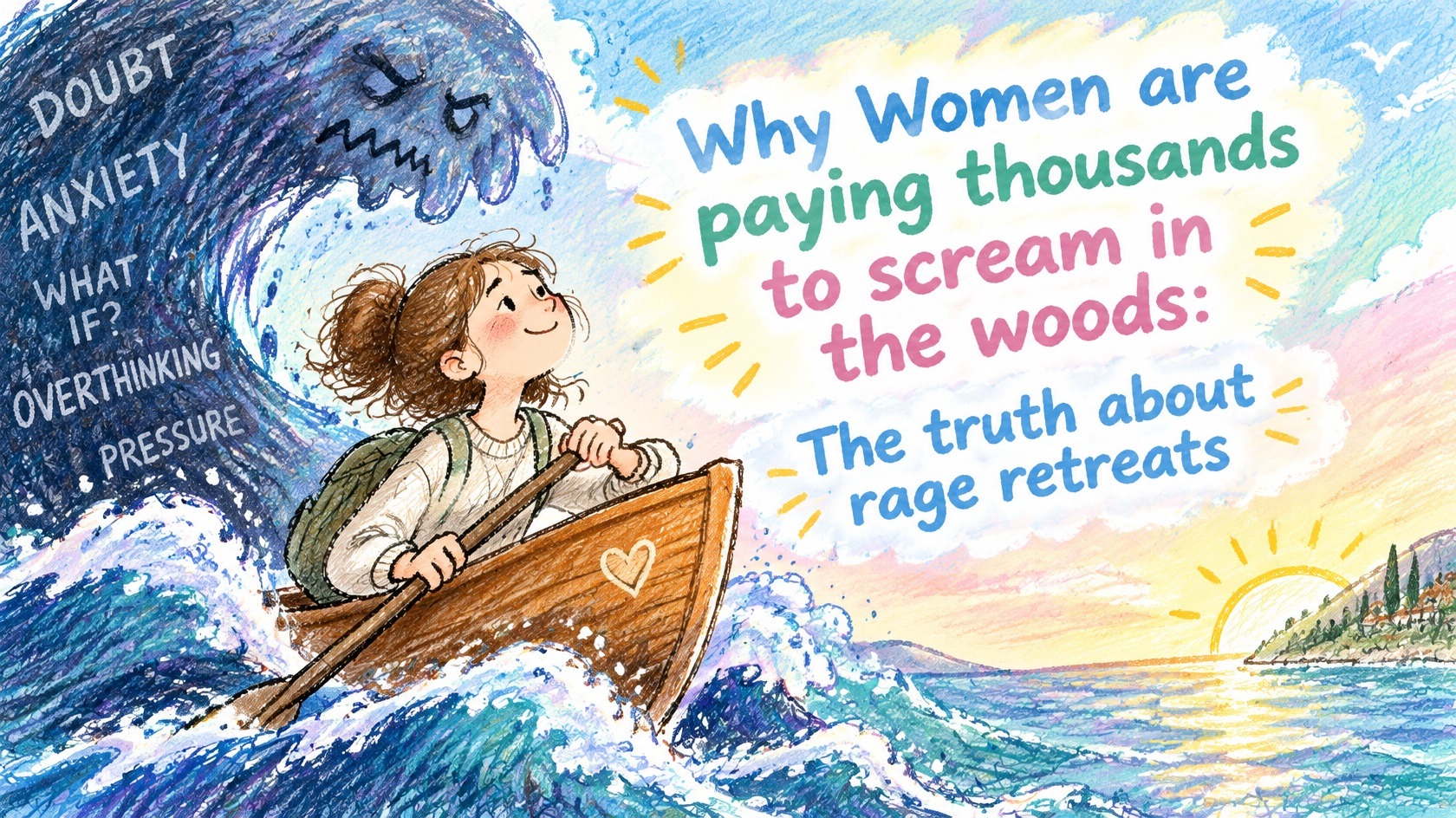
Women screaming in the woods have become an irresistible wellness story. There is a forest. There is a group. Sometimes there are sticks being swung against the ground. And somewhere in the coverage, there is a price tag large enough to make you stop scrolling.
My first question is not why anyone would want to scream.
My first question is why getting permission to do it might feel like something worth buying.
Because underneath the dramatic images, I see a much more familiar tension: wanting to express anger without immediately having to explain, soften, apologize for, or recover from everyone else’s reaction.
That does not mean every rage retreat is helpful. It certainly does not mean screaming is a scientifically established way to heal trauma. But I think the appeal deserves a better conversation than either “This is ridiculous” or “Every woman needs this.”
Women’s rage retreats are wellness experiences that may include guided anger expression alongside other activities. Some women may be drawn to the privacy, companionship, and time away. Reported prices in the thousands have referred to whole retreat packages, while research does not support the simple claim that intensifying anger reliably makes it disappear.
Let’s look at what is actually being sold, what the research says, and what you might be craving if the idea of disappearing into a forest sounds surprisingly reasonable.
What are Women’s rage retreats?
A rage retreat is an organized wellness experience that gives participants space to explore or express anger. Depending on the provider, that might involve shouting, movement, group discussion, or symbolic activities.
In May 2024, The Independent reported on rage rituals associated with Mia Banducci, known as Mia Magik, describing retreats priced around $2,000 to $4,000. Those prices covered experiences lasting several days with multiple activities. They were not simply a charge for standing beside a tree and screaming. These are historical reported prices, not current booking quotes.
That distinction matters to me.
“Women spend thousands to scream” makes an excellent headline. “Women purchase a retreat that includes an anger ritual” is less exciting, but more accurate.
Still, the scream is the part that catches our attention. Nobody is sharing a viral clip of a woman enjoying the deeply luxurious experience of eating lunch before it goes cold.
I also want to separate three things that are easily blurred together:
→ A retreat is an organized experience.
→ A ritual is an activity with symbolic meaning.
→ Psychotherapy is a professional service with a defined clinical scope.
A retreat can be meaningful without being therapy. A ritual can feel powerful without proving a medical claim. An engaging facilitator can create a memorable experience without being qualified to treat psychological difficulties.
I would keep those distinctions in view before handing over any money.
Why the idea makes more sense than the headline suggests
Imagine saying, “I am angry about what happened,” and receiving this response:
“What happened?”
Now imagine receiving this one:
“Why are you being so aggressive?”
Those conversations go in completely different directions.
In the first, there is room for the problem. In the second, your emotional presentation becomes the problem.
I think that difference helps explain the attraction of a place where anger is expected rather than treated as a social emergency.
And there is research behind the concern that anger can carry different social costs for women. In a 2020 experiment involving 630 participants, researchers used workplace descriptions to examine evaluations of employees. Angry women received lower status evaluations than angry men and women described as sad. It was a particular experimental setting, not a prediction about every interaction, but it provides evidence that these concerns are not simply imagined.
You do not need to assume every woman has the same experience to recognize the dilemma.
Perhaps you have learned that disappointment is acceptable if you look sufficiently wounded, but anger makes people uncomfortable. Perhaps you can complain, provided you finish with a joke. Perhaps you are allowed to disagree, but only after reassuring everyone that they are still wonderful.
That is a lot of editing.
My interpretation is that a rage retreat may offer something more compelling than permission to make noise: a temporary break from managing how your emotions land on other people.
You do not have to make the sentence prettier.
You do not have to smile halfway through it.
You do not have to reassure the room before the room listens.
I can understand why that might feel appealing.
Sometimes the anger is hiding inside “I’ll just do it”
When I think about the emotional world behind this trend, I do not picture one enormous argument.
I picture a hundred small moments.
The appointment nobody else remembered.
The task that became yours because you noticed it.
The conversation where someone said, “You should have asked,” after you had spent weeks wishing you did not have to be the person who asks.
These are illustrative examples, not an explanation for every woman’s anger. But they point toward an important distinction: doing a task is different from carrying responsibility for making sure it happens.
Research on cognitive household labor makes that distinction visible. A study of 322 mothers of young children examined planning and organizing domestic tasks separately from physically completing them. Greater responsibility for the cognitive work was associated with poorer wellbeing across several measures. The findings were based on participants’ reports and do not establish causation or describe every household.
The everyday version is easy to recognize.
Someone offers to “help” with dinner.
Lovely.
Then they ask what to cook, where the ingredients are, what time everyone needs to eat, whether there is enough rice, and what to do if there is not.
At some point, you realize that the task has changed hands while the responsibility has stayed with you.
A weekend away might offer a welcome pause from that pattern. But I would want to ask what happens afterward.
Does somebody else take ownership?
Does the arrangement change?
Or do you return refreshed enough to keep carrying it?
I do not want emotional wellbeing to become another task assigned to the person who already has too many.
Sometimes the question is not “How can I become less irritated?”
Sometimes it is “Why does this arrangement require so much from me?”
What are Women really paying for?
I find the phrase “paying to scream” too narrow to explain the appeal.
People pay for experiences because of the setting, structure, company, meaning, and permission surrounding them. A dance class is not simply paying to move your legs. A restaurant is not simply paying to sit beside food.
That does not make every retreat worth its price. It means we should examine the whole purchase.
The following table is my interpretation of the possible needs involved, not a survey of retreat participants.

That last question is the one I keep coming back to.
Would an ordinary afternoon off feel indulgent, while a paid retreat feels legitimate?
Would you struggle to say, “I need time alone,” but feel more comfortable saying, “I have a booking”?
If so, the booking may be doing more than reserving accommodation. It may be acting as permission.
I would not criticize someone for wanting that permission. But I would gently question why they have to purchase it.
Your need for space does not become real only when someone sends an invoice.
Does screaming actually help with anger?
Here is where I want to slow the conversation down.
The idea that anger needs to be “let out” is deeply intuitive. It sounds like steam building inside a container. Open the lid, release the pressure, and everything should settle.
I understand why that picture is appealing.
But an appealing picture is not the same as an established psychological mechanism.
A 2024 meta analysis examined 154 studies involving 10,189 participants. Activities that reduced physiological arousal lowered anger and aggression overall. Activities that increased arousal did not show an overall benefit. The findings challenge the general idea that deliberately venting anger is an effective way to manage it. This was not a direct trial of commercial rage retreats, so it cannot isolate the effects of their other components.
That leaves us with a more nuanced answer than either “Screaming works” or “Nobody could possibly benefit.”
A participant might genuinely value the experience.
She might enjoy being away.
She might feel understood.
She might finally say something she had struggled to put into words.
Those outcomes matter. They do not establish that anger was physically emptied from her body or that a particular healing theory was proven.
I would take someone’s account of feeling better seriously while remaining careful about the explanation attached to it.
There is a difference between:
“I found that experience meaningful.”
And:
“This activity reliably treats anger.”
The first is a personal report. The second requires a different kind of evidence.
Feeling something intensely is not the only way to take it seriously
I worry about the idea that a powerful emotional experience must look dramatic.
What if you do not scream?
What if you feel awkward?
What if your anger comes out as one very clear sentence?
“I do not want to keep doing this.”
To me, that sentence can carry more significance than a performance of fury.
A person should not have to demonstrate distress at maximum volume before it counts. Nor should quiet participation be interpreted as resistance, emotional blockage, or insufficient commitment.
I would be wary of any setting where people are expected to produce a particular emotional result.
The woman who cries has not necessarily gone deeper than the woman who stays composed.
The woman who leaves an exercise has not necessarily avoided something important.
She may simply have noticed that she wanted to stop.
If a retreat promises to help people reclaim their voice, “No, thank you” needs to be one of the voices it respects.
There are more options than swallowing anger or exploding
I think a lot of conversations about anger become trapped between two extremes.
At one end, you say nothing.
At the other, you release everything.
But most of daily life happens somewhere between those points.
You can say you are angry without shouting. You can pause a conversation without abandoning it. You can recognize unfairness without deciding, in the hottest moment, what you are going to do about it.
For clarity, I like separating three tasks:
Expression: acknowledging and communicating what you feel.
Regulation: making enough room to choose your response.
Action: deciding what needs to happen next.
These are practical categories for reflection, not a validated treatment framework.

What I like about this approach is that it leaves room for complexity.
You can have a legitimate concern and misunderstand a detail.
You can appreciate someone and still be angry with them.
You can accept an apology and still want a different arrangement.
You can understand why something happened and decide you are unwilling to continue with it.
Anger does not have to disappear before thoughtful action becomes possible. It also does not need to become the only voice in the room.
Maybe You want the woods more than the scream
Try a small thought experiment.
Imagine the retreat without the shouting.
You wake up somewhere quiet. Nobody asks where their belongings are. You eat something you did not have to organize. You go outside. For a while, there is no urgent message requiring your particular combination of competence and patience.
Does that still sound good?
If it does, I would pay attention.
Perhaps what appeals to you is the distance from ordinary demands. Perhaps it is being with other people without hosting them. Perhaps it is having a day that does not arrive already assigned to everyone else.
Nature research offers relevant context, although it does not prove anything specific about rage retreats. A 2019 study of 19,806 adults in England found that at least 120 minutes of weekly recreational nature contact was associated with better reported health and wellbeing compared with none. The study was observational, so it did not establish causation or a universal prescription.
I would not turn that finding into another target to fail.
You do not need an impressive forest.
You do not need to make outdoor time a personal improvement project.
A nearby accessible green space may be what you have. A short visit may be what fits. The useful question is whether a change of surroundings gives you something you need.
And if the quiet version of the retreat is the part you want, you are allowed to choose the quiet version.
The question I would ask before spending thousands
Here it is:
What do I hope will be different when I come home?
Not during the final ceremony.
Not in the photograph.
Not while everyone is hugging goodbye.
At home.
If the answer is “I want a memorable experience with other people,” that is a valid reason to consider a trip.
If the answer is “I want my partner to take equal responsibility,” the retreat cannot make that agreement on your behalf.
If the answer is “I want my employer to stop giving me an impossible workload,” you may need changes that exist outside your personal emotional practice.
Consider a fictional employee who spends a weekend reconnecting with herself, then returns to the same understaffed team. She may have had a worthwhile experience. Her employer still has a staffing problem.
Or consider someone who must prepare every meal, instruction, and emergency contact before taking time away from home. The break might be welcome, while the preparation tells its own story.
My concern is that a personal purchase can sometimes become the main answer to a shared problem.
The person under pressure pays.
The arrangement producing the pressure stays.
That is an ethical concern, not a claim that every retreat operates this way. But I think it deserves a place in the conversation.
I want room for rest, companionship, and personal exploration. I also want room for fairer schedules, shared responsibilities, and ordinary respect.
Before booking, notice how the provider responds to boundaries
I would learn more from a retreat’s response to “Can I skip that activity?” than from its most beautiful promotional video.
Ask directly.
Can you observe?
Can you leave an exercise?
Can you decline physical contact?
Will you be filmed?
What happens if you become overwhelmed?
These are reasonable questions about a service you are considering.

This table is a consumer checklist, not a clinical quality rating.
Still, I think the ability to say no is a useful test of any experience sold in the language of empowerment.
I would be particularly careful about recording. Agreeing to participate in an emotional activity is different from agreeing to become part of someone’s marketing.
You do not owe a facilitator your most vulnerable moment because it would make a compelling video.
A quieter starting point: Let the anger finish one sentence
If the whole topic makes you think, Honestly, I do need somewhere to put this feeling, I would begin smaller.
The exercise below is a reflection tool, not a clinical protocol. Choose a manageable irritation rather than your most painful experience.
You do not need to work yourself into a state to do it properly.
Start with what actually happened
Write one sentence describing the event.
“The plan changed after I had arranged my day around it.”
That is more workable than “Nobody ever considers me.”
The second sentence may capture your frustration. The first gives you a specific situation to examine.
I would resist the temptation to add every related disappointment. You are looking at one moment, not assembling evidence for your entire life.
Ask what mattered to you
Complete this sentence:
“I am angry because this affected my…”
Time?
Trust?
Privacy?
Ability to choose?
Sense of being treated fairly?
I like this question because it moves the focus from “Am I being too emotional?” toward “What is the concern?”
You may notice several feelings. Anger does not have to arrive alone.
Give yourself room before choosing a response
You might step away from the conversation, sit somewhere quieter, or let your breathing settle comfortably.
A 2023 randomized study examined brief daily breathing practices and mindfulness meditation over a month. It found mood benefits, with particular advantages for a breathing practice emphasizing longer exhalations. That supports a modest discussion of breathing as a tool; it does not establish a cure for trauma or a solution to the situation causing anger.
I would keep any breathing practice gentle. There is no need to force deep breaths or push through discomfort. If paying attention to breathing feels unpleasant, choose another way to pause.
The purpose is to create room for a decision.
Choose one useful next step
Ask:
“What can I request, decide, document, or stop agreeing to?”
Perhaps you need to clarify an agreement.
Perhaps you need to say you are unavailable.
Perhaps you need advice before acting.
If a relationship or situation is unsafe, direct confrontation may not be the appropriate next step. Support and safety matter more than finding a perfect sentence.
Come back to the practical outcome
Later, ask whether anything changed.
Was the agreement respected?
Did the responsibility move?
Did you follow through on your decision?
I would use those questions to assess usefulness, rather than asking whether you expressed enough emotion.
→ Name the event → Identify what matters → Pause → Choose a step → Review what changed.
You can still choose the retreat
I do not think you need to defend wanting an unusual experience.
You can be curious. You can enjoy ritual. You can want company. You can decide that a trip is worth the money because of what it offers you personally.
I would simply keep the expectations honest.
“I want time away and space to reflect” is a clearer goal than “I want to remove every emotional wound.”
“I want to try something different” leaves more room than “This has to transform me.”
Before booking, consider the full cost and what you can afford without needing an extraordinary result to justify it.
That gives you permission to return with a complicated opinion.
Maybe it was lovely.
Maybe parts were useful.
Maybe it was not for you.
You do not have to call something life changing because it was expensive.
If anger is persistently affecting your relationships, sleep, work, or sense of control, individualized professional support may be more appropriate than relying on a wellness experience. That is a different need, and it deserves a service equipped to address it.
I want the permission to come home with You
I understand why the forest is the image people remember.
It is dramatic. It is unusual. It gives an invisible feeling a visible scene.
But the scene I care about most happens afterward.
A woman returns to her ordinary life. She sits at the kitchen table, opens her laptop, or has the conversation she has been postponing.
Can she speak honestly there?
Can she say she is unavailable?
Can she ask for a fairer arrangement without turning the request into an apology?
That is where I would look for meaningful change.
I can appreciate the appeal of a place where anger does not need a carefully prepared introduction. I also want that permission to survive beyond the retreat.
Perhaps you will choose the woods. Perhaps you will choose a quiet afternoon, a boundary, a supportive conversation, or professional care.
Whatever you choose, I hope it helps you take your own experience seriously without requiring a performance.
You do not have to become louder to prove you are hurting. You do not have to become perfectly calm to deserve a fair response.
And you should not have to travel into a forest for your ordinary voice to matter.
Related posts You’ll love
- Rage bait content: Why it hooks You so fast (and how to break the outrage loop without losing Your voice)
- Truth over silence: The 4-week Courage Lab to speak Your truth without burning bridges
- How to turn rage into a healing script: Transforming anger through narrative alchemy
- Why You may have been more confident at eight than You are now
- 20 mantras for courage before big life changes: Words to anchor Your heart
- How having a pen pal changes the speed of a friendship: The psychology of slow connection
FAQ
-
Why are women paying thousands to scream in the woods?
Some women are purchasing broader retreat experiences that include an anger ritual. The appeal may involve privacy, companionship, permission to express difficult feelings, and time away. The widely reported prices referred to packages with multiple activities, rather than a fee for screaming alone.
-
Are rage retreats therapy?
Not automatically. Check the service being offered, the facilitator’s credentials, and their professional scope. Emotional intensity, spiritual language, and a supportive atmosphere do not by themselves make an event psychotherapy.
-
Does screaming get anger out of your system?
That phrase is a metaphor, not an established description of how anger works. Research does not support deliberately increasing arousal as a generally effective anger management approach. Individual experiences of relief do not settle the question of effectiveness.
-
Does being angry mean I am aggressive?
No. Anger is a feeling. Aggression involves behavior intended to harm. You can acknowledge anger and choose a response that does not threaten or injure anyone. You do not have to act on every impulse to take the emotion seriously.
-
Is the alternative to screaming just suppressing everything?
No. You can name the feeling, explain the concern, pause, and decide what to do next. I would focus on honest expression with choice, rather than forcing yourself into either silence or an explosion.
-
Can a rage retreat heal trauma?
The research discussed here does not establish that rage retreats heal trauma. Treat promises of guaranteed trauma release cautiously. If trauma related difficulties are why you are considering an event, discuss suitable care with a qualified clinician.
-
What if I do not want to scream when I get there?
You should be able to decline without pressure. Ask about this before booking. Quiet participation, hesitation, or stopping an activity does not make you less sincere. Your limits are part of the experience, not an obstacle to it.
-
Could I benefit from going outdoors instead?
Outdoor time might meet part of what you are looking for, particularly space or a change of surroundings. Research connects nature contact with wellbeing, but it does not guarantee that a walk will resolve a particular emotional problem.
-
How do I know whether a retreat was worth it?
Compare the experience with your original goals. Did you get the rest, companionship, or reflection you wanted? Was the service respectful and transparent? Did anything useful carry into ordinary life? You do not need a dramatic breakthrough for an experience to have value.
-
When is professional help a better option?
Consider individualized support when anger is persistent, difficult to manage, or affecting daily functioning and relationships. A qualified professional can assess the broader situation. A retreat should not be marketed as a substitute for that assessment.
-
What can I do today without spending money?
Write down one situation that keeps irritating you. Identify what matters and one realistic next step. Keep it specific. You do not need to solve every problem before taking one concern seriously.
Sources and inspirations
- Hebert, O. (2024, May 8). ‘Rage rituals’ are the latest wellness trend among women. The Independent.
- Kjærvik, S. L., & Bushman, B. J. (2024). A meta-analytic review of anger management activities that increase or decrease arousal: What fuels or douses rage? Clinical Psychology Review.
- Marshburn, C. K., Cochran, K. J., Flynn, E., & Levine, L. J. (2020). Workplace anger costs women irrespective of race. Frontiers in Psychology.
- Aviv, E., Waizman, Y., Kim, E., Liu, J., Rodsky, E., & Saxbe, D. (2025). Cognitive household labor: Gender disparities and consequences for maternal mental health and wellbeing. Archives of Women’s Mental Health.
- White, M. P., Alcock, I., Grellier, J., Wheeler, B. W., Hartig, T., Warber, S. L., Bone, A., Depledge, M. H., & Fleming, L. E. (2019). Spending at least 120 minutes a week in nature is associated with good health and wellbeing. Scientific Reports.
- Yilmaz Balban, M., Neri, E., Kogon, M. M., Weed, L., Nouriani, B., Jo, B., Holl, G., Zeitzer, J. M., Spiegel, D., & Huberman, A. D. (2023). Brief structured respiration practices enhance mood and reduce physiological arousal. Cell Reports Medicine.
Editorial note: First person passages express the authorial perspective of this article, not claims of retreat attendance or clinical practice. Research findings, illustrative examples, and personal interpretation are distinguished throughout. The household labor study was published online in 2024 and appears in the journal’s 2025 volume.


Leave a Reply