Table of Contents
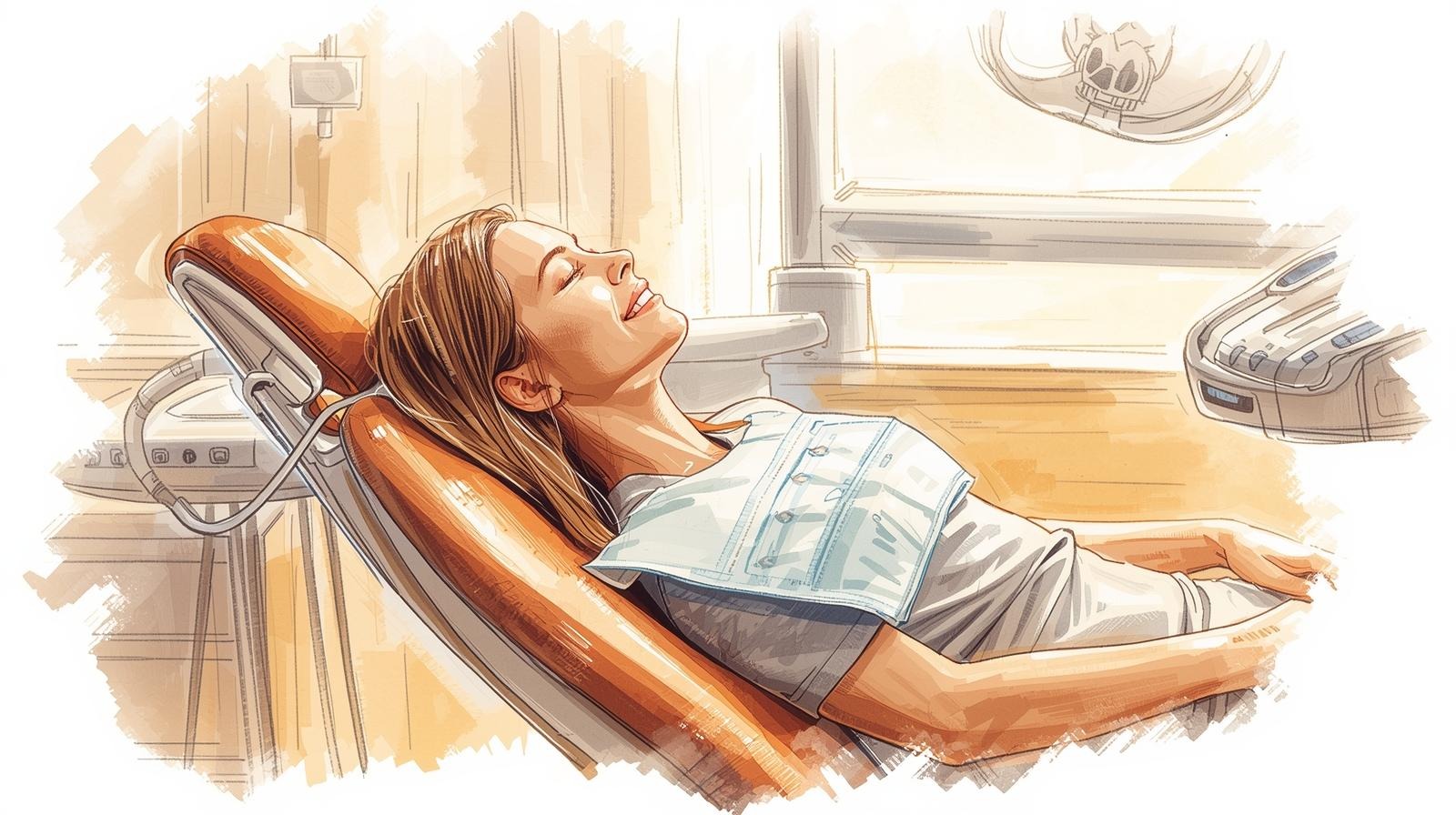
You are lying back in the dentist chair. The light is bright, you hear the drill warming up, and your brain is already running every worst-case scenario it can imagine.
If that sounds familiar, you are absolutely not alone. Dental anxiety is one of the most common health-related fears in the world and it often leads to cancelled appointments, delayed treatment, and a lot of unnecessary pain later on.
The usual advice is often vague. “Just relax.” “Think of something nice.” “It will be over soon.”
That is not enough for a nervous system that feels under threat.
This article is about something much more specific and practical: three micro-skills you can use right in the dentist chair, in real time. Eye focus. Breath pacing. Self-talk. Together, they create a tiny but powerful nervous-system toolkit you can carry into every appointment.
You will learn how to use your gaze as a pain filter, your breath as a built-in sedative, and your inner voice as a calm coach instead of a critic. We will also ground everything in recent research on dental anxiety, breathing, attention and cognitive-behavioural therapy, so you know you are not just “trying random tricks” but working with your brain and body in an evidence-informed way.
This piece lives in the Calm Space category of CareAndSelfLove.com for a reason. The goal is not perfection. The goal is: “I can walk into the clinic, stay in the chair, and feel just enough calm to get through this safely and kindly with myself.”
Why the dentist chair feels so intense
Dental anxiety is not “being dramatic.” It is a real cluster of sensations, thoughts, and memories that make the body react as if something truly dangerous is happening. Recent reviews show that dental fear and anxiety can exist on a spectrum, from mild tension to full dental phobia that keeps people away from treatment for years.
Several things make the dentist chair a perfect storm for anxiety. Your body is reclined, which can make you feel less in control. Your mouth is open and sometimes numbed, which can trigger vulnerability and even old trauma. There are intense sounds, bright lights, strange tastes, and the feeling that someone is working in a very intimate part of your body. Most importantly, it is hard to speak, which can trigger fear of being trapped or not being able to say “stop.”
Research on dental anxiety highlights a few consistent themes. Many people with high dental anxiety have had previous painful or shaming experiences in the chair. Some have more general anxiety, fear of needles, or a strong sensitivity to pain or unpredictability. Others feel ashamed about the state of their teeth and anticipate judgment from the dentist.
Inside your nervous system, the sympathetic branch ramps up. Your heart rate increases, your muscles tense, your breathing becomes shallow and quick, and your brain’s threat circuits pay intense attention to anything related to pain or danger. Studies on attention and pain show that when you are anxious, your eyes and thoughts are pulled toward anything that might hurt, which can actually make pain feel worse.
So if your body reacts like this, it is not a failure. It is a nervous system doing exactly what it was designed to do: protect. The problem is that what counts as “danger” in your brain may be based on old experiences rather than what is actually happening now in this specific appointment with this specific dentist.
The three tools you are about to learn do not erase fear overnight. Instead, they give your body a different set of signals: “We are here on purpose. We have choices. We are allowed to feel scared and still stay.”
How eye focus, breath pacing, and self-talk work together
Think of your dentist-visit anxiety as a three-layer experience.
There is the body layer: heart rate, breath, muscle tension, sensations in the mouth.
There is the attention layer: where your eyes and thoughts keep going.
There is the meaning layer: the story your inner voice tells about what all of this means.
Eye focus mainly works with attention. Breath pacing works with the body. Self-talk works with meaning.
Research on dental anxiety and behaviour guidance techniques shows that combining physiological strategies like relaxation or breathing with cognitive strategies such as positive self-talk and distraction tends to work better than any single technique alone.
Breathing practices have been shown, in multiple trials and systematic reviews, to reduce state anxiety, lower heart rate, and improve mood, sometimes in just a few minutes of practice per day. Guided or structured breathing also reduces anxiety and stress in clinical settings, not just in quiet meditation rooms.
At the same time, clinical and online cognitive-behavioural interventions for dental anxiety show that working directly with thoughts and beliefs, including self-talk, can significantly reduce fear and help patients actually complete necessary treatment.
Finally, distraction and attentional focus techniques are widely used in paediatric and adult dentistry. Systematic reviews confirm that methods that pull attention away from threatening sensations—whether through music, virtual reality, or focused gaze—often reduce self-reported anxiety and improve cooperation during treatment.
What we will do here is translate all that science into something simple enough to remember even when your brain feels foggy:
Look.
Breathe.
Talk to yourself.
You will discover that you can cycle through these three quietly—even with hands in your mouth—and nobody in the room needs to know you are actively regulating your nervous system.

Eye focus: using your gaze as a pain filter
Most of us have never been taught that our eyes are part of our emotional regulation toolkit. But research on attention and pain tells a clear story: when your gaze keeps returning to pain-related cues, pain feels more intense, and anxiety stays high. When attention is guided elsewhere, pain often becomes more manageable.
In dental settings, this can be surprisingly specific. A study on eye movement distraction in children found that simply guiding kids to move their eyes side-to-side during a needle injection significantly reduced their reported pain and anxiety scores compared to controls. Other distraction techniques that involve visual focus, such as watching a screen or virtual reality scenes, also reduce dental anxiety, especially in children and younger patients.
You can borrow this principle in a very low-tech way, right in your dentist chair.
Imagine your attention as a spotlight. When that spotlight is glued to the dental light, the syringe, the ceiling tiles directly above your mouth, or the dentist’s hands, your brain is constantly scanning for danger. Your goal is not to pretend nothing is happening but to deliberately give your eyes a non-threatening “anchor” to rest on.
Before the procedure begins, gently look around the room. Notice if there is anything visually neutral or slightly pleasant. A poster. A plant. A corner of the ceiling with an interesting pattern. Even the edge of a cabinet. Choose it as your anchor.
Once you are reclined, adjust your head slightly so that you can still see that anchor without straining. If you wear glasses and they are removed for the procedure, you do not need a perfectly sharp image. A soft blur is enough. What matters is that your eyes know, “When I look here, I am safe enough.”
When the procedure begins, your mind will naturally want to flick back to what the dentist is doing. That is normal. Every time you notice this, gently return your gaze to your anchor and mentally label it. You might think, “Corner of the ceiling. Stay here.”
If you prefer to close your eyes, you can still use gaze in an internal way. Bring to mind a very simple mental image: perhaps a window looking out onto a calm sky, or a gentle color field. Let your “inner eyes” rest on that. You are still using attention as a tool, just with imagination instead of the physical room.
The key is not to stare rigidly. A soft, steady gaze sends a different signal to your nervous system than a sharp, scanning gaze. Imagine your eyes are “listening” instead of “hunting.”
As you practice, you may notice moments where the sound of the drill spikes your anxiety again. Each time, you can acknowledge it and then bring your eyes back. Think of it as a tiny physical way of saying, “I see you, fear, and I choose my anchor anyway.” Over time, this repetition trains your attention away from constant pain-watching and toward something more neutral, which can make procedures feel shorter and less overwhelming,
Breath pacing: turning your body into a built-in calming system
You cannot talk much with instruments in your mouth, but your breath is with you the entire appointment, quietly influencing your heart rate and how safe or unsafe your body feels.
Slow, deliberate breathing may sound basic, but several high-quality studies and reviews show that breathwork is one of the most reliable ways to reduce state anxiety in the moment. Even short daily practices of a few minutes can significantly improve mood and decrease physiological measures of stress. Breathing exercises in hospital and clinical settings have also been shown to reduce anxiety and perceived pain during medical procedures.
In the dentist chair, breath pacing is less about achieving some perfect meditative state and more about giving your body a steady rhythm to lean on.
A simple pattern that fits dental work well is a gentle extended exhale. For example, breathing in for a count of four through the nose and breathing out for a count of six through the nose or slightly parted lips. The exact numbers do not matter as much as keeping the exhale a little longer than the inhale and staying within what feels comfortable.
When you first sit down in the waiting room, you can begin to “warm up” this pattern. Notice if your breath is up in your chest and fast. Without forcing anything, invite the breath a bit lower, as if your ribs could expand sideways. Let the inhale come in like a small wave and the exhale leave like a longer wave rolling out.
Once you are in the chair and the procedure starts, your job is not to breathe perfectly but to stay in relationship with your breath. There will be moments when the dentist asks you to breathe a certain way or to hold still. Follow their instructions, and then gently return to your own pacing when you can.
You might imagine that each exhale is a mini-reset. While instruments move in your mouth, your inner instruction can be as simple as, “In for four. Out for six. Again.” When a spike of fear appears, you do not need to fight it. You can let the fear be there and still lengthen the next exhale.
If you find counting stressful, you can use words instead. On the inhale, you think, “I am here.” On the exhale, “And I am safe enough.” Or inhale, “Breathing in.” Exhale, “Breathing out.” The repeated rhythm itself, rather than the specific words, helps signal your nervous system that you are not in an immediate life-or-death crisis.
The beauty of breath pacing is that it quietly supports the other techniques. A steadier breath makes it easier to keep your gaze on your chosen anchor. A steadier breath also creates space between scary thoughts and your reaction to them, which helps with self-talk.
You are using your body’s own built-in sedation system, not to numb you completely, but to reduce the volume of fear so you can stay present without feeling overwhelmed.
Self-talk: turning your inner critic into a calm coach
When you think of “self-talk,” you might picture cheesy affirmations. But in cognitive-behavioural therapy (CBT), inner dialogue is treated as one of the main drivers of anxiety, including dental anxiety. The way you mentally describe what is happening changes how your body reacts to it.
Several studies show that CBT-based approaches, which include noticing and reshaping thoughts, significantly reduce dental anxiety in both children and adults. Guided self-help CBT resources, dentist-administered CBT, and modern online CBT programs have all shown promising results in helping people go from avoidance to actually completing treatment.
The goal of self-talk in the dentist chair is not to force yourself into unrealistic positivity. It is to shift from catastrophising to coaching. From “This is unbearable” to “This is difficult, and I have tools.”
Your old anxious script might sound something like:
“They are going to hurt me again.”
“I cannot breathe.”
“I am trapped.”
“If I flinch they will be angry.”
“My body is out of control.”
Your new script does not need to deny that you are scared. Instead, it can name what is happening and add a layer of support and choice. For example:
“This is the part where my body gets anxious. I know this pattern.”
“My only job right now is to breathe and look at my anchor.”
“I can raise my hand if I need them to pause.”
“The numbness feels strange, not dangerous.”
“Every breath is one breath closer to being done.”
Before your appointment, you can write down three or four short phrases that feel believable and kind. They should be simple enough to remember even when you are stressed. During the appointment, you repeat them silently, especially during moments when your anxiety rises.
You can also use self-talk to remind yourself of the collaboration between you and your dentist. Evidence suggests that when patients feel more in control and more informed, dental anxiety decreases. You can choose phrases like:
“I have agreed to this treatment, and I can speak up at any time.”
“My dentist has done this procedure many times; my job is simply to show up and breathe.”
After the appointment, the way you talk to yourself about what happened shapes your memory of it. Instead of replaying every uncomfortable second, you can intentionally highlight your strengths.
“Yes, I was shaking at first, and I still stayed in the chair.”
“I used my breathing three separate times. That matters.”
“I did something that scared me, and that is courage, not weakness.”
This kind of compassionate, realistic self-talk is not about pretending the dentist is your favourite spa. It is about respecting your nervous system and giving it updated information: “Yes, this is hard. Yes, you can do hard things with support.”
Putting it together: your “Dentist Chair Calm” routine
To make these tools truly useful, it helps to weave them into a simple routine you repeat every time you have a dental appointment. Think of it as a three-phase practice: before, during, and after.
Before the appointment, your job is to set up your anchors. On the day of the visit, you might give yourself a few extra minutes at home or in the car. You can run through a short cycle: a few rounds of extended-exhale breathing, mentally rehearsing your chosen self-talk phrases, and imagining yourself in the chair using your eye anchor.
This is not about visualising a perfect experience. It is about rehearsing the skills you will use when anxiety shows up. Studies of exposure-based CBT approaches to dental anxiety show that gradual practice and mental rehearsal of coping skills can reduce fear responses when you face the real situation.
When you arrive at the clinic and sit in the waiting room, you can quietly start your breath pacing. Notice your feet on the floor, your body on the chair, and your breath moving in and out. You do not need to “empty your mind.” You only need to keep coming back to the rhythm of the breath and a gentle, supportive phrase like, “I am here, and I am allowed to take up space even when I am scared.”
As you enter the treatment room, you can practise being an active collaborator. If your anxiety is high, you might briefly tell your dentist, “I get pretty anxious in the chair. It helps if you tell me what is happening step by step, and I may raise my hand if I need a small pause.” Many dentists are increasingly trained in behavioural techniques and appreciate this clear communication because it helps them support you better.
Once you are in the chair, phase two begins. This is where your three tools work together.
You choose your visual anchor and let your eyes rest there. You begin your extended-exhale breath pacing and keep it gentle, so it does not feel like “work.” You start your inner coaching script, maybe cycling through a few phrases like, “This is the part where my heart races. And this is the part where I breathe.”
When anxiety surges—perhaps during the injection, the drilling, or an unexpected sensation—you do not have to invent a strategy from scratch. You simply return to your micro-routine: eyes to anchor, exhale a little longer, repeat your phrase. This repetition is what trains your nervous system. It is completely okay if you need to do this dozens of times during one appointment.
Phase three happens after the procedure. As soon as you sit up, your body might feel shaky, flooded with relief, or even emotional. Instead of rushing past this, give yourself a brief moment either in the chair or in the restroom. Take a few more paced breaths. Ask yourself gently, “What did I do that helped? Where did I feel even a tiny bit more in control this time compared to previous visits?”
This reflection matters. Research on pain and attention suggests that how we encode a difficult experience after the fact changes how threatening it feels next time. When you consciously highlight your skills, your brain begins to associate the dentist not only with fear but also with capacity.
You might choose to write a short note in your phone immediately after. Something like, “Appointment on Tuesday: injection was hard, but breathing and ceiling anchor really helped. Next time remember that.” This becomes a little archive of proof that you can handle difficult sensations with care.

Non-traditional upgrades: making the dentist chair your nervous-system lab
If you want to go further, you can treat each dental appointment as a kind of micro-experiment in self-regulation. Several non-traditional tweaks can amplify the effect of eye focus, breath pacing, and self-talk.
One option is to pair your visual anchor with sound. Many clinics now allow you to use headphones during treatment. Systematic reviews on distraction methods show that audiovisual distractions, including music and video, can significantly reduce anxiety and pain in dental and medical procedures.
Rather than using sound to escape entirely, you can choose audio that supports your breath rhythm, such as slow instrumental music or nature sounds. Your gaze can rest on a ceiling anchor or even on a small screen, while your breath and self-talk sync with the audio.
Another tweak is to bring something physical that gives your body a sense of weight and containment. A small weighted lap blanket or even a heavier jacket can help some people’s nervous systems feel less “floaty” and overwhelmed. While this is not specifically studied in dental settings yet, research on interoception and embodiment suggests that feeling the body’s weight and contact with surfaces can support down-regulation of anxiety. You can consciously include this in your inner dialogue: “I feel the weight on my thighs. I feel the chair under my back. My body is held.”
You can also collaborate with your dentist to create a personalised “calm plan.” Based on modern behavioural guidance research, dentists are increasingly encouraged to use patient-centred techniques, explain procedures clearly, and offer choices such as short breaks or signal systems. In a calm plan, you might agree in advance on things like:
That the dentist will tell you “You will feel pressure for about ten seconds” before major sensations.
That you will raise one hand if you need a five-second break to breathe.
That they will pause at certain milestones so you can reset your gaze and breath.
Even if you never use the signal, knowing it is there can significantly change your sense of control, which is central in dental anxiety.
Finally, if you use meditation, breathwork, or nervous-system practices at home, you can treat the dentist as your “advanced level.” You are not expected to be Zen and glowing in the chair. But you can bring the same curiosity you might use on a yoga mat: “What happens if I lengthen this exhale? What happens if I soften my gaze?” This mindset can transform the appointment from “a thing to survive” into “a place I test and grow my skills, even if I do not enjoy it.”
When anxiety is very high: combining in-chair tools with professional support
For some people, dental anxiety is less of a “nerves” issue and more like a full-body phobic response. You may experience panic attacks, flashbacks, or intense dissociation in the chair. You may have history of medical or childhood trauma that makes dental procedures particularly triggering.
If that is your reality, please know that you are not failing if self-help tools do not feel like enough. In these cases, a combination of dentist-chair techniques and professional support is often the safest path.
Cognitive-behavioural therapy tailored to dental phobia has strong evidence behind it. It typically includes gradual exposure to dental cues, training in coping skills like breathing and cognitive restructuring, and collaborative planning with your dentist. Reviews and trials show that CBT, including guided self-help and dentist-delivered versions, can reduce dental anxiety and help previously avoidant patients complete treatments without relying solely on sedation.
Recent work on internet-based CBT for children and adults with dental anxiety suggests that online programs can also significantly reduce fear and increase willingness to attend appointments, even when delivered remotely. If in-person therapy feels hard to access or overwhelming, asking your dentist or primary care provider about online CBT options may be a gentle first step.
Sedation and pharmacological options can also play an important role, especially in the early stages of treatment or for complex procedures. Evidence-based guidelines often recommend combining sedation with psychological strategies rather than using it in isolation, so that patients gradually build confidence instead of remaining dependent on medication alone.
In all these scenarios, your three in-chair tools still have value. Even under mild sedation, you can gently use eye focus, breath pacing, and soothing self-talk to support your nervous system. Over time, as the external supports are slowly reduced, these internal skills become a trusted foundation.
If you recognise that your dental anxiety is tied to deeper trauma, give yourself permission to move slowly. You might start by booking a short, non-invasive visit just to meet the dentist and sit in the chair for a few minutes, using your tools. Each small step counts. Each appointment where you stay in the room and practise is a meaningful act of self-care and self-respect.
Reclaiming the dentist chair as a place of quiet courage
It is unlikely that the dentist chair will ever become your favourite place. And that is okay. Calm does not have to mean liking something. In this context, calm means, “My fear is here, and I have enough tools to stay in the chair without abandoning myself.”
Eye focus, breath pacing, and self-talk may sound simple, but they touch three powerful levers in your nervous system: attention, physiology, and meaning. Research on dental anxiety, breathing, distraction, and CBT consistently shows that when patients feel a greater sense of control and have concrete coping strategies, anxiety goes down and completion of treatment goes up.
The next time you walk into a clinic, you can do so as someone who is not helpless, even if you are shaking. You can scan the room for your visual anchor. You can feel your breath and let the exhale linger. You can whisper inside, “This is hard, and I am staying with myself.”
On CareAndSelfLove.com, Calm Space is about exactly this: not erasing your sensitivity, but partnering with it. Using everyday situations as training grounds for self-trust. The dentist chair, of all places, can become one of those unlikely classrooms.
You do not have to do this perfectly. You only have to show up, breathe, and keep talking to yourself like someone you are learning to love.
Related posty You’ll love
- Postpartum sensory overload: The five-minute cocoon—A science-backed reset for new Moms
- Diaspora calm: Rituals that hold homesickness and pride together
- Phone-call phobia: Exposure with compassion. FREE PDF WORKBOOK!
- Hosting as calm: Low-stimulus gathering ideas that soothe the nervous system
- Wintering well: Private joy—practicing delight no one can grade. With FREE PDF workbook!
- The zen of having fewer choices: How trimming options restores calm, clarity, and joy
- Diaspora calm: Rituals that hold homesickness and pride together
- How to stop mental overstimulation before it starts: A clinically-grounded, human guide to calm focus

FAQ: Dentist chair calm
-
How can I calm myself down in the dentist chair without medication?
It helps to think of calming down as something you do with your whole nervous system, not just your thoughts. One of the fastest non-medication tools you can use is breath pacing. When you slow your breathing and lengthen your exhale slightly, your heart rate often follows and your body receives the message that you are safe enough to stay. You can pair this with a soft eye focus on a neutral point in the room, such as a corner of the ceiling or a picture on the wall, and repeat a simple supportive phrase in your mind like, “This is hard, and I am breathing through it.” Together, these three tools—breath, eye focus, and gentle self-talk—work like a small inner calming routine you can use from the moment you sit in the chair until the treatment is finished.
-
What is the best breathing technique for dental anxiety?
There is no one “perfect” breathing technique, but many anxious patients find that an extended exhale pattern is both simple and effective in the dentist chair. You can breathe in through your nose for a count of four, and out through your nose or softly parted lips for a count of six. If counting stresses you, you can drop the numbers and instead silently repeat phrases like “breathing in” and “breathing out.” The key is to keep the breath comfortable and sustainable, not forced or dramatic. A slightly longer exhale activates your body’s natural calming system, and when you stay with this rhythm throughout the appointment, it can gently reduce the intensity of your fear.
-
Does focusing my eyes really help reduce pain and fear at the dentist?
Yes, eye focus can make a real difference. When you constantly look at the drill, needle, or the dentist’s hands, your brain’s threat system stays on high alert and pain can feel more intense. Choosing a neutral visual anchor and letting your gaze rest there softens that threat response. It is a subtle form of visual distraction that gives your attention somewhere safe to land. You can think of your eyes as the steering wheel of your attention. Wherever your gaze rests, your nervous system tends to follow. A soft, steady gaze on a calm, non-threatening spot helps your body understand that it does not need to stay in full emergency mode during the entire procedure.
-
What should I tell my dentist if I have strong dental anxiety?
You do not have to hide your dental anxiety or pretend you are “fine.” A simple, honest sentence can be powerful, such as, “I experience a lot of dental anxiety and it really helps me when you explain what is happening step by step.” You can also ask to agree on a signal, like raising your hand, if you need a short pause to breathe. Many modern dentists are familiar with behaviour guidance techniques and appreciate patients who communicate clearly, because it allows them to slow down, check in, and support you better. You are not being difficult or demanding when you ask for this. You are advocating for your nervous system, which is an important part of your health care.
-
How can I stop panicking before a dental appointment?
Panic before a dental appointment often starts hours or even days earlier in your thoughts. Your mind rehearses worst-case scenarios, and your body responds as if they are already happening. To interrupt this loop, you can start using your dentist chair calm tools before you even get to the clinic. On the morning of your appointment, set aside a few minutes to practise your breathing, choose two or three self-talk phrases, and picture yourself in the chair using your eye anchor and your breath. You are not trying to erase all fear; you are rehearsing how you will respond when fear shows up. When you reach the waiting room, you can return to this routine: focus on your breath, soften your gaze, and remind yourself, “I have a plan for my anxiety this time.”
-
Are there any quick grounding techniques I can use during an injection or drilling?
Yes. During the most intense moments, it helps to give your body something simple and repetitive to do. You can quietly press your feet into the footrest or floor and feel the support under you while gently lengthening your exhale. At the same time, keep your gaze on your chosen anchor and silently repeat a short phrase such as, “This part is temporary” or “Ten more breaths.” By tying your attention to three things—where your eyes are, how your breath moves, and what your inner voice is saying—you reduce the mental space available for catastrophic images. You are not pretending the sensation is pleasant; you are building a small island of steadiness inside it.
-
What if my anxiety is so strong that I feel like I might faint or bolt out of the chair?
If your anxiety feels overwhelming, that does not mean you are weak. It usually means your nervous system has learned to associate dental care with real or perceived danger. In that case, it is very helpful to combine your in-chair tools with professional support. You might talk to your dentist and ask for very short, non-invasive visits at first, where the only goal is to sit in the chair and practise breathing and eye focus without any major procedures. You can also look into cognitive-behavioural therapy (CBT) for dental anxiety or dental phobia, including online programs that guide you through gradual exposure and new coping skills. If needed, your dentist may suggest sedation or medication, especially at the beginning. This does not cancel out your calm techniques; it gives you a safer starting point from which to practise them slowly.
-
Is sedation the only option for severe dental anxiety?
Sedation can be a helpful tool, especially for people with severe dental anxiety, trauma histories, or complex treatments ahead. However, it is not the only option and it does not have to be the final answer. Many people benefit from a blended approach: using sedation when necessary while also learning practical regulation skills like breath pacing, eye focus, and supportive self-talk. Over time, with the help of CBT or psychological support, some patients are able to reduce their reliance on sedation for simpler procedures. The goal is not to prove anything or rush the process, but to give yourself more than one way to feel safer in the chair.
-
Can eye focus, breath pacing, and self-talk help with other medical procedures too?
Absolutely. Your nervous system does not know whether you are at the dentist, in a medical imaging room, or about to have a blood test. It only knows whether it feels overwhelmed or supported. The same three tools you use in the dentist chair can be easily adapted to other situations: choose a visual anchor, regulate your breathing, and speak to yourself in a calm, honest, encouraging voice. Over time, these skills can become part of your everyday self-care, not just something you pull out for appointments. They are portable, quiet, and always available to you, even in places where you cannot speak or move much.
-
When should I seek professional help for my fear of the dentist?
It is a good idea to seek professional help if your fear keeps you from booking or completing necessary dental appointments, if you feel intense panic or dissociation in the chair, or if even thinking about the dentist makes your daily life feel smaller and more restricted. These are signs that your nervous system is trying to protect you so strongly that it is now limiting your health and comfort. You can talk to a therapist who has experience with anxiety or medical trauma, ask your dentist about CBT options for dental anxiety, or explore reputable online CBT programs designed for dental fear. Reaching out for help is not a failure of willpower; it is a wise investment in your long-term well-being.
Sources and inspirations
- Avramova, N., & Tsetsova, E. (2023). Dental fear, anxiety, and phobia: Behavioral management and implications for dentists. JMMS.
- Bux, S., Porritt, J., Marshman, Z., (2019). Evaluation of self-help cognitive behavioural therapy for children’s dental anxiety in general dental practice. Dentistry Journal.
- Tirupathi, S., & Rajasekhar, S. (2019). Eye movement distraction: A new distraction technique for management of dental anxiety during intraoral local anesthesia administration in children. International Journal of Clinical Pediatric Dentistry.
- Sheikh, S., (2024). Clinical effectiveness of guided breathing exercises in reducing anxiety, stress, and depression in COVID-19 patients. Scientific Reports.
- Bentley, T. G. K., (2023). Breathing practices for stress and anxiety reduction: Conceptual framework of implementation guidelines based on a systematic review. Healthcare.
- Chin, P., (2024). A systematic review of brief respiratory, embodiment, cognitive, and mindfulness interventions to reduce state anxiety. Frontiers in Psychology.
- Balban, M. Y., (2023). Brief structured respiration practices enhance mood and reduce physiological arousal more than mindfulness meditation. Cell Reports Medicine.
- Chan, F. H. F., (2020). Pain-related attentional processes: A systematic review of eye-tracking research. Clinical Psychology Review.
- Mac Goris, J. L., (2024). The role of attention bias malleability in experiencing pain and disability. PeerJ.
- Robles, E., (2024). Attentional biases towards emotional information in chronic pain: A multilevel meta-analysis of eye-tracking studies. Acta Psychologica.
- Dhaliwal, J. K., (2025). Behaviour guidance techniques and dental anxiety in paediatric patients: A systematic review and narrative synthesis. European Archives of Paediatric Dentistry.
- Ouhammou, M. M. K., (2024). Distraction methods for management of dental anxiety in children: A systematic review. Journal of Pediatric Dentistry.
- Schibbye, R., (2024). Internet-based cognitive behavioral therapy for children and adolescents with dental anxiety. Journal of Medical Internet Research.
- Hauge, M. S., (2021). Dentist-administered cognitive behavioural therapy versus usual care for dental anxiety: A randomized controlled trial. European Journal of Oral Sciences.
- Tellez, M., (2025). Online cognitive-behavioural intervention to manage dental anxiety: A 12-month randomised clinical trial. Community Dentistry and Oral Epidemiology.



Leave a Reply