Table of Contents
A gentle warning before we begin
Some content does not stay on a screen.
It travels. It moves into your partner’s tone. Into their patience. Into the way they interpret your emotions. Into the meaning they assign to your boundaries. Into the stories they tell themselves about what love “should” be.
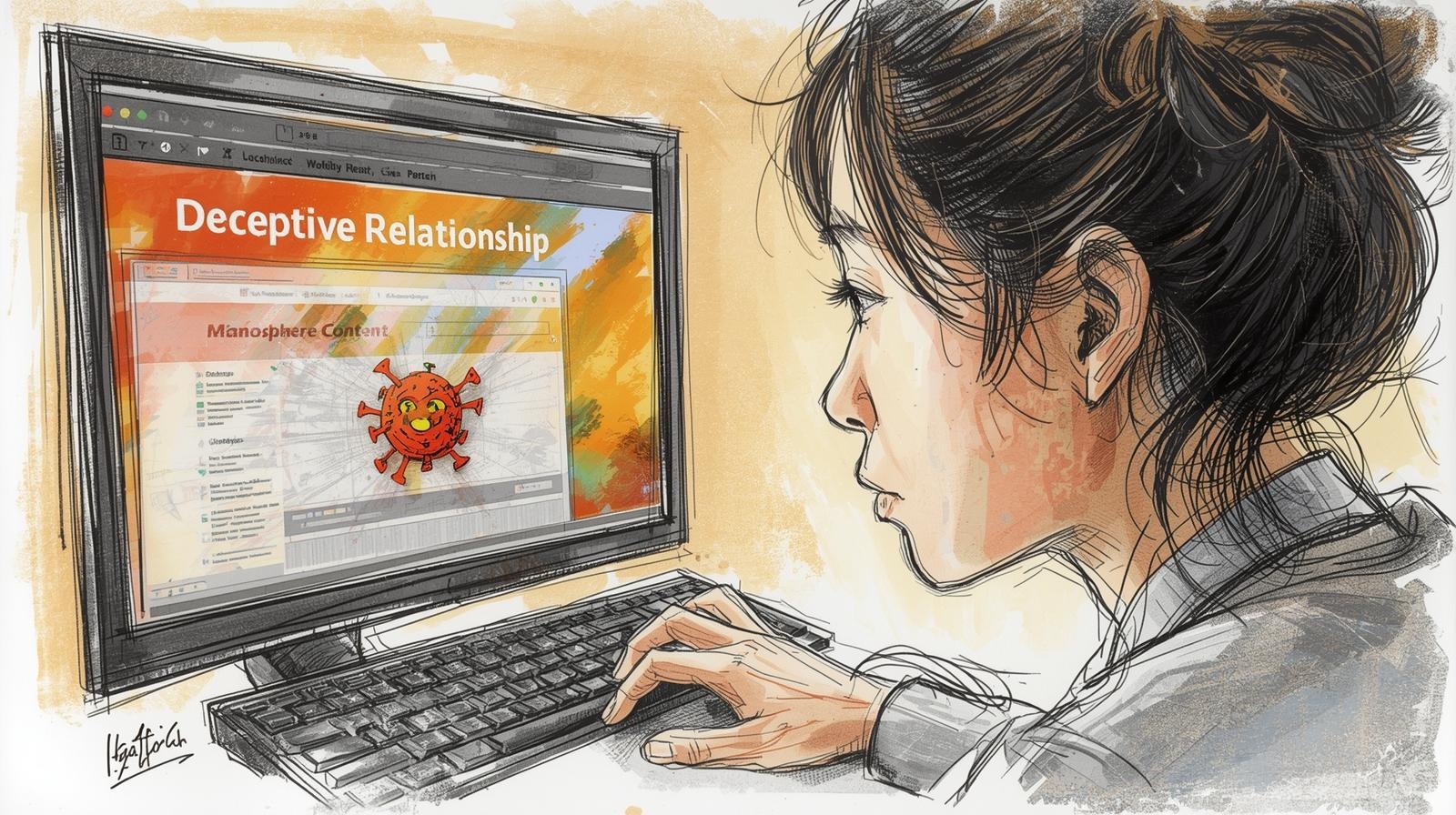
This article uses a metaphor on purpose: manosphere content as a relationship virus.
Not because men are the problem. Not because people who get pulled into online narratives are “bad.” The metaphor works because viruses are experts at three things: entering through small openings, replicating quietly, and hijacking normal systems for their own survival. That is exactly how this style of content often behaves inside real relationships.
A practical note: if your relationship includes intimidation, isolation, threats, humiliation, sexual coercion, stalking, or fear, please treat that as a safety issue, not a communication issue. You deserve support and a plan, not just more conversations.
Now, let’s name what we are dealing with.
What “manosphere content” means in plain English
The term manosphere generally refers to a loose online ecosystem of male centered communities and influencers where content often revolves around grievance, status anxiety, and a hostile story about women and gender equality. Some spaces brand themselves as “self improvement” or “dating strategy,” but many normalize contempt, dominance, and a zero sum view of relationships. The Institute for Strategic Dialogue describes the manosphere as encompassing a range of misogynistic communities that can vary from anti feminism to more explicit and violent rhetoric.
This matters because the harm is rarely just “opinions.” The harm shows up as behavior: suspicion, entitlement, control, emotional shutdown, and contempt that replaces tenderness.
So when I say “manosphere content,” I am not talking about a man watching fitness videos or learning social skills. I am talking about a recognizable content pattern that teaches a specific emotional posture toward women: distrust first, dominance as safety, empathy as weakness.
Why “relationship virus” is an accurate metaphor
Most couples imagine harmful content arriving like a dramatic event. In reality, it often arrives like background noise. A few clips. A few comments. A few “jokes.” Then a shift you can feel but cannot immediately prove.
Here is the common infection pathway, written as arrows you can return to when you feel confused:
Stress or rejection → algorithmic exposure → identity hook → belief shift → behavior shift → relationship symptoms → isolation → deeper exposure
The relationship virus rarely begins with hatred. It often begins with pain. Loneliness. A breakup. Feeling undesirable. Feeling disrespected. Feeling invisible. The content validates the pain, then redirects it into a worldview that keeps people stuck.
Research on “manfluencer” style threatening content suggests exposure can increase mistrust of women and misogynistic attitudes, especially among young men who feel rejected.
That is the first truth that helps couples: the pull is often emotional, not intellectual.
The second truth is even more important: once the content becomes identity, disagreement feels like an attack on the self. That is why regular conflict skills sometimes fail. You are not arguing a topic. You are fighting a belief system that is being fed daily.
The entry points: How it gets into Your relationship
The virus is opportunistic. It enters through predictable openings.
One opening is vulnerability disguised as self improvement. Someone gets hurt and looks for guidance. The internet offers certainty.
Another opening is humor and “banter”. A clip frames contempt as comedy. If you laugh, the boundary softens. If you object, you are labeled controlling or overly sensitive. Either way, your reality is questioned.
Another opening is pseudo therapy language. Words like “boundaries,” “standards,” “value,” and “respect” get used, but the outcome is not mutual care. The outcome is control.
And one opening is simply the recommendation machine. A major study from Dublin City University’s Anti Bullying Centre documents how recommender systems on short form platforms can rapidly amplify misogynistic and male supremacist content, creating a “bombardment” effect once engagement begins.
This is why many partners say, “I don’t even search for it,” and still end up saturated.
It is not always deliberate. It is often engineered.
The infection cycle: What it does to a relationship’s core systems
Healthy relationships run on a few basic systems. Think of them as the relationship immune system:
Empathy. Curiosity. Repair. Accountability. Mutuality. Safety.
Manosphere infected content tends to weaken these systems and replace them with substitutes that look like strength but behave like corrosion.
Here is a clear map you can use.
Table 1: Relationship immune system vs virus substitutes
| Relationship immune system | What it looks like in healthy love | Virus substitute | What it looks like after exposure |
|---|---|---|---|
| Empathy | “I care how this lands for you.” | Emotional contempt | “Feelings are manipulation.” |
| Curiosity | “Help me understand your experience.” | Suspicion | “I know what you are really doing.” |
| Repair | “I’m sorry. I will do better.” | Winning | Debates, gotcha moments, scorekeeping |
| Accountability | “My behavior is my responsibility.” | Blame transfer | “You made me do it.” |
| Mutuality | “We matter more than my ego.” | Hierarchy | “Someone must lead, someone must submit.” |
| Safety | “You can be fully human here.” | Control | Monitoring, restricting, punishing closeness |
If you feel a quiet ache reading that table, trust your body. Many people sense the infection before they can name it.
The symptoms: How to tell when the virus is active at home
A relationship rough patch still has humanity inside it. Even in conflict, you still recognize each other as complex people.
A manosphere infected patch tends to have contempt inside it. The partner stops being a person and becomes a category.
Below is a symptom scanner you can save and revisit.
Table 2: Symptom scanner
| Symptom in the relationship | What it sounds like in real life | What it does over time |
|---|---|---|
| Suspicion becomes the default | “Women always…” “You are testing me.” “I know the game.” | Trust collapses, you feel constantly on trial |
| Your needs are reframed as manipulation | “You just want attention.” “You are trying to control me.” | You stop asking, then you stop feeling safe |
| Empathy is mocked | “That is weak.” “Stop being emotional.” | Intimacy shrinks, emotional shutdown grows |
| Power replaces partnership | “I need to be the leader.” “Know your place.” | Mutual respect erodes, fear enters the room |
| Consent becomes a transaction | Pressure, sulking, entitlement, “prove you love me” | Desire turns into anxiety, affection feels unsafe |
| Isolation is normalized | “Your friends are bad influence.” “Therapy is brainwashing.” | Your support system shrinks, dependence grows |
| Dehumanizing generalizations | “Modern women are broken.” “All women are like that.” | Being seen as an individual becomes impossible |
| Humiliation becomes communication | Sarcasm, ridicule, public shaming | Your self esteem erodes, resentment becomes chronic |
If you recognize several rows, do not rush into panic. But do not minimize it either. Patterns matter. Repetition matters. The direction of change matters.

Why it feels so convincing: The psychological hooks
This content often works like a three stage spell.
Stage one is validate the wound. The viewer feels seen. “You were rejected.” “You were disrespected.” “You were used.” That validation can feel like relief.
Stage two is assign a villain. Women. Feminism. “Modern culture.” “Weak men.” A villain creates emotional coherence. Suddenly everything makes sense.
Stage three is offer a costume called identity. “Alpha.” “High value.” “Red pill.” The identity promises protection from pain. The cost is empathy.
Research reviewing incel ideology and experiences highlights how romantic rejection, loneliness, fear of being single, and insecure attachment can be part of the emotional landscape that makes grievance narratives sticky.
This does not excuse harmful beliefs. It explains how the hook works.
And the hook spreads faster in a world where disconnection is common. A Pew Research Center analysis, for example, reports that a large share of adults are living without a spouse or partner, even with slight recent declines in unpartnered rates.
Loneliness does not automatically create misogyny. But loneliness can make a worldview that offers certainty feel like rescue.
The accelerant: Recommendation systems and short form feeds
If you have tried to “argue someone out” of a feed, you know how exhausting it is.
A systematic review of studies on YouTube recommendations and problematic content found evidence that recommendations can facilitate pathways to problematic material in many cases, while some studies show mixed results.
At the same time, scholarship urges nuance: it is not accurate to claim recommendation systems automatically radicalize everyone, even while platforms can host and profit from dubious or extremist content.
Here is the most useful takeaway for relationships: short form feeds reward emotional intensity, not relational wisdom.
The Dublin City University research on short form recommendations is especially relevant because it documents how quickly misogynistic and male supremacist content can be amplified by recommender systems on TikTok and YouTube Shorts once engagement begins.
So when your partner says “it is just entertainment,” the real question is not whether they meant harm. The real question is what the content is training.
Because training shows up at home.
When the virus spreads beyond the relationship: Why this is also a safety issue
Online misogyny does not stay purely interpersonal. It connects to wider patterns of harassment and intimidation that disproportionately target women, including technology facilitated abuse.
The European Institute for Gender Equality has published a measurement framework for cyber violence against women and girls, reflecting how significant and organized these harms have become across contexts.
In December 2025, UN Women published findings on online violence against women in the public sphere and how it can spill into offline harm, with warnings about AI enabled abuse.
UNESCO reporting in January 2026 similarly highlights ongoing high levels of online violence against women journalists and the emerging issue of AI assisted abuse.
You do not need to be a public figure to feel the spillover. When a culture normalizes contempt, it enters living rooms. It shapes what people think they are allowed to demand. It shapes what people think they are allowed to dismiss.
That is why this article treats the issue as relational health and cultural safety, not as a petty “dating debate.”
A nonstandard but practical model: “Viral load” in relationships
Instead of asking “Is my partner in the manosphere,” a more useful question is:
“How much of this content is living inside our dynamic right now?”
That is viral load.
Viral load is not about what your partner watches once. It is about what your relationship repeatedly absorbs.
Table 3: Viral load self check
| Viral load level | What you notice | What it usually means |
|---|---|---|
| Low | Occasional clips, no change in respect, repair still works | Curiosity can work, boundaries may be enough |
| Medium | More suspicion, more gender generalizations, less empathy | Content is shaping interpretations and tone |
| High | Contempt, control, humiliation, coercion, isolation attempts | Safety is compromised, support is needed, boundaries must be firm |
| Critical | Fear, threats, stalking, sexual pressure, punishment, intimidation | Prioritize safety planning and professional help |
This table is not meant to scare you. It is meant to stop you from gaslighting yourself.
If your body feels unsafe, treat that as data.
The relationship antivirus protocol: CARE
When couples try to “talk it out” without a protocol, they often fall into a trap: one person defends their humanity while the other defends their identity. That spiral feeds the virus.
Here is a protocol you can actually use. Think CARE.
Contain the topic. You are not debating society. You are naming relationship impact.
Say something like: “I’m not asking you to agree with me about the world. I’m asking you to notice what this content is doing to how you treat me.”
Ask for observable change. Not “stop watching everything,” but specific behaviors.
Say: “When I express a need, I need you to respond as my partner, not as a commentator.”
Require respect as the minimum. Respect is not earned by silence. It is the foundation.
Say: “We can disagree, but contempt is not allowed here.”
Exit spirals early. The virus thrives on endless conflict. Starve it.
Say: “I’m going to pause this conversation if it turns into insults. We can return when we’re regulated.”
Notice what CARE does: it moves the conversation from ideology to behavior, from identity defense to relationship protection.

Quarantine: What to do when Your partner is deep in it
Quarantine is not about punishment. Quarantine is about preventing spread.
Spread looks like: you shrinking, you self censoring, you losing support, you losing joy, you losing your sense of reality.
One of the most effective quarantine moves is refusing to debate bait topics. Many manosphere talking points are designed like glue traps. The more you argue, the more stuck you get.
A better move is a single question that cuts to the core:
“When you use that belief, what behavior are you trying to justify?”
This does not attack the person. It exposes the function.
Next, focus on boundaries that target behavior, not identity. Boundaries fail when they sound like character assassination. They succeed when they are simple and consistent.
Below are scripts you can adapt.
Table 4: Boundary scripts that protect dignity
| Situation | Boundary sentence you can use | Why it works |
|---|---|---|
| Gender generalizations | “I won’t argue with stereotypes about my gender. Talk to me as a person.” | Stops dehumanization at the door |
| Mocking emotions | “My feelings are not a debate topic. If you can’t be respectful, I’m stepping away.” | Protects emotional safety |
| Escalating sarcasm | “Sarcasm is not repair. We can speak gently or we pause.” | Replaces cruelty with structure |
| Sexual pressure | “Consent is not negotiable. Pressure ends the conversation immediately.” | Makes safety nonoptional |
| Isolation attempts | “I will keep my support system. If you attack it, we have a serious problem.” | Blocks dependence dynamics |
| Therapy shaming | “Support is not brainwashing. I’m allowed to get help.” | Protects your reality |
| Phone as third partner | “I need presence. If your feed changes how you treat me, we address it.” | Names the actual impact |
If your partner can respond to boundaries with accountability, you have a door to repair.
If your partner responds with ridicule, punishment, or escalation, that is not a misunderstanding. That is a sign.
What repair requires, when repair is possible
Repair is not a promise. Repair is a practice.
Here is a clean repair pathway written as arrows. You can use it like a checklist.
Name the harm → validate the impact → take responsibility → commit to new behavior → create accountability → practice repair repeatedly
If your partner cannot do “take responsibility,” repair is mostly fantasy. If they can do it, you have something to build on.
One reason this matters: the content often trains the opposite of responsibility. It trains blame transfer.
So when a partner says “you made me do it,” the virus is speaking.
When they say “I did it, and I’m sorry, and I will change,” the immune system is alive.
If You are the one watching it: A compassionate wake up call
If you recognize yourself in this, I want to speak to you with respect.
If your feed teaches you that love requires dominance, that women are enemies, that tenderness is humiliation, that empathy is weakness, you are being sold a counterfeit version of strength.
Real strength is the ability to stay human when you are hurt.
The incel ideology review literature makes clear that many people in grievance based communities carry significant loneliness, rejection, and emotional pain.
Pain deserves care. But contempt does not heal pain. Contempt multiplies it.
Try this private test. No performance. No posting. Just honesty:
“After I watch this content, do I feel more capable of intimacy, or more suspicious of it?”
If the answer is “more suspicious,” you are not becoming powerful. You are becoming armored. Armor protects you from rejection and blocks love at the same time.
There is a reason this style of influence spreads among boys and young men. A YouGov poll reported that a notable minority of boys aged 6 to 15 held positive views of a prominent misogyny associated influencer, while many had also heard of him, reflecting reach even when people disagree.
Dublin City University has also summarized literature about the phenomenon among boys, reinforcing how exposure and cultural conversation can extend beyond a single platform.
If you want to detox, start with environment. Reduce exposure. Reset recommendations. Add content that builds emotional literacy. Then address the wound underneath the hook: rejection sensitivity, shame, loneliness, fear of being ordinary, fear of being left.
You are allowed to heal without harming someone else.
Words of power: Language that stops the spread and rebuilds respect
This is the heart of your Words of Power category. These are not cute quotes. They are relational anchors.
Read them slowly. Notice which ones make your shoulders drop.
Table 5: Words of power for relationship immunity
| Word of Power | When to use it | What it protects |
|---|---|---|
| “Respect is the minimum, not the reward.” | When kindness is treated like something you must earn | Dignity |
| “I won’t argue with stereotypes about women.” | When you are reduced to a category | Humanity |
| “I’m your partner, not your opponent.” | When everything becomes a power struggle | Mutuality |
| “Your pain is real. Your contempt is not acceptable.” | When hurt becomes an excuse for cruelty | Accountability |
| “I’m available for repair, not for humiliation.” | When sarcasm replaces apology | Emotional safety |
| “If love requires me to shrink, it isn’t love.” | When you feel pressured to silence yourself | Self respect |
| “We can disagree without dehumanizing.” | When ideology overrides empathy | Kindness |
| “Pause. We are escalating.” | When nervous systems are taking over | Regulation |
| “I choose relationships built on trust, not theories.” | When the feed is louder than real life | Reality |
| “Consent is not negotiable.” | When pressure enters intimacy | Safety |
Here is one more, written as a private vow:
“My love is not a battleground.”
When you repeat that sentence, you are choosing a different culture inside your home.
A message You can keep
If your relationship has started to feel like a courtroom, a competition, or a loyalty test, please hear this clearly:
Love is supposed to feel like a place where your nervous system can rest.
If content makes rest impossible, it is not harmless. It is not neutral. It is not “just entertainment.”
It is a relationship virus.
And you are allowed to choose health.
Related posts You’ll love
- Misogyny incident report: How sexualized harassment becomes a silencing tool and how to document it, name it, and reclaim Your voice. FREE PDF!
- Incident report: 47 applications, 0 replies, 1 nervous system crash. A trauma informed, AI era guide to job search recovery, regulation, and words that bring You back to Yourself
- The hope contract: Small, realistic terms for staying human in a high stress world
- Letter to my body: The beautiful breakthrough that ends the evidence trap for good
- The “Good Woman” Contract I never signed (but keep living by): How invisible gender rules steal Your voice, time, and power
- Why incel slang became everyday talk: The hidden path from fringe forums to mainstream culture, and a calm guide for Women to keep inner dignity when the world gets coarser
- Opt out form for free therapy for Men: A stigma proof, science backed way to start counseling without overthinking it

FAQ: manosphere content virus
-
What is manosphere content?
Manosphere content is an online ecosystem of male centered influencers and communities that often frames dating and relationships as power games, promotes distrust of women, and rewards contempt disguised as “truth.” Some creators market it as confidence or self improvement, but the core message frequently shifts from growth to control, from accountability to blame, and from partnership to hierarchy. When that worldview enters a relationship, it can reshape how empathy, boundaries, and intimacy are interpreted.
-
Why can manosphere content feel like a relationship virus?
It tends to enter through vulnerability, then quietly replicates through repeated clips, “jokes,” and identity language. Over time it can hijack normal relationship systems like empathy, repair, and mutual respect, replacing them with suspicion, scorekeeping, and dominance. The “virus” metaphor is useful because the damage often spreads indirectly: not only through opinions, but through tone, reactions, and what a partner starts believing your emotions “mean.”
-
What are the earliest signs that manosphere content is affecting my relationship?
Early signs are usually subtle shifts rather than dramatic events. You may notice more gender generalizations, less curiosity, more “testing” language, more sarcasm during conflict, and a tendency to interpret your needs as manipulation. Another common sign is emotional flattening: tenderness becomes rare, and empathy gets mocked as weakness. Pay attention to direction: if respect and softness decrease as screen time increases, that pattern matters.
-
Is all male self improvement content part of the manosphere?
No. Healthy self improvement content increases self awareness, emotional regulation, responsibility, and relational skills. Manosphere infected content typically increases contempt, entitlement, and distrust, while encouraging rigid gender hierarchies. A simple test helps: after watching, does your partner become kinder and more accountable, or more suspicious and controlling. The outcome is the clue.
-
Why does it spread so fast on short form platforms?
Short form feeds reward emotional intensity, certainty, and conflict because those keep attention. Research on recommendation pathways shows that once someone engages with certain themes, platforms can amplify similar content quickly, creating a rapid “more of the same” loop. This is why someone can feel “pulled in” even without intentionally searching, especially when they are lonely, stressed, or angry.
-
What should I do if my partner says it is “just entertainment”?
Shift the conversation from ideology to impact. You do not need to debate the internet. Ask one grounded question: “After you watch it, do you treat me with more respect or less.” Then name one observable change you need, such as no insults, no gender stereotypes, and no dismissing feelings. Entertainment is not neutral if it repeatedly trains contempt at home.
-
How can I talk about this without triggering a defensive blow up?
Keep it concrete, short, and behavior focused. Start with impact: “I’ve noticed more suspicion and sarcasm lately, and it hurts.” Then make a clear request: “I need respectful language, and I need repair after conflict.” Finally set a boundary: “If the conversation turns into insults, I will pause and return later.” This structure avoids arguing about beliefs and centers relational safety.
-
What boundaries work best when the content is already influencing behavior?
The strongest boundaries target behavior, not identity. For example: “I won’t stay in conversations that include contempt, insults, or sexual pressure.” Follow through consistently with a pause and distance, not a debate. If boundaries are met with ridicule, punishment, or escalation, treat that as serious data. Boundaries are not ultimatums when they protect dignity and safety.
-
Can this kind of content increase emotional abuse or control?
It can, especially when it normalizes dominance, entitlement, and dehumanizing stereotypes. In some relationships, the shift shows up as monitoring, isolating you from friends, punishing you for saying no, or framing your autonomy as disrespect. If fear enters your body, or you feel like you must shrink to keep peace, prioritize support and safety planning. When coercion is present, “communication tips” are not enough.
-
What if I am the one watching it and I feel ashamed?
Shame keeps people stuck. Curiosity helps people change. Start by noticing the effect: does the content make you more capable of intimacy, or more suspicious of it. Then reduce exposure, reset your feed, and replace it with resources that build emotional skills and real connection. If the content soothed loneliness or rejection, address that wound directly through community, therapy, or coaching. Healing is possible without turning pain into contempt.
-
Can couples therapy help if one partner is deep into manosphere beliefs?
It can help when both partners agree on one baseline: respect is non negotiable. Therapy is most effective when the goal is not “who is right,” but how to restore empathy, repair, and safety. If one partner uses ideology to justify humiliation, control, or coercion, couples therapy may not be appropriate until safety is established. Individual support can still help you regain clarity and protect your nervous system.
Sources and inspirations
- Baker, C., Ging, D., & Brandt Andreasen, M. (2024, April). Recommending Toxicity: The role of algorithmic recommender functions on YouTube Shorts and TikTok in promoting male supremacist influencers (Summary report). Dublin City University, Anti Bullying Centre.
- European Institute for Gender Equality. (2025, February 7). Combating cyber violence against women and girls: Developing an EU measurement framework. Publications Office of the European Union.
- Institute for Strategic Dialogue. (2022, September 20). The manosphere (Explainer).
- Pew Research Center. (2025, January 8). Share of U.S. adults living without a romantic partner has ticked down in recent years.
- Renström, E. A., & Bäck, H. (2024). Manfluencers and young men’s misogynistic attitudes: The role of perceived threats to men’s status. Sex Roles.
- Shaw, A. (2023). Social media, extremism, and radicalization. Science Advances.
- Sparks, B., Zidenberg, A. M., & Olver, M. E. (2022). Involuntary celibacy: A review of incel ideology and experiences with dating, rejection, and associated mental health and emotional sequelae. Current Psychiatry Reports.
- UN Women. (2025, December 8). Tipping point: The chilling escalation of online violence against women in the public sphere in the age of AI.
- UN Women. (2025, December 9). Seven in ten women human rights defenders, activists and journalists report online violence.
- UNESCO. (2026, January 7). Global survey reveals rising violence against women journalists.
- Yesilada, M., & Lewandowsky, S. (2022). Systematic review: YouTube recommendations and problematic content. Internet Policy Review.
- YouGov. (2023, September 27). One in six boys aged 6 to 15 have a positive view of Andrew Tate (Survey reporting).
- European Parliament, Policy Department for Citizens’ Rights and Constitutional Affairs. (2023, March 1). The impact of the use of social media on women and girls (Study).
- Dublin City University, Anti Bullying Centre. (2025). Understanding the Andrew Tate phenomenon among boys: State of the literature review (Overview page).




Leave a Reply