Table of Contents
Quick answer: What are microfeminisms?
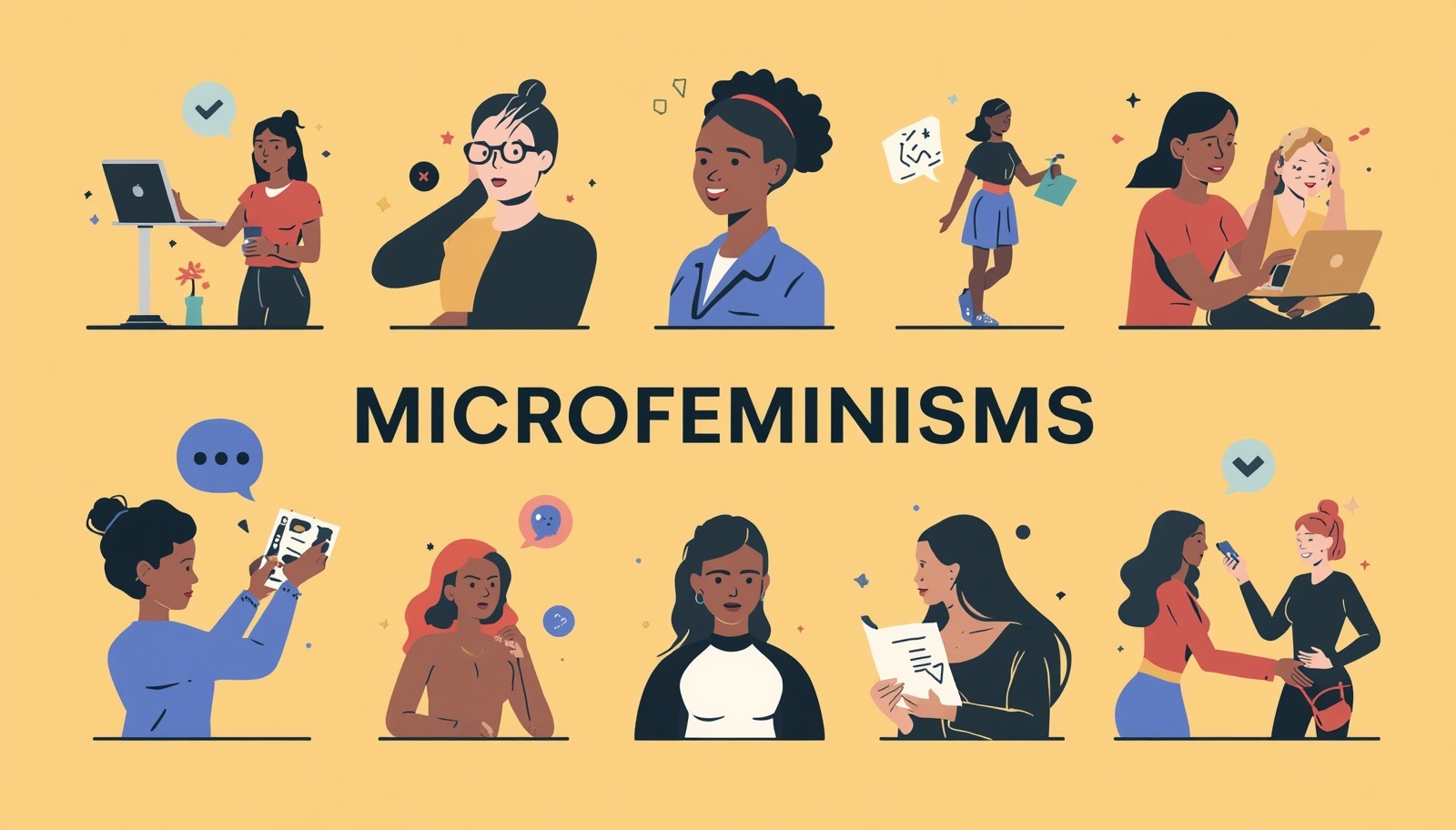
Microfeminisms are small, intentional, everyday actions that challenge gender bias, protect women’s dignity, and make invisible power dynamics visible. They can be as simple as crediting a woman’s idea in a meeting, refusing to soften a valid boundary with “sorry,” using “she” as the default pronoun for leaders, asking why a woman was interrupted, or naming the emotional labor that usually goes unnoticed.
Microfeminisms do not replace structural change, but they help women feel less powerless because they turn vague frustration into one clear act of agency. They say: “I may not be able to dismantle the whole system today, but I can interrupt this one pattern right now.”
The quiet exhaustion of feeling powerless
There is a specific kind of tiredness that many women know too well. It is not simply physical fatigue. It is the exhaustion of being interrupted and then wondering whether you are “too sensitive.” It is the tiny internal collapse that happens when your idea is ignored until someone else repeats it. It is the pressure to be warm, helpful, available, pretty, agreeable, ambitious, humble, emotionally intelligent, and never “difficult” — all at the same time.
When these moments happen once, they may seem small. When they happen repeatedly, they become an atmosphere. And atmospheres shape how safe, visible, and powerful we feel. Research on sex discrimination and women’s mental health has found that perceived sex discrimination is associated with poorer mental health and well-being, including psychological distress and lower life satisfaction.
This is where microfeminisms become more than a social media phrase. I see microfeminism as the practice of reclaiming one inch of power at a time. Not through dramatic confrontation every day, not through exhausting self-defense, and not through asking women to personally fix sexism. Instead, microfeminisms offer a small, repeatable, human-scale response to the moments where women are socially trained to shrink. They create a bridge between “I hate that this happened” and “Here is one thing I can do now.”
The reason microfeminisms feel emotionally powerful is that powerlessness often thrives in vagueness. A woman may feel uneasy after a meeting but struggle to name why. She may feel depleted after a family gathering but tell herself she is overreacting. She may notice that women are doing the note-taking, organizing, smoothing, caring, remembering, and apologizing, but because each act seems small, the pattern hides in plain sight. Microfeminism brings the pattern into focus. It turns the blurred background into a visible object. → Once something is visible, it becomes easier to respond to it.
Before we go further, one boundary matters: microfeminism is not about making women responsible for repairing the systems that harm them. Workplace policies, pay equity, legal protections, safe public spaces, digital safety, and healthcare justice still require structural change. The value of microfeminisms is not that they replace institutions, but that they help women preserve agency inside everyday systems that often move too slowly.
In that sense, microfeminism is not “small” because it is weak. It is small because it is portable. You can carry it into a meeting, an email, a dinner table, a doctor’s appointment, a classroom, a sidewalk, a group chat, and your own self-talk.
Why microfeminisms matter now
Microfeminisms are emerging at a moment when many women are emotionally done with the idea that sexism only counts when it is obvious, loud, or legally actionable. The modern experience of gender bias is often subtle, deniable, and socially polished. It may appear as “just a joke,” “just a compliment,” “just tradition,” “just how things work,” or “just office culture.” But subtle does not mean harmless. In workplace research, microaggressions are linked to burnout, lower feelings of equity, and greater consideration of leaving a company.
The emotional burden is not limited to physical spaces. Online life has created new forms of visibility and vulnerability. Research on online harms suggests that women may do more “safety work” online, feeling less comfortable expressing political opinions or challenging content, even when overall exposure to harms may look similar between genders.
Another study on online harassment found that women across multiple geographic regions perceived greater harm from online harassment than men, especially around non-consensual image sharing (Im et al., 2023). In other words, women are not only navigating bias in rooms; they are navigating it in feeds, comments, private messages, screenshots, algorithms, and digital reputations.
Microfeminism answers a deeply modern question: “What can I do when the problem is too big, but doing nothing makes me feel smaller?” The answer is not to perform empowerment. The answer is to practice agency. Empowerment research describes empowerment as increasing control over decisions and life conditions, while recognizing that context, culture, gender, race, socioeconomic status, and institutions all shape what agency is possible.
Microfeminism works best when it respects this complexity. It should never shame a woman for staying silent when speaking up would be unsafe. It should never romanticize risk. It should never pretend that a clever sentence can replace policy. But when a woman does have enough safety, clarity, and energy to act, microfeminism gives her a language for doing so.
The psychology of tiny resistance: Why small acts can feel big
Powerlessness often grows when three things happen together: you notice something unfair, you doubt your perception, and you feel alone in the noticing. Microfeminism interrupts all three. First, it validates perception: “Yes, that was a pattern.” Second, it gives a response: “Here is one small move.” Third, it creates solidarity: “Other women see this too.” That last piece matters. When an experience finally has a name, it stops feeling like a private flaw and starts looking like a shared pattern. The viral rise of microfeminism likely resonated because many women recognized behaviors they had already been doing quietly for years.
Microfeminisms also work because they reduce the emotional distance between values and behavior. Many women believe in equality but feel frozen when bias appears in real time. This freeze is understandable. Confronting sexism can carry social costs; women may be judged as oversensitive, aggressive, humorless, or difficult. Recent research on challenging sexist comments suggests that women who challenge sexism often already hold more egalitarian beliefs, but the act itself may not create immediate emotional transformation in every situation. That finding is important because it protects us from overpromising. Microfeminism is not magic. One sentence may not heal years of being dismissed. But repeated acts can help align your outer behavior with your inner values.
I like to think of microfeminisms as “agency reps.” Just as physical strength is built through repeated movement, psychological agency can be strengthened through repeated choices. A small boundary today may make tomorrow’s boundary feel more available. Crediting another woman today may make collective visibility feel more normal. Refusing unnecessary apology today may help your nervous system learn that you can be kind without shrinking. → The goal is not to become fearless. The goal is to become more practiced at staying with yourself.
Table 1: The microfeminism map — from powerless moment to inner shift

Microfeminism is not “being mean.” It is being precise
One reason women hesitate to practice microfeminism is the fear of becoming unkind. Many of us have been taught to confuse kindness with self-erasure. We learn to make the room comfortable before we make ourselves honest. We learn to soften every sentence with cushioning phrases: “Sorry, but…” “Maybe I’m wrong…” “This is probably silly…” “I just wanted to…” There is nothing wrong with warmth. The problem begins when warmth becomes a tax women must pay before being allowed to speak.
Microfeminism does not require cruelty. In fact, the most effective microfeminisms are often calm, precise, and almost boring. “Let’s rotate that task.” “I want to return to her point.” “Please use my correct title.” “I’m not available for that.” “I’d like the same information shared with everyone.” These sentences do not attack. They clarify. They interrupt the fog. Microintervention frameworks suggest that one strategy for addressing microaggressions is to make the invisible visible, disarm the moment, educate where possible, and seek support where needed (Sue et al., 2019).
The precision matters because sexism often survives by staying slippery. If a woman says, “This whole culture feels unfair,” she may be dismissed as emotional. But if she says, “In the last three meetings, women took notes every time; can we rotate that role?” the pattern becomes concrete. If she says, “You interrupted her before she finished,” the behavior becomes harder to deny. If she says, “I noticed the client’s email addressed the male junior colleague as the decision-maker; please redirect them to the actual project lead,” the hierarchy becomes visible.
→ Microfeminism turns atmosphere into evidence.
The “teaspoon theory” of feminist power
Here is the unconventional way I think about it: microfeminisms are teaspoons. A teaspoon cannot empty an ocean in one heroic gesture. But a teaspoon can place medicine on the tongue. It can stir sugar into bitterness. It can measure what was previously vague. It can make something concentrated enough to use.
The teaspoon theory of feminist power says this: a small act becomes powerful when it is specific, repeatable, and connected to a larger value. Holding a door because you are polite is not necessarily microfeminism. Holding a door while also refusing the old script that women must always make themselves smaller in public space can become microfeminist. Saying “thank you” instead of “sorry” once may feel like a language tweak. Doing it repeatedly can become a quiet rebellion against the belief that your needs are inherently inconvenient.
This is why microfeminisms are especially useful for women who feel overwhelmed by the scale of gender inequality. Large-scale injustice can create emotional paralysis. The nervous system hears “patriarchy,” “bias,” “violence,” “pay gaps,” “online harassment,” “reproductive rights,” “leadership gaps,” and understandably asks: “Where would I even begin?” Microfeminism answers: “Begin with the next sentence. Begin with the next room. Begin with the next credit-giving moment. Begin with the next time you are tempted to disappear.”
Table 2: Microfeminisms by life area

The credit loop: A microfeminism that changes rooms
One of my favorite microfeminisms is what I call the Credit Loop. It has three steps: notice contribution, name the woman, reconnect the room to her idea. For example: “I want to highlight that Aisha raised this risk earlier, and the current plan is stronger because of that.” This move is simple, but it does several things at once. It protects the woman’s intellectual labor. It teaches the room to track authorship. It makes it harder for ideas to be detached from the person who offered them.
The Credit Loop matters because erasure can be subtle. Many women do not lose power in one dramatic act; they lose it through repeated moments where their labor becomes communal while recognition becomes individual for someone else. In studies analyzing workplace sexism narratives, themes such as being ignored, talked over, denied opportunities, paid less, or subjected to gender harassment appeared in accounts of everyday workplace sexism. The Credit Loop is not a complete solution, but it is a practical counter-pattern.
Try this language:
→ “I want to return to what Priya said.”
→ “That connects directly to Elena’s earlier point.”
→ “Before we move on, I want to credit Samira for identifying this issue.”
→ “Yes, and I think the original insight came from Noor.”
Notice the tone. It does not need to sound angry. It can be calm, matter-of-fact, and professional. That is part of the power. Microfeminism does not always need to announce itself as feminism. Sometimes it simply changes the record.
The “no apology audit”: Reclaiming language without losing warmth
Many women apologize as a social reflex, not because they did anything wrong. The apology becomes a softener, a permission slip, a way of saying, “Please do not punish me for having a need.” Microfeminism invites a different question: “Did I cause harm, or am I simply taking up space?”
A No Apology Audit does not mean you stop apologizing when you genuinely hurt someone. Real apologies are relational medicine. But unnecessary apologies can slowly train your mind to experience normal needs as offenses. For one week, look at your emails and messages. Every time you write “sorry,” ask: Did I violate a boundary, or am I communicating a normal update, delay, request, or preference?
- Instead of “Sorry for following up,” try “Following up on this.”
- Instead of “Sorry, can I ask a question?” try “I have a question.”
- Instead of “Sorry for the delay,” when the timeline was reasonable, try “Thank you for your patience.”
- Instead of “Sorry, I disagree,” try “I see it differently.”
This tiny linguistic shift can feel surprisingly emotional. That is because you are not only editing a sentence. You are editing a social contract that taught you to make yourself smaller before being direct. Microfeminism often begins exactly there: in the half-second before you abandon yourself.
Microfeminism and the nervous system: Why small safety signals matter
Feeling powerless is not only an idea; it can become a body state. The shoulders tighten. The stomach drops. The throat closes. The mind starts rehearsing: “Was that sexist? Should I say something? What if I make it worse? What if they think I’m difficult?” When women repeatedly experience dismissal, interruption, objectification, or disbelief, their bodies may learn to prepare for social threat.
Microfeminisms can serve as small safety signals to the self. When you say, “I want to finish my thought,” your nervous system hears: “I am still here.” When you credit another woman, your body hears: “We are not alone.” When you rotate note-taking, your body hears: “Invisible labor can be named.” These actions may not remove the threat entirely, but they can interrupt helplessness. This distinction matters. Microfeminism is not about forcing confidence. It is about giving the body evidence that some response is possible.
Research on empowerment emphasizes that power is shaped by both individual awareness and context (Couva et al., 2024). That means the same microfeminist action may feel easy in one room and unsafe in another. A woman with job security may be able to challenge a comment directly. A woman in a precarious position may choose documentation, alliance-building, or strategic silence.
Microfeminism should be flexible enough to include all of these. Sometimes the bravest microfeminism is speaking. Sometimes it is leaving. Sometimes it is saving the email. Sometimes it is whispering to another woman afterward, “I saw what happened, and you were not imagining it.”
Table 3: The C.A.R.E. framework for everyday microfeminism

The C.A.R.E. Framework keeps microfeminism from becoming impulsive or self-sacrificial. Clarify first, because not every uncomfortable moment is the same. Assess safety, because women should not be pressured into risky confrontation for someone else’s idea of bravery. Respond in a way that matches your energy and context. Then echo the action, because cultural change often requires repetition.
The echo step is especially overlooked. A microfeminist act should not vanish after one sentence. If someone corrected credit in a meeting, echo it in the recap. If someone set a boundary, affirm it later. If a woman was brave enough to name unfairness, do not leave her standing alone in the silence afterward. Microfeminism becomes more powerful when it becomes shared memory.
The microfeminism of believing Women — Including Yourself
One of the deepest forms of microfeminism is believing your own perception before the world has approved it. Many women have been trained to cross-examine their discomfort. “Maybe I’m exaggerating.” “Maybe he didn’t mean it.” “Maybe I should be grateful.” “Maybe I’m too emotional.” Reflection is healthy. Chronic self-doubt is not.
Believing yourself does not mean assuming you are always right. It means taking your own experience seriously enough to investigate it rather than dismiss it automatically. This is particularly important in areas where women’s experiences have historically been minimized, such as pain, safety, harassment, ambition, anger, and boundaries. Studies on sex discrimination and well-being remind us that discrimination is not merely an abstract fairness issue; it is connected to mental and emotional health outcomes.
A simple practice: when something feels wrong, replace “Am I overreacting?” with “What pattern might I be noticing?” That one question shifts you from shame to observation. It does not force a conclusion. It simply gives your perception a seat at the table.
Digital microfeminisms: Small acts in online spaces
Online sexism often thrives because digital spaces reward speed, outrage, humiliation, and pile-ons. Sexist content can be subtle, coded, memetic, or framed as humor. Research on online sexism detection shows that binary labels often fail to capture the many forms sexism can take, which is why more nuanced taxonomies are being developed. Another study found that sexism detection models can struggle with subtle expressions and may rely on narrow linguistic markers, which reflects how difficult subtle sexism can be to identify even computationally.
Digital microfeminisms are small actions that protect women’s participation and dignity online. Examples include publicly crediting women creators, refusing to amplify misogynistic jokes, reporting targeted harassment, blocking without guilt, correcting gendered misinformation, and leaving supportive comments on women’s posts when they are taking visible risks. These actions matter because online participation is now part of public life. If women feel less comfortable expressing opinions, challenging content, or occupying visible space, digital inequality becomes voice inequality.
A digital microfeminism can be as simple as this: when a woman posts something thoughtful and receives dismissive comments, do not only message her privately. Support her publicly when safe. Private support comforts. Public support changes the atmosphere.
Microfeminism at home: The revolution of named labor
Some of the most powerful microfeminisms happen inside homes, where inequality often hides under the language of love. Women may be expected to remember birthdays, plan meals, monitor emotions, schedule appointments, buy gifts, manage family diplomacy, notice what is running out, and anticipate everyone’s needs. Because this labor is relational, it can be hard to challenge without seeming cold.
The microfeminist move is not to stop caring. It is to stop allowing care to become invisible by default. Name the labor. Share the system. Rotate responsibility. Ask: “Who owns this task from beginning to end?” Not “who helps,” because helping implies that the responsibility naturally belongs to someone else. Ownership changes the structure.
Try these sentences:
→ “I’m not the family calendar; let’s make a shared one.”
→ “I can cook tonight, but I’m not also planning the meals.”
→ “Please don’t ask me what needs to be done. Look at the list and choose.”
→ “Remembering your mother’s birthday is your relationship task.”
These statements may feel small, but they challenge a major emotional pattern: the expectation that women’s love should express itself through endless management. Microfeminism at home says love should not require one person to disappear into logistics.
Microfeminism in healthcare: Asking better questions
Women’s self-advocacy in healthcare can be emotionally complicated. Many women are afraid of being labeled anxious, dramatic, difficult, or demanding. A microfeminist approach to healthcare does not mean distrusting every clinician. It means participating in your care with grounded authority.
Useful questions include:
→ “What else could explain these symptoms?”
→ “What would you recommend if I were your sister or daughter?”
→ “Can you document in my chart that I asked about this and it was not pursued?”
→ “What symptoms would make this urgent?”
→ “What is the follow-up plan if this treatment does not work?”
These questions are not rude. They are clarifying. They transform the appointment from passive reception into collaborative decision-making. Empowerment in health contexts is closely connected to awareness, agency, and the ability to participate in decisions affecting one’s life and body (Couva et al., 2024).
When microfeminism is not safe
A responsible article on microfeminisms must say this clearly: not every woman can safely challenge every sexist moment. Race, class, disability, immigration status, sexuality, age, religion, job security, relationship dynamics, and local culture all shape risk. A sentence that is safe for one woman may be dangerous for another. Microfeminism should never become another standard women are judged against.
If direct confrontation is unsafe, indirect microfeminisms still count. Documentation counts. Asking an ally to speak counts. Leaving a room counts. Not laughing counts. Naming the pattern privately counts. Saving money counts. Resting counts. Teaching a younger girl that her “no” matters counts. Choosing not to debate someone committed to misunderstanding you counts.
This is where microfeminism becomes more emotionally mature. It is not only about visible boldness. It is about choosing the smallest action that protects your dignity without abandoning your safety.
Microfeminisms for allies: Do not just admire Women — back Them up
Microfeminism is not only for women. Allies can practice it by using their social position to interrupt bias without waiting for women to absorb the cost first. In fact, allyship is often most useful when it reduces the burden on the person targeted. Microintervention research emphasizes that bystanders and allies can help by making the invisible visible, disarming microaggressions, validating targets, and seeking support when needed (Sue et al., 2019).
Ally microfeminisms include:
→ Credit women clearly and repeatedly.
→ Interrupt interruptions.
→ Refuse sexist humor without turning it into a performance.
→ Recommend women for visible opportunities.
→ Ask who is missing from the decision-making room.
→ Share office housework fairly.
→ Believe women the first time, not only after proof becomes socially convenient.
The best ally microfeminisms are not dramatic rescues. They are consistent redistributions of attention, credit, risk, and labor.
25 unconventional microfeminism examples You can use this week
- Put the woman’s name first when listing a heterosexual couple on invitations, forms, or introductions.
- Use “she” as the default pronoun for CEOs, surgeons, presidents, engineers, and geniuses.
- When a woman is interrupted, say, “I want to hear the end of that.”
- When a woman’s idea is repeated, say, “That echoes what she said earlier.”
- Stop using “girls” for adult women in professional settings.
- Replace “helping with the kids” with “parenting.”
- Replace “helping around the house” with “doing your share.”
- Ask, “Is this task assigned because of role, skill, or gender habit?”
- Do not automatically ask the woman in the room to take notes.
- Compliment girls on curiosity, courage, humor, and problem-solving — not only appearance.
- Ask women what they think before the loudest person dominates the room.
- Publicly support women creators, not only privately admire them.
- Treat blocking online as hygiene, not weakness.
- Stop laughing at jokes that require women’s humiliation to work.
- Ask, “Would this feedback be phrased this way to a man?”
- Say “woman-owned business” when recommending one.
- Ask doctors direct follow-up questions without apologizing.
- Name emotional labor when it appears.
- Refuse to translate a man’s harshness into “he means well” when the impact is harmful.
- Teach boys that care work is competence, not charity.
- Teach girls that politeness should not cost them safety.
- Keep a “credit receipts” document for your contributions at work.
- Recommend women for paid opportunities, not only praise.
- Ask women friends, “Do you want comfort, strategy, or backup?”
- Say to yourself: “My discomfort is data. I will not dismiss it automatically.”
The risk of turning microfeminism into asesthetic
Like every useful idea, microfeminism can be flattened. It can become a cute trend, a caption, a branded empowerment phrase, or a way to make women feel individually responsible for surviving inequality with better scripts. We should resist that flattening. Microfeminism is not about making patriarchy more manageable so institutions can avoid change. It is about keeping women connected to agency while broader change is still unfinished.
The strongest version of microfeminism has two hands. One hand practices everyday agency. The other hand points toward structural accountability. One hand says, “I can interrupt this moment.” The other says, “This pattern should not depend on individual women interrupting it forever.” Both are necessary.
This is also why I believe microfeminism belongs on a self-love and emotional healing platform like CareAndSelfLove.com. Self-love is not only bubble baths, affirmations, and soft blankets. Sometimes self-love is naming the meeting dynamic. Sometimes it is refusing the unpaid emotional job. Sometimes it is letting your “no” be a full sentence. Sometimes it is believing that your irritation may be wisdom before you call it overreaction.
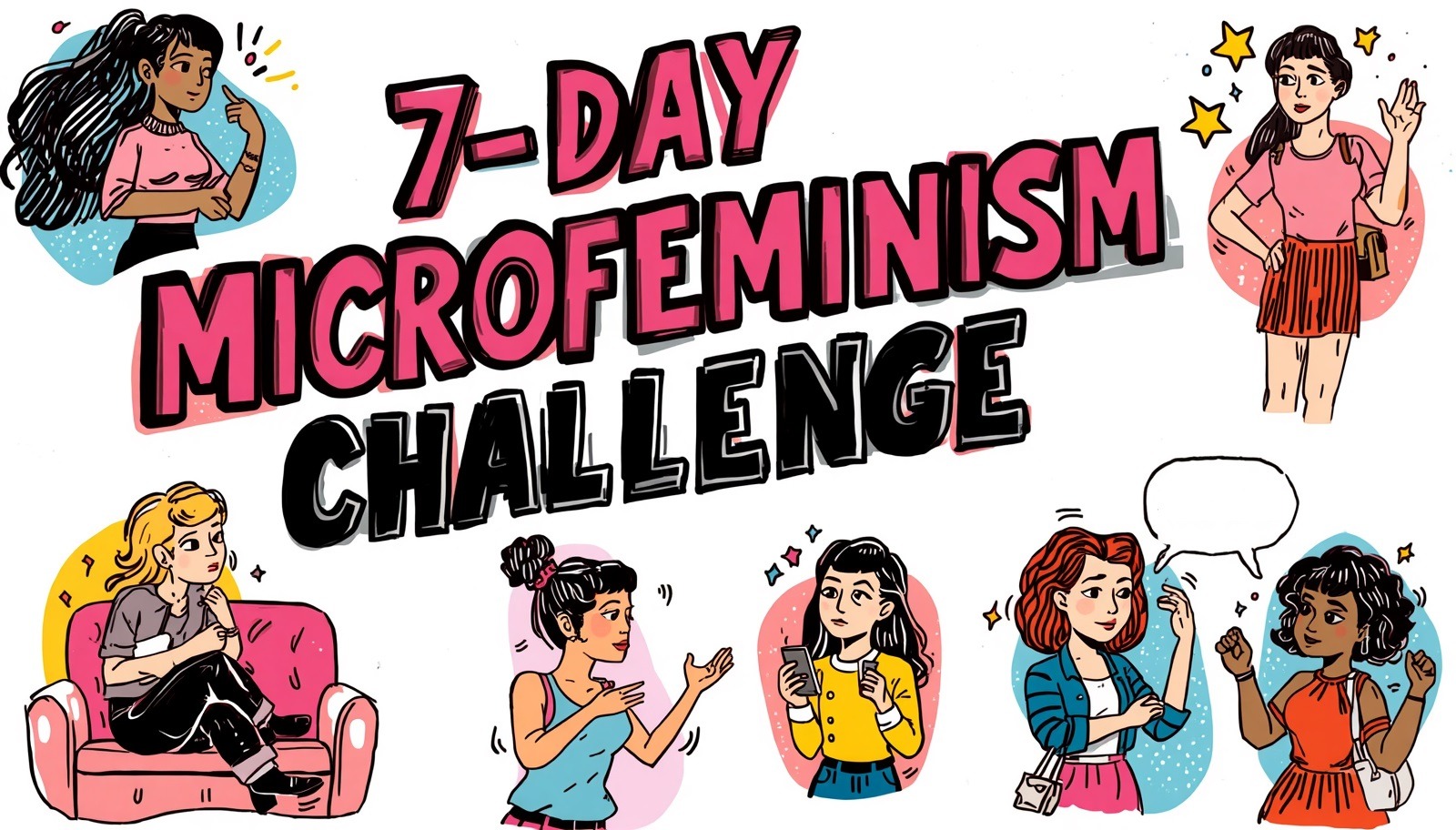
How to start: A 7-day microfeminism practice
For the next seven days, choose one microfeminism per day. Keep it small enough that you will actually do it.
Day 1: Remove one unnecessary apology from your language.
Day 2: Credit a woman clearly in public.
Day 3: Notice who performs invisible labor in one space.
Day 4: Ask one clarifying question instead of silently absorbing discomfort.
Day 5: Support a woman’s online visibility with a public comment or share.
Day 6: Rotate or renegotiate one default task.
Day 7: Write down one moment where you trusted your perception.
At the end of the week, do not ask, “Did I change the world?” Ask, “Did I abandon myself less?” That is the emotional doorway microfeminism opens.
The power of not shrinking
Microfeminisms help women feel less powerless because they restore movement where bias creates freeze. They take the heavy, abstract weight of inequality and translate it into one possible action: one sentence, one redirect, one refusal, one credit, one boundary, one act of public support. They remind us that power is not only something held in boardrooms, laws, salaries, and titles. Power also lives in attention. In language. In who gets believed. In who gets named. In who gets to finish a sentence.
I do not think microfeminism is small because women’s lives are small. I think it is small because daily life is where so much of women’s power has been negotiated away. And daily life is also where we can begin to take it back.
Not all at once. Not perfectly. Not always loudly.
But again and again.
A woman finishes her thought.
A girl learns her “no” matters.
A colleague gets credit.
A mother’s invisible labor becomes visible.
A woman stops apologizing for a normal human need.
A friend says, “I saw that too.”
A room learns a new rule.
→ This is how power returns: not only through grand declarations, but through repeated refusals to disappear.
Related posts You’ll love
- When feminism turns into a dating strategy, not a value: 10 red flags, reality checks, and Words of Power that protect Your heart
- What femininity feels like when no one is watching: The quiet psychology of authentic feminine energy
- Why “bad feminists” go viral faster than good arguments
- The “Men are trash” shortcut: How to name harm without dehumanizing and still hold Men accountable
- Dating advice that sounds feminist but trains self abandonment: The hidden scripts, red flags, and power phrases to protect Your desire
- Power moves vs. peace moves: Feminine scripts that build real security (without losing Yourself)
FAQ
-
What is microfeminism in simple words?
Microfeminism means small everyday actions that challenge sexism, gender bias, or unequal expectations. It can include crediting women’s ideas, refusing unnecessary apologies, rotating invisible labor, or speaking up when a woman is interrupted.
-
Are microfeminisms only for women?
No. Women, men, and people of all genders can practice microfeminisms. Allies can be especially helpful when they use their position to interrupt bias instead of leaving women to carry the full social risk.
-
Do microfeminisms actually change anything?
Microfeminisms are not a replacement for structural change, but they can change the immediate social environment. They make bias visible, support women’s agency, and create small norms that can spread through repetition.
-
Is microfeminism the same as everyday feminism?
They overlap. Everyday feminism is a broad commitment to gender equality in daily life. Microfeminism focuses specifically on small, concrete actions that interrupt subtle gendered patterns.
-
Can microfeminism help women feel more confident?
It can help some women feel more connected to their agency, but it should not be presented as an instant confidence cure. The emotional benefit often comes through repetition: each small act gives the self evidence that a response is possible.
-
What are examples of microfeminism at work?
Examples include saying “Let her finish,” crediting a woman’s idea, rotating note-taking, challenging gendered assumptions about leadership, documenting contributions, and asking whether office housework is being distributed fairly.
-
What is a microfeminist response to being interrupted?
A simple response is: “I’d like to finish my thought.” An ally can say: “I want to hear the rest of what she was saying.” The goal is to restore the conversational floor without overexplaining.
-
Is it microfeminism to stop saying sorry?
It can be. The point is not to avoid genuine apologies, but to stop apologizing for normal needs, questions, boundaries, or presence. Replacing unnecessary “sorry” with clear language can be a microfeminist practice.
-
Can microfeminism be practiced online?
Yes. Digital microfeminisms include supporting women’s posts publicly, reporting harassment, refusing to share misogynistic content, crediting women creators, and treating blocking as a valid safety tool.
-
What if speaking up feels unsafe?
Then direct confrontation may not be the right microfeminism. Safety matters. Alternatives include documenting the incident, seeking support, using private validation, asking an ally to intervene, or choosing not to engage.
-
What is the biggest misunderstanding about microfeminism?
The biggest misunderstanding is that microfeminism asks women to fix sexism through tiny personal choices. A healthier view is that microfeminism helps women preserve agency in daily life while still demanding broader cultural, institutional, and legal change.
Sources and inspirations
- Couva, M., Talias, M. A., Christou, M., & Soteriades, E. S. (2024). Women’s empowerment and health: A narrative review. International Journal of Environmental Research and Public Health.
- Enock, F. E., Stevens, F., Bright, J., Cross, M., Johansson, P., Wajcman, J., & Margetts, H. Z. (2024). Understanding gender differences in experiences and concerns surrounding online harms: A short report on a nationally representative survey of UK adults. arXiv.
- Hackett, R. A., Steptoe, A., & Jackson, S. E. (2019). Sex discrimination and mental health in women: A prospective analysis. Health Psychology.
- Im, J., Schoenebeck, S., Iriarte, M., Grill, G., Wilkinson, D., Batool, A., Alharbi, R., Funwie, A., Gankhuu, T., Gilbert, E., & Naseem, M. (2023). Women’s perspectives on harm and justice after online harassment. arXiv.
- Karami, A., Swan, S. C., White, C. N., & Ford, K. (2019). Hidden in plain sight for too long: Using text mining techniques to shine a light on workplace sexism and sexual harassment. arXiv.
- Kirk, H. R., Yin, W., Vidgen, B., & Röttger, P. (2023). SemEval-2023 Task 10: Explainable detection of online sexism. arXiv.
- McKinsey & Company, & LeanIn.Org. (2024). Women in the workplace 2024: The 10th-anniversary report.
- McNeal, S. (2024, April 11). We should all be microfeminists. Glamour.
- Samory, M., Sen, I., Kohne, J., Floeck, F., & Wagner, C. (2021). “Call me sexist, but…”: Revisiting sexism detection using psychological scales and adversarial samples. Proceedings of the International AAAI Conference on Web and Social Media.
- Sayer, H., Juanchich, M., Lamarche, V. M., & Whiley, L. A. (2025). Standing up to sexism: Does challenging sexist comments have transformational benefits in how women value themselves and other women? Sex Roles.
- Sue, D. W., Alsaidi, S., Awad, M. N., Glaeser, E., Calle, C. Z., & Mendez, N. (2019). Disarming racial microaggressions: Microintervention strategies for targets, White allies, and bystanders. American Psychologist.

Leave a Reply