Table of Contents
What is the 7-day microfeminism challenge?
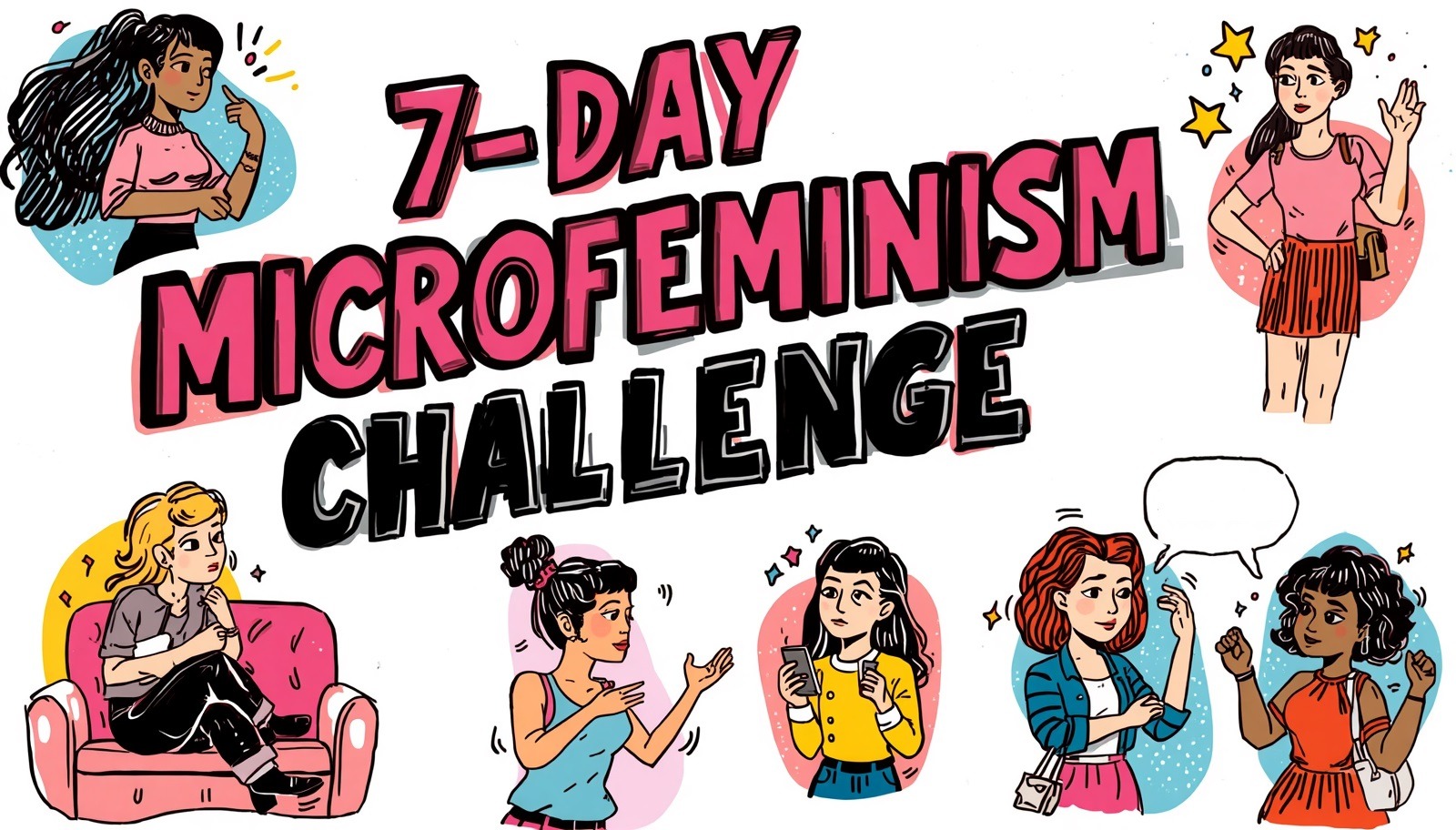
The 7-Day Microfeminism Challenge is a gentle but powerful practice plan that helps women stop shrinking in everyday life through small, intentional feminist actions. Each day focuses on one micro-shift: noticing bias, replacing unnecessary apologies, reclaiming your voice, crediting another woman, setting a boundary, making invisible labor visible, and reflecting on your own agency. Microfeminism does not replace structural change, but it helps women practice daily self-advocacy in the moments where power often disappears quietly.
The moment You realize You have been making Yourself smaller
There is a moment many women know. It happens so quickly that it is easy to dismiss. You are in a meeting, and someone interrupts you. You start an email with “Sorry” even though you did nothing wrong. You laugh at a joke that makes your stomach tighten. You agree to take notes again because everyone assumes you will. You explain your boundary three different ways because simply saying “no” feels too sharp. Later, you wonder why you feel so tired.
I think of these moments as small leaks in a woman’s sense of agency. None of them may seem dramatic on their own. Yet repeated over time, they can train the body and mind to expect less space, less credit, less ease, and less permission. Research has linked perceived sex discrimination with poorer mental health and well-being outcomes in women, which reminds us that everyday bias is not just an intellectual issue; it can become emotional weight.
This is why I created this Practice Corner challenge. The goal is not to make you louder, harsher, or constantly ready for conflict. The goal is to help you become less available for self-erasure. Microfeminism is about small, intentional acts that challenge gendered patterns in daily life. It can be as simple as crediting a woman’s idea, refusing to apologize for a normal need, asking why a task was assigned to you, or choosing not to make a sexist joke more comfortable by laughing.
Microfeminism became widely discussed because it gives language to something many women were already doing quietly. It is not always a protest sign. Sometimes it is a sentence. Sometimes it is a pause. Sometimes it is documentation. Sometimes it is saying, “Let’s go back to what she was saying.” The power is not only in the act itself, but in the inner message it sends: I noticed. I matter. I can respond.
This 7-day challenge is designed to be realistic. You do not need a perfect workplace, a perfect family, a perfect relationship, or perfect confidence to begin. You only need one week of paying attention. Each day gives you one practice, one script, one reflection, and one optional “brave version” if you have enough safety and energy. → The point is not to become fearless. The point is to stop abandoning yourself by reflex.
Why a 7-day challenge works better than waiting to “feel confident”
Many women wait to feel confident before they speak, ask, refuse, correct, or advocate. I understand why. Confidence feels like it should come first. But in real life, confidence is often not the beginning of action. It is the result of repeated evidence that you can survive small acts of honesty.
Behavior-change research shows that specific planning can help people translate intention into action. Mental contrasting with implementation intentions, for example, combines a desired future with a realistic obstacle and a concrete “if–then” plan. This matters for microfeminism because vague goals like “I want to be more empowered” are emotionally inspiring but behaviorally weak. A stronger plan sounds like: “If I am interrupted today, then I will say, ‘I want to finish this thought.
This challenge is built on that principle. Every day has a clear cue and a small response. You are not trying to rebuild your identity in one week. You are training your nervous system to recognize that power can return through tiny, repeatable acts.
Psychological safety also matters here. Speaking up is easier in environments where people believe they can raise concerns, ask questions, or make mistakes without being punished or humiliated. That means microfeminism must never become another way to shame women for staying quiet. Sometimes the safest response is direct. Sometimes it is private. Sometimes it is delayed. Sometimes it is documentation. Sometimes it is choosing not to spend your precious energy on someone committed to misunderstanding you.
Table 1: The 7-day microfeminism challenge at a glance

Before You begin: The safety rule
Before practicing any form of microfeminism, ask yourself: “Is this safe enough for me?” Not ideal. Not comfortable. Safe enough.
A woman with job security may be able to interrupt bias directly in a meeting. A woman in a precarious job, unsafe relationship, discriminatory family system, or high-risk environment may need a quieter strategy. This does not make her less brave. It makes her wise. Empowerment is not only about personal courage; it is shaped by context, resources, culture, relationships, and institutions.
So here is the rule for this challenge:
→ If direct action feels safe, practice direct action.
→ If direct action feels risky, practice indirect action.
→ If indirect action still feels unsafe, practice private witnessing, documentation, support-seeking, or internal reframing.
Microfeminism is not performance. It is not about proving how bold you are. It is about choosing the smallest action that protects your dignity without sacrificing your safety.
Day 1: The shrinking audit
Practice: Notice the places where You disappear
Day 1 is not about changing anything yet. It is about noticing. Most women cannot interrupt a pattern they are still blaming themselves for. The Shrinking Audit helps you observe the moments where you make yourself smaller, softer, quieter, more convenient, or more apologetic than you need to be.
For one day, carry a note in your phone called “Where I Shrink.” Every time you catch yourself minimizing, record the moment. Do not judge it. Do not turn it into self-criticism. Just write it down. Self-compassion research reminds us that a supportive relationship with ourselves can reduce harsh self-judgment and make difficult self-awareness easier to tolerate (Neff, 2023; Wakelin et al., 2022).
Examples might include: “I said sorry before asking a question.” “I let someone interrupt me.” “I did the organizing task because nobody else noticed.” “I softened my boundary with too many explanations.” “I stayed quiet when someone credited the wrong person.” “I laughed even though the joke made me uncomfortable.”
The point is not to shame yourself. The point is to shift from fog to evidence. When you write these moments down, you may notice that your shrinking is not random. It often follows patterns: authority figures, romantic tension, family expectations, workplace meetings, group chats, medical appointments, or conversations where you fear being seen as difficult.
Day 1 script
“Interesting. I am noticing a pattern. I do not have to fix it today. I only have to see it.”
Brave version
Tell one trusted person: “I’m doing a microfeminism challenge this week, and today I’m noticing where I shrink. I may need to talk it through later.”
Reflection prompt
Where do I make myself smaller because I believe it keeps me safe, liked, or accepted?
Day 2: The no-apology reset
Practice: Stop apologizing for existing
Day 2 is about language. Many women use “sorry” as a social lubricant. “Sorry, can I ask something?” “Sorry, just following up.” “Sorry, I disagree.” “Sorry, I need to reschedule.” Sometimes an apology is appropriate and healing. But often, “sorry” becomes a tiny confession of guilt for having a normal human need.
The No-Apology Reset is simple: every time you type or say “sorry,” pause and ask: “Did I harm someone, or am I just taking up space?” If harm happened, apologize sincerely. If no harm happened, replace the apology with clear, warm language.
- Instead of “Sorry to bother you,” try “Do you have a moment for a question?”
- Instead of “Sorry for the delay,” try “Thank you for your patience.”
- Instead of “Sorry, I disagree,” try “I see it differently.”
- Instead of “Sorry, can I add something?” try “I’d like to add something.”
This practice is small, but it can feel surprisingly emotional. That is because unnecessary apology is not only a word habit. It can be a body habit. It may carry years of being taught that women should be low-maintenance, agreeable, and grateful for attention.
Table 2: The no-apology reset

Day 2 script
“I do not need to apologize for a question, a boundary, a follow-up, a preference, or a normal delay.”
Brave version
Look at your last five emails or messages. Rewrite one unnecessary apology before sending your next message.
Reflection prompt
What do I fear will happen if I sound clear instead of overly apologetic?
Day 3: Reclaim Your sentence
Practice: Finish what You started
Day 3 is about interruption. Being interrupted once is annoying. Being interrupted repeatedly teaches women that their thoughts are public property and their speaking time is negotiable. Workplace sexism research has identified women being ignored or talked over as part of broader patterns of gendered workplace experiences. The goal today is to practice calmly reclaiming your sentence.
This does not mean you need to fight for every word in every room. It means you practice one sentence that brings the conversation back to you.
Try:
→ “I want to finish that thought.”
→ “Let me complete the point, and then I’d like to hear your view.”
→ “I wasn’t finished yet.”
→ “I’ll come back to that after I finish this sentence.”
Notice that none of these are rude. They are not aggressive. They simply protect the basic dignity of finishing a thought. In microintervention language, this is a way of making an invisible dynamic visible and interrupting it in real time.
The nervous system tip
Before you speak, press your feet into the floor. Lower your shoulders. Exhale slowly. Then use the shortest sentence possible. Many women over-explain because silence feels dangerous. But sometimes the cleanest sentence is the strongest one.
Day 3 script
“I want to finish that thought.”
Brave version
Use the script once in a low-stakes conversation, even if the interruption was mild. Practice when the stakes are smaller so your body has a memory before the stakes get higher.
Reflection prompt
When I am interrupted, do I disappear, rush, apologize, compete, or freeze?
Day 4: The credit-back practice
Practice: Make Women’s contributions visible
Day 4 is about credit. One of the most painful everyday patterns is watching a woman’s idea get ignored until someone else repeats it with confidence. The Credit-Back Practice is a microfeminist way of restoring authorship.
The structure is simple:
- Name the woman.
- Name the contribution.
- Connect the room back to her idea.
For example: “I want to credit Maya for naming that risk earlier. The plan we’re discussing now builds directly on her point.”
This practice matters because recognition shapes authority. When women’s ideas are separated from their names, women lose visibility, leverage, and sometimes opportunity. McKinsey and LeanIn.Org’s workplace research has continued to highlight the importance of addressing microaggressions and bias because these experiences affect women’s day-to-day work lives and advancement.
The Credit-Back Practice also changes the emotional atmosphere. It tells other women: “I saw it too.” That sentence, even unspoken, can be deeply regulating. One of the most exhausting parts of subtle sexism is not only the event itself, but the loneliness of wondering whether anyone else noticed.
Credit-back scripts
→ “That connects to what Priya said earlier.”
→ “I want to make sure we credit Lena for introducing that idea.”
→ “Yes, and I think the original insight came from Aisha.”
→ “Before we move on, I want to return to her point.”
Day 4 script
“I want to credit her for naming this first.”
Brave version
Credit a woman publicly today — in a meeting, a group chat, a comment, an email, or a family conversation.
Reflection prompt
Where have I allowed my own work or another woman’s work to become invisible because I did not want to seem difficult?
Day 5: The one-sentence boundary
Practice: Say less, mean more
Day 5 may be the hardest for many women. Boundaries can feel simple in theory and terrifying in practice. This is especially true if you were praised for being easy, helpful, flexible, emotionally available, or “mature for your age.” A one-sentence boundary challenges the belief that your “no” must come wrapped in a legal defense.
The practice is this: set one boundary today using one clear sentence. Do not over-explain. Do not apologize unless you caused harm. Do not turn your boundary into a debate invitation.
Examples:
→ “I’m not available for that.”
→ “That doesn’t work for me.”
→ “I need more time before I answer.”
→ “I’m not discussing this tonight.”
→ “Please don’t speak to me that way.”
→ “I can help for 20 minutes, but I can’t take ownership of the whole task.”
Self-compassion is useful here because boundary-setting can activate guilt. You may feel selfish even when you are simply being honest. Research on self-compassion interventions suggests they can help reduce self-criticism, which is important because self-criticism often pulls women back into over-giving and over-explaining.
The boundary formula
“I can/can’t/will/won’t + clear limit + optional next step.”
For example: “I can’t take this on, but I can send you the document I used last time.”
Or: “I won’t discuss my body at dinner. Let’s change the subject.”
The optional next step is not required. Sometimes a boundary needs no alternative.
Day 5 script
“That doesn’t work for me.”
Brave version
Use a boundary without adding a long explanation. Let the other person feel the pause.
Reflection prompt
What do I believe I owe people before I am allowed to say no?
Day 6: Make invisible labor visible
Practice: Name the work that “magically” gets done
Day 6 is about invisible labor. In many homes, workplaces, friendships, and families, women do not only do tasks; they notice tasks. They remember, anticipate, coordinate, soothe, track, remind, schedule, plan, and emotionally translate. Because this labor is often relational, it can be dismissed as personality instead of recognized as work.
Today’s microfeminism is to name one invisible task and move it from assumption into structure.
Instead of silently doing it, ask:
→ “Who owns this task?”
→ “Can we rotate this responsibility?”
→ “Is this assigned because of role, skill, or habit?”
→ “Who is tracking the follow-up?”
→ “Can we put this in a shared system instead of relying on me to remember?”
This practice is especially powerful because it changes the frame from “help” to “ownership.” Help implies the task naturally belongs to one person and others are assisting. Ownership asks who is actually responsible from beginning to end.
Table 3: Invisible labor → visible system

Day 6 script
“Who owns this task from beginning to end?”
Brave version
Choose one recurring invisible task and refuse to hold it alone this week. Create a shared system, ask for rotation, or step back long enough for the absence of your labor to become visible.
Reflection prompt
What do people assume I will notice, remember, or manage because I am a woman?
Day 7: The agency echo
Practice: Prove to Yourself that You did not imagine Your power
Day 7 is about integration. Many women practice courage and then immediately minimize it. “It wasn’t a big deal.” “Anyone could do that.” “I still should have said more.” “I probably sounded awkward.” This is how agency disappears again. The Agency Echo is the practice of letting your small act count.
Today, write down what you did this week. Not perfectly. Not dramatically. Just honestly.
Use this format:
→ “I noticed…”
→ “I interrupted…”
→ “I protected…”
→ “I named…”
→ “I practiced…”
→ “Next, I want to…”
The echo matters because identity is reinforced through memory. If you do not record your own micro-shifts, your nervous system may only remember the discomfort. When you write them down, you give your mind evidence: “I acted. I responded. I did not shrink in the same old way.”
Day 7 script
“I am allowed to let small acts count.”
Brave version
Share one micro-shift with someone you trust. You might say, “This week I practiced not apologizing for normal needs, and I noticed how often I do it.”
Reflection prompt
What tiny act made me feel most like myself this week?
The unconventional part: Your “power leak” map
Most self-growth advice asks, “What do you want to become?” That is a beautiful question, but this challenge asks something more specific: “Where is your power leaking?”
A power leak is a repeated moment where your energy, voice, confidence, credit, or clarity drains away. It may happen when you over-explain. It may happen when you let people misname your role. It may happen when you do emotional labor for adults who could speak directly to each other. It may happen when you answer messages instantly because being unavailable feels dangerous. It may happen when you stay silent after someone subtly undermines you.
Create a small map with three columns:

This map is not about becoming suspicious of everyone. It is about becoming honest with yourself. Your power does not usually disappear all at once. It leaks through repeated scripts. When you identify the script, you can write a new one.
What if You freeze?
You might. Freezing does not mean you failed. Freezing is a protective response. Many women freeze because the social cost of speaking has been real. Maybe you were mocked. Maybe you were punished. Maybe you learned that being agreeable kept the peace. Maybe you are navigating a workplace or family system where directness is not equally safe for everyone.
If you freeze, use a delayed microfeminism.
After the moment, you can say:
→ “I want to return to something from earlier.”
→ “I realized I didn’t finish my point.”
→ “I want to clarify what I meant.”
→ “I noticed I was assigned that task again. Can we rotate it next time?”
→ “I didn’t respond in the moment, but that comment didn’t sit right with me.”
Delayed response is still response. Private documentation is still response. Asking an ally for backup is still response. Choosing not to engage with someone unsafe is still response.
Microfeminism should expand your options, not narrow them.
How to keep going after the 7 days
After the challenge, choose one practice to keep for the next month. Do not try to do everything. Pick the microfeminism that meets your real life.
- If you are constantly apologizing, keep the No-Apology Reset.
- If you are talked over, keep Reclaim Your Sentence.
- If your labor disappears, keep Make Invisible Labor Visible.
- If you struggle with boundaries, keep the One-Sentence Boundary.
- If you often doubt yourself, keep the Shrinking Audit once a week.
You can also create an “if–then” plan:
→ If I start to say “sorry” without causing harm, then I will replace it with “thank you” or a clear statement.
→ If someone interrupts me, then I will say, “I want to finish that thought.”
→ If I am asked to organize something by default, then I will ask, “Who owns this task?”
→ If I feel guilty after setting a boundary, then I will remind myself, “Discomfort is not evidence that I did something wrong.”
This is how small acts become habits. Not through perfection, but through repetition.
The 7-day microeminism challenge workbook, FREE PDF!
A note on intersectionality and real-life risk
A microfeminism challenge must be honest about risk. Women do not all experience gender bias in the same way. Race, class, disability, sexuality, body size, religion, age, immigration status, neurodivergence, job security, and relationship dynamics can all shape what happens when a woman speaks up. Some women are punished more harshly for the same directness that others are praised for.
This means the challenge should be adapted, not obeyed. You are allowed to choose the version that fits your safety. You are allowed to skip a day. You are allowed to practice privately. You are allowed to decide that a situation requires support, documentation, legal advice, HR, therapy, community care, or exit planning rather than a single sentence.
Microfeminism is not the whole revolution. It is a daily practice of not disappearing while larger change is still needed.
You do not have to become someone else to stop shrinking
At the end of this challenge, you may not feel transformed in a cinematic way. You may not suddenly become fearless. You may still hesitate. You may still over-explain sometimes. You may still replay conversations in your head.
That does not mean the challenge failed.
The real shift is quieter. Maybe you notice your apology before it leaves your mouth. Maybe you finish one sentence. Maybe you credit one woman. Maybe you ask who owns the task. Maybe you say no with one less paragraph. Maybe you trust your discomfort for ten seconds longer before dismissing it.
This is how power returns in daily life: not always through a dramatic declaration, but through repeated refusal to vanish.
I believe microfeminism matters because it gives women a practical bridge between awareness and action. It says: you do not have to fix the whole system today. You do not have to become perfectly confident. You do not have to have the perfect words. You can begin with one sentence, one pause, one credit, one boundary, one moment of not shrinking.
And when you do that, something changes.
The room may not change immediately.
The person may not understand immediately.
The system may not reward you immediately.
But inside you, a new message begins to form:
→ I noticed
→ I responded
→ I stayed with myself
→ I am allowed to take up space
That is not small. That is practice. And practice is how a woman returns to herself.
Related posts You’ll love
- Microfeminisms: How tiny acts of everyday feminism help Women feel less powerless
- Why “bad feminists” go viral faster than good arguments
- The receipts method: How to spot a feminist ally (and trust Yourself without overthinking)
- “Male feminist” or feminist ally? How to spot real values vs personal branding: A practical, evidence informed guide for Women who want clarity without cynicism
- Weaponized feminist language: 17 phrases that sound empowering but aren’t
- Stop putting Your desires on trial: 17 things Women need to remember when wanting more feels wrong
- Why so many Women crave sisterhood but struggle to trust it
FAQ
-
What is the 7-Day Microfeminism Challenge?
The 7-Day Microfeminism Challenge is a practical one-week plan that helps women practice small feminist actions in everyday life. Each day focuses on a tiny but meaningful shift, such as reducing unnecessary apologies, reclaiming your voice, giving women credit, setting boundaries, and naming invisible labor.
-
Is microfeminism the same as feminism?
Microfeminism is a form of everyday feminism. Feminism is the broader belief in gender equality and liberation from gender-based oppression. Microfeminism focuses on small daily actions that challenge subtle sexism, bias, and unequal expectations.
-
Can small acts really make a difference?
Small acts do not replace structural change, but they can change immediate dynamics. They help women practice agency, make bias visible, support one another, and build confidence through repeated action.
-
What if I am too scared to speak up?
Start with private or delayed microfeminisms. You can document what happened, talk to an ally, reflect in a journal, or respond later. The challenge should be adapted to your safety, not used to pressure yourself into risky confrontation.
-
Is stopping unnecessary apologies really microfeminism?
Yes, it can be. When women apologize for normal needs, questions, preferences, or boundaries, they may reinforce the idea that their presence is inconvenient. Replacing unnecessary apologies with clear language is a small act of self-advocacy.
-
What is the easiest microfeminism to start with?
The easiest starting point is noticing. Before changing anything, write down three moments where you shrink, apologize, over-explain, stay silent, or take on invisible labor. Awareness creates the foundation for action.
-
What should I say when someone interrupts me?
Try a calm sentence such as: “I want to finish that thought,” “I wasn’t finished yet,” or “Let me complete the point, and then I’d like to hear your view.” Keep it short and grounded.
-
How can I practice microfeminism at work?
You can credit women’s ideas, rotate note-taking, document your contributions, ask for clear ownership of tasks, challenge interruptions, and use direct language in emails. These actions help make invisible patterns visible.
-
How can I practice microfeminism at home?
At home, microfeminism may include naming invisible labor, creating shared systems, rotating responsibilities, refusing to be the default emotional manager, and asking family members to take ownership of their own tasks and relationships.
-
Can men practice microfeminism too?
Yes. Men and people of all genders can practice microfeminism by interrupting bias, crediting women, sharing labor fairly, refusing sexist jokes, listening when women name harm, and using their position to reduce the social cost women often carry.
-
What should I do after the 7 days?
Choose one practice to continue for a month. The best microfeminism is the one that meets your real life. You might keep the No-Apology Reset, the One-Sentence Boundary, the Credit-Back Practice, or the Shrinking Audit as a weekly reflection.
Sources and inspirations
- Couva, M., Talias, M. A., Christou, M., & Soteriades, E. S. (2024). Women’s empowerment and health: A narrative review. International Journal of Environmental Research and Public Health.
- Edmondson, A. C., & Bransby, D. P. (2023). Psychological safety comes of age: Observed themes in an established literature. Annual Review of Organizational Psychology and Organizational Behavior.
- Hackett, R. A., Steptoe, A., & Jackson, S. E. (2019). Sex discrimination and mental health in women: A prospective analysis. Health Psychology.
- Karami, A., Swan, S. C., White, C. N., & Ford, K. (2019). Hidden in plain sight for too long: Using text mining techniques to shine a light on workplace sexism and sexual harassment. Psychology of Violence.
- McKinsey & Company, & LeanIn.Org. (2024). Women in the workplace 2024: The 10th-anniversary report.
- Neff, K. D. (2023). Self-compassion: Theory, method, research, and intervention. Annual Review of Psychology.
- Sue, D. W., Alsaidi, S., Awad, M. N., Glaeser, E., Calle, C. Z., & Mendez, N. (2019). Disarming racial microaggressions: Microintervention strategies for targets, White allies, and bystanders. American Psychologist.
- Wakelin, K. E., Perman, G., & Simonds, L. M. (2022). Effectiveness of self-compassion-related interventions for reducing self-criticism: A systematic review and meta-analysis. Clinical Psychology & Psychotherapy.
- Wang, G., Wang, Y., & Gai, X. (2021). A meta-analysis of the effects of mental contrasting with implementation intentions on goal attainment. Frontiers in Psychology.



Leave a Reply