Table of Contents
Schoolyard spillover happens when viral myths and misinformation migrate from feeds into real classroom conversations, shaping what students believe, how they treat each other, and what they think “counts” as truth. The fastest way to respond is not a debate, it is a language shift: move students from performance mode into inquiry mode with calm, specific “Words of Power” that invite checking, sourcing, and reflection.
A scene You have probably lived through (even if You never named it)
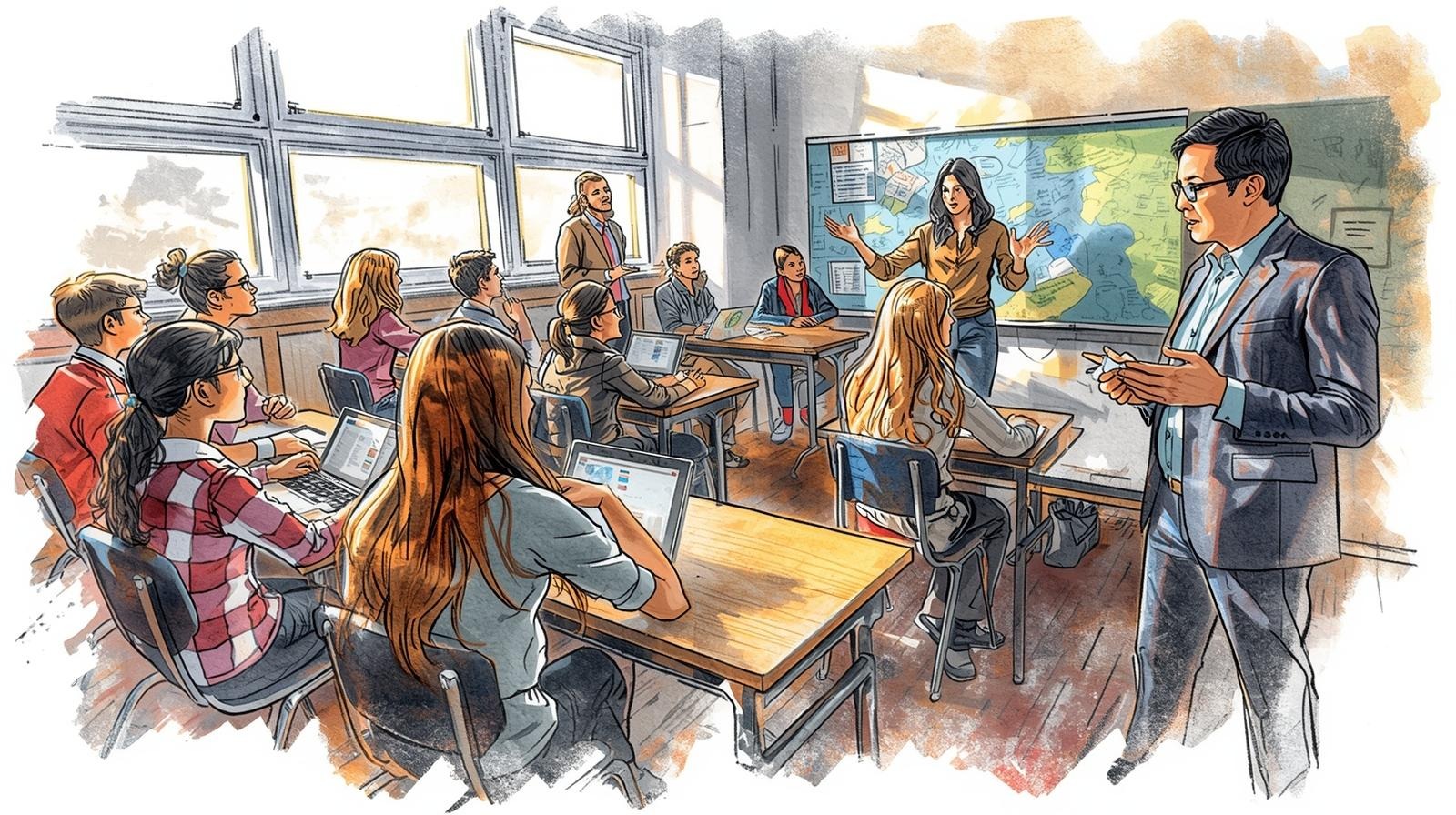
A student raises their hand with the confidence of someone holding a trump card. They heard something. They saw a clip. They watched a creator who “proved it.” The claim might be about health, history, science, relationships, gender, money, politics, or some suspiciously dramatic story about what “they” are doing “behind the scenes.”
A few students nod like it is obvious. A few laugh. A few stiffen, because the myth lands on a real fear or a real identity. You can feel the classroom tilt. Not toward learning. Toward social gravity.
This is the part that can make teachers and parents feel exhausted: it is not only about facts. It is about belonging. About status. About trying to look unfooled. About not wanting to be the only one who does not “get it.” It is about adolescents navigating a world where attention is currency and outrage is a shortcut to influence.
And it is why myths spread so effectively online in the first place. Research on diffusion of true versus false news has shown that falsehood tends to travel farther and faster than truth, driven largely by human sharing behavior and novelty.
But inside a classroom, “faster” and “farther” looks like something more intimate: a whisper, a joke, a dare, a challenge to the teacher, a group chat screenshot, a sudden shift in who feels safe to speak.
So let’s name the real problem.
Not “kids these days.” Not “technology is bad.” Not “they are brainwashed.”
The problem is that online myths are engineered to trigger the social nervous system, and then they spill into classrooms where the social nervous system is already running hot.
That is schoolyard spillover.
What exactly is “schoolyard spillover”
Schoolyard spillover is the offline migration of online myths into student relationships and classroom learning, often carried by short form video, memes, influencer commentary, algorithmic repetition, and peer group reinforcement.
It shows up as:
- A claim repeated as if it is common knowledge
- A “gotcha” question aimed at the adult in the room
- A cruel stereotype disguised as humor
- A moral panic dressed up as concern
- A conspiracy flavored storyline that makes ordinary events feel suspicious
- A viral “hack” that pretends complexity is a scam
Schoolyard spillover is not just misinformation as content. It is misinformation as culture.
And that is why the solution is not only teaching students what is true. It is teaching them how truth is built, how confidence can be faked, and how language can move a group from heat to light.
For a deeper psychological look at why people form and hold onto misinformation beliefs, and why correction can be difficult even after exposure to accurate information, see Ecker and colleagues’ synthesis of cognitive, social, and emotional drivers.
The spillover loop: How a myth travels from a feed into Your lesson
Here is the pattern that repeats across topics and age groups:
Scroll → Spark → Share → Social proof → Status reward → Spillover → Classroom tension → Reinforcement
Scroll
A student consumes a steady stream of simplified narratives.
Spark
Something triggers emotion: outrage, fear, disgust, superiority, excitement.
Share
They forward it, quote it, remix it, or bring it into conversation.
Social proof
Others react. Likes become a substitute for evidence.
Status reward
The student gains attention for being “in the know.”
Spillover
The myth enters school, not as information, but as identity and performance.
Classroom tension
A learning moment becomes a social moment.
Reinforcement
Even if corrected, the myth stays “sticky” because it served a social purpose.
This stickiness is part of what misinformation research calls continued influence, where initial misinformation can keep shaping reasoning even after correction.
If you want a single sentence to keep in your pocket, make it this:
When a myth wins in a classroom, it is often because it made someone feel something before it made them think.
Why online myths feel true to smart students
This is where adults sometimes underestimate teenagers. Many students who repeat myths are not unintelligent. They are socially strategic. They are developmentally tuned to belonging. They are living inside a reward system where attention comes quickly, but verification feels slow and uncool.
Below is a table that reframes “gullibility” into something more accurate: a set of needs that myths temporarily satisfy.
Table 1: What myths give students (and why correction alone often fails)
| What the student seems to be doing | What they might actually be needing | What the myth provides in 5 seconds | What the classroom can provide in 5 minutes |
|---|---|---|---|
| Repeating a viral claim confidently | Safety through certainty | A simple story with a villain and a hero | A stable process for checking reality |
| Challenging the teacher with a “gotcha” | Status and autonomy | Power through disruption | Power through skill and discernment |
| Sharing “insider” narratives | Belonging | A tribe and a code | Belonging that does not require distortion |
| Mocking other students using myth based stereotypes | Social protection | Joining the crowd | A norm of dignity and accountability |
| Refusing credible sources as “biased” | Control | Immunity from embarrassment | A way to revise beliefs without shame |
| Doom scrolling “warning” content | Emotional regulation | Fear that feels like preparation | Tools for anxiety, nuance, and grounded action |
What helps is not only knowledge, but also what Pennycook and colleagues call attention to accuracy. When people are prompted to think about accuracy, they share higher quality information and less misinformation.
In plain language: students do better when the room rewards accuracy, not adrenaline.
The 6 classroom myth archetypes (so You can recognize them quickly)
Online myths are not random. They come in recognizable shapes. When you can name the shape, you can choose the right response.
Table 2: Six myth archetypes and the “tell” that gives them away
| Myth archetype | How it sounds in class | The hidden hook | The best first move |
|---|---|---|---|
| The “Everyone knows” myth | “It’s literally proven” | Social proof replaces evidence | Ask for the original source and context |
| The “Secret truth” myth | “They don’t want you to know” | Suspicion feels like intelligence | Separate curiosity from accusation |
| The “One clip” myth | “I saw a video, so…” | Vividness beats validity | Teach lateral reading and corroboration |
| The “Label and dismiss” myth | “That source is fake” | Identity protection | Teach students to evaluate claims, not teams |
| The “Moral panic” myth | “Kids are being harmed by…” | Fear as belonging | Slow the tempo, ask what evidence would count |
| The “Shortcut” myth | “This one trick fixes everything” | Complexity fatigue | Ask about tradeoffs and mechanisms |
This is exactly why education researchers emphasize strategies used by professional fact checkers: leaving the site, checking other sources, and reading laterally across the web. Wineburg and McGrew describe lateral reading as a core feature of expert online evaluation.
Words of Power: The real lever You control in the moment
You cannot control what students watch at 11:47 p.m.
You can control what you reward at 11:47 a.m.
“Words of Power” are not magical phrases. They are verbal design. They shape the emotional climate and the social incentives of the room. They help students move from performance to inquiry without humiliation.
Below are the most effective language pivots I have seen across schools, parent conversations, and media literacy interventions. Notice what they do: they lower threat, raise curiosity, and set a standard that truth is something we build, not something we declare.

Table 3: Myth talk → Inquiry talk (scripts that keep dignity intact)
| When a student says | You can say (Words of Power) | Why it works |
|---|---|---|
| “It’s obviously true.” | “Let’s treat ‘obvious’ as a hypothesis and earn it.” | Turns certainty into a testable claim |
| “I saw it online.” | “Cool. Let’s locate the original and see what changed on the way here.” | Teaches source tracing without shaming |
| “That site is biased.” | “Maybe. What would a trustworthy source look like for this claim?” | Shifts from labels to criteria |
| “My influencer proved it.” | “Let’s separate persuasion from proof. What counts as proof here?” | Builds epistemic clarity |
| “So are you saying I’m lying?” | “I’m saying brains can be fooled. Mine too. We check together.” | Lowers defensiveness, keeps relationship |
| “Everyone agrees.” | “If everyone agrees, we should be able to find multiple independent confirmations.” | Teaches corroboration |
| “You can’t trust anything.” | “That feeling is real. The conclusion isn’t. Let’s build a trust ladder.” | Acknowledges emotion, rejects nihilism |
That last phrase, trust ladder, is worth expanding, because it is one of the most nonstandard but effective classroom tools I know.
The trust ladder: A new way to make verification feel human
Students often swing between two extremes:
- Everything is true if my group shares it
- Nothing is true so nothing matters
Both are emotional strategies. Both reduce anxiety. Both destroy learning.
A trust ladder creates a middle path. It is not “trust mainstream, distrust social.” It is “raise trust based on transparent methods.”
Trust ladder (simple classroom version):
Claim with no source → Claim with a named source → Claim with primary evidence → Claim corroborated by independent sources → Claim consistent with established knowledge and open to revision
You can literally draw it on the board. Then use it all year.
A surprising benefit: it gives students a way to change their mind without losing face, because they are not switching teams. They are climbing a ladder.
UNESCO’s media and information literacy curriculum stresses building competencies to counter misinformation and disinformation, including understanding how evidence and sources work in digital environments.
⟡
The A C T protocol: A classroom response that takes 90 seconds
Here is a protocol you can use the moment a myth enters the room. It is designed for real life. Not a perfect workshop. Not a quiet seminar. A normal Tuesday.
A: Acknowledge the emotion
Say what you observe without agreeing with the claim.
“I can see this feels intense, and people have strong reactions.”
C: Clarify the claim
Make it specific. Vagueness is where myths breed.
“Let’s write the claim as one sentence we can test.”
T: Test with a method
Pick one method and do it together.
“Before we argue, we verify. We will do lateral reading: we check what other credible, independent sources say about the same claim.”
Notice what you did. You did not let the class become a court. You turned it into a lab.
And when you do this repeatedly, you build a culture where “checking” becomes a status behavior.
That matters because scalable interventions show that teaching students concrete evaluation strategies can improve their ability to reason about online information. McGrew’s work on civic online reasoning interventions points to the value of teaching students how to evaluate digital content using professional fact checker moves.
The dignity rule: The only non negotiable boundary
If you take one idea from this article, take this:
You cannot shame a student into better thinking. You can only shame them into better hiding.
Public humiliation is myth fertilizer. It makes students cling harder to their claim because backing down would cost social identity. When correction feels like an attack, misinformation becomes a shield.
Ecker and colleagues highlight how psychological barriers and identity related processes can make belief revision difficult, especially in socially charged contexts.
So set a classroom norm that sounds like love and functions like rigor:
- “In this room, changing your mind is a skill, not a weakness.”
Then prove it by protecting students when they do it.
“But what if the myth is harmful right now”
Some myths are not just wrong, they are socially dangerous. They can target groups, encourage harassment, or escalate fear. This is where Words of Power must include boundaries.
Here is a boundary script that stays calm and firm:
“We can examine claims. We do not use claims as weapons against people. If a statement targets someone’s identity or safety, we pause and repair before we continue.”
Then redirect:
“Let’s move from story to evidence. What is the claim, and what is the strongest source for it. Not a clip, not a reaction, the source.”
This approach aligns with the broader view that misinformation has real harms, including social harms, and that mitigation requires both competence and norms. UNICEF’s report on digital misinformation and children emphasizes that children need critical literacy skills to judge whether a story is real or false.
A weekly “immunity routine” that makes myths less exciting
Most schools try to address misinformation in one assembly.
Students experience misinformation every day.
So the solution needs to be rhythmic, not dramatic.
Here is a routine that feels fresh, non preachy, and surprisingly popular when done consistently. It treats myth resistance like fitness: small reps, often.
Table 4: A 4 week classroom immunity cycle (10 minutes each week)
| Week | The micro skill | What you do in class | What students learn to say |
|---|---|---|---|
| 1 | Claim surgery | Turn a viral sounding statement into a testable claim | “What exactly is being claimed?” |
| 2 | Source tracing | Find the earliest version and compare changes | “Where did this originate?” |
| 3 | Lateral reading | Open multiple independent sources and compare | “What do other sources say?” |
| 4 | Accuracy pause | Before sharing, ask one accuracy question | “Would I bet my reputation on this?” |
This is not theoretical. Evidence suggests that even brief prompts that shift attention to accuracy can reduce misinformation sharing.
Also, media literacy interventions at scale have shown improvements in discernment between mainstream and false news content, though effects can vary by context.
What you are doing here is building a classroom identity: “We are the kind of people who check.”
The myth friendly classroom: How to keep curiosity without letting nonsense run the show
There is a fear some educators have: “If I invite discussion, I will invite chaos.”
That happens when discussion is unstructured.
A myth friendly classroom is not one where myths are welcomed as equal to facts. It is one where students are allowed to bring in what they are hearing, so you can teach them how to handle it.
Here is the paradox:
If you ban the conversation, it continues in private, and the myth becomes more glamorous.
If you host the conversation with structure, the myth becomes less glamorous, because it has to survive daylight.
This is why inoculation and prebunking approaches have gained attention: you strengthen resistance by exposing people to weakened examples of misleading tactics and showing how they work.
One playful but powerful way to do this with adolescents is to name “the trick,” not “the belief.”
Instead of saying: “That claim is wrong.”
Say: “That is a persuasion move called false certainty. Let’s slow it down.”
Instead of saying: “Stop believing that.”
Say: “Notice how the post uses a single clip as total proof. That is a one clip myth.”
Now you are teaching pattern recognition. Students love pattern recognition because it feels like mastery.
And mastery is what they were chasing in the first placeRoozenbeek and van der Linden’s work on inoculation style interventions, including game based approaches, supports the idea that learning the tactics of misinformation can build psychological resistance.
The parent bridge: What to say at home without starting a war
Parents often ask: “How do I talk to my kid about misinformation when they think I’m clueless?”
The answer is not a lecture. It is a role shift.
Teenagers resist being managed. They respond to being respected.
Try this “expert role” invitation:
“I want your help. You spend more time online than I do. Teach me how you decide what to trust.”
Then follow with a gentle precision question:
“When you trust something, what is your strongest reason. The source, the evidence, or the vibe.”
If they say vibe, do not mock it. Vibes are data about emotion. Just do not confuse them with evidence.
Now add a Word of Power that keeps the door open:
“We can disagree and still stay connected. I’m not trying to win. I’m trying to understand how you’re building your view.”
This approach overlaps with interventions that place adolescents in an “expert” position to encourage vigilance, though results suggest that effects can fade over time without reinforcement.
So keep it light, frequent, and relational.
Small conversations beat one big confrontation.

When the myth is not just misinformation, but identity
Some online myths are designed to recruit. They offer a ready made worldview that explains pain, provides enemies, and gives a sense of superiority. In these cases, fact checking alone can miss the deeper function of the myth.
Here is a more powerful question:
“What problem does this story solve for you.”
Sometimes the answer is loneliness. Sometimes it is fear. Sometimes it is feeling small.
Your goal is not to psychoanalyze your student or child. Your goal is to widen the emotional options so the myth is no longer the only place they can put their feelings.
Then you can return to method:
“If a story is comforting, that does not make it true. If a story is scary, that does not make it true. We check anyway.”
Ecker and colleagues emphasize that misinformation belief is shaped by cognitive, social, and affective factors, which is a fancy way of saying: feelings matter, and they are not the enemy, they are part of the system.
A nonstandard tool: The “myth to meaning” rewrite
Here is something unconventional you can try in classrooms and at home. It works especially well for students who love dramatic narratives.
- Step one: write the myth as a story. Not as a fact claim. As a story.
- Step two: ask what the story is trying to protect.
- Step three: rewrite it as a question that can be researched.
Example transformation:
Myth story
“They are hiding the truth and nobody wants you to see it.”
Meaning
“I feel powerless and I want a sense of control.”
Researchable question
“What evidence would show hidden coordination, and what evidence would show normal institutional mistakes.”
This does not validate the myth. It validates the human underneath it.
And once the human is seen, the brain becomes more flexible.
The classroom is still stronger than the feed
Algorithms are powerful. But they do not hold the deepest power.
The deepest power is relational. It is the moment a student realizes they can be curious without being cruel, confident without being careless, and strong without needing to cling to a story that collapses under daylight.
So here are a few Words of Power you can end with, quietly, consistently, until they become a classroom culture:
- “Truth is not a vibe. It is a practice.”
- “We check because we care.”
- “Changing your mind is proof you are learning.”
- “We do not trade dignity for certainty.”
- “In this room, we earn our beliefs.”
That is how you stop schoolyard spillover. Not by winning an argument.
By changing the language of belonging.
Related posts You’ll love
- Safety advisory: Manosphere content is a relationship virus. A science backed, reader friendly guide to spotting the infection, stopping the spread, and restoring respect
- Misogyny incident report: How sexualized harassment becomes a silencing tool and how to document it, name it, and reclaim Your voice. FREE PDF!
- Incident report: 47 applications, 0 replies, 1 nervous system crash. A trauma informed, AI era guide to job search recovery, regulation, and words that bring You back to Yourself
- The under 16 social media debate is about adults too: What age limits reveal about us and what actually protects teens
- The privacy safe parent: How to protect under 16 teens online without turning into a surveillance system
- Why we can’t stop watching “Punch” the baby monkey — and how comfort objects soothe adult stress (shame-free)
- Opt out form for free therapy for Men: A stigma proof, science backed way to start counseling without overthinking it

FAQ: Schoolyard spillover
-
What is “schoolyard spillover” in the context of online myths?
Schoolyard spillover is what happens when viral claims, rumors, and misinformation leave social feeds and enter real classrooms through jokes, certainty, fear, and peer status. The content often changes when it travels: it gets shorter, louder, and more absolute. In practice, spillover affects learning, relationships, and safety because students start debating social narratives instead of evidence.
-
Why do online myths spread so easily among students?
Online myths spread because they are designed to trigger emotion fast and reward sharing fast. In school, that speed turns into social proof: if enough peers repeat a claim, it starts to feel true even without evidence. Teens are also navigating identity and belonging, so a myth can function like a badge that says “I am informed” even when the information is unreliable.
-
How can teachers respond when misinformation shows up in class?
The most effective response is to shift the room from debate mode to inquiry mode. A simple script is: acknowledge the heat, clarify the claim into one testable sentence, then verify using a shared method like finding the original source and checking independent confirmations. This protects student dignity while teaching a repeatable skill, which is more durable than winning a single argument.
-
What are the best “Words of Power” to calm the room without validating the myth?
Use language that honors curiosity but requires evidence. For example: “Let’s earn that claim,” “Let’s locate the original source,” and “We can check together without shaming anyone.” These phrases reduce defensiveness and make accuracy the shared goal. The point is not to sound clever, but to make verification feel normal, safe, and socially acceptable.
-
How do students tell the difference between a claim, an opinion, and a personal story?
A claim is something that can be verified or falsified with evidence, like “This policy causes X.” An opinion is a value based stance, like “This is unfair.” A personal story is lived experience, like “This happened to me.” Confusion happens when a viral post blends all three. A strong classroom habit is to ask: “Which part is the claim we can test.”
-
Are screenshots, short clips, and reaction videos reliable evidence?
Often, no. A screenshot can be real but taken out of context, edited, or missing critical details like date, location, and original author. A short clip can remove the before and after that changes the meaning. Reaction videos add persuasion and confidence, but they are not proof. A good rule is: treat clips as leads, then verify with original sources and independent reporting.
-
What is lateral reading and why does it matter for classroom misinformation?
Lateral reading means leaving the page you are looking at to check what other credible sources say about it. Instead of reading a site deeply to decide if it is trustworthy, you open new tabs, search the organization, compare coverage, and look for independent confirmation. This mirrors how professional fact checkers work and it is one of the fastest ways to prevent students from being impressed by polished misinformation.
-
What should students do before they share a viral claim in a group chat?
They should pause for accuracy. One quick routine is: restate the claim in one sentence, find the earliest source, and check whether at least two independent sources report the same core facts. If the claim is emotionally explosive, that is a signal to slow down, not speed up. This habit protects students from social embarrassment and reduces the spread of harmful myths.
-
What if an online myth targets a group of students or makes someone feel unsafe?
Safety comes first. Pause the discussion, name the boundary clearly, and separate claims from harm. A strong line is: “We can analyze ideas, we do not use ideas as weapons against people.” Then move into evidence based inquiry only after the room is regulated. If needed, follow your school safeguarding and reporting policies. The goal is to protect students while still teaching how harm spreads through misinformation.
-
Does debunking misinformation work, or can it backfire?
Debunking can work, but it is most effective when it is calm, specific, and paired with a method students can reuse. It can backfire when it humiliates a student or turns the moment into a public battle, because social identity kicks in and students defend the myth to protect status. A safer approach is to “correct with dignity”: verify together, show the process, and make belief updating a respected skill.
-
What is a simple daily classroom habit that reduces schoolyard spillover over time?
Make verification normal in small doses. A short weekly routine can train students to rewrite a viral statement into a testable claim, trace the original source, and compare independent confirmations. Over time, the classroom becomes a place where “checking” is socially rewarded. That culture shift matters more than any single correction because it changes what students admire: accuracy over adrenaline.
Sources and inspirations
- Ecker, U. K. H., Lewandowsky, S., Cook, J., Schmid, P., Fazio, L. K., Brashier, N., Kendeou, P., Vraga, E. K., & Amazeen, M. A. (2022). The psychological drivers of misinformation belief and its resistance to correction. Nature Reviews Psychology.
- Guess, A. M., Lerner, M., Lyons, B., Montgomery, J. M., Nyhan, B., Reifler, J., & Sircar, N. (2020). A digital media literacy intervention increases discernment between mainstream and false news in the United States and India. Proceedings of the National Academy of Sciences.
- Jones Jang, S. M., Mortensen, T., & Liu, J. (2021). Does media literacy help identification of fake news? Information literacy helps, but other literacies don’t. American Behavioral Scientist.
- Lewandowsky, S., & van der Linden, S. (2021). Countering misinformation and fake news through inoculation and prebunking. European Review of Social Psychology.
- McGrew, S. (2020). Learning to evaluate: An intervention in civic online reasoning. Computers & Education.
- Orosz, G., Faragó, L., Paskuj, B., Krekó, P., & Roland Lévy, P. (2024). Strategies to combat misinformation: Enduring effects of a 15 minute online intervention on critical thinking adolescents. Computers in Human Behavior.
- Nygren, T., Alafifi, M., & Werner Axelsson, C. A. (2025). Boosting fact checking in the classroom: Verifying war photos and the pitfalls of overconfidence in education against disinformation. Education Inquiry. Advance online publication.
- Pennycook, G., McPhetres, J., Zhang, Y., Lu, J. G., & Rand, D. G. (2021). Shifting attention to accuracy can reduce misinformation online. Nature.
- Pennycook, G., & Rand, D. G. (2022). Nudging social media toward accuracy. The ANNALS of the American Academy of Political and Social Science.
- Roozenbeek, J., & van der Linden, S. (2019). The fake news game: Actively inoculating against the risk of misinformation. Journal of Risk Research.
- UNESCO. (2021). Media and information literate citizens: Think critically, click wisely! (2nd ed.). UNESCO.
- UNICEF Office of Global Insight and Policy. (2021). Digital misinformation/disinformation and children. United Nations Children’s Fund.
- Wineburg, S., & McGrew, S. (2019). Lateral reading and the nature of expertise: Reading less and learning more when evaluating digital information. Teachers College Record.
- Vosoughi, S., Roy, D., & Aral, S. (2018). The spread of true and false news online. Science.




Leave a Reply