Table of Contents
The strange freedom of today’s world
We live in a world that constantly tells us we are free.
We can choose our careers, our clothes, our diets, our homes, our partners, our beliefs, our morning routines, our online identities, and even the version of ourselves we want to present to strangers. We can order almost anything, watch almost anything, learn almost anything, and compare ourselves to almost anyone. From the outside, modern life looks like an endless hallway of open doors.
And yet, so many people feel trapped.
Not always dramatically. Not always in a way they can explain at dinner. The prison is often quiet. It sounds like, “I should be grateful, but I feel empty.” It looks like scrolling for an hour when your soul is begging for rest. It feels like waking up already behind, performing wellness while secretly exhausted, saying yes while your body says no, and living a life that appears functional but does not feel fully yours.
This is the paradox of today’s world: we have more options than many generations before us, but less inner spaciousness. More connection, yet more loneliness. More information, yet less clarity. More visibility, yet less intimacy. More productivity tools, yet more burnout. More language for healing, yet sometimes less patience for the slow, human work of actually healing.
I believe one of the most painful modern experiences is not failure. It is self-abandonment disguised as success. It is the moment you realize you are not necessarily living a bad life, but you are living a life built around fear, expectation, survival, comparison, and constant performance.
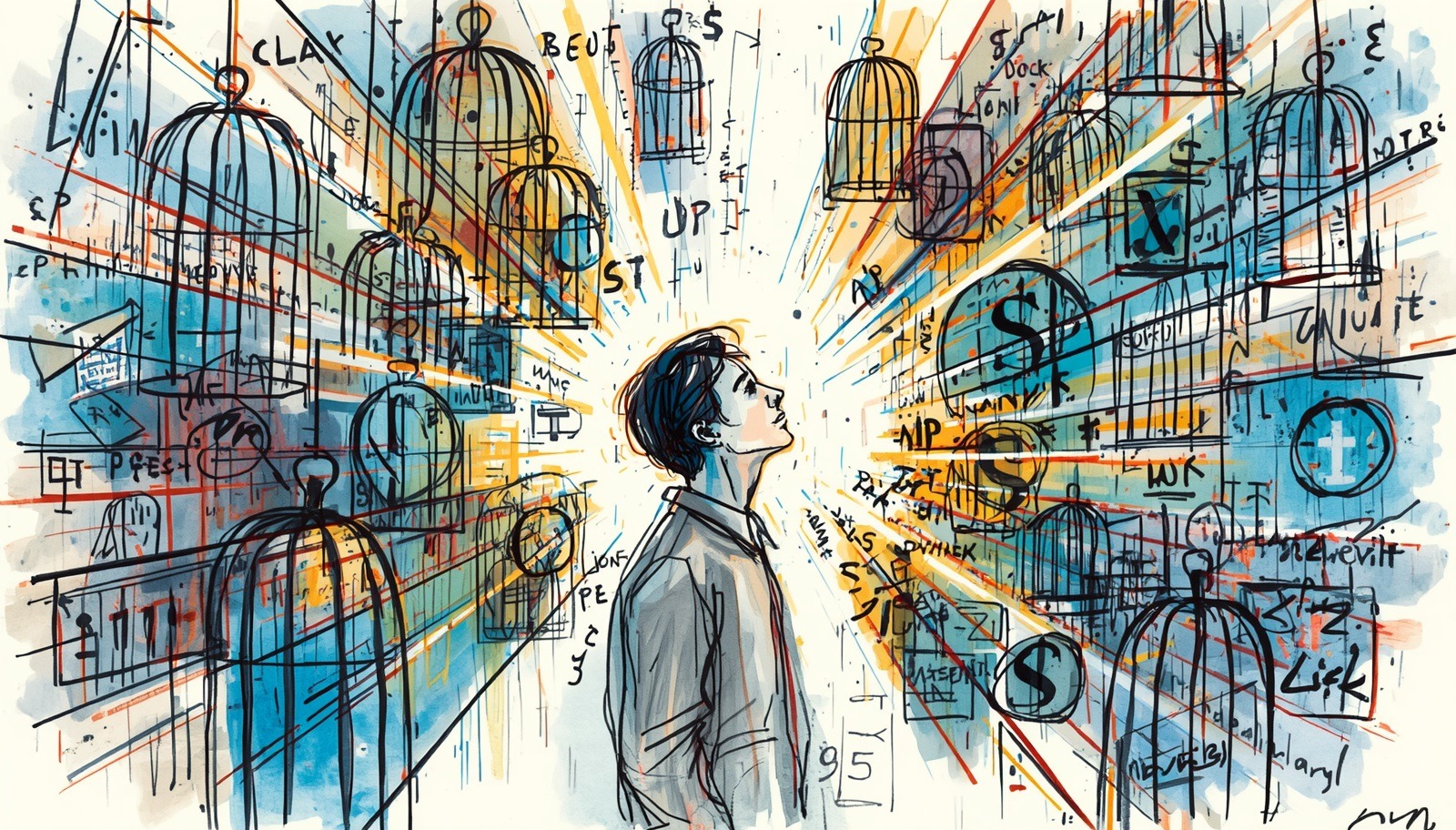
This article is not about blaming you for feeling trapped. It is about naming the invisible cages. Because what we cannot name, we often obey. And what we can name, we can begin to question.
This is a Words of Power article because sometimes the first key is not a plan. Sometimes the first key is a sentence. A sentence that breaks the spell. A sentence that lets you breathe. A sentence that reminds you:
I am not here merely to function. I am here to belong to myself.
What does it mean to be a prisoner of Your own life?
Being a prisoner of your own life does not mean your life is objectively terrible. It means your inner world feels restricted, even when your outer world looks acceptable.
You may have responsibilities, relationships, a job, a phone full of contacts, and a calendar full of commitments — but still feel like there is no room for your real self. You may be doing everything “right” while quietly wondering, “Is this all there is?” You may feel guilty for wanting more because, technically, nothing is wrong enough to justify your sadness.
This is where many people get stuck. They wait for their pain to become extreme before they give themselves permission to listen to it. But emotional imprisonment often begins long before crisis. It begins with tiny betrayals of the self repeated over time.
You ignore your body’s no.
You silence your needs to keep peace.
You choose approval over authenticity.
You mistake being needed for being loved.
You confuse being busy with being meaningful.
You keep becoming who life rewards, while losing who life once knew.
The prison is not always made of walls. Sometimes it is made of “should.”
- I should be further ahead by now
- I should not feel this way
- I should be more productive
- I should be easier to love
- I should tolerate this
- I should be over it
- I should not need so much
Every “should” can become a bar in the cage when it disconnects you from truth.
The modern cage is often invisible
In older stories, imprisonment was obvious. A locked room. A guarded gate. A sentence handed down by someone else. In modern emotional life, the cage is subtler. It can look like ambition, loyalty, politeness, discipline, family duty, aesthetic perfection, spiritual growth, or “just being realistic.”
This is why so many people do not recognize their own captivity. They are praised for it.
- The overworker is called dedicated
- The people pleaser is called kind
- The emotionally numb person is called strong
- The perfectionist is called high-achieving
- The chronically available friend is called loyal
- The self-silencing partner is called easygoing
- The exhausted parent is called selfless
But praise can be dangerous when it rewards a person for disappearing.
A prison that earns applause is harder to escape because leaving it feels like disappointing everyone. You may think, “Who am I if I stop being the strong one? Who am I if I stop rescuing people? Who am I if I rest? Who am I if I no longer organize my life around being chosen?”
The answer is terrifying and beautiful:
You are someone who is finally available to yourself.
Table 1: 11 invisible cages of modern life

Cage one → The productivity trap: When Your worth becomes a to-do list
Modern culture has turned productivity into a personality. We track habits, optimize mornings, measure steps, count calories, schedule rest, monetize hobbies, and turn healing into another project to complete. There is nothing wrong with discipline. Discipline can be an act of self-respect. But when productivity becomes the only language through which you understand your value, your life starts to feel like a performance review you can never pass.
This cage is especially cruel because it gives you evidence of success while quietly starving your soul. You may be praised, promoted, admired, and relied upon. Yet inside, you may feel strangely hollow. You may not know how to rest without guilt. You may feel anxious when you are not useful. You may confuse stillness with failure.
I have noticed that many people do not fear laziness as much as they fear meeting themselves without noise. Productivity can become a socially acceptable way to avoid grief, uncertainty, desire, loneliness, and the uncomfortable question: “What do I actually want?”
The words that open this cage are simple but radical:
My worth does not begin after I finish everything.
Say it slowly. Let it interrupt the old programming.
You are not a machine that earns permission to exist through output. You are a human being with rhythms, seasons, limits, needs, and a nervous system that was never designed to live under constant pressure. A meaningful life is not always a maximized life. Sometimes it is a life with enough space to taste your coffee, notice the sky, answer honestly, cry when needed, laugh without documenting it, and sleep without negotiating your right to be tired.
Cage two → The comparison trap: Living in someone else’s mirror
Comparison has always existed, but today it follows us everywhere. It lives in our pockets. It wakes up with us. It sits beside us in bed. It shows us someone’s engagement, someone’s body, someone’s kitchen, someone’s business, someone’s vacation, someone’s “soft life,” someone’s perfect healing journey, someone’s beautiful relationship, someone’s extraordinary discipline.
The problem is not that other people have beautiful things. The problem is that constant exposure to curated fragments can make your own real life feel defective.
You begin to measure your behind-the-scenes against someone else’s edited chapter. You forget that a photo is not a full emotional reality. You forget that people can be admired and lonely, successful and anxious, beautiful and insecure, loved and still grieving. You forget that visibility is not the same as fulfillment.
Comparison turns your life into a courtroom. Every scroll becomes evidence against you.
The words that open this cage are:
Their life is information, not instruction.
Someone else’s path can inspire you, but it should not erase you. Their marriage is not proof that you are late. Their career is not proof that you failed. Their confidence is not proof that you are behind. Their beauty is not proof that you are less. Their peace is not proof that your healing is too slow.
Your life is not a copy of anyone else’s assignment. It has its own timing, textures, lessons, thresholds, and hidden wisdom. The more you return to your own body, values, and honest desires, the less power comparison has over your nervous system.
Cage three → The people-pleasing trap: The prison of being “easy”
People-pleasing often begins as protection. Maybe you learned early that love depended on your mood, usefulness, silence, obedience, or ability to anticipate others’ needs. Maybe conflict felt dangerous. Maybe being “good” kept you connected. Maybe you became skilled at reading rooms because no one taught you that you were allowed to take up space inside them.
People-pleasing looks like kindness. Over time, it becomes self-erasure.
You say yes while resentment grows. You apologize for needs you have not even expressed. You monitor everyone’s comfort but your own. You become the person who understands everyone, accommodates everyone, forgives everyone, and secretly wonders why no one sees how tired you are.
The heartbreaking truth is that people-pleasing may keep you accepted, but it rarely lets you feel deeply known. If people only love the version of you that never disagrees, never needs, never changes, and never says no, then the relationship is built around your disappearance.
The words that open this cage are:
I can be kind without being available for self-abandonment.
This is not an invitation to become cold. It is an invitation to become honest. Boundaries do not destroy love that is healthy. They reveal whether love has room for your truth.
Start small. Replace “Whatever you want” with “Let me check what works for me.” Replace “No worries” when there are worries with “I understand, and I need to be honest about my capacity.” Replace automatic yes with a pause.
A pause can be a doorway back to yourself.
Cage four → The digital trap: Attention as the new captivity
The digital world does not only take time. It trains desire. It teaches your brain to seek novelty, approval, outrage, beauty, speed, and stimulation. It interrupts boredom before boredom can become imagination. It interrupts loneliness before loneliness can become a request for real connection. It interrupts discomfort before discomfort can become self-knowledge.
Your phone may not be the enemy. But unconscious digital life can become a cage because it fragments the one resource required for inner freedom: attention.
Where your attention goes, your life begins to follow.
If your first waking moments belong to notifications, your nervous system starts the day in reaction. If your pauses are filled instantly, you lose the ability to hear subtle inner signals. If every emotion becomes content, every meal becomes an image, every opinion becomes a performance, and every insecurity becomes a search query, you may start living beside yourself rather than inside yourself.
The words that open this cage are:
My attention is sacred. I do not have to spend it everywhere.
Try one unconventional practice: create an “unreachable hour.” Not because you hate technology, but because your soul needs proof that it still exists without being summoned. During that hour, do something analog and ordinary. Walk. Cook. Stretch. Write by hand. Look out a window. Let your thoughts become audible again.
The goal is not digital perfection. The goal is digital sovereignty.
Cage five → The image trap: When healing becomes a performance
There is a strange pressure today to appear healed. To have the right language. The right boundaries. The right morning routine. The right glow. The right nervous system regulation tools. The right self-love captions. The right aesthetic of peace.
But real healing is not always beautiful. Sometimes it looks like admitting envy. Sometimes it sounds like an awkward boundary. Sometimes it means crying after making the right decision. Sometimes it means missing someone you no longer want back. Sometimes it means being proud and still scared. Sometimes it means choosing rest while your mind calls you lazy.
The image trap convinces you that transformation must be visible to be valid. But the deepest changes often happen quietly. They are not always postable. They are not always impressive. They may not look like reinvention. They may look like finally telling the truth.
The words that open this cage are:
I do not need to look transformed to be transforming.
You are allowed to be in process. You are allowed to be messy and wise at the same time. You are allowed to teach what you are still practicing, as long as you stay humble. You are allowed to be healing without turning yourself into a brand of healing.
Freedom begins when you stop asking, “How does this look?” and begin asking, “Is this honest?”
Cage six → The survival trap: Emotional numbness in a loud world
Many people think numbness means they do not care. Often, it means they have cared too much for too long without enough safety, softness, or support.
Emotional numbness can be the nervous system’s way of lowering the volume when life has been too loud. If you have lived in chronic stress, relational instability, grief, burnout, financial pressure, social comparison, or constant uncertainty, your body may eventually protect you by reducing access to feeling. You may still function. You may still smile. You may still answer emails. But inside, life feels muted.
This is one of the most misunderstood modern prisons: looking fine while feeling far away from yourself.
The words that open this cage are:
My numbness is not emptiness. It is a message from a tired part of me.
Do not attack the numbness. Approach it gently. Ask: “What would feel one percent more alive today?” Not fully alive. Not magically joyful. Just one percent.
A warm shower. A song from a younger version of you. A walk without headphones. A real conversation. A meal eaten slowly. A hand on your chest. A sentence in a journal: “I think I have been carrying too much.”
Numbness softens when safety returns. Safety returns through consistency, compassion, connection, and permission to feel without rushing the feeling into a lesson.
Table 2: The inner freedom map

Cage seven → The loyalty trap: When Your past still owns Your future
Loyalty is beautiful when it is chosen freely. It becomes a cage when it requires you to remain small, silent, or emotionally frozen in order to belong.
Many people are not trapped by lack of ambition. They are trapped by invisible contracts with the past.
- Do not be happier than your family
- Do not be freer than your mother
- Do not be softer than your father
- Do not name what everyone survived by denying
- Do not become different, because difference feels like betrayal
This is how generational patterns continue. Not always through cruelty, but through loyalty to pain.
You may feel guilty for wanting a life that is calmer, healthier, more honest, more emotionally expressive, more spacious, or more joyful than what you saw growing up. You may confuse healing with disloyalty. You may fear that choosing yourself means rejecting where you came from.
The words that open this cage are:
I can love my roots without living inside their limits.
You are allowed to carry gratitude and still choose change. You are allowed to honor your ancestors by not repeating every wound. You are allowed to say, “This came before me, but it does not have to continue through me.”
Breaking a pattern does not mean you think you are better than those who came before. It means you are willing to metabolize pain instead of passing it on unchanged.
That is not betrayal. That is devotion with a future.
Cage eight → The fear trap: Safety that slowly becomes a cell
Fear is not the enemy. Fear protects. Fear calculates risk. Fear remembers pain. Fear tells us to slow down, prepare, pay attention, and choose wisely.
But fear becomes a prison when it is promoted from advisor to ruler.
When fear rules, you do not simply avoid danger. You avoid aliveness. You stop applying, asking, creating, dating, leaving, beginning, trying, resting, changing, speaking, or being seen. You call it realism. You call it timing. You call it “not ready.” Sometimes that is true. But sometimes “not ready” is fear wearing a responsible outfit.
The words that open this cage are:
I do not need fear to disappear before I move.
This sentence matters because many people wait for confidence before action. But confidence often arrives after evidence. And evidence arrives through movement.
Choose gentle courage. Not reckless courage. Not dramatic courage. Gentle courage asks: “What is the smallest honest step?” Send the message. Open the document. Make the appointment. Say the sentence. Take the class. Decline the invitation. Admit the desire.
Freedom is rarely one grand escape. More often, it is a series of tiny exits.
Cage nine → The burnout trap: When pushing through becomes identity
Burnout is not just tiredness. It is what happens when demand repeatedly exceeds restoration, when meaning thins out, when the body keeps paying for promises the mind made under pressure.
In today’s world, burnout can become normalized because everyone seems tired. We joke about exhaustion. We bond over overwhelm. We treat rest as a luxury, sleep as negotiable, and boundaries as something we will establish once life becomes less chaotic.
But life may not become less chaotic until boundaries exist.
The burnout cage says, “Just get through this week.” Then next week says the same thing. Months pass. Your body whispers, then speaks, then shouts. Headaches, resentment, irritability, numbness, insomnia, decision fatigue, cynicism, and loss of joy may all be signals that your system is no longer willing to be managed like an infinite resource.
The words that open this cage are:
My body is not an obstacle to my life. It is the place where my life happens.
This is a sacred reframe. Your body is not being dramatic. Your body is keeping score of what your schedule refuses to admit. You do not need to earn rest by collapsing. You do not need to justify needing less noise, fewer obligations, deeper support, or a slower pace.
Rest is not the opposite of responsibility. Sometimes rest is the responsibility.
Cage ten → The meaninglessness trap: A life that works but does not feel alive
There is a particular sadness in having a life that functions but does not nourish you.
The bills are paid, the tasks are done, the messages answered, the obligations met — and still something inside asks, “But where am I in all of this?”
Meaninglessness does not always come from having nothing. Sometimes it comes from having many things that do not connect to your deeper values. You can be surrounded by activity and still be starving for meaning. You can be socially busy and spiritually lonely. You can be achieving goals that once impressed you but no longer feel connected to who you are becoming.
The words that open this cage are:
Meaning is not found only in big answers. It is built through small acts of alignment.
This is important because many people wait for a grand purpose before they begin living more truthfully. But purpose often grows from contact. Contact with your values. Contact with your gifts. Contact with pain you want to transform. Contact with people you want to serve. Contact with beauty that reminds you you are not only here to survive.
Ask yourself:
- What kind of pain am I no longer willing to normalize?
- What beauty do I want to protect?
- What conversation do I keep avoiding?
- What would I do even if no one applauded?
- What small act today would make me respect myself more?
Purpose is not always a lightning bolt. Sometimes it is a breadcrumb trail.
Cage eleven → The self-criticism trap: Mistaking inner cruelty for discipline
Many people are afraid to be kind to themselves because they think kindness will make them weak, lazy, selfish, or complacent. They believe self-criticism keeps them improving. But there is a difference between accountability and emotional violence.
- Accountability says, “This behavior is not aligned with who I want to be.”
Shame says, “I am disgusting for struggling.” - Accountability says, “I can repair this.”
Shame says, “I ruin everything.”
Accountability supports change. - Shame freezes identity around failure.
Self-criticism may create short-term pressure, but it rarely creates deep safety. And without safety, growth becomes performance. You change because you hate yourself, not because you are caring for yourself.
The words that open this cage are:
I can become better without treating myself as broken.
This is one of the most powerful sentences you can practice. It allows growth without self-rejection. It allows responsibility without punishment. It allows humility without humiliation.
When you speak to yourself with compassion, you are not excusing everything. You are creating the conditions in which honest change becomes possible.
Table 3: Words of power — Replace the cage sentence

The unconventional way out: Do not escape Your life — re-inhabit it
When people feel trapped, they often fantasize about escape. A new city. A new job. A new relationship. A new body. A new identity. Sometimes external change is necessary. Some environments truly are harmful. Some relationships truly need to end. Some workplaces truly exploit. Some family systems truly suffocate. Leaving can be a sacred act.
But not every prison dissolves through external escape. Sometimes the deeper work is re-inhabitation.
To re-inhabit your life means to return to yourself inside the life you already have and begin changing the relationship you have with it. It means you stop living only as a role — employee, partner, parent, helper, achiever, caretaker, survivor — and begin living again as a person.
A person with preferences.
A person with limits.
A person with anger.
A person with longing.
A person with intuition.
A person with a body.
A person with a private inner world that deserves tenderness.
Re-inhabiting your life might look like making your home feel like you, not just like a place where tasks happen. It might mean telling the truth in one relationship. It might mean no longer laughing at jokes that hurt you. It might mean eating breakfast without your phone. It might mean choosing one evening a week that belongs to your nervous system. It might mean admitting that the dream you are chasing is outdated. It might mean grieving the years you spent trying to be easy to love.
This is not always glamorous. But it is powerful.
Because the opposite of being a prisoner of your own life is not having a perfect life.
The opposite is participation.
You participate in your choices. You participate in your boundaries. You participate in your healing. You participate in your relationships. You participate in your own becoming.
A 7-day inner freedom practice
This practice is intentionally simple. Not because transformation is easy, but because overwhelmed people do not need more complicated self-improvement systems. They need small doors that actually open.
Day 1 → Name the cage
Write this sentence: “The cage I feel most often is…” Then complete it honestly. Do not make it sound wise. Make it true. Maybe it is comparison. Maybe it is guilt. Maybe it is debt. Maybe it is fear. Maybe it is an old family role. Naming is not complaining. Naming is orientation.
Day 2 → Notice the bars
Ask: “What keeps this cage in place?” Look for habits, beliefs, relationships, environments, apps, routines, and fears. For example, the comparison cage may be held in place by late-night scrolling. The people-pleasing cage may be held in place by fear of conflict. The burnout cage may be held in place by unclear boundaries.
Day 3 → Find the sentence that locks it
Every cage has a sentence. “I have to.” “They’ll leave.” “I’m behind.” “I can’t rest.” “I’m not enough.” Find yours. Then ask, “Who taught me this, directly or indirectly?” You may discover that the belief is inherited, not chosen.
Day 4 → Write the counter-sentence
Create a Words of Power sentence that does not deny reality but restores agency. For example: “I can be responsible without being endlessly available.” Or: “I can move slowly and still be moving.” Repeat it throughout the day, especially when the old sentence appears.
Day 5 → Make one tiny exit
Take one action that contradicts the cage. If the cage is people-pleasing, say, “I can’t commit to that today.” If the cage is digital overwhelm, leave your phone outside the bedroom. If the cage is meaninglessness, do one value-based act. Tiny exits matter because they teach your nervous system that change does not have to be catastrophic.
Day 6 → Tell one safe truth
Share one honest sentence with someone trustworthy, or write it in a journal if no safe person is available. The sentence might be, “I have been more tired than I admit.” Or, “I am realizing I want something different.” Truth becomes less terrifying when it has somewhere to land.
Day 7 → Choose a new ritual of belonging to Yourself
Create one weekly ritual that says, “I am not abandoning myself.” It could be a Sunday reset, a walk, a bath, a money check-in, a creative hour, a therapy appointment, a prayer, a journal practice, or a phone-free dinner. The ritual matters less than the message: “I return to myself regularly.”
The door was never only outside You
There are real systems that trap people. Poverty, discrimination, trauma, unsafe relationships, exploitative workplaces, illness, debt, and social isolation are not solved by positive thinking. Any honest conversation about inner freedom must respect outer reality.
But there is also another truth: even within imperfect circumstances, some part of you is asking to be returned to yourself.
Not fixed. Not optimized. Not turned into a more impressive version for public approval. Returned.
Returned to your own voice.
Returned to your own body.
Returned to your own values.
Returned to your own pace.
Returned to your own ability to say, “This is not the life I want to keep rehearsing unconsciously.”
You may not break every cage today. You may not know the full map. You may still feel afraid, tired, unsure, or guilty. That does not mean you are failing. It means you are human at the threshold.
Start with one sentence.
I am allowed to belong to myself again.
Then let that sentence become a pause.
Let the pause become a choice.
Let the choice become a pattern.
Let the pattern become a life.
A free life is not a flawless life. It is a life where you are no longer missing from the center of it.
Related posts You’ll love
- Modern girlhood feels more fragile than it looks: Hidden pressure, anxiety, and social media
- The midlife silence epidemic: Why Women don’t reach out (and what it’s really costing us)
- The agency bridge workbook: Evidence based 9 exercises to unlearn helplessness after modern news and rebuild Your inner power
- Time scarcity reset: 11 exercises to break the “always behind” feeling without changing Your whole life (WITH PDF!)
- Life You built, but don’t like: 7 gentle steps to change Your path
- Late bloomer energy: Why Your ‘delayed’ life is secretly Your biggest superpower
FAQ
-
What does it mean to feel like a prisoner of your own life?
Feeling like a prisoner of your own life means you experience your daily reality as emotionally restricted, even if your life appears normal or successful from the outside. You may feel trapped by expectations, responsibilities, fear, comparison, people-pleasing, burnout, or an identity you have outgrown. It is not always about wanting to abandon your life. Often, it is about wanting to feel present, honest, and free inside it.
-
Why do so many people feel trapped in modern life?
Many people feel trapped because modern life combines constant comparison, digital overstimulation, economic pressure, loneliness, productivity culture, and social expectations. We are given endless options, but not always enough emotional support, rest, or clarity to choose what is truly aligned. This creates a painful gap between outer freedom and inner freedom.
-
Can social media make me feel like a prisoner of my own life?
Yes, social media can contribute to feeling trapped when it becomes a constant source of comparison, validation-seeking, distraction, or emotional avoidance. The issue is not simply using social media; it is losing sovereignty over your attention. When your nervous system is repeatedly exposed to curated lives, it can begin to interpret your own real, imperfect life as inadequate.
-
Is feeling trapped a sign that I need to change everything?
Not necessarily. Sometimes feeling trapped is a sign that major change is needed, especially if your environment is harmful, unsafe, or deeply misaligned. But often, the first step is not changing everything. It is telling the truth about what feels restrictive, identifying where you still have agency, and making small changes that restore self-trust.
-
How do I know if I am people-pleasing?
You may be people-pleasing if you often say yes while feeling resentment, apologize for having needs, avoid conflict at the cost of your honesty, feel responsible for other people’s emotions, or fear that boundaries will make you unlovable. People-pleasing is not the same as kindness. Kindness includes you. People-pleasing often excludes you.
-
What are “Words of Power”?
Words of Power are intentional phrases that help interrupt old emotional programming and reconnect you with truth, agency, and self-compassion. They are not magic spells, and they do not replace action. But language shapes attention. The right sentence, repeated with honesty, can become a bridge between an old survival pattern and a new choice.
-
Can affirmations really help when I feel stuck?
Affirmations can help when they are believable, grounded, and connected to action. A vague affirmation like “Everything is perfect” may feel false if you are struggling. A grounded affirmation like “I can take one honest step today” is often more powerful because it respects reality while restoring agency.
-
What is the difference between comfort zone and emotional prison?
A comfort zone is familiar and may be restful, neutral, or temporarily protective. An emotional prison restricts your growth, truth, or aliveness. The difference is often in how you feel afterward. A healthy comfort zone restores you. An emotional prison shrinks you.
-
How can I start breaking free if I feel overwhelmed?
Start with one small truth and one small action. Name the cage you feel most often. Then choose a tiny exit: pause before saying yes, take a walk without your phone, write one honest paragraph, ask for help, or rest without apologizing. Overwhelmed people do not need a total life overhaul on day one. They need evidence that change is possible.
-
Why do I feel guilty when I choose myself?
You may feel guilty because your nervous system learned that love, safety, or belonging depended on self-sacrifice. If you were rewarded for being easy, useful, quiet, or endlessly available, choosing yourself may initially feel wrong. Guilt does not always mean you are doing something bad. Sometimes it means you are breaking an old rule that kept you small.
-
What is the first sentence I should say to myself when I feel trapped?
Try this: “I may not control everything, but I can choose my next honest step.” This sentence is powerful because it does not deny difficulty. It simply returns you to the part of your life where freedom still exists: the next honest step.
Sources and inspirations
- American Psychological Association. (2024). Stress in America 2024: A nation in political turmoil. American Psychological Association.
- Gallup. (2026). State of the global workplace: 2026 global data summary. Gallup.
- Han, A., & Kim, T. H. (2023). Effects of self-compassion interventions on reducing depressive symptoms, anxiety, and stress: A meta-analysis. Mindfulness.
- Macri, J. A., & Rogge, R. D. (2024). Examining domains of psychological flexibility and inflexibility as treatment mechanisms in acceptance and commitment therapy: A comprehensive systematic and meta-analytic review. Clinical Psychology Review.
- Office of the Surgeon General. (2023). Our epidemic of loneliness and isolation: The U.S. Surgeon General’s advisory on the healing effects of social connection and community. U.S. Department of Health and Human Services.
- Riehm, K. E., Feder, K. A., Tormohlen, K. N., Crum, R. M., Young, A. S., Green, K. M., Pacek, L. R., La Flair, L. N., & Mojtabai, R. (2019). Associations between time spent using social media and internalizing and externalizing problems among US youth. JAMA Psychiatry.
- Roberts, H., van Lissa, C., Hagedoorn, P., Kellar, I., & Helbich, M. (2019). The effect of short-term exposure to the natural environment on depressive mood: A systematic review and meta-analysis. Environmental Research.
- Ryan, R. M., & Deci, E. L. (2020). Intrinsic and extrinsic motivation from a self-determination theory perspective: Definitions, theory, practices, and future directions. Contemporary Educational Psychology.
- Schippers, M. C., & Ziegler, N. (2019). Life crafting as a way to find purpose and meaning in life. Frontiers in Psychology.
- World Health Organization. (2019). Burn-out an “occupational phenomenon”: International Classification of Diseases. World Health Organization.
- World Health Organization. (2022). World mental health report: Transforming mental health for all. World Health Organization.



Leave a Reply