Table of Contents
Rain is one of those natural phenomena we often take for granted. We open our umbrellas, rush across wet sidewalks, complain about the inconvenience, and forget to pause long enough to realize that rainfall has been a cleansing ritual for the earth since long before humans even existed. What if, instead of rushing through the storm, we treated rainfall as an invitation to slow down, reset, and heal?
The sound of falling rain, the fresh scent that lingers afterward, the way the air feels lighter and softer once the storm passes—all of these are not just natural occurrences. They are gentle reminders that rain cleanses more than just the earth. It can cleanse our nervous system, our energy, and even our relationship to ourselves. In this article, we will explore the many layers of rainfall as a metaphor, a sensory experience, and a scientifically backed tool for renewal.
This is not simply about weather. It is about connection, about how nature speaks to us in subtle, powerful ways, and about the possibility of finding calm in places we may not have looked before. Let us step into the rain together, without an umbrella, and discover what it has been trying to teach us all along.
The ancient story of rain as renewal
Throughout human history, rain has held deep symbolic meaning. In ancient myths, rainfall was a gift from the gods, a symbol of fertility and rebirth. Cultures across the globe prayed for rain not only because it nourished crops but also because it represented divine cleansing. The Mayans, for instance, worshipped Chaac, the rain god, and saw storms as sacred acts of renewal. In Hinduism, rain is linked with Indra, the god of thunder and rain, who is both feared and revered.
Even in the Abrahamic traditions, rain appears as a metaphor for grace and spiritual washing. The Bible refers to “showers of blessing,” and the Quran describes rain as a purifying element. Indigenous traditions often incorporate rain into ceremonies, using it to cleanse not just the land but the community itself.
This symbolic history matters because it shows that humans have always sensed that rain was more than water. It was a force that could wash away heaviness, restore balance, and invite a new beginning. In a world where many of us feel weighed down by stress, overthinking, and emotional residue, it is worth remembering these older ways of seeing.
Rain and the nervous system: A scientific perspective
Science has a way of confirming what our ancestors intuitively knew. The sound of rain, especially steady rainfall, has been shown to affect the human nervous system. Researchers have found that natural sounds, particularly flowing water and rainfall, activate the parasympathetic nervous system—the body’s “rest and digest” mode (Alvarsson, 2010).
This activation helps lower cortisol, the stress hormone, while regulating blood pressure and heart rate. That is why so many sleep apps include rain sounds. They are not simply pleasant; they are deeply regulating. When you listen to rainfall, your body instinctively begins to unwind.
Beyond sound, the physical presence of rain changes the air itself. The scent after a storm, known as petrichor, comes from plant oils and a compound called geosmin. Studies show that this scent can evoke feelings of nostalgia and calm, triggering relaxation responses in the brain (Bear & Thomas, 1964; Seidlitz, 2011). The air after rainfall is also rich in negative ions, which some studies suggest may improve mood and decrease symptoms of depression (Harrison & Tammet, 2008).
In this sense, rainfall does not just symbolically cleanse—it literally alters the chemistry of our environment in ways that soothe and restore us.
Rain as a mirror for emotional release
Think about the last time you cried. Perhaps it was a quiet trickle of tears, or maybe it was a full, thunderous sobbing that left you gasping for breath. In either case, crying often feels like an internal rainfall. It is no coincidence that we describe heavy emotions as storms building inside us, or that relief comes when the clouds finally break.
Rainfall can be seen as an external mirror of this emotional truth. It arrives when pressure has built in the skies, when release is no longer avoidable. The storm may be loud, chaotic, even frightening. But when it passes, the sky clears, and something in us recognizes that release is necessary for renewal.
Learning to sit with rain instead of running from it can teach us the same about emotions. Avoidance builds pressure. Expression brings relief. The rain reminds us that tears are not weakness; they are cleansing.

The sensory gift of rain
To fully embrace rainfall as healing, it helps to slow down and let your senses take over. The texture of raindrops on your skin can feel like a gentle massage, a reminder that you are embodied and alive. The sound can act as white noise, covering the static of daily worries. The smell after rain connects you to the earth itself, grounding you in a way that artificial environments rarely can.
Sensory psychology has long shown that grounding in our senses interrupts cycles of anxiety. When we bring attention to what we are hearing, smelling, or touching in real time, we step out of spiraling thoughts. Rain, in this sense, is an automatic mindfulness tool provided by nature. It invites us to tune in, to pause, and to reorient.
Imagine standing by a window, watching droplets slide down the glass. For those few moments, time slows. The rhythm of rain becomes a meditation, and the world feels softer. That is the sensory gift rain offers, if we let ourselves receive it.
The ecology of renewal: How rain shapes the earth
Of course, rain is essential for ecosystems. It nourishes soil, replenishes rivers, and sustains life. But beyond this ecological truth lies a metaphor. Just as rain revives wilted plants, it can revive parts of ourselves that feel dry, depleted, or lifeless.
Psychologists often use the metaphor of inner drought when describing burnout. We become parched, brittle, unable to thrive. What we often need is not more striving but a kind of inner rainfall—gentle nourishment, softness, release.
When we see rainfall soaking into the ground, we can remember that we too need moments of absorption. We cannot endlessly output without taking in. We must allow ourselves to be replenished, drop by drop, if we are to bloom again.
Rain as a soundtrack to reflection
There is a reason so many writers, poets, and musicians have turned to rain as inspiration. It sets the stage for introspection. The rhythm of raindrops on a roof creates a backdrop that makes inner dialogue clearer.
For some, this reflection can feel heavy, even melancholic. Yet melancholy has its place. Psychologists like Tim Lomas have argued that melancholy is not always negative; it can be a fertile emotional state that helps us process and grow (Lomas, 2018). Rain can be the setting in which such gentle melancholy unfolds—not destructive sadness, but thoughtful reflection.
Journaling during a rainy day can become a ritual of self-understanding. Listening to rainfall while meditating can deepen presence. Sitting quietly and letting the storm rage outside can remind us that we too can survive turbulence and eventually see the light return.
The unexpected joy in rain
Not all rain is solemn or reflective. Sometimes it invites play. Children instinctively know this, running through puddles, tilting their faces upward, squealing as water splashes around them. Somewhere along the path to adulthood, many of us lose this joy. We become too concerned with staying dry, too busy to pause.
Reclaiming the childlike joy of rain can itself be a radical act of healing. To dance in the rain, to laugh while getting drenched, to see the storm as an ally instead of an enemy—these are practices that loosen the grip of perfectionism and control. They allow spontaneity back into our bodies.
And joy, as positive psychology research confirms, is not frivolous. It is deeply restorative. Joy strengthens resilience, increases immune function, and enhances creativity (Fredrickson, 2001). Rain, then, is not only a cleanser but also a source of delight, if we let it be.
Turning rain into ritual
What if we began to treat rainy days not as disruptions but as invitations? You could create small rituals around rainfall. Brew tea and sit by the window. Light a candle and listen to the storm as though it were music. Step outside for just a few minutes, without fear of getting wet, and feel the drops on your skin.
Such rituals reframe rain from inconvenience to sacred pause. They remind us that healing does not always require drastic measures. Sometimes it is as simple as opening the window and breathing in the damp, earthy air.
Over time, these rituals build a new relationship to rain. Instead of wishing storms away, you may find yourself looking forward to them. They become your ally in the pursuit of calm, balance, and renewal.
Mindfulness in the rain: Turning weather into a meditation
One of the simplest yet most profound practices you can try is to allow rainfall to become your meditation guide. Instead of retreating from the storm, step closer. Find a safe spot—perhaps under a porch, a balcony, or even by an open window—and simply listen. The sound of rain has an irregular rhythm, neither mechanical nor entirely predictable. It is this quality that lulls the brain into a meditative state.
Close your eyes and notice how each droplet seems to have its own voice. Some are soft whispers, others sharp taps, together forming a chorus that cannot be replicated by human instruments. As you listen, try to match your breath to the cadence of the rainfall. Inhale as the rain intensifies, exhale as it softens. With every cycle, let yourself feel cleansed not just physically but emotionally.
This practice is more than relaxation. It engages sensory mindfulness, grounding you in the present moment. Rainfall is, in a way, nature’s sound bath—offered freely, requiring only your attention.

Rain bathing: Immersing Yourself in nature’s cleanse
In many cultures, rituals of purification involve water. From rivers to hot springs to ceremonial baths, people have long turned to water as a way of starting anew. Rainfall offers us a natural form of this cleansing ritual, and one that requires no preparation—only willingness.
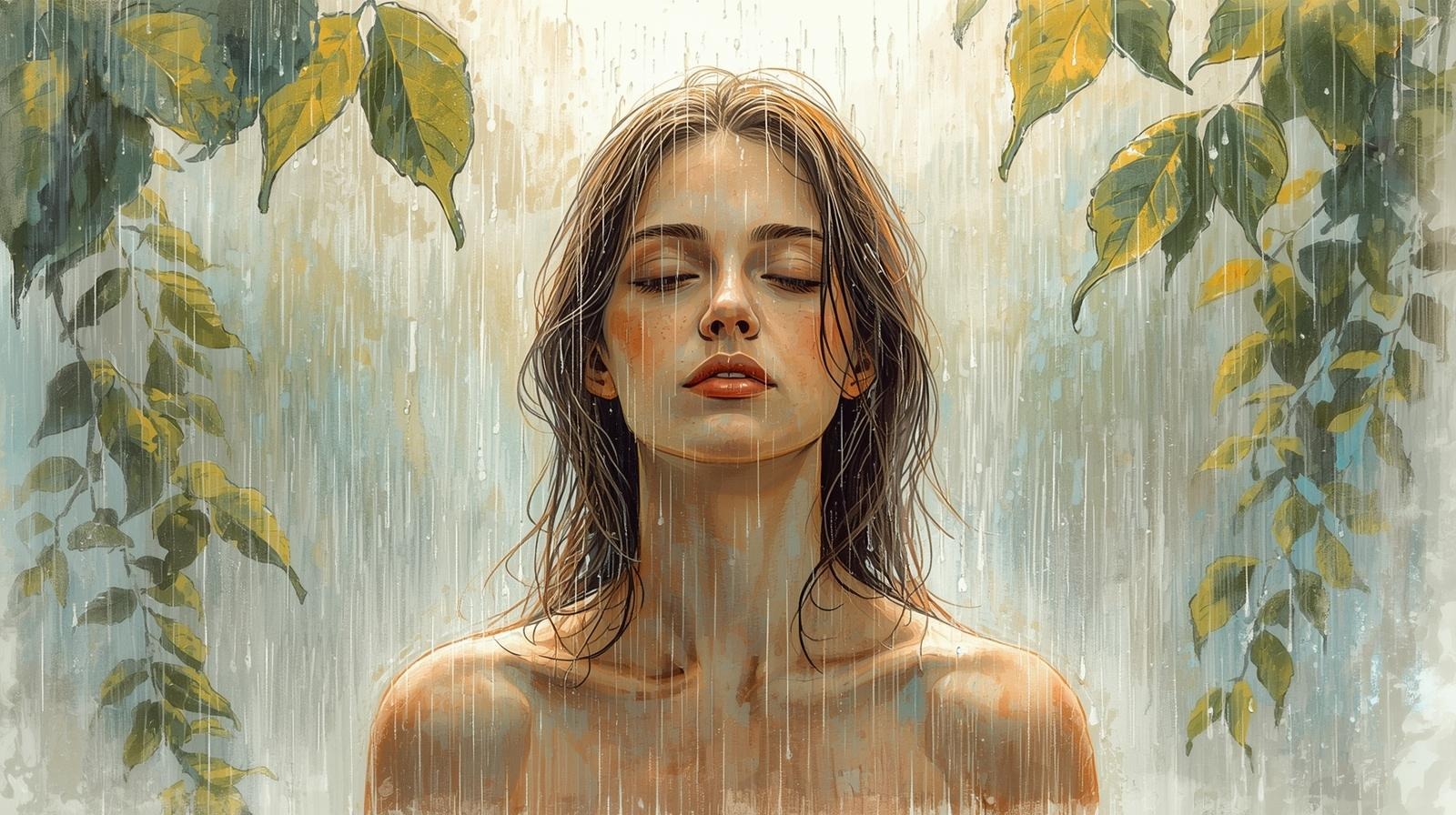
Rain bathing is the practice of intentionally being in the rain with presence. It is not about rushing from the car to the doorway, nor about enduring the storm reluctantly. It is about stepping outside, even if only for a few minutes, and allowing the rain to fall on you.
When you stand in the rain, you are reminded of the porous boundary between yourself and the world. The droplets touch your skin, soak your hair, and connect you to the same water cycle that nourishes forests and oceans. It is a direct encounter with nature’s rhythm, one that bypasses thought and brings you into your body.
For many, the first sensation is resistance. We are conditioned to avoid getting wet, to protect ourselves from discomfort. But once that resistance softens, rain bathing becomes an act of freedom. You may feel the cool drops as tiny awakenings, each one pulling you into the present moment. The experience can be playful, humbling, and deeply soothing all at once.
Some practitioners describe rain bathing as a reset button for the nervous system. The sensory stimulation washes away mental clutter, and the physical act of surrendering to the weather feels symbolic. You are no longer fighting against the world; you are participating in it.
Even five minutes of rain bathing can shift your mood, making you feel lighter and more alive. It is a practice of allowing nature to care for you in its simplest, most generous form.
Rain and memory: Why storms awaken the past
Have you ever noticed how a rainy day can make you suddenly nostalgic? The scent of wet earth, the sound of raindrops on rooftops—these often awaken memories that seemed long forgotten. There is a neurological reason for this. Smell and sound are processed in brain areas closely linked to memory and emotion, especially the amygdala and hippocampus. Rain, with its unique sensory profile, can therefore unlock moments from childhood or earlier life stages.
Instead of resisting this, you can welcome it. Allow yourself to drift back into those memories with curiosity rather than judgment. Sometimes the rain will bring up bittersweet recollections, sometimes joyful ones. Either way, this retrieval process can be healing. Memory is not static; when we revisit it in a calm, mindful state, we can reframe it, soften it, and integrate it into our present understanding of ourselves.
Dancing in the storm: The body as an instrument of joy
While mindfulness and reflection are one way to embrace rain, the body also craves movement. There is something undeniably liberating about stepping into a downpour without resistance. To dance in the rain is to declare, even for a moment, that you are willing to be fully alive, unguarded, unashamed.
Try this when you feel stuck or heavy with overthinking: the next time it rains, put on clothes you do not mind getting wet and step outside. Move with the rhythm of the storm. Let the raindrops be your percussion, your heartbeat the melody. You may find that laughter comes unbidden, a reminder of the child within who once loved puddles without hesitation.
Somatic therapists remind us that the body holds stress long after the mind has tried to release it. Dancing in the rain gives the body permission to let go. It is not about elegance but about freedom. The storm becomes both partner and witness, washing away layers of self-consciousness.
Rain as a teacher of surrender
Perhaps the most powerful lesson rain offers us is surrender. No matter how much we plan, the rain will come when it comes. We cannot command it to stop or start; we can only adjust ourselves to meet it. This is why rain so often becomes a metaphor for acceptance.
In modern life, we are trained to control as much as possible. But control is often an illusion, and clinging to it creates suffering. Rainfall reminds us that some forces cannot be managed—they must be experienced. To surrender to rain, whether by stepping into it or simply pausing to let it fall, is to practice surrender to life itself.
Acceptance, in psychological terms, is not resignation. It is active acknowledgment of what is, without resistance. Studies on acceptance-based therapies, like Acceptance and Commitment Therapy (Hayes, 2011), show that cultivating this mindset reduces anxiety and increases well-being. Rain can be our teacher in this practice: an everyday lesson in meeting life on its own terms.
Imagining the inner rainfall: Visualization for emotional cleansing
Even when the weather outside is dry, you can invite rain into your inner world through visualization. Close your eyes and picture a gentle rainfall washing over you. Imagine it clearing away stress, doubt, and self-criticism. Feel it soaking into your body, hydrating your inner landscape.
This guided imagery can be especially powerful before bed or after a difficult day. Neuroscience shows that the brain often responds to vivid imagery as though it were real (Kosslyn, 2001). By visualizing rain, you can activate the same calming pathways in your nervous system that actual rainfall provides.
You might deepen this practice by combining it with breathwork. As you inhale, imagine drawing in the freshness of rain. As you exhale, picture it carrying away tension. Over time, this can become a personal ritual of renewal—rain as a companion, even when the skies are clear.
Rain as teacher
Rain has always been more than just weather. It is a teacher, a healer, a mirror, and a companion. It shows us that release is necessary, that cleansing is natural, and that renewal always follows. It touches not just the soil but our nervous systems, our emotions, and our imaginations.
When we begin to notice rain not only with our eyes but with our whole being, it transforms from background noise to sacred experience. It is in these subtle, everyday encounters with nature that we often find the deepest lessons in self-love and healing.
The next time the sky darkens and droplets begin to fall, pause. Step into the moment. Breathe in the freshness. Feel the cleansing. Remember that the earth is not the only thing being washed clean.
Related posts You’ll love:
- The science of coloring as emotional regulation: How simple strokes calm the mind and heal the heart
- Why doodling unlocks a calmer mind: The science and soul of scribbles
- Why mountain air feels so refreshing for Your mind
- The ritual of rocking back and forth: A forgotten calming practice
- How decluttering Your purse brings emotional relief: The hidden psychology of carrying less
- Love letters to Yourself: 25 one-line morning messages for daily self-love and inner healing
- 30 healing inner child affirmations that will transform Your emotional life – Even if You’ve tried everything else

Frequently Asked Questions about rain and renewal
-
Why does the sound of rain feel so calming?
The sound of rain has a natural rhythm that resembles white noise. Because it lacks sudden, sharp variations, it soothes the brain and activates the parasympathetic nervous system, which is responsible for relaxation. Studies show that natural water sounds—including rainfall—help reduce cortisol levels and promote a sense of calm.
-
What is the smell after rain called, and why is it so refreshing?
That earthy, fresh scent is called petrichor. It comes from natural oils released by plants and a compound called geosmin, which is stirred up when rain hits the ground. Humans are highly sensitive to this smell, and many people associate it with renewal, safety, and emotional grounding.
-
Can rain really affect my mood?
Yes. For some, rainy days can feel heavy, but for many others, the negative ions in the air after rainfall can lift mood and create a sense of clarity. Pairing rainy days with intentional practices like meditation, tea rituals, or even stepping outside for a “rain bath” can transform your relationship with the weather into one of healing.
-
Why do people often feel nostalgic when it rains?
Rain engages both scent and sound—two senses closely tied to memory. The smell of petrichor and the unique rhythm of raindrops can trigger memories stored in the hippocampus. That’s why rainy days often bring back childhood experiences, family moments, or past emotions in a powerful way.
-
How can I use rainy days for self-care?
Instead of seeing rain as an inconvenience, try reframing it as an invitation. Light a candle, slow down your pace, listen to the storm, or simply breathe in the freshness after rainfall. You can also try mindful rain bathing—stepping outside to let the rain fall on your skin—as a symbolic and sensory cleansing ritual.
-
Is rain ever linked to spiritual or cultural cleansing?
Absolutely. Across many cultures, rain is seen as sacred. In Hinduism, it is connected to renewal through Indra, the god of rain. In Indigenous traditions, rain is often called upon in ceremonies as a purifying force. Even in modern spirituality, rain is considered a symbol of release and rebirth, reminding us that cleansing is part of every natural cycle.
-
What if rainy weather makes me feel sad instead of calm?
For some people, lack of sunlight during prolonged rainy seasons can contribute to lower energy or mood. This is sometimes linked to Seasonal Affective Disorder (SAD). If this resonates with you, balance rainy-day practices with gentle movement indoors, light therapy lamps, or cozy rituals that brighten your space. Rain can still be a companion—just one you meet on your own terms.
Sources and inspirations
- Environmental Noise. International Journal of Environmental Research and Public Health.
- Bear, I. J., & Thomas, D. A. (1964). The Nature of Petrichor. Nature.
- Fredrickson, B. L. (2001). The Role of Positive Emotions in Positive Psychology: The Broaden-and-Build Theory of Positive Emotions. American Psychologist.
- Harrison, R. G., & Tammet, H. (2008). Ions in the Terrestrial Atmosphere and Other Solar System Atmospheres. Space Science Reviews.
- Lomas, T. (2018). The Positive Power of Negative Emotions. Piatkus.
- Seidlitz, J., et al. (2011). Geosmin and Human Olfaction: A Functional MRI Study. NeuroImage.
- Hayes, S. C., Strosahl, K. D., & Wilson, K. G. (2011). Acceptance and Commitment Therapy: The Process and Practice of Mindful Change. Guilford Press.
- Kosslyn, S. M., Ganis, G., & Thompson, W. L. (2001). Neural Foundations of Imagery. Nature Reviews Neuroscience.




Leave a Reply