Table of Contents
The calm You had five minutes ago did not vanish, it got outvoted
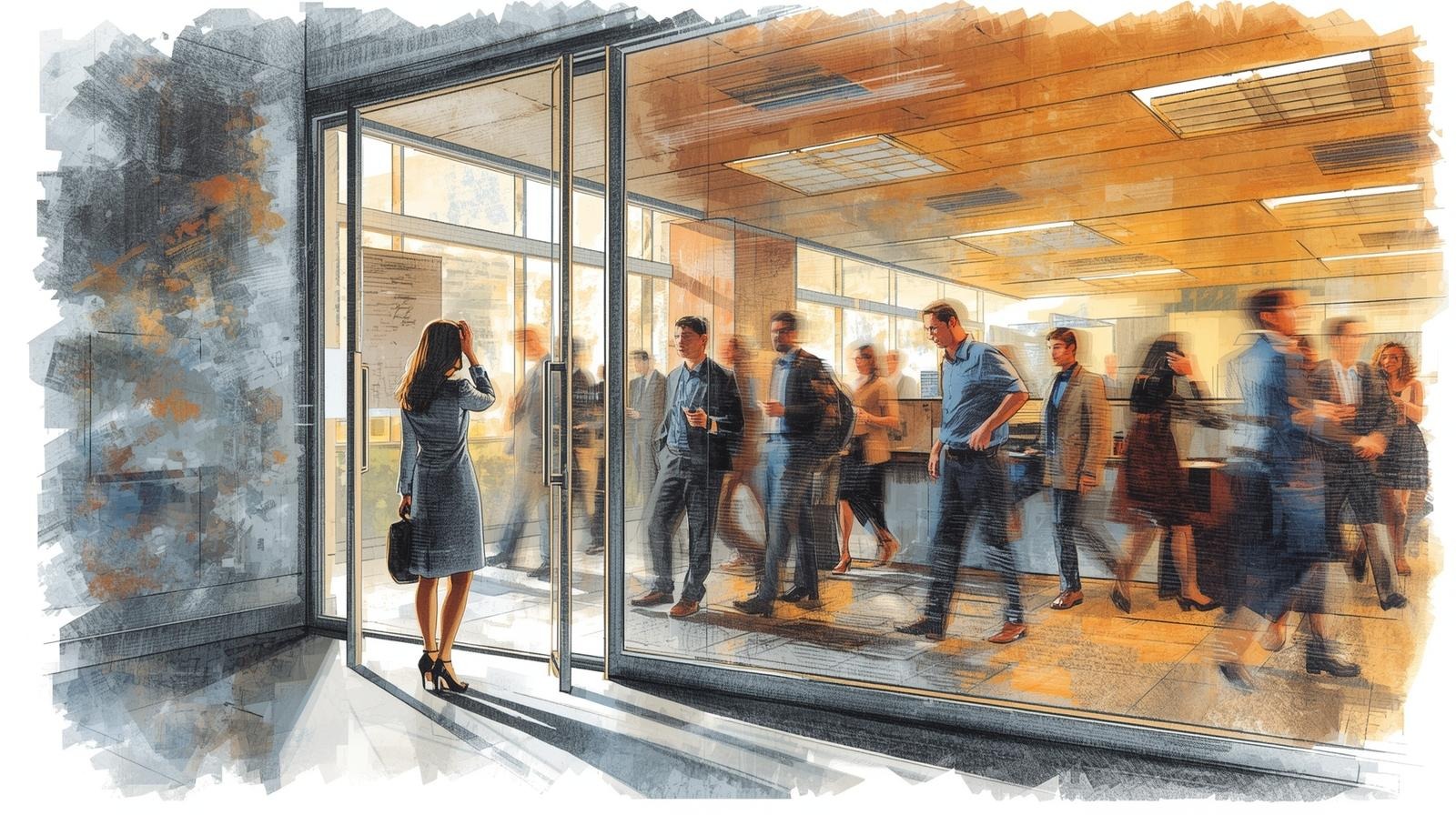
You can start the day feeling surprisingly okay. Maybe even steady. Then you walk into work and your body changes before your brain can explain it.
Your shoulders lift. Your breath shortens. Your stomach tightens like it is bracing. Your mind begins scanning for what you might have missed, what might go wrong, who might need something from you, whether you will be judged, whether today will be one of those days.
If that sounds familiar, I want to start with a simple, deeply relieving idea:
Your calm is not a personality trait. Your calm is a biological state.
It appears when your nervous system receives enough signals of safety, and it disappears when the environment sends signals that feel uncertain, demanding, or socially risky. Work often does all three at once, even when your job is not objectively “terrible.”
This is why you can be calm at home, calm in the car, calm in the elevator, and then feel your calm drop the second you step into the workplace or open your laptop. Your body is not failing. It is doing what bodies do: reading context and preparing you.
In this article, we are going to treat your disappearing calm like valuable data, not like a flaw. We will name what is actually happening, why work environments so reliably trigger stress physiology, and how to rebuild calm in a way that fits real workdays, not imaginary ones.
The doorway effect: Your nervous system starts “forecasting” the moment you arrive
There is a specific pattern many people notice: the anxiety is not always strongest during the hardest tasks. Sometimes it is strongest at the beginning. The entry. The arrival. The first look at the inbox. The first Slack ping.
This is what I call the Doorway Effect.
The Doorway Effect is what happens when your nervous system has learned that “work” predicts certain sensations and outcomes. Not necessarily disaster. Often something subtler: pressure, evaluation, interruption, urgency, conflict, or a constant low hum of needing to perform.
So when you cross the threshold, your system does not wait to see if today will be fine. It prepares based on what has happened before.
Work, for your nervous system, becomes a weather forecast.
Clouds appear, your body grabs an umbrella.
This is why telling yourself “Nothing is happening yet” often does not help. Because your body is not responding to what is happening yet. It is responding to what usually happens next.
Why work is uniquely good at stealing calm: It contains “social evaluative threat”
There are many types of stress. Some stress comes from effort, like learning something difficult. Some comes from time pressure. Some comes from conflict.
But one category hits the human nervous system especially hard: social evaluative threat, the feeling that you are being judged, ranked, assessed, or exposed.
Even when nobody is openly criticizing you, the workplace can contain constant evaluation cues: performance reviews, metrics, visibility, meetings where you can be put on the spot, managers who have power over your future, colleagues whose opinions matter, and cultures where mistakes travel fast.
Research has found that stressors involving social evaluation are particularly connected to cortisol responses, supporting the idea that “being judged” is not just uncomfortable psychologically, it is physiologically activating.
If your calm disappears at work, ask yourself this with gentleness, not blame:
When I enter work, do I feel I must prove that I am competent, likable, fast, helpful, unproblematic, valuable?
That proving energy is not moral weakness. It is often a nervous system strategy for safety and belonging.
Calm is a safety signal problem more than a coping skill problem
A lot of advice about workplace stress focuses on coping skills: meditate, reframe, think positive, manage time.
Those can help. But there is a missing piece: coping is harder when safety signals are low.
Calm does not come from effort alone. Calm comes from the presence of cues that tell your nervous system: I can exhale here.
Work often reduces those cues through five common pathways:
- Predictability gets replaced by shifting priorities.
- Control gets replaced by constant demands.
- Recovery gets replaced by back to back tasks.
- Belonging gets replaced by subtle competition.
- The body’s need for closure gets replaced by endless open loops.
When those patterns become normal, your nervous system adapts by staying partially activated.
That is not you “overreacting.” That is your system trying to be prepared.
Burnout is not just exhaustion, it is stress that never completed its cycle
If your calm has been disappearing for months, you might notice that you do not fully return to baseline even after work. You get home but your mind keeps running. You sleep but you do not feel restored. You rest but you still feel wired.
This is where we need to talk about burnout in a grounded way.
The World Health Organization describes burnout in ICD 11 as a syndrome resulting from chronic workplace stress that has not been successfully managed, and it emphasizes that it is specifically an occupational phenomenon.
The key phrase is not “you are not managing well enough.” The key phrase is chronic workplace stress.
If your calm disappears the moment you enter work, it may be your nervous system recognizing the start of another cycle it has not had the chance to close.

A workplace can be “not that bad” and still be biologically stressful
Many people invalidate themselves by comparing their job to worse situations. They tell themselves they should be grateful, tougher, more resilient.
But the nervous system does not measure stress by comparison. It measures stress by demands, resources, and safety cues.
A widely used framework in occupational psychology, Job Demands Resources theory, explains how high demands combined with insufficient resources can drive strain and burnout, while adequate resources buffer demands and support engagement.
This is a powerful reframe because it shifts the focus from “What is wrong with me?” to “What is the ratio of demands to resources in this environment?”
Sometimes your calm disappears at work because the ratio is quietly brutal.
- High demand, low control.
- High urgency, low clarity.
- High visibility, low psychological safety.
- High responsibility, low support.
Even when nobody yells. Even when the office has snacks. Even when the company posts mental health reminders.
Your body responds to lived conditions, not branding.
The sensory truth: Sometimes Your calm disappears because Your body is overloaded before You speak to anyone
Work stress is not only emotional. It is also sensory.
Noise. Bright lights. Crowded spaces. Constant motion in your peripheral vision. Lack of privacy. Being interrupted mid thought. Even the feeling of being watched.
Open plan environments are especially complex. Research on open plan office noise and simulated open plan conditions has linked noise and open layouts with stress related effects, including measurable stress detection outcomes in controlled settings.
At the same time, newer field research suggests the relationship between office openness and stress can depend heavily on factors like perceived privacy, ambience, and autonomy, meaning “open” is not automatically bad, but the way it is implemented matters.
So if your calm disappears simply when you enter the building, your nervous system might be reacting to sensory load, not just tasks.
This matters because sensory stress often cannot be thought away. It must be reduced, buffered, or balanced.
Digital pressure: Work that lives in Your pocket steals calm before the next day starts
Even if your workplace is physically calm, digital expectations can create a constant background alarm.
Checking work email outside work hours has been linked with emotional exhaustion and reduced wellbeing in research examining after work email use and employee outcomes.
This is not because email is evil. It is because your nervous system struggles to recover when it never receives a clear “we are done” signal.
A separate stream of research on psychological detachment from work during leisure time also shows that not detaching is associated with worse wellbeing, and it explores the mechanisms that keep work in the mind after hours.
If you want calm when you walk into work, one of the most effective places to protect it is the evening before, by creating a simple closure signal for your brain.
Not a long routine. A closure cue.
Psychological safety: Why some teams feel calming even when busy
Two people can have the same workload in two different environments, and their bodies will respond differently. Often, the difference is psychological safety.
Psychological safety is the sense that it is safe to speak up, ask questions, admit uncertainty, and take interpersonal risks without fear of punishment or humiliation.
Research has examined how psychological safety and the feeling of being heard relate to burnout and adaptation during uncertainty, finding meaningful associations between these factors and burnout outcomes.
If your calm disappears at work, consider this quietly powerful question:
Do I feel safe to be human here?
- Safe to not know.
- Safe to ask.
- Safe to slow down for clarity.
- Safe to make a mistake without social injury.
If the answer is no, your nervous system may stay braced, no matter how many breathing exercises you do.
Micro incivility: The calm killer that rarely gets named
Sometimes the issue is not workload. It is the social texture of the environment.
Interruptions that feel dismissive. Eye rolls. Being ignored. Being talked over. Sarcasm used as power. Little comments that are easy to deny but hard to forget.
Systematic reviews and meta analyses in healthcare settings show that incivility is prevalent and linked to harm, including stress related outcomes, and broader evidence has found that incivility at work is associated with worse ratings across many indicators of health, stress, and recovery.
You do not need dramatic conflict to lose calm. Repeated subtle social threat is enough.
Your nervous system is exquisitely sensitive to relational safety, because belonging has always mattered for survival.
A practical diagnostic: What exactly steals your calm at work?
Before we jump into tools, let’s do something that feels almost radical: name the pattern precisely.
Not “work stresses me out.” That is too big and too vague.
We want to know: which part of work is the cue that flips your body into activation?
Here is a table you can use like a mirror. Read it slowly. Notice which row feels like “that is me.”
| The moment calm disappears | What your nervous system may be perceiving | Common body response | The hidden need underneath |
|---|---|---|---|
| Walking in or opening your laptop | Forecasting pressure based on past patterns | Tight chest, shallow breath | Predictability and a gentle start |
| Seeing certain names in messages | Social evaluative threat, power dynamics | Heart drop, heat, dread | Relational safety and clarity |
| Before meetings | Exposure risk, being put on the spot | Dry mouth, blank mind | Preparation, control, permission to pause |
| During interruptions | Loss of control, attention fragmentation | Irritability, fatigue | Protected focus and fewer context switches |
| After work, at home | Unfinished loops, lack of closure | Rumination, restless body | Completion signal and detachment |
| In noisy or bright spaces | Sensory overload | Headache, tension, shutdown | Reduced input and micro privacy |
This table is not here to label you. It is here to make your stress specific, because specificity is calming.
When you can name the trigger, you can choose a tool that actually matches it.
Calm at work is not “relaxed,” it is “steady”
Many people expect calm to feel like a spa. Soft, loose, sleepy, peaceful.
But work calm usually looks different. It is often steadiness, not softness.
It feels like: I can breathe. I can think. I can respond without panic. I can handle this next moment.
If you aim for the wrong kind of calm, you will feel like you are failing. You are not failing. You are trying to bring Sunday nervous system into Monday reality.
Instead, aim for steady calm, the kind you can access while still being alert and capable.
The calm loop: A nonconventional way to rebuild calm in the middle of a workday
Most workplace tools fail because they are too big. They require time you do not have. Or privacy you do not have. Or emotional bandwidth you do not have.
So here is a different approach: the Calm Loop.
Cue -> Body signal -> One tiny intervention -> Return to task -> Repeat
This is not about becoming calm once. It is about returning to steady again and again, the way you return to the center while walking.
Here are examples of Calm Loops you can use without making it a production:
- Inbox cue -> jaw tight -> exhale longer, soften tongue -> open only one email
- Manager cue -> stomach drop -> feet press into floor -> read message once slowly
- Meeting cue -> throat tight -> slower blink, shoulders down -> ask one clarifying question
- Noise cue -> brain fog -> reduce input for 90 seconds -> restart with one clear task
You will notice something important: these interventions are body first.
That is intentional, because your calm disappears through physiology before it becomes thoughts.

Micro resets that fit real workdays
Below is a table of micro resets designed for reality. They are small enough to do in a bathroom, at your desk, or in a meeting without anyone noticing.
| Situation | What is happening inside | Micro reset that works fast | Why it works |
|---|---|---|---|
| You are about to check messages | Anticipation of demand | One longer exhale, then open only one thread | Exhale shifts the body toward regulation and reduces overwhelm |
| You feel watched or judged | Social evaluation cue | Press feet into floor, feel the contact points, then look at one neutral object | Anchors you in present safety cues instead of predicted threat |
| You are spiraling after an interaction | Social injury or unfinished meaning | Write one sentence on paper: “The story my brain is telling is…” then return to task | Externalizes rumination so it does not keep looping internally |
| Your brain feels scattered | Attention fragmentation | Close every tab except the one you need, then do 2 minutes on a single task | Reduces cognitive load by removing choices |
| The office is too loud | Sensory overload | Create a micro boundary: headphones, earplugs, or a two minute quiet break | Less input equals less activation |
| You cannot stop thinking about work after hours | No detachment | End day with a closure note: “Tomorrow, the first safe step is…” | Gives the brain a plan so it stops rehearsing |
These are not substitutes for systemic changes, but they can prevent your nervous system from spending the whole day in a stress posture.
They also align with research showing that after hours work contact and poor detachment are linked with worse exhaustion and wellbeing.
The three minute arrival: Protect calm before the day takes it
If your calm collapses at the doorway, the highest leverage moment is the first three minutes.
Not because three minutes will fix everything, but because it prevents you from starting the day in a braced state.
Try this, exactly as written, without trying to perfect it.
First minute: breathe in through the nose, and let the exhale be slightly longer than the inhale. Keep it subtle.
Second minute: orient with your eyes. Let your gaze move slowly around the room. Notice shapes and edges. Tell your body, silently, “I am here.”
Third minute: choose one controllable action before you open messages. One small task you can complete in ten minutes.
This sequence works because it does three things your nervous system craves: breath regulation, present moment orientation, and control.
It is not a ritual for productivity. It is a ritual for safety.
Meetings: The place where calm disappears because the body fears exposure
For many people, meetings are the most activating part of work, even more than deadlines.
That makes sense when you remember social evaluative threat.
A meeting is a stage, even when it is called a “sync.”
If your calm disappears in meetings, consider changing your goal. Do not aim to feel confident. Aim to feel grounded.
Grounded can look like this:
- You slow your inhale slightly.
- You allow a pause before speaking.
- You ask for clarification instead of rushing to sound smart.
- You let your body stay connected to the chair and floor.
A practical phrase that often reduces nervous system pressure is:
“I want to make sure I understood. Are you asking for X, or Y?”
This buys you time and returns control without apologizing for having a nervous system.
The environment layer: Small changes that return safety cues
There are situations where the most compassionate move is to stop treating the problem as purely internal.
If the environment keeps screaming “urgent,” your body will keep responding.
Here is a table that separates what you can do internally from what can be negotiated externally. This is not about blaming the workplace or blaming yourself. It is about being accurate.
| Stress driver | Internal support you can do today | External adjustment that changes the system |
|---|---|---|
| Priorities constantly change | Pick one next action you control, then ask for confirmation of top priority | Request priorities in writing, or ask for a single owner of the priority list |
| You are expected to respond instantly | Micro boundary: silence notifications for a set window | Set explicit response windows with your team when possible |
| Open office overload | Reduce input with headphones, micro breaks, or a quieter corner | Ask about quiet zones, partitions, or flexible seating |
| Low psychological safety | Ground yourself before speaking, then choose one small risk | Ask for meeting norms: agendas, no interrupting, clarity on decisions |
| After work contact | Create a closure cue and limit checking | Align on after hours communication expectations and true urgency criteria |
This table reflects a core truth in job stress research: resources and control matter, and they are not only inside you.
Commute and transition: Calm can be built before You arrive
If you notice calm disappearing on the commute or right before you enter, you may be able to support yourself through the transition.
Research on active commuting has examined associations with perceived commuting stress, suggesting that the way we transition into work can shape stress responses.
This does not mean you must walk or cycle to be calm. It means transitions matter.
Try giving your brain a different entry signal:
Instead of scrolling or rehearsing problems, let the commute be a decompression space.
Instead of rushing in mentally, arrive two minutes early and do your Three Minute Arrival.
Instead of entering work with ten tabs open in your mind, enter with one sentence: “Today I will do the next right step.”
The nervous system loves a clean beginning.
When the calm will not stay: The honest possibility of mismatch
Sometimes, calm disappears at work because your body is accurately detecting chronic stressors that are not solvable with techniques alone.
If your workplace has ongoing incivility, humiliation, discrimination, retaliation, or constant unpredictability, your nervous system may be refusing to settle because it does not feel safe to settle.
In those cases, self regulation tools are still useful, but they are not the whole answer. The whole answer might include documentation, ally building, formal reporting pathways when appropriate, professional support, and sometimes planning a transition to a healthier environment.
This is not failure. It is self respect.
And it aligns with what we know about burnout as chronic workplace stress, not a personal weakness.
A calm that stays is not a performance, it is a relationship with Your day
If you take one thing from this article, let it be this:
Your calm disappears at work because your nervous system is responding to cues, not because you are doing life wrong.
When you rebuild calm, you are not forcing yourself to be “fine.” You are teaching your body that you can find steadiness inside the day, and you are also learning what kinds of environments deserve your energy.
That is what real calm is: not silence, not perfection, not emotional numbness.
A steady inner place you can return to.
Again and again.
Related posts You’ll love
- Decompression between roles: The powerful secret to a calmer, happier life
- Why You feel more calm alone (and what that means for Your relationships)
- How to stop letting tomorrow steal today’s peace
- Love without self abandonment: Calm practices for Women who give too much
- The “He doesn’t get it” Stress: How to stay calm while being misunderstood
- 10 exercises that help You stop taking things personally in certain environments: A practice corner workbook for rejection sensitivity, social anxiety, and self worth
- Why laughter works like social medicine: The science of shared joy, stress relief, and stronger bonds

FAQ: Why Your calm disappears when You walk into work
-
Why do I feel calm at home but anxious the second I enter work?
Because your nervous system reads work as a higher-stakes environment. Even if you like your job, work often includes evaluation, uncertainty, interruptions, and social dynamics that your body interprets as “I need to be alert.” Calm at home usually comes from familiarity and control. At work, those cues can drop fast. A useful reframe is this: your calm didn’t vanish, it got temporarily outvoted by your body’s prediction system. The goal is not to force calm, but to rebuild steady regulation in small, repeatable moments.
-
Why does my anxiety spike before I even start working?
That spike is often anticipatory stress. Your brain is forecasting based on past patterns: emails, meetings, pressure, or unpredictable requests. The doorway, the login screen, the office smell, or the first notification can all become cues your body associates with demand. Try a tiny “arrival buffer” before you open anything: one longer exhale, eyes slowly scanning the room, then choose one small task you control. This creates a new association: entering work does not have to mean instant stress.
-
Why does one email or message ruin my calm for hours?
Because the message is rarely “just a message.” Your body may read it as urgency, criticism, conflict, or status threat, especially if it comes from someone with power over your workload or evaluation. When your system gets activated, it can take time to settle unless you give it a clear safety cue. Try this pattern: read once, exhale longer, place both feet on the floor, then write one sentence that clarifies your next step. Clarity is calming because it reduces uncertainty.
-
How can I stay calm at work when the environment is genuinely stressful?
You’re not meant to “zen” your way through constant pressure. The most realistic target is steady calm, not perfect calm. Think of it as a skill: returning to center, again and again. Use micro-resets that fit work reality: longer exhales, grounding through your feet, reducing sensory input for 60 seconds, and narrowing your focus to one next action. At the same time, look for system changes that reduce stress at the source, like clearer priorities, fewer interruptions, or defined response windows.
-
What are the fastest ways to calm down at my desk without anyone noticing?
Try a quiet reset that works from the body outward. Let your exhale be a little longer than your inhale for three breaths. Drop your shoulders a few millimeters. Unclench your jaw and soften your tongue. Press your feet into the floor and feel the chair supporting your back. Then pick one small action you can complete in two minutes. This signals safety and control, which are two of the quickest calm-builders during a workday.
-
Why do meetings make me feel panicky even when I’m prepared?
Meetings can trigger performance pressure and social exposure. Your nervous system may interpret being watched, judged, or put on the spot as a threat, even if no one intends harm. Preparation helps, but regulation helps more in the moment. Before speaking, allow a tiny pause, breathe out slowly, and anchor your attention in a physical point like your feet or your hands. If your mind goes blank, ask a clarifying question instead of forcing an instant answer. That returns control without self-criticism.
-
Why do I overthink work after hours and can’t “switch off”?
Overthinking is often your brain trying to create safety through rehearsal. If work feels unpredictable, the mind keeps running scenarios to prevent future mistakes. A simple closure ritual helps your nervous system detach: at the end of the day, write one sentence that names tomorrow’s first safe step, then close your laptop and physically change your environment. When your brain has a plan, it reduces the need to loop. The goal is not to stop thinking entirely, but to give your mind an ending.
-
Can workplace stress cause physical symptoms like nausea, headaches, or fatigue?
Yes. Stress is not only mental; it is bodily. When your nervous system stays activated, it can affect digestion, muscle tension, sleep quality, and energy. Some people feel it as nausea or a tight throat; others as migraines or exhaustion. If you notice physical symptoms increasing around work, treat it as real information. Micro-resets can help, but persistent symptoms are also worth discussing with a healthcare professional, especially if they’re new, intense, or worsening.
-
What if my calm disappears because my workplace is toxic?
If the environment is chronically unsafe, your body may be responding accurately. In that case, “calm tools” are support, not a solution. You may need boundaries, documentation, ally-building, and sometimes a longer-term plan to change teams or workplaces. A key sign is when your body relaxes away from work and tenses immediately around specific people, channels, or situations. You don’t have to train yourself to tolerate harm. The most self-loving calm is often the calm that comes from protection and change.
-
What’s the best daily routine for staying calmer at work long-term?
Think in three phases: arrival, mid-day resets, and closure. On arrival, take three minutes before messages to settle your body and choose one controllable action. During the day, do tiny resets at predictable trigger points, like before inbox checks or after meetings. At closure, write tomorrow’s first step and create a clear “work is done” cue. Consistency matters more than intensity. Your nervous system learns calm through repetition, not through one perfect day.
Sources and inspirations
- World Health Organization. Burn out an “occupational phenomenon” in ICD 11 (2019).
- Woody, A., Social evaluative threat, cognitive load, and the cortisol and cardiovascular stress response (2018).
- Tedone, A. M., Keeping up with work email after work hours and employee wellbeing (2022).
- Sonnentag, S. Not detaching from work during leisure time: a control theory perspective (2024).
- Kerrissey, M. J., Psychological safety, feeling heard, and burnout amid uncertainty (2022).
- Bakker, A. B., Demerouti, E., Sanz Vergel, A. Job Demands Resources Theory: Ten Years Later (2023).
- Sander, E. L. J., Open plan office noise is stressful: multimodal stress detection in a simulated work environment (2021).
- Alexander, V., Office openness affects stress regulation and teamwork: a neurophysiological field study (2024).
- Shoorideh, F. A., Incivility toward nurses: a systematic review and meta analysis (2021).
- Hasson, D., Incivility is systematically associated with indicators of health, wellbeing, stress, recovery, and the psychosocial work environment (2024).
- Sattler, M. C., Active commuting and perceived commuting stress: results from the HOTway study (2020).
- American Psychological Association. Work in America survey reports (2023).



Leave a Reply