Table of Contents
A tiny pause that can change Your whole evening
You close your laptop, but your mind does not close with it.
Your body is in the kitchen, yet part of you is still in the meeting. Your jaw is tight like you are still explaining yourself. Your shoulders sit high like they are bracing for another request. Someone you love says something ordinary, and you answer with a tone that belongs to a different room, a different hour, a different version of you.
This is not because you are failing at life.
It is because your nervous system needs a transition, and your schedule often refuses to provide one.
We live as if roles are light switches. Work on. Home on. Caregiver on. Partner on. Friend on. Alone time on. But a human being is not a switch. A human being is a system that needs to downshift, reorient, and land.
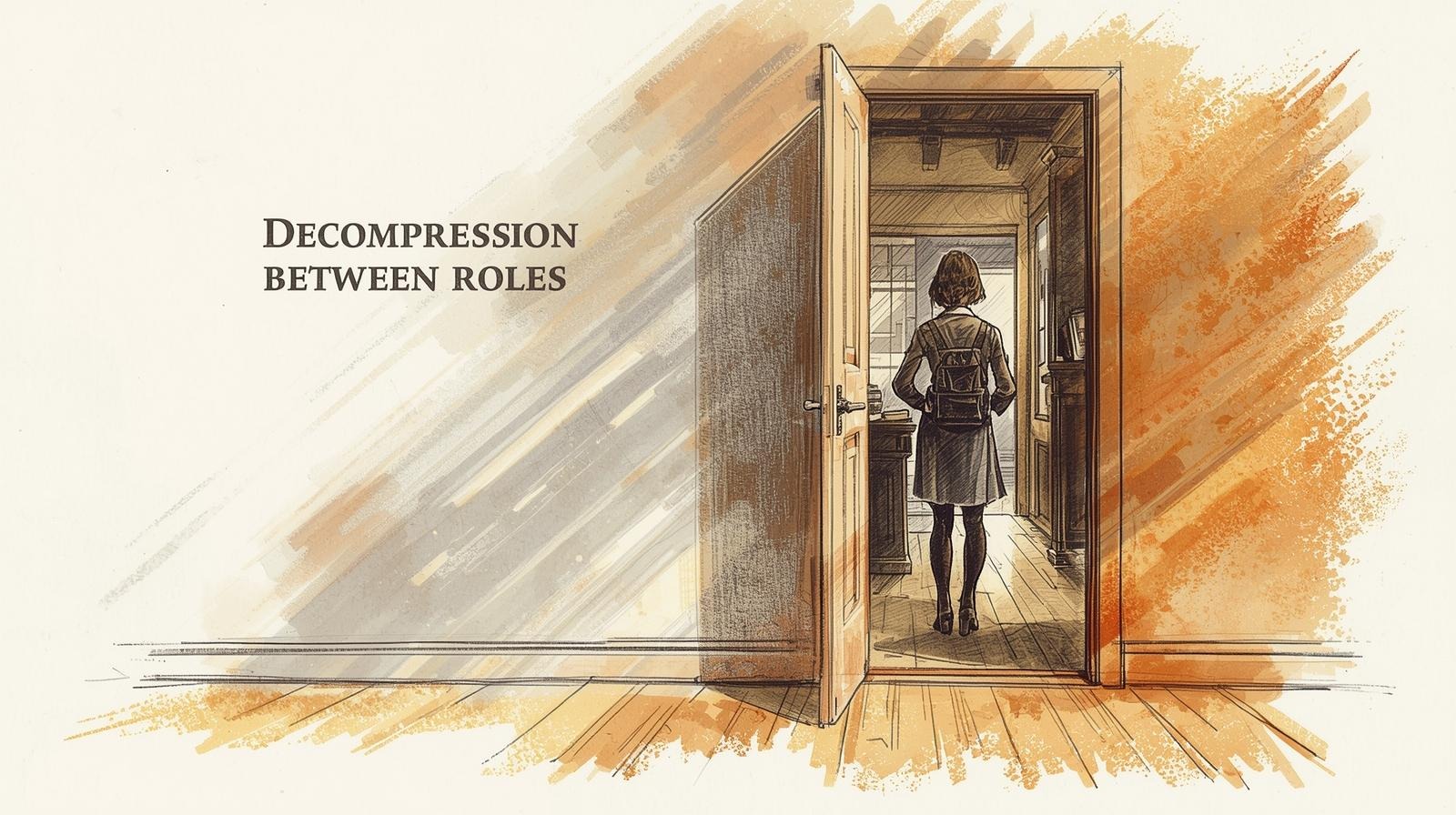
Decompression between roles is that landing.
It is the small buffer that stops stress from spilling into the next chapter. It is also the quiet skill that makes your life feel less like a pile of tasks and more like a series of rooms you can actually enter.
There is a reason this matters so much. Research on recovery from work repeatedly highlights that unwinding and psychological detachment are strongly linked with better wellbeing and lower strain, and that recovery processes shape how we feel and function in the rest of life.
Decompression is not a luxury. It is basic emotional hygiene for anyone living more than one role.
What a role really is, and why switching roles costs more than You think
A role is not just a label. It is a full internal state.
When you are in a role, your attention narrows toward certain demands. Your posture changes. Your vocabulary shifts. Your face holds a specific expression. Your nervous system runs a specific program. Even when you enjoy the role, it still asks your brain to predict, decide, monitor, and respond.
Role switching has a cost because it is not merely logistical. It is biological and psychological.
That cost becomes obvious when you notice patterns like these:
You arrive home, yet you cannot relax because your mind is still solving.
You are with your partner, yet you feel emotionally distant because you are still in performance mode.
You are alone, yet your body stays activated like someone might need something at any moment.
You finish one responsibility and instantly feel another one waiting, as if you never truly complete anything.
A large body of recovery research describes how demands deplete resources, and how recovery experiences such as detachment, relaxation, mastery, and control help restore them. This is one of the most consistent themes in modern organizational psychology: if recovery does not happen, strain carries forward.
Decompression between roles is one of the smallest, most practical ways to support that recovery in daily life.
Decompression between roles, defined in a way You can actually use
Decompression between roles is a deliberate transition space that helps you do three things:
- Release the previous role.
- Regulate your nervous system.
- Enter the next role with intention instead of residue.
It can be thirty seconds or twenty minutes. It can happen in a car, in a doorway, in the bathroom, on a staircase, at the edge of your bed, or even with your hand on the kitchen counter before you turn toward the next demand.
The size is not the point. The signal is the point.
You are teaching your system this sequence:
Previous role → transition space → next role
When that middle space disappears, the roles collide:
Previous role → next role
Collisions are where we snap, shut down, numb out, overeat, scroll endlessly, or carry tension into the people who did not cause it.
Decompression is not about becoming perfectly calm. It is about giving your body and mind a clear punctuation mark so life stops feeling like one long run on sentence.
Why decompression works, even when it is very short
Many people assume that a short pause cannot possibly matter. Yet micro recovery matters precisely because it interrupts accumulation.
A meta analysis on microbreaks found that short breaks taken between tasks can improve wellbeing outcomes like vigor and fatigue, and can support performance depending on the conditions and activities involved. The core idea is simple: tiny breaks can create meaningful relief when they are repeated.
Decompression between roles is a microbreak designed for identity shifts. It is a brief moment that tells your brain: you are no longer required to carry that context.
This aligns with broader recovery research showing that psychological detachment is a key mechanism through which strain reduces and wellbeing improves. When detachment is low, stress related activation stays switched on longer.
It also aligns with evidence that interventions can improve psychological detachment. A meta analysis of detachment interventions found an overall positive effect, suggesting that detachment is trainable, not a personality trait you either have or do not have.
So decompression works for the same reason physical stretching works. You are not trying to fix your life in one moment. You are training a pattern.

The hidden cost of skipping decompression
Skipping decompression does not just make you tired. It subtly shapes your relationships and your self image.
Stress spillover becomes Your normal voice
You do not mean to sound sharp. But you carry urgency into a room that does not require urgency.
Emotional residue becomes misdirected emotion
You feel annoyed at your partner, but the annoyance started hours ago with a different conversation, a different demand, a different power dynamic.
Presence gets replaced with performance
You smile, you nod, you respond, yet you do not feel truly there. It is like living behind glass.
Rest starts to feel unsafe
If you move from one role to the next without a buffer, your body learns that stopping is not allowed. Over time, even quiet moments can feel uncomfortable because your system has forgotten how to downshift.
This is one reason recovery research emphasizes sustainability. Recovery is not separate from performance, it is part of performance. Without recovery, you borrow energy from tomorrow and pay it back with interest.
A non conventional metaphor that makes decompression feel obvious
Think of each role as a scented lotion.
- Work lotion smells like urgency, evaluation, speed.
- Caregiver lotion smells like scanning, anticipating, holding.
- Social lotion smells like performance, attunement, being perceived.
- Creative lotion smells like openness, play, vulnerability.
- Home lotion smells like softness, intimacy, honesty.
If you apply one lotion and immediately apply another on top, the scents mix. They contaminate each other. You cannot smell the second one clearly because the first is still on your skin.
Decompression is washing your hands between scents.
Not because the first scent was wrong. Because you deserve to enter the next room clean.
The three layer decompression model: Body, mind, boundary
The fastest decompression is not the one that includes the most steps. It is the one that addresses the right layers.
Layer one: The body downshift
Your body often stays activated after the role ends. You can signal safety with small physical cues: a longer exhale, unclenching the jaw, dropping the shoulders, loosening the hands, feeling the feet.
This is not spiritual. This is nervous system logic: breath and muscle tone are direct channels of regulation.
Layer two: The mind closure
Your mind holds open loops. If you try to relax while the loops stay open, you will feel restless. Closure does not mean solving everything. Closure means containing it.
A simple closure sentence is enough: “This is paused. I will return later.”
Layer three: The boundary cue
A boundary cue tells your brain you are in a new context. It can be sensory, digital, or environmental: changing clothes, washing hands slowly, dimming lights, turning off notifications, stepping outside for one minute.
Boundary management research and training studies highlight that boundaries and recovery are connected, and that people can learn tactics that improve detachment and wellbeing outcomes.
When you combine all three layers, even a short decompression becomes powerful.
A table You can use immediately: Role shift patterns and fast decompression levers

If you want to make this more personal, notice the specific emotion that leaks through. Naming the leak is often enough to stop it from driving.
Why the commute used to help, and why remote life can feel like emotional whiplash
Many people did not realize the commute was doing psychological work.
Not because traffic was healing, but because the commute was a built in transition zone. It created a liminal space, a between space where you were not fully in one role or the other. Research on commute liminality argues that this in between experience can free cognitive resources for role transition and recovery.
More recent commute recovery research also examines how recovery experiences during morning and evening commutes relate to daily resources across domains, reinforcing the idea that the commute can function as a recovery container.
If you do not have a commute, you can create a symbolic one.
A symbolic commute is simply a repeated transition ritual that signals: work ended, home began.
You do not need distance. You need differentiation.
The doorway method: Decompression in under two minutes
This method is simple because it uses a place your brain already understands: thresholds.
Doorways, hallways, elevators, stairwells, even the moment you close a laptop are natural transitions. Your mind already labels them as “in between.”
Step one: Pause at the threshold
Place your hand on the doorframe, wall, countertop, or the edge of your desk. Feel the contact. Let your exhale be longer than your inhale.
Step two: Name the ending
Say quietly: “This role is complete for now.”
Not forever. Not perfectly. For now.
Step three: Choose the entry quality
Ask: “What quality do I want to bring into the next room?”
Warmth. Patience. Play. Quiet. Firmness. Openness.
Step four: Enter with one visible action
A visible action becomes a landing pad. Put your phone in a drawer. Change your shirt. Wash your hands slowly. Turn on a lamp. Sit for ten breaths. Greet someone with eye contact.
This is how you build calm without needing a whole meditation session. You create a reliable micro transition, and your system learns it.
When decompression feels impossible, it is often a boundary problem, not a discipline problem
If you are thinking, “I do not have time,” you are probably not lazy. You are saturated.
This is why the smallest possible version matters. Ten seconds is still a signal.
The bigger challenge for many people is not time. It is intrusion, especially digital intrusion.
A review on work related smartphone use during off job hours found that increased work related smartphone use is commonly associated with higher work life conflict and negative outcomes including strain and sleep disturbances.
If your phone is an open door back into the previous role, decompression will keep failing until you close that door.
You can do this gently. You do not need to disappear. You need a boundary cue.
For example, you might decide that the first thirty minutes after work are phone quiet time, or that notifications are off until after dinner, or that the phone does not enter the bedroom.
This is not about being perfect. It is about giving your nervous system a protected space to switch roles.

Decompression for personal role shifts that nobody talks about
Many people think this topic is only about work and home. Yet personal roles can collide just as hard.
Parent role to partner role
Parenting often keeps the nervous system in monitoring mode. Even when the children are asleep, the body can stay alert. If you attempt intimacy or deep emotional conversation without decompression, your body may resist, not because you do not love your partner, but because your system is still guarding.
A good decompression here is sensory and slow: warm shower, soft clothes, dim lights, quiet sitting together before talking. The goal is to tell the body: the emergency channel is off.
Helper role to self role
If you are the person everyone leans on, you might carry “usefulness” as a survival strategy. Rest can feel selfish. Silence can feel like abandonment. Decompression is a reclaiming ritual.
Try this sentence: “For the next ten minutes, I am unavailable for being useful. I am available for being human.”
Even if you cannot get ten minutes, start with one minute. One minute is still a boundary.
Social role to solitude role
Social time can be beautiful and still activating. If you are sensitive, introverted, anxious, or simply attentive, your system holds stimulation after you leave. Decompression here is not analysis, it is metabolizing. Music, dim light, repetitive movement, warm tea, a shower, slow breathing.
This is you letting your body finish what the event started.
A table that turns decompression into a repeatable ritual
A ritual is just meaning repeated. It sticks when it is small, sensory, and identity affirming.

If you want your ritual to feel especially Calm Space, choose an entry action that brings you into your senses rather than your thoughts.
Taste something warm. Feel water. Smell something familiar. Let your system hear: we are here now.
The science of detachment and sleep, explained like a human
Many people struggle with sleep not because they lack discipline, but because their day never truly ends.
Sleep asks for a different internal state. It asks for release. If you carry the previous role into bed, your mind keeps working, your body keeps listening, your nervous system keeps scanning.
A study on psychological detachment and sleep related outcomes found that detachment can mediate links between workload, fatigue, and sleep problems, illustrating how detachment helps buffer the impact of demands on sleep.
This is why evening decompression is often the most life changing. It is not only about being calm. It is about teaching your system that it is safe to stop.
If your evenings feel wired, try a decompression sequence that looks like this:
Work role → closure sentence → boundary cue → low light → slow breath → bed
Not perfection. Just a clear staircase downward.
Decompression in a blended life: Hybrid work, flexible roles, blurred boundaries
Modern life is increasingly blended. Many people work from home, parent while working, answer messages in the evening, and switch roles without leaving a room.
This is not a personal failure. It is a context.
Research on telework boundary dynamics and hybrid work suggests that boundary preferences and boundary strategies matter, and that boundary management is a real psychological task in blurred environments.
There are also emerging intervention studies focused on hybrid workers, including work on self regulation strategies such as time spatial job crafting and work home domain management, showing that training and structured strategies can support better outcomes.
In a blended life, decompression becomes less about location and more about signals.
Three signals are especially powerful:
- A sensory signal: light, music, scent, texture.
- A digital signal: notification changes, app boundaries, device placement.
- A posture signal: shift from forward tight posture to open grounded posture.
You do not need a separate room for calm. You need a reliable signal that tells your system: the role changed.
A seven day decompression experiment that is simple enough to finish
This is not a challenge. It is a gentle training week. Pick one transition you do most days, then repeat it.

Microbreak evidence supports the idea that small repeated breaks can meaningfully impact wellbeing, especially when the break activity supports recovery.
The win is not doing it perfectly. The win is making the transition visible to your nervous system.
When decompression feels emotionally loaded: Guilt, self criticism, and the fear of pausing
Sometimes the biggest barrier is not logistics. It is guilt.
If you learned that rest must be earned, that productivity equals worth, or that your needs are inconvenient, decompression can feel wrong. You might pause, then immediately fill the pause with self judgment.
This is where self compassion becomes part of decompression. Not as a motivational quote, but as a nervous system permission slip.
A study examining psychological detachment, emotional exhaustion, and depressive symptoms found that self compassion can moderate the association between exhaustion and depressive symptoms, suggesting that self compassion can buffer emotional costs when strain is high.
Self compassion in decompression sounds like this:
Of course I feel activated, my day asked a lot of me.
A small pause is not selfish, it is responsible.
I can transition without abandoning anyone.
This is not softness for the sake of softness. It is the most practical way to return to your life with less residue.
The calm space truth: You do not find calm only at the end, You insert it between chapters
Many people chase calm like it lives only in big things: a vacation, a weekend, a perfect morning routine, a silent house, a long bath, a meditation streak.
Those can be wonderful. But everyday calm is often built in smaller places.
In thresholds. In doorways. In one song. In warm water on your hands. In one long exhale that tells your body: you are safe to switch.
Decompression between roles is how you protect the meaning of your roles. It is how home feels like home instead of a second workplace. It is how relationships receive your real presence instead of whatever is left. It is how you stop dragging the emotional weather of one hour into the next.
Previous role → transition → next role
That middle space is not empty.
It is where you come back to yourself.
Related posts You’ll love
- Why You feel more calm alone (and what that means for Your relationships)
- How to stop letting tomorrow steal today’s peace
- Love without self abandonment: Calm practices for Women who give too much
- The “He doesn’t get it” Stress: How to stay calm while being misunderstood
- The calm way to ask for effort (without sounding like You’re begging)
- Why the first 20 minutes after coming home matter so much
- Calendar control: The manifesto Women are afraid to write, and the new rules to reclaim Your time without guilt

FAQ: Decompression between roles
-
What is decompression between roles?
Decompression between roles is a short transition period that helps you mentally and physically “close” one role (like work) before entering the next (like partner, parent, or friend). It reduces stress spillover, improves emotional presence, and supports nervous system regulation.
-
Why do I feel irritable when switching from work to home?
Irritability often happens because your body is still in “high alert” mode from the previous role. Without decompression, work urgency and tension leak into home life. A brief transition ritual helps your nervous system downshift so you can respond, not react.
-
How long should decompression between roles take?
It can be as short as 30–120 seconds. The key is not length but clarity: you need an ending signal for the previous role and an entry signal for the next one. Even two minutes of intentional decompression can make role switching feel smoother.
-
What are the best decompression techniques for role switching?
The best techniques are simple and repeatable: a longer exhale, a short walk, washing your hands slowly, changing clothes, turning off notifications, or one sentence of closure like “This can wait.” The goal is a clear micro transition, not perfection.
-
Is decompression between roles the same as procrastination?
No. Procrastination avoids the next task without closure. Decompression is a purposeful reset that creates closure and restores calm so you can enter the next role with more focus, warmth, and presence.
-
How can I decompress between roles when working from home?
When you don’t have a commute, you need a symbolic one. Use a consistent cue: close your laptop, stand up, change the light or music, take ten slow breaths, and silence work notifications. Consistency teaches your brain that the role has changed.
-
What is stress spillover and how does decompression help?
Stress spillover is when the emotional tone of one role bleeds into another, like bringing workplace pressure into relationships. Decompression interrupts that carryover by helping your body release tension and helping your mind stop rehearsing the previous role.
-
Why do I feel emotionally numb after a busy day of roles?
Emotional numbness can be a shutdown response to constant role switching without recovery. If your nervous system never gets a transition, it may protect you by reducing emotional intensity. Gentle decompression can restore access to feelings by creating safety and slowing the pace.
-
Can decompression between roles improve relationships?
Yes. Decompression helps you show up with less residue—less urgency, less irritation, fewer distracted responses. That makes it easier to listen, connect, and be emotionally available, especially during sensitive transitions like parent-to-partner or work-to-home.
-
Does decompression between roles help with sleep?
Often, yes. Many sleep problems are worsened by mental carryover—your mind stays “on duty.” A short evening decompression ritual (closure sentence, low light, phone boundary, slow breathing) signals to your brain that the day is complete.
-
What’s a quick decompression ritual I can do in under 2 minutes?
Try this: stop at a doorway, exhale slowly twice, drop your shoulders, and say “I’m switching roles now.” Then do one entry action like washing your hands, dimming the lights, or greeting someone with full eye contact. Small and repeatable wins.
-
Why do I feel guilty taking decompression time?
Guilt often comes from beliefs that rest must be earned or that you must stay useful. Decompression isn’t laziness—it’s emotional hygiene. A short pause helps you be more patient, more present, and more regulated in the roles that matter.
-
How do I know my decompression is working?
You’ll notice fewer sharp reactions, less mental replay, and an easier sense of “arriving” in the next role. You may also feel calmer in your body—lower jaw tension, softer shoulders, slower breathing—within minutes.
-
What if I don’t have privacy or uninterrupted time to decompress?
Use micro decompression in plain sight: one long exhale, unclench your hands, soften your face, and take ten seconds of stillness. Even tiny cues teach your nervous system to transition, especially when done consistently every day.
Sources and inspirations
- Bennett, A. A. (2018). Recovery from work related effort: A meta analysis.
- Sonnentag, S., Cheng, B. H., Parker, S. L. (2022). Recovery from Work: Advancing the Field Toward the Future. Annual Review of Organizational Psychology and Organizational Behavior.
- Steed, L. B., (2021). A meta analysis on employee recovery from work. Journal of Management.
- Karabinski, T., (2021). Interventions for improving psychological detachment from work: A meta analysis.
- Albulescu, P., (2022). Give me a break: Systematic review and meta analysis on microbreaks. PLOS ONE.
- Reinke, K., (2024). Boundary management training: randomized controlled intervention study. Journal of Occupational and Organizational Psychology.
- Rivkin, W., (2025). Roles of morning and evening commute recovery experiences for daily resources. Human Relations.
- McAlpine, K. L., (2023). Along for the ride through liminal space: role transition and recovery perspective on the work to home commute. Journal of Health Psychology.
- Cho, H., (2024). Psychological detachment from work during nonwork time and sleep related outcomes. Sleep Health.
- Wu, Q., (2023). Psychological detachment and depressive symptoms: emotional exhaustion mediation and self compassion moderation.
- Blake, H., (2024). Work related smartphone use during off job hours and work life conflict: review evidence. PLOS Digital Health.
- Demerouti, E., (2025). Time spatial job crafting and self regulation strategies in hybrid work: intervention study. Journal of Business and Psychology.
- Urbanavičiūtė, I., (2023). Work home boundary management dynamics in telework.
- Wan, M. M., (2025). Adapting boundary preferences to match hybrid work reality.




Leave a Reply