
Table of Contents
There is a very specific kind of exhaustion that happens when eating stops being just eating. You sit down with a meal, but instead of tasting it, your mind begins running calculations. Was this too much? Was it “clean” enough? Did I earn it? Will I regret it? Should I compensate later? Is everyone noticing? Should I look more disciplined than hungry?
For many women, food is not only food. It becomes a daily negotiation with shame, desirability, health anxiety, gender expectations, social comparison, and the quiet fear of being seen as “out of control.” That is why eating “normally” can feel almost impossible in a culture that teaches women to treat appetite as something suspicious rather than human.
When I use the phrase “normal eating,” I do not mean perfect eating. I do not mean eating only whole foods, never eating emotionally, never overeating, never craving sugar, never eating past fullness, never skipping a meal, and never having complicated feelings. That version of “normal” is not normal at all. It is a polished fantasy sold by diet culture, wellness marketing, and algorithm-friendly self-optimization. Real normal eating is flexible. It changes with stress, hormones, culture, pleasure, money, time, illness, celebration, grief, and access. It is not a moral performance. It is a relationship between a body and the world it lives in.
And this is where the problem begins: women are often asked to live as if their bodies are public property, personal projects, and moral report cards all at once. A woman’s body is expected to be attractive but effortless, disciplined but not obsessive, healthy but not “too much,” small but curvy in the correct places, hungry but never greedy, sensual but never uncontrolled. Food becomes the place where all these impossible instructions collide.
Research on eating disorders, weight stigma, social media, and self-objectification repeatedly shows that body surveillance, comparison, stigma, and internalized appearance ideals can shape disordered eating patterns and body dissatisfaction.
So if eating feels hard, the first question is not “What is wrong with me?” A better question is: “What kind of culture trained me to distrust something as basic as hunger?”
The unspoken rule: A “good Woman” is supposed to be in control
Many women are taught, directly and indirectly, that self-control is part of femininity. Not just emotional control, but bodily control. Control your appetite. Control your waist. Control your aging. Control your cravings. Control your facial expressions. Control your tone. Control your ambition. Control how much space you take up. Then, if you do it gracefully enough, pretend it was never effort.
This is why dieting often disguises itself as virtue. Restriction is called discipline. Ignoring hunger is called willpower. Eating less than you want is called “being good.” Shrinking is framed as self-improvement. In this moral universe, appetite becomes a character flaw, and food becomes a test women are expected to pass several times a day.
Researchers exploring diet culture have described it as more than individual dieting; it is a broader system of beliefs that creates health myths about food and eating, builds a moral hierarchy around body size, and is shaped by social and structural forces.
The most confusing part is that control is often marketed as empowerment. A woman may be told she is “choosing health,” “choosing discipline,” “choosing her best self,” or “becoming unstoppable,” while the underlying message still says: your body is only acceptable if it is managed. I find this especially important because not all control feels violent from the inside. Sometimes it feels like ambition. Sometimes it feels like safety. Sometimes it feels like identity. Sometimes it feels like the one area of life where you can finally be praised.
But praise for control can become a cage. When a woman receives social approval for weight loss, smaller portions, visible discipline, or “clean” eating, she may learn that her body is more loved when it is less demanding. Over time, eating enough can feel like failure, rest can feel like laziness, and pleasure can feel like danger. That is not a personal weakness. It is conditioning.
Table 1: What culture says vs. what the body hears

The body hears these messages long before the mind has language for them. Then one day, a woman finds herself afraid of a sandwich, guilty after pasta, proud of hunger, ashamed of fullness, and confused about why eating has become so emotionally loud.
“Normal eating” becomes hard when food turns into a moral language
One of the most damaging tricks of diet culture is that it turns food into a language of morality. A salad is “good.” Cake is “bad.” Protein is “clean.” Carbs are “dangerous.” Eating lightly is “disciplined.” Eating freely is “letting yourself go.” These labels may sound harmless, but they train the nervous system to treat ordinary eating decisions as ethical decisions. That means a meal can suddenly feel like a confession.
This moralization matters because shame rarely produces a peaceful relationship with food. Shame creates secrecy, rigidity, rebellion, compensation, and anxiety. If a person believes that eating a certain food makes them bad, then the aftermath of eating that food becomes emotionally charged. The food itself may not be the main issue anymore. The story attached to it is. This is one reason restriction can lead to preoccupation: the more forbidden a food becomes, the more power it gains.
The cycle often looks like this:
Food rule → restriction → hunger or emotional pressure → craving → eating → guilt → compensation → stricter food rule
Or even more simply:
Control → deprivation → loss of control → shame → more control
This is why telling someone to “just have balance” often does not help. Balance is difficult when your internal system has been trained to swing between obedience and rebellion. If food has been coded as morality, then eating freely can feel like becoming a person you were taught to fear.
A more humane approach begins by separating nutrition from virtue. Some foods provide more fiber, protein, vitamins, minerals, or long-lasting energy. Some foods provide comfort, pleasure, memory, convenience, culture, celebration, or relief. None of these categories make a person morally superior or inferior. A cookie is not a crime. A salad is not a personality. A woman is not more worthy because she ordered the lower-calorie option.
This does not mean nutrition does not matter. It means nutrition works better when it is not wrapped in shame. Research on intuitive eating suggests that approaches focused on internal cues, body respect, and flexibility can support psychological health and reduce disordered eating behaviors more effectively than rigid control-based thinking for many people.
The Female body as a public project
For women, eating is often watched even when nobody is physically watching. That is the power of internalized surveillance. A woman may be alone in her kitchen and still feel observed by the imagined gaze of partners, parents, peers, strangers, doctors, influencers, former classmates, and the endless invisible audience of social media. This is not paranoia. It is cultural training.
Self-objectification theory helps explain this. When women are repeatedly taught that their bodies are evaluated from the outside, they may begin to view themselves from the outside too. Instead of asking, “How do I feel?” the mind asks, “How do I look?” Instead of “Am I hungry?” it asks, “Will this show?” Instead of “What would satisfy me?” it asks, “What would a disciplined woman choose?” A meta-analysis found a significant positive relationship between self-objectification and disordered eating, with stronger effects in female samples.
This matters deeply for eating because hunger, fullness, satisfaction, and comfort are internal signals. But body surveillance pulls attention outward. It teaches women to monitor appearance more than sensation. It asks the body to be viewed before it is inhabited. Over time, this can make appetite feel distant, confusing, or untrustworthy.
I often think of this as the “mirror problem.” Not because mirrors are evil, but because many women are trained to live as if every meal must pass through an invisible mirror before it reaches the body. The question is no longer “What do I need?” The question becomes “What will this make me become?” That is a heavy question to place on breakfast.
Social media did not create the problem, but it intensified the mirror
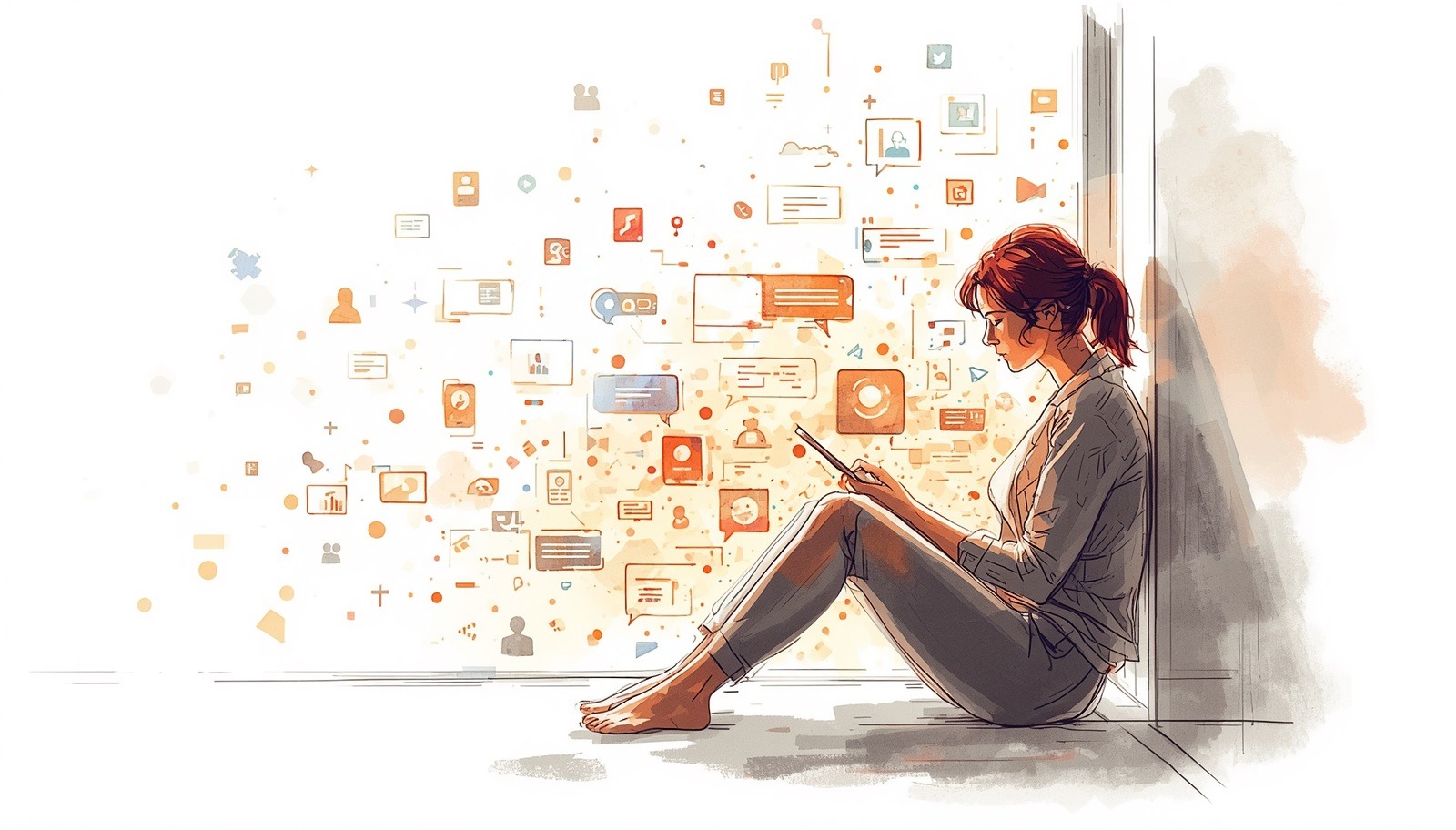
Diet culture existed long before Instagram, TikTok, YouTube, filters, fitness apps, calorie trackers, and “what I eat in a day” videos. But social media has made body comparison faster, more constant, more personalized, and more difficult to escape. The modern woman does not simply compare herself to celebrities in magazines. She compares herself to friends, strangers, influencers, edited bodies, genetically rare bodies, surgically altered bodies, algorithmically boosted bodies, and bodies presented as casual proof of discipline.
A scoping review of 50 studies across 17 countries found that social media use is associated with body image concerns, eating disorders or disordered eating, and poor mental health through pathways such as social comparison, thin/fit ideal internalization, and self-objectification. The review also noted that certain exposures, including appearance-focused platforms, trends, pro-eating-disorder content, and investment in photos, may strengthen risk, while social media literacy and body appreciation may be protective.
Food content adds another layer. “What I eat in a day” videos may look casual, but they often transform eating into a public performance. Viewers may begin comparing not only bodies, but breakfasts, portion sizes, snacks, timing, cravings, calories, restaurant choices, and perceived discipline. A 2025 review of food-related social media found that the current evidence is still mixed and developing, but it suggests a potential relationship between food-related social media, negative body image, and disordered eating.
The non-obvious harm is not always that one video “causes” disordered eating. The harm is the accumulation of tiny comparisons. A woman watches someone eat less. Then someone eat “cleaner.” Then someone “bounce back.” Then someone claim bloating is avoidable. Then someone says seed oils are poison. Then someone says fruit has too much sugar. Then someone says protein is everything. Then someone says fasting changed her life. Then someone says discipline is self-love. Eventually, the nervous system receives the same message from different costumes:
Your body cannot be trusted. Your appetite must be supervised. Your worth depends on management.
The wellness mask: When control pretends to be care
One of the most difficult things about modern diet culture is that it rarely calls itself diet culture anymore. It calls itself wellness. Gut healing. Hormone balancing. Clean living. Detoxing. Resetting. Biohacking. Anti-inflammatory living. “Becoming your highest self.” Some of these areas can include legitimate health conversations. But the cultural packaging often turns them into another version of body control, especially for women.
The problem is not caring about health. The problem is when health becomes another socially acceptable way to fear food, shrink the body, and measure moral worth. A woman may no longer say, “I am dieting.” Instead, she says, “I’m just avoiding gluten, dairy, sugar, seed oils, processed foods, late meals, snacks, carbs after 4 p.m., and anything that spikes cortisol.” Again, some people have real medical reasons for specific nutrition choices. But when the list keeps growing and fear keeps expanding, the body does not experience it as freedom. It experiences it as threat.
This is why I believe any conversation about mindful eating must include power. Mindfulness is not just chewing slowly or noticing texture. It is noticing the culture inside the choice. Am I choosing this because it supports me, or because I am afraid of being judged? Am I avoiding this food because it harms me, or because I was taught that good women are easy to approve of when they are small, controlled, and low-maintenance? Am I pursuing health, or am I trying to become untouchable?
Wellness becomes harmful when it makes women hyper-responsible for every bodily sensation. Bloating becomes failure. Fatigue becomes poor discipline. Weight change becomes moral evidence. Hunger becomes lack of planning. Cravings become emotional weakness. But bodies are not machines. They are living systems. They fluctuate. They respond to sleep, stress, menstruation, medication, trauma, illness, caregiving, grief, aging, poverty, pleasure, and safety.
A culture obsessed with female control often sells the fantasy that if a woman does everything correctly, she can avoid vulnerability. But no amount of “perfect” eating can make a human body completely predictable. The goal is not to control the body until it becomes silent. The goal is to build enough trust that the body no longer has to scream.Why “Just Listen to Your Body” Can Feel Impossible
“Listen to your body” sounds beautiful. It can also sound impossible when someone has spent years being rewarded for ignoring it. Many women have learned to override hunger, delay meals, distrust fullness, suppress cravings, and view satisfaction as dangerous. So when they first try to listen, the body may not speak in clear sentences. It may speak in confusion, urgency, numbness, fear, or extremes.
This does not mean the body is broken. It may mean the body is recovering from being interrupted.
If you have ignored hunger for years, hunger may return loudly. If you have forbidden certain foods, those foods may feel unusually magnetic at first. If you have treated fullness as failure, comfortable fullness may feel emotionally unsafe. If you have used food rules to manage anxiety, flexibility may feel like chaos. If thinness has protected you socially, eating enough may feel like risking love, approval, identity, or safety.
This is where intuitive eating is often misunderstood. It is not “eat whatever, whenever, without reflection.” It is not a new aesthetic. It is not a hunger-fullness diet. It is not a trick to lose weight. At its best, it is a process of rebuilding trust between body, mind, food, and context. Research suggests intuitive eating interventions can improve intuitive eating and support positive changes in health-related psychological outcomes, while longitudinal evidence has linked greater intuitive eating with lower odds of depressive symptoms, low self-esteem, body dissatisfaction, unhealthy weight-control behaviors, extreme weight-control behaviors, and binge eating over time.
But body trust is not built by force. It is built through repeated experiences of safety. Eating regularly. Eating enough. Eating foods that satisfy. Discovering that a craving does not have to become a crisis. Discovering that fullness is not a moral emergency. Discovering that a body can change and still belong to you.
Table 2: Why body cues become hard to hear

Relearning body cues may require patience, structure, therapy, dietetic support, or eating disorder treatment. This is especially true if restriction, bingeing, purging, compulsive exercise, fear foods, or obsessive body checking are present. There is no shame in needing support. The shame belongs to the culture that made support feel necessary and then told people to fix themselves alone.
Weight stigma makes eating “normally” harder, not healthier
One of the most persistent myths in our culture is that shame motivates people into health. The evidence does not support this simple story. Weight stigma is associated with disordered eating cognitions and behaviors, including binge eating, body dissatisfaction, dietary restraint, unhealthy weight-control behaviors, and drive for thinness. A 2024 systematic review found a consistent relationship between greater weight stigma and more disordered eating outcomes across 242 included articles.
Weight stigma does not only affect people in larger bodies, although they are targeted most directly and structurally. It affects the entire eating environment. When everyone knows that gaining weight may lead to judgment, disrespect, medical dismissal, dating discrimination, workplace bias, family comments, and social humiliation, food becomes emotionally loaded. Eating enough may feel risky because weight gain is not treated neutrally. It is treated like social failure.
This is why “body positivity” alone is not enough. A woman can repeat affirmations in the mirror, but if her doctor dismisses her symptoms because of weight, if clothing stores exclude her, if online comments mock bodies like hers, if family members praise restriction, if workplace wellness programs reward weight loss, then the problem is not only internal. It is structural.
The more stigmatized weight becomes, the more eating becomes surveillance. People begin eating for the imagined court of public opinion: What would they think if they saw this plate? Would a “healthy” person eat this? Would a thin person stop now? Would a disciplined person order dressing on the side? Would I be treated differently if my body changed?
That is not health. That is fear dressed as responsibility.
The hidden grief beneath food anxiety
Food anxiety is not always about food. Sometimes it is grief. Grief for the years spent counting instead of tasting. Grief for celebrations spent negotiating with guilt. Grief for photos deleted, swimsuits avoided, meals skipped, vacations controlled, hunger ignored, and pleasure postponed until the body became “acceptable.” Grief for the younger self who learned that being loved might require being smaller.
I think this grief deserves more attention. Many women do not only need nutrition education. They need mourning space. They need to name what diet culture took from them: spontaneity, cultural foods, family meals, sensuality, trust, mental energy, body neutrality, social ease, and the quiet dignity of eating without needing to explain.
The grief can be especially intense when a woman realizes that the promised body did not deliver the promised life. Maybe she became smaller and still felt anxious. Maybe she became “healthier” and more isolated. Maybe she followed all the rules and still did not feel worthy. Maybe she spent years trying to earn peace through control, only to discover that peace does not live at the end of another body project.
This is where the work becomes deeper than “stop dieting.” It becomes identity work. Who am I if I am not the disciplined one? Who am I if I eat the bread? Who am I if my body changes? Who am I if I stop chasing the version of myself that culture keeps rewarding? Who am I if I let my appetite be part of my humanity instead of evidence against it?
A new framework: From control-based eating to relationship-based eating
Instead of asking, “How do I control my eating?” I prefer a more revealing question: “What kind of relationship am I building with myself through the way I eat?”
Control-based eating asks the body to obey. Relationship-based eating asks the body to communicate. Control-based eating is built on suspicion. Relationship-based eating is built on curiosity. Control-based eating often begins with an external rule. Relationship-based eating begins with context: What is happening in my life? What does my body need? What would satisfy me? What is available? What matters today?
This does not mean every meal becomes a deep spiritual practice. Sometimes dinner is just dinner. Sometimes food is practical. Sometimes it is imperfect. Sometimes you eat in the car, eat leftovers, eat cereal, eat emotionally, eat socially, eat quickly, eat late, eat what is affordable, or eat what your energy allows. Relationship-based eating makes room for real life.
Here is the shift:
From “How do I stay in control?” → to “How do I stay connected?”
From “What am I allowed to eat?” → to “What would nourish and satisfy me?”
From “Will this change my body?” → to “How will this support my life today?”
From “I ruined everything” → to “One meal is not a moral event.”
From “I need rules” → to “I can build trust through practice.”
Table 3: Control-based eating vs. relationship-based eating

This is not a quick fix. It is a different philosophy. And in a culture obsessed with female control, choosing relationship over control can feel quietly radical.
What “eating normally” can actually mean
A more compassionate definition of normal eating might sound like this: eating enough, eating with flexibility, eating with pleasure, eating with respect for your body’s needs, eating without constant moral judgment, and being able to move on with your life afterward.
Normal eating does not mean you never eat emotionally. Humans are emotional. Food is connected to memory, care, culture, comfort, and celebration. The question is not “Do I ever use food emotionally?” The question is whether food is your only coping tool, whether shame follows, whether you feel out of control, and whether your emotional needs are being ignored outside of eating.
Normal eating does not mean you never care about nutrition. It means nutrition is one part of care, not a weapon. Gentle nutrition can ask, “What helps me feel steady?” instead of “What makes me smaller?” It can include protein, fiber, hydration, regular meals, and medical needs without turning every bite into a morality exam.
Normal eating does not mean you always love your body. Body love can feel inaccessible for many people, especially those living with trauma, chronic illness, disability, dysphoria, weight stigma, racialized beauty standards, aging anxiety, or eating disorder recovery. Body neutrality may be a more realistic bridge: I do not have to adore my body to feed it. I do not have to feel beautiful to deserve breakfast. I do not have to feel confident to stop punishing myself.
Normal eating also does not mean ignoring social injustice. Food choices are shaped by money, work schedules, caregiving, culture, disability, geography, trauma, time, and access. A mindful conversation about food must be honest about this. It is not mindful to tell overwhelmed women to “just cook whole foods” without acknowledging labor, class, burnout, and the unequal burden of domestic care.
A gentle practice: The three-layer check-in
Because this article belongs in Mindful Reads, I want to offer a practice that is reflective rather than prescriptive. This is not a diet tool. It is a way to interrupt the automatic control script and return to curiosity.
Before or after a meal, ask yourself three layers of questions.
Layer 1: Body
What physical cues are present? Hunger, fullness, tension, fatigue, thirst, nausea, energy, comfort, discomfort? Can I notice them without immediately judging them?
Layer 2: Emotion
What feeling is near this food moment? Anxiety, pleasure, guilt, loneliness, rebellion, sadness, excitement, numbness, pressure? Is the feeling actually about the food, or did the food simply reveal it?
Layer 3: Culture
What rule or outside voice is speaking here? Is it a parent’s comment, an influencer’s routine, a doctor’s dismissiveness, a partner’s preference, a beauty standard, a fear of being judged, or an old diet rule?
Then add one final question: What would care look like now?
Sometimes care is eating more. Sometimes it is stopping. Sometimes it is adding something satisfying. Sometimes it is deleting a triggering account. Sometimes it is making an appointment with a therapist or dietitian. Sometimes it is texting a friend instead of spiraling alone. Sometimes it is saying, “I am allowed to eat even while I am still learning.”
This practice matters because it widens the frame. Food anxiety wants to shrink the moment down to one question: “Was I good or bad?” Mindfulness expands it: “What is happening in me, around me, and to me?”
When eating feels hard, these signs deserve support
Because diet culture normalizes so many harmful behaviors, it can be difficult to know when a struggle has become serious. Support may be especially important if thoughts about food, weight, body size, or exercise take up significant mental space; if you regularly skip meals to compensate; if you feel intense guilt after eating; if you binge or feel loss of control; if you purge, misuse laxatives, or exercise as punishment; if your food rules keep expanding; if you avoid social events because of food; or if your self-worth rises and falls with the scale.
The DSM-5-TR describes feeding and eating disorders as persistent disturbances in eating or eating-related behavior that alter food consumption or absorption and significantly impair physical health or psychosocial functioning (American Psychiatric Association). But a person does not need to “look sick,” be underweight, or meet a stereotype to deserve help. Eating disorders and disordered eating can affect people across body sizes, ages, races, genders, and backgrounds. In fact, many people with eating disorders are not medically underweight, and weight-based assumptions can delay care.
The most loving thing I can say here is this: you do not have to wait until it is “bad enough.” If food feels frightening, obsessive, punishing, or emotionally consuming, that is enough reason to seek support. You are allowed to want a life where meals do not feel like trials.
The quiet rebellion of feeding Yourself
In a culture obsessed with female control, feeding yourself can become a form of rebellion. Not loud rebellion, necessarily. Sometimes it looks like eating breakfast even when your mind says you should “save calories.” Sometimes it looks like ordering what you actually want. Sometimes it looks like refusing to discuss diets at the table. Sometimes it looks like unfollowing accounts that make you abandon yourself. Sometimes it looks like wearing clothes that fit your current body instead of punishing yourself with discomfort. Sometimes it looks like choosing recovery even when part of you misses the praise that came with control.
This rebellion is not about giving up on health. It is about refusing to define health as obedience to body hierarchy. It is about remembering that a woman’s body is not a résumé. It is not a public apology. It is not a productivity tool. It is not a before picture waiting for permission to become worthy.
Food can become ordinary again. Not instantly. Not perfectly. But slowly, through repeated acts of trust. A meal can become a meal. Hunger can become information. Fullness can become tolerable. Pleasure can become allowed. The body can become a home rather than a project under review.
And maybe the most powerful shift is this: instead of trying to eat in a way that proves you are controlled, you can begin eating in a way that proves you are cared for.
You were never meant to live at war with appetite
Eating “normally” feels hard because women are not only eating food. They are often eating under surveillance, under inherited rules, under beauty standards, under wellness pressure, under weight stigma, under social comparison, and under the old belief that a controlled woman is a better woman.
But appetite is not a flaw. Hunger is not a weakness. Fullness is not a failure. Pleasure is not irresponsibility. Your body is not a public project. Your plate does not need to prove your worth.
The way forward is not another stricter rule. It is a slower return to trust. Trust that your body is allowed to need. Trust that care does not have to look like control. Trust that food can be nourishing without being morally pure. Trust that you can be a thoughtful, loving, intelligent, self-respecting person and still eat the bread, need the snack, enjoy the dessert, change your body, and take up space.
A culture obsessed with female control may never hand women permission to eat freely, live fully, and belong to themselves. So perhaps the work is to stop waiting for permission.
Perhaps the work begins here:
I am allowed to eat.
I am allowed to need.
I am allowed to be more than a body under control.
Related posts You’ll love
- Stop treating Your face like a problem: Gentle 25 mantras for body trust, soft confidence, and real self compassion
- Body privacy is a mental health need: How to stop explaining Your weight, Your diet, and Your choices
- Ozempic honesty anxiety: Why Women feel forced to confess (and how to reclaim Your body privacy)
- Letter to my body: The beautiful breakthrough that ends the evidence trap for good
- The “wrongness” detox: 7 considerate, research guided practices to unlearn beauty shame without forcing body positivity
- What secure love feels like in the body: The somatic signature of safety for Women who are used to tension
FAQ
-
Why does eating normally feel so hard for many women?
Eating normally can feel hard because many women are raised in a culture that moralizes food, praises body control, stigmatizes weight gain, and teaches women to monitor their bodies from the outside. Over time, hunger, fullness, cravings, and satisfaction can become tangled with shame, fear, and social approval.
-
What does “normal eating” actually mean?
Normal eating is flexible, adequate, satisfying, and realistic. It allows for nutrition, pleasure, culture, convenience, emotion, and changing life circumstances. It does not require perfection, constant balance, or total freedom from complicated feelings.
-
Is diet culture the same as dieting?
Not exactly. Dieting is usually an individual behavior, while diet culture is the larger belief system that glorifies thinness, moralizes food, links body size to worth, and frames control as virtue. Diet culture can appear in wellness, fitness, medical, beauty, and social media spaces.
-
Why do I feel guilty after eating “bad” foods?
Guilt often comes from learned food morality. If certain foods have been labeled as bad, dirty, fattening, addictive, or shameful, eating them can trigger emotional threat even when the food itself is not harmful in that moment.
-
Can healthy eating become unhealthy?
Yes. Health-supporting choices can become harmful when they are driven by fear, rigidity, obsession, punishment, or social withdrawal. A pattern that reduces mental peace, flexibility, nourishment, or connection may deserve compassionate attention.
-
Why do “what I eat in a day” videos affect me so much?
These videos can invite comparison around portions, food choices, body size, discipline, and lifestyle. Even when they seem casual, they can make eating feel like a performance and encourage viewers to judge their own meals against someone else’s edited snapshot.
-
Is intuitive eating just eating whatever you want?
No. Intuitive eating is often misunderstood. It includes hunger, fullness, satisfaction, body respect, emotional awareness, and gentle nutrition. It is not a weight-loss method or an excuse to ignore health; it is a framework for rebuilding trust with food and the body.
-
What if I cannot hear my hunger and fullness cues?
That is common, especially after years of dieting, stress, trauma, restriction, chaotic eating, or body distrust. Regular meals, professional support, and a nonjudgmental approach can help rebuild awareness over time.
-
Does rejecting diet culture mean rejecting health?
No. Rejecting diet culture means rejecting shame, body hierarchy, and moralized control. Health can still include nourishment, movement, sleep, medical care, emotional support, pleasure, and sustainable habits.
-
When should I seek professional help?
Consider support if food or body thoughts feel obsessive, if you restrict, binge, purge, overexercise, avoid social eating, feel intense guilt after meals, or feel that your worth depends on your body size. You do not need to wait until you meet a stereotype or crisis point.
-
How can I start making peace with food?
Start by noticing food rules without immediately obeying them. Eat regularly, include satisfying foods, reduce triggering comparison content, practice body neutrality, and seek eating-disorder-informed support if the process feels overwhelming. Peace with food is not a single decision; it is a relationship rebuilt through repeated safety.
Sources and inspirations
- American Psychiatric Association. (2022). Diagnostic and statistical manual of mental disorders (5th ed., text rev.). American Psychiatric Association Publishing.
- Babbott, K. M., Cavadino, A., Brenton-Peters, J., Consedine, N. S., & Roberts, M. (2023). Outcomes of intuitive eating interventions: A systematic review and meta-analysis. Eating Disorders.
- Dane, A., & Bhatia, K. (2023). The social media diet: A scoping review to investigate the association between social media, body image and eating disorders amongst young people. PLOS Global Public Health.
- Galmiche, M., Déchelotte, P., Lambert, G., & Tavolacci, M. P. (2019). Prevalence of eating disorders over the 2000–2018 period: A systematic literature review. The American Journal of Clinical Nutrition.
- Hazzard, V. M., Telke, S. E., Simone, M., Anderson, L. M., Larson, N. I., & Neumark-Sztainer, D. (2020). Intuitive eating longitudinally predicts better psychological health and lower use of disordered eating behaviors: Findings from EAT 2010–2018. Eating and Weight Disorders.
- Jaeger, T., & Jovanovski, N. (2024). “People need to be valued because of who they are”: Self-conception and strategies of resistance in women who challenge weight-loss diet culture. Feminism & Psychology.
- Jovanovski, N., & Jaeger, T. (2022). Demystifying “diet culture”: Exploring the meaning of diet culture in online “anti-diet” feminist, fat activist, and health professional communities. Women’s Studies International Forum.
- Levinson, J. A., Kinkel-Ram, S. S., Myers, B., & Hunger, J. M. (2024). A systematic review of weight stigma and disordered eating cognitions and behaviors. Body Image.
- López-Gil, J. F., García-Hermoso, A., Smith, L., Firth, J., Trott, M., Mesas, A. E., Jiménez-López, E., Gutiérrez-Espinoza, H., Tárraga-López, P. J., & Victoria-Montesinos, D. (2023). Global proportion of disordered eating in children and adolescents: A systematic review and meta-analysis. JAMA Pediatrics.
- Roorda, B. A., & Cassin, S. E. (2025). A review of food-related social media and its relationship to body image and disordered eating. Nutrients.
- Schaefer, L. M., & Thompson, J. K. (2018). Self-objectification and disordered eating: A meta-analysis. International Journal of Eating Disorders.
Leave a Reply