Table of Contents
We are connected everywhere, yet many Women still feel far from themselves
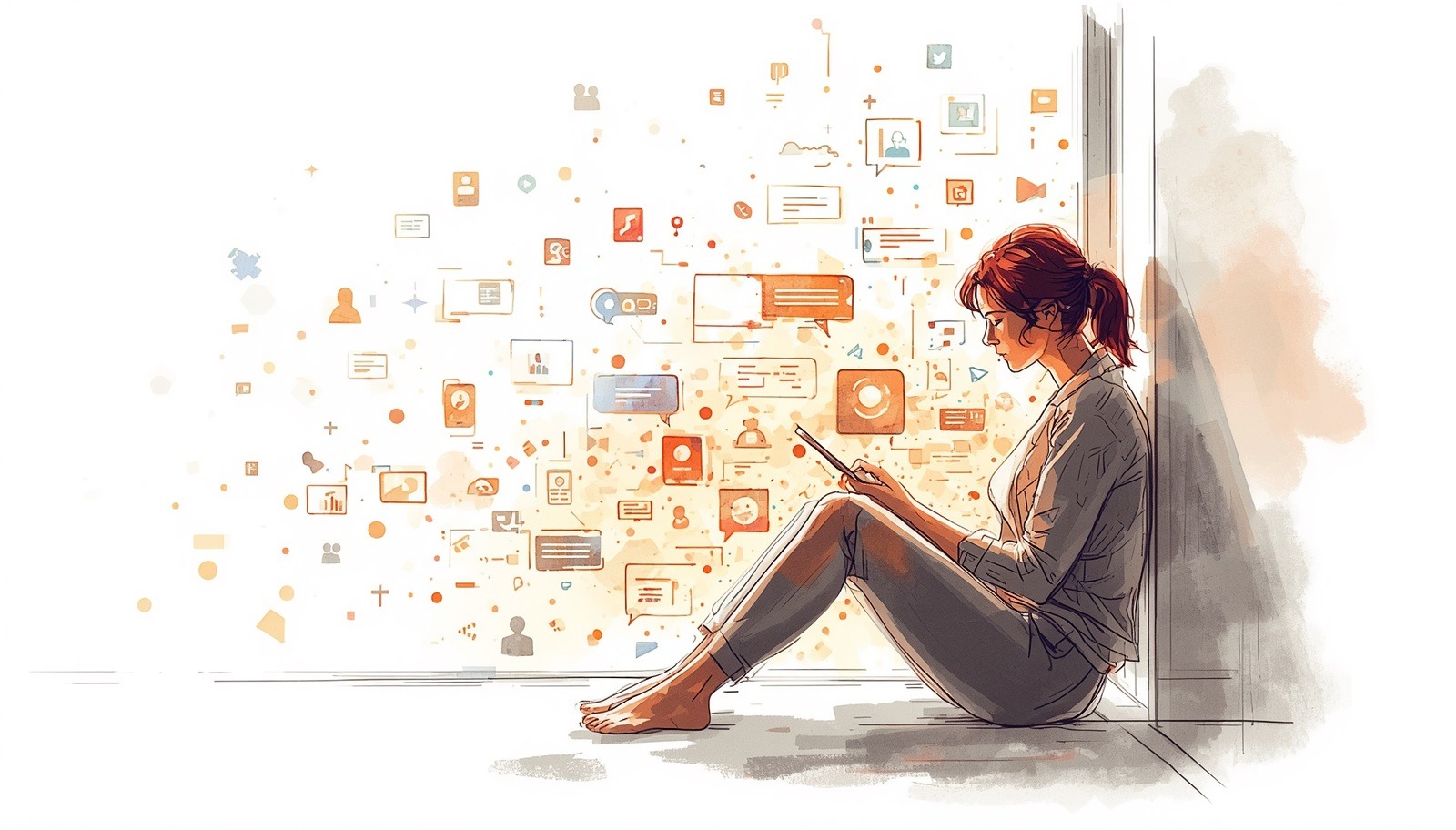
There is a strange kind of tiredness that many modern women know well. It does not always look dramatic. It can look like answering messages while making coffee, listening to a podcast while walking, checking emails before the body has fully woken up, saving healing posts that never get practiced, and feeling guilty for needing space even when no one has technically asked for anything. From the outside, life may look full, responsive, informed, and socially active. Inside, however, there can be a quiet ache: “Why do I feel so far away from myself when I am connected to everything?”
I think this question matters deeply for women, especially in a world where connection has become almost constant. A woman can be available to her workplace, family, friends, social media audience, private messages, group chats, news alerts, wellness advice, online communities, and emotional labor threads before she has even asked herself how she feels. Hyper-connection promises closeness, but without deeper quiet, it often becomes another form of noise. It gives us contact without always giving us communion. It gives us updates without always giving us understanding. It gives us information without always giving us integration.
This article is not anti-technology. It is not a romantic call to disappear into the woods, delete every app, or become unreachable. Digital connection can be supportive, educational, creative, and even lifesaving. Research shows that online spaces may offer mental health benefits, social support, identity affirmation, and access to resources for people who might otherwise feel alone. The problem is not connection itself. The problem is connection without recovery, stimulation without reflection, visibility without privacy, and constant input without a sacred inner pause.
For women, this matters because the nervous system is not designed to be permanently available. Attention is not infinite. Emotional energy is not endlessly renewable just because the phone keeps lighting up. And self-love cannot grow in a life where every quiet moment is immediately filled with someone else’s voice, request, opinion, highlight reel, crisis, advice, or expectation.
Deeper quiet is the missing layer. It is not merely silence. It is not merely “me time.” It is not just turning off notifications for an hour. Deeper quiet is a state of returning. It is the space where your body stops bracing for the next interruption. It is where your thoughts become audible again. It is where your emotions stop performing and start speaking honestly. It is where you remember that being reachable is not the same as being connected, and being informed is not the same as being nourished.
The new feminine exhaustion: Not just busy but continuously reachable
Many women are not only tired because they have too much to do. They are tired because they are too reachable while doing it. There is a difference. A long day of meaningful work can be tiring, but a long day of fragmented attention can feel like being mentally pulled apart. Every notification, message, update, and micro-demand asks the brain to shift focus. Even when the interruption is small, the cumulative effect can feel like emotional static.
Studies on smartphone notifications suggest that notification sounds can affect attention and cognitive control, even when we do not fully engage with the device. This matters because women often carry multiple invisible channels of responsibility at once: professional responsiveness, family coordination, social care, household planning, emotional support, wellness maintenance, and self-improvement. Hyper-connection does not simply add more information. It multiplies the number of doors through which people can enter a woman’s attention.
The modern woman may be expected to be professionally ambitious, emotionally intelligent, physically well, socially aware, politically informed, aesthetically presentable, digitally responsive, relationally available, and self-healing — all at the same time. No wonder quiet can feel radical. No wonder a few minutes without input may initially feel uncomfortable. When constant connection becomes the norm, quiet can feel like withdrawal, laziness, loneliness, or even danger.
But deeper quiet is not absence. It is a form of presence that the hyper-connected world rarely rewards.
What is “deeper quiet”?
Deeper quiet is not simply the absence of sound. A woman can sit in a silent room and still feel crowded inside by comparison, worry, imagined conversations, unfinished tasks, old shame, and digital residue. True quiet is deeper than volume. It is a shift from outer demand to inner listening.
I define deeper quiet as a restorative state in which your body, attention, and emotions are no longer being managed for an audience. It is a space where you are not producing, proving, replying, absorbing, comparing, explaining, or optimizing. You are allowed to exist without becoming content, service, performance, or solution.
This kind of quiet has layers. At the surface, it may begin with turning off the phone, sitting without music, walking without earbuds, journaling before checking messages, or eating without scrolling. But the deeper layer is psychological: you stop outsourcing your sense of reality to the digital world. You ask, “What do I know before I ask everyone else?” You ask, “What do I feel before I translate it into something acceptable?” You ask, “What is my body saying beneath my habits?”
Research on solitude suggests that time alone can help regulate high-arousal emotions and support calmer emotional states, especially when solitude is chosen rather than forced. This is an important distinction. Deeper quiet is not loneliness. Loneliness feels like disconnection against your will. Deeper quiet feels like chosen reconnection with yourself.
The hyper-connection loop: How digital life slowly occupies the inner room
Hyper-connection often starts innocently. You check one message. Then one notification. Then one post. Then a news headline. Then someone’s life update. Then a healing video. Then a comment section. Suddenly, your mind is holding ten emotional climates that are not yours. You have absorbed a friend’s anxiety, a stranger’s success, a creator’s advice, a global crisis, a beauty standard, a productivity tip, and a reminder that you are supposedly behind in life.
This is not weakness. It is exposure.
The brain and body respond to what they repeatedly consume. Social media research is complex and not one-sided, but several studies indicate that certain patterns of use are associated with loneliness, depressive symptoms, social comparison, and lower well-being, especially when use becomes passive, compulsive, or emotionally dysregulating.
For women, the digital world can become especially loaded because so much online content is relational, visual, aspirational, and identity-based. It does not merely say, “Look at this.” It often implies, “Measure yourself against this.” Your body, home, healing journey, relationship status, morning routine, career pace, emotional maturity, friendships, and femininity can all become comparison material. Even self-care content can become another standard to fail.
Table 1: The hyper-connection loop and the deeper quiet response

The loop is powerful because it disguises itself as connection, productivity, learning, or emotional support. But deeper quiet asks a different question: “Is this input helping me become more present, or is it pulling me away from my own center?”
Why Women often need quiet differently
Women do not need deeper quiet because they are fragile. They need it because many are trained to be porous. From a young age, girls are often socialized to notice moods, maintain harmony, anticipate needs, soften discomfort, stay likable, and keep relational bridges intact. Even when a woman becomes independent and accomplished, her nervous system may still carry the old training: scan the room, read the tone, answer kindly, do not disappoint, do not be too much, do not disappear.
Digital life intensifies this. The “room” is now endless. There is always another tone to read, another message to interpret, another person’s emotional state to consider, another comment to decode, another social cue to manage. Women are not only consuming information; many are emotionally metabolizing it.
Research has found gender differences in associations between social media interaction and well-being among young people, with some findings suggesting that girls may be more vulnerable to certain negative well-being pathways related to social media use. While we should not overgeneralize from adolescent data to all adult women, these patterns point toward something culturally recognizable: digital environments can amplify comparison, relational pressure, body image concerns, and emotional exposure.
The deeper issue is that many women have been taught to feel responsible for connection but not equally entitled to restoration. They are praised for responding, supporting, checking in, remembering birthdays, sending resources, noticing silence, and holding emotional nuance. But when they need quiet, they may feel selfish.
This is why deeper quiet must be reframed as self-respect, not withdrawal.
The difference between shallow quiet and deeper quiet
Not all quiet restores us. Sometimes we turn everything off but continue mentally arguing, rehearsing, comparing, planning, or shaming ourselves. Sometimes we call it rest, but we are still performing rest in a way that can be photographed, tracked, or optimized. Deeper quiet asks for something more honest.
Shallow quiet says: “I am not making noise.”
Deeper quiet says: “I am no longer abandoning myself.”
Shallow quiet may be a clean room, candles, soft music, and a phone on silent. These can help. But deeper quiet is what happens when your inner life finally has permission to be uncensored. You can feel resentment without immediately spiritualizing it. You can notice exhaustion without turning it into a productivity problem. You can admit loneliness without blaming yourself for not being grateful enough. You can hear desire before editing it into something acceptable.
Table 2: Three layers of quiet

Deeper quiet often begins where distraction ends. That is why it can feel uncomfortable at first. When the noise stops, the unprocessed parts of life may step forward. You may notice how tired you are. You may feel grief you were outrunning. You may realize that your online life has been feeding a version of you that your real life cannot sustain. This does not mean quiet is failing. It means quiet is working.
Deeper quiet and the nervous system: Why “calm” cannot be forced
A hyper-connected woman may try to relax while her body is still waiting for the next alert. She may sit down, close her eyes, and wonder why she cannot instantly feel peaceful. But calm is not a command. It is a condition the body learns to trust.
The nervous system becomes shaped by repetition. If your day repeatedly teaches your body that any moment can be interrupted, your body may begin to anticipate interruption even during rest. This is one reason quiet must be practiced gently. You are not just changing a habit; you are teaching your body that it is safe to stop scanning.
Mindfulness research suggests that present-moment awareness is associated with mental health outcomes, though the mechanisms and effects vary across people and contexts. Meditation and mindfulness-based interventions also show promise in reducing loneliness, though researchers note variation in study quality and outcomes. For the everyday woman, the practical takeaway is simple: the body often needs repeated experiences of undemanding presence before it believes that rest is allowed.
This is where deeper quiet becomes more than silence. It becomes a relationship with your own body.
Try noticing the difference between “quiet as discipline” and “quiet as safety.” Discipline says, “I must meditate perfectly.” Safety says, “I can sit here for three minutes and let my shoulders drop.” Discipline says, “I failed because my mind wandered.” Safety says, “My mind wandered because it is human; I can return.” Discipline says, “I should be calm by now.” Safety says, “My body is learning.”
A woman who has lived in constant responsiveness may not need harsher routines. She may need softer repetition.
The quiet deficit: Signs You need deeper quiet, not more advice
One of the most confusing parts of modern self-care is that women often reach for more input when what they actually need is integration. You may save another post, buy another journal, listen to another expert, follow another healing account, or search another question — not because the advice is bad, but because the mind is trying to solve emotional overload with more information.
But sometimes the next layer of healing is not more content. It is digestion.
You may need deeper quiet if you feel emotionally full but spiritually undernourished. You may need deeper quiet if you know the language of healing but struggle to feel your own needs in real time. You may need deeper quiet if your first instinct during discomfort is to reach for your phone, ask someone else, research the feeling, distract yourself, or turn your pain into a productivity plan.
You may need deeper quiet if your life is connected but not intimate. If you are surrounded by messages but rarely feel truly seen. If you are informed but not grounded. If your attention is everywhere, but your presence is nowhere.
And perhaps most tenderly: you may need deeper quiet if you miss yourself.
The “inner room” practice: A new way to think about quiet
Here is a metaphor I often return to: every woman has an inner room. This room is where her real voice lives. It holds her intuition, grief, desire, anger, creativity, tenderness, memory, and private knowing. In a healthy life, people may visit the doorway of this room. Loved ones may be invited in. Work may influence it. Community may nourish it. But the room still belongs to her.
Hyper-connection leaves the door open all day.
Messages walk in. Opinions walk in. Trends walk in. Other people’s emergencies walk in. The algorithm walks in. Old comparisons walk in wearing new outfits. Eventually, the woman may stand in her own inner room and realize there is no place left to sit.
Deeper quiet is the act of clearing the room.
Not violently. Not forever. Just enough to ask: “What belongs here?”
What is mine?
What is inherited?
What is urgent?
What is only loud?
What is true?
What is asking for care?
This is an unconventional but powerful self-love practice: treat your attention like a sacred room, not a public hallway.
Deeper quiet is not isolation
Because loneliness is real, we need to be careful. Deeper quiet should not become emotional avoidance, social withdrawal, or a way to disappear when support is needed. Human connection is essential. Public health reports have emphasized that social disconnection and loneliness are associated with significant mental and physical health risks. The goal is not to become less connected. The goal is to become more truthfully connected.
Deeper quiet actually improves connection because it helps you return to others with less resentment and more presence. When you have had time to hear yourself, you are less likely to expect other people to decode needs you have not admitted. You are less likely to confuse constant contact with emotional safety. You are less likely to say yes from depletion or no from panic. Quiet gives your relationships a cleaner signal.
A woman who practices deeper quiet may become less instantly available, but more genuinely present. That is not disconnection. That is relational maturity.
The digital detox myth: Why quitting everything is not always the answer
A lot of digital wellness advice sounds extreme: delete the apps, disappear for thirty days, never check your phone in the morning, block everything, become minimalist, reject modern life. For some women, strong boundaries may be necessary. But for many, all-or-nothing digital detoxing does not address the deeper pattern.
A 2023 systematic review found that social media interventions had mixed effects on adult mental well-being, with therapy-based approaches often appearing more effective than simple restriction or full abstinence. A 2024 meta-analysis on digital social media detox interventions found significant effects for reducing depressive symptoms, but not statistically significant effects for some broader outcomes such as life satisfaction, stress, or overall mental well-being.
This matters because the problem is not only screen time. It is screen relationship.
A woman can spend less time online and still compare herself intensely. She can delete one app and transfer the same anxiety to another. She can take a weekend offline and return to the same over-availability pattern on Monday. Deeper quiet asks not only, “How much do I use technology?” but also, “What role has technology taken in my emotional life?”
- Does it soothe you or stimulate you?
- Does it connect you or scatter you?
- Does it inform you or invade you?
- Does it support your values or hijack your attention?
- Does it help you feel more human or more performative?
The goal is not digital purity. The goal is inner sovereignty.
A gentle framework: The 5 doors into deeper quiet
Instead of treating quiet like a punishment or luxury, we can treat it as a homecoming. These five doors are practical ways to enter deeper quiet without making your life unrealistic.
1. The door of sensation
Begin with the body because the body lives in the present. Put one hand on your chest. Feel your feet. Notice the temperature of the room. Drink water slowly. Walk without audio for ten minutes. Let your senses become louder than your thoughts.
This is powerful because hyper-connection often pulls women upward into the head: analyzing, comparing, anticipating, responding. Sensation brings you back down into lived experience. You are not a profile, role, inbox, or image. You are a breathing body.
2. The door of delayed response
Choose one non-urgent message and do not answer immediately. Notice what happens inside. Do you feel guilt? Fear? A need to explain? A belief that you are being rude? This tiny delay can reveal your availability pattern.
Delayed response teaches the nervous system that love, respect, and belonging do not require instant access to you. It also teaches others that your attention has boundaries.
3. The door of unshared beauty
Experience something beautiful without posting it, photographing it, or turning it into a story. A sky. A meal. A candle. Your own face in soft morning light. A sentence in a book. Let beauty complete itself inside you.
This is a quiet rebellion. In a world that converts experience into content, unshared beauty protects intimacy with life.
4. The door of emotional sorting
At the end of the day, ask: “What did I absorb today that was not mine?” Then write three words. Maybe: panic, comparison, urgency. Then ask: “What was actually mine?” Maybe: fatigue, longing, tenderness.
This practice helps women stop carrying emotional noise as identity. Not everything you feel began with you.
5. The door of sacred nothing
For five minutes, do nothing useful. No breathwork goal. No journaling prompt. No educational audio. No productivity. Just sit, lie down, stare at the wall, look out a window, or let your tea cool in your hands.
At first, this may feel strange. But sacred nothing is where the soul stops being managed.
Table 3: A 14-day deeper quiet reset for hyper-connected Women

This reset is not about perfection. Missing a day is not failure. The deeper purpose is to become curious about how your inner world changes when you stop letting every empty space be colonized by input.
Why deeper quiet can feel threatening at first
Many women discover that quiet brings discomfort before relief. This is normal. Noise can become a coping strategy. If you have used constant connection to avoid loneliness, grief, uncertainty, resentment, boredom, or desire, then quiet may initially feel like standing in a room with everything you postponed.
This does not mean you should force yourself into overwhelming silence. Trauma-informed self-care matters. If quiet brings intense distress, panic, intrusive memories, or emotional flooding, it may be wise to practice with grounding, therapeutic support, or gentle structure. Deeper quiet should not become a place where you abandon yourself again.
Start small. One minute counts. A quiet hand on the heart counts. Turning off one notification counts. Looking out the window before replying counts. Leaving your phone in another room while showering counts. The nervous system often trusts change when it comes in doses.
Quiet does not have to be dramatic to be healing.
How deeper quiet rebuilds self-trust
Self-trust does not appear magically. It grows when you repeatedly listen to yourself and act in alignment with what you hear. Hyper-connection can weaken self-trust because it trains you to check externally before sensing internally. What do they think? What does the internet say? What is everyone doing? Is this normal? Am I behind? Should I feel differently?
Deeper quiet reverses the direction.
Instead of moving outward first, you move inward first. You can still seek advice. You can still learn. You can still ask for support. But you do not abandon your own knowing at the first sign of uncertainty.
This is especially important in self-love work. Self-love is not just speaking kindly to yourself. It is believing that your inner signals deserve attention. Hunger, fatigue, grief, irritation, joy, envy, tenderness, and longing are not inconveniences. They are information.
When women practice deeper quiet, they often begin to notice patterns earlier. “I am not angry; I am overstimulated.” “I am not lazy; I am depleted.” “I do not need another opinion; I need sleep.” “I am not jealous; I am craving creative expression.” “I am not antisocial; I need a slower form of connection.”
That kind of clarity is difficult to access in constant noise.
Quiet as feminine power, not disappearance
There is a cultural misunderstanding that quiet women are passive, and loud visibility is the only proof of confidence. But deeper quiet is not passivity. It can be one of the strongest forms of feminine power because it interrupts the economy of extraction.
A woman in deeper quiet is harder to manipulate through urgency. She is less available to comparison. She is less likely to confuse attention with affection. She is harder to rush into choices that betray her. She becomes more intimate with her body, more honest about her limits, and more discerning about what deserves access to her energy.
This is not about becoming cold. It is about becoming clear.
The hyper-connected world benefits when women are constantly reachable, emotionally responsive, visually available, and endlessly self-optimizing. Deeper quiet says: I am not an open tab. I am a living being. I do not need to be constantly witnessed to be real. I do not need to answer immediately to be loving. I do not need to consume every voice to be wise.
That is power.
Creating a calm space that supports deeper quiet
Because this article belongs in Calm Space, let’s make the idea practical. A calm space does not need to be expensive, aesthetic, or large. It simply needs to communicate to your body: nothing is being demanded from you here.
Your calm space might be one chair near a window. A corner of the bedroom. A bathroom ritual. A walking route. A blanket. A notebook. A morning cup. A candle you do not photograph. The key is repetition. When you return to the same quiet cue again and again, the body begins to associate it with safety.
Try building your calm space around the senses:
Sight → fewer visual demands, soft light, one meaningful object.
Sound → silence, nature sounds, or one calming track without lyrics.
Touch → blanket, warm mug, hand on heart, comfortable clothing.
Smell → lavender, cedar, citrus, clean air, or simply no scent.
Time → a protected beginning and ending so quiet feels contained.
The goal is not to escape your life. The goal is to create a small sanctuary inside it.
What deeper quiet teaches about real connection
After practicing deeper quiet, some women notice that certain connections feel different. Some feel warmer. Some feel thinner. Some feel more reciprocal. Some were held together mostly by habit, guilt, or instant access.
This can be revealing. When you are no longer constantly numbing or scattering yourself, you may notice who truly nourishes your nervous system and who repeatedly dysregulates it. You may notice where you perform emotional availability. You may notice which conversations leave you feeling more human and which leave you feeling consumed.
Deeper quiet does not make you less relational. It makes your relationships more honest.
You may begin saying things like:
- “I need to respond tomorrow when I have more capacity.”
- “I care about you, and I also need quiet tonight.”
- “I am not available for this conversation right now.”
- “I want connection, but I need it slower.”
- “I need support, not more advice.”
- “I need to hear myself before I decide.”
These sentences are not walls. They are doors with handles.
The quiet You need is not empty — it is full of You
Hyper-connected women do not need deeper quiet because connection is bad. They need deeper quiet because connection without self-contact becomes noise. They need it because the body cannot soften while constantly bracing for the next message. They need it because the soul cannot speak clearly when every silence is filled. They need it because being available to everyone while unavailable to yourself is not love. It is depletion dressed as goodness.
Deeper quiet is where a woman returns to her own signal.
It is where she remembers that her worth does not depend on response time. Her beauty does not need public confirmation. Her healing does not need to be constantly consumed as content. Her intuition does not need a committee. Her rest does not need to be earned through collapse.
In a world that asks women to stay visible, reachable, informed, optimized, and emotionally fluent, deeper quiet is a sacred refusal. It says: I will not let the noise decide who I am. I will not confuse constant contact with true belonging. I will not abandon my inner room just because the world keeps knocking.
The quiet you need is not empty.
It is full of your breath, your truth, your body, your timing, your grief, your softness, your boundaries, your becoming.
And perhaps the most healing thing a hyper-connected woman can do is not to disconnect from life, but to reconnect with herself so deeply that every connection after that becomes more honest.
Related posts You’ll love
- Why mental noise feels louder at night: The science of racing thoughts, nighttime anxiety, and how to quiet Your mind
- Camera culture is quietly damaging how Women experience themselves
- What femininity feels like when no one is watching: The quiet psychology of authentic feminine energy
- Intermittent kindness is still a control system: Variable reward, trauma bonds, and the quiet engineering of compliance
- Quiet confidence: 12 practices that make You feel internally steady (even on hard days)
- The quiet pain of being the only single Woman in a family of couples
FAQ
-
Why do hyper-connected women still feel lonely?
Hyper-connected women may have frequent digital contact but still lack emotionally nourishing connection. Likes, messages, and updates can create interaction without depth. Loneliness is not only about the number of people around you; it is about whether you feel known, understood, and emotionally met.
-
Is deeper quiet the same as loneliness?
No. Loneliness is usually an unwanted feeling of disconnection. Deeper quiet is chosen self-contact. It can actually reduce the panic of loneliness by helping you feel more present with yourself before seeking connection from others.
-
Do I need to delete social media to experience deeper quiet?
Not necessarily. For some people, deleting apps may help, but deeper quiet is more about your relationship with digital input than total abstinence. You can begin with notification boundaries, phone-free mornings, silent walks, or intentional check-in times.
-
Why does quiet make me anxious at first?
Quiet may reveal emotions, thoughts, or body signals that were hidden under stimulation. If your nervous system is used to constant input, silence can initially feel unfamiliar. Start with small, safe doses of quiet rather than forcing long periods of stillness.
-
How much quiet do women need daily?
There is no universal amount. Even five to ten minutes of intentional quiet can be meaningful. Research suggests that the quality, motivation, and autonomy of solitude matter greatly, not just the number of minutes spent alone.
-
Can deeper quiet improve relationships?
Yes. When you hear your own needs more clearly, you can communicate with less resentment and more honesty. Quiet can help you separate genuine connection from compulsive availability.
-
What is the best time of day for deeper quiet?
Morning and evening are especially powerful because they shape how you enter and exit the day. Morning quiet protects your inner voice before the world enters. Evening quiet helps your nervous system release the day’s stimulation.
-
Is listening to podcasts or music considered quiet?
It can be calming, but it is still input. Deeper quiet sometimes asks for no added voices, even helpful ones. Try alternating: some walks with audio, some walks with only your senses.
-
What if I am a mother, caregiver, or very busy woman?
Deeper quiet does not need to be long to matter. It may happen in micro-moments: before opening the car door, in the shower, while making tea, during a bathroom pause, or after everyone sleeps. Small quiet moments repeated consistently can become emotionally powerful.
-
Can deeper quiet help with social media comparison?
Yes, because it helps you return to your own timing, values, and embodied reality. Comparison thrives when attention is externalized. Quiet creates space to ask, “What do I actually want, and what did I only start wanting after seeing someone else perform it?”
-
What is one simple practice I can start today?
Before checking your phone tomorrow morning, place one hand on your chest and ask: “What do I need before the world tells me who to be?” Stay with the answer for one minute. That is deeper quiet beginning.
Sources and inspirations
- Bonsaksen, T., Ruffolo, M., Leung, J., Price, D., Thygesen, H., Schoultz, M., & Geirdal, A. Ø. (2023). Associations between social media use and loneliness in a cross-national population: Do motives for social media use matter? Health Psychology and Behavioral Medicine.
- Booker, C. L., Kelly, Y. J., & Sacker, A. (2018). Gender differences in the associations between age trends of social media interaction and well-being among 10–15 year olds in the UK. BMC Public Health.
- Enkema, M. C., McClain, L., Bird, E. R., Halvorson, M. A., & Larimer, M. E. (2020). Associations between mindfulness and mental health outcomes: A systematic review of ecological momentary assessment research. Mindfulness.
- Kelly, Y., Zilanawala, A., Booker, C., & Sacker, A. (2018). Social media use and adolescent mental health: Findings from the UK Millennium Cohort Study. EClinicalMedicine.
- Naslund, J. A., Bondre, A., Torous, J., & Aschbrenner, K. A. (2020). Social media and mental health: Benefits, risks, and opportunities for research and practice. Journal of Technology in Behavioral Science.
- Nguyen, T. T.-v., Ryan, R. M., & Deci, E. L. (2018). Solitude as an approach to affective self-regulation. Personality and Social Psychology Bulletin.
- OECD. (2024). The impact of digital technologies on well-being: Main insights from the literature. OECD Publishing.
- Office of the Surgeon General. (2023). Our epidemic of loneliness and isolation: The U.S. Surgeon General’s advisory on the healing effects of social connection and community. U.S. Department of Health and Human Services.
- Plackett, R., Blyth, A., & Schartau, P. (2023). The impact of social media use interventions on mental well-being: Systematic review. Journal of Medical Internet Research.
- Ramadhan, R. N., Rampengan, D., & colleagues. (2024). Impacts of digital social media detox for mental health: A systematic review and meta-analysis. Narra Journal.
- Weinstein, N., Vuorre, M., Adams, M., & Nguyen, T. T. (2023). Balance between solitude and socializing: Everyday solitude time both benefits and harms well-being. Scientific Reports.




Leave a Reply