Table of Contents
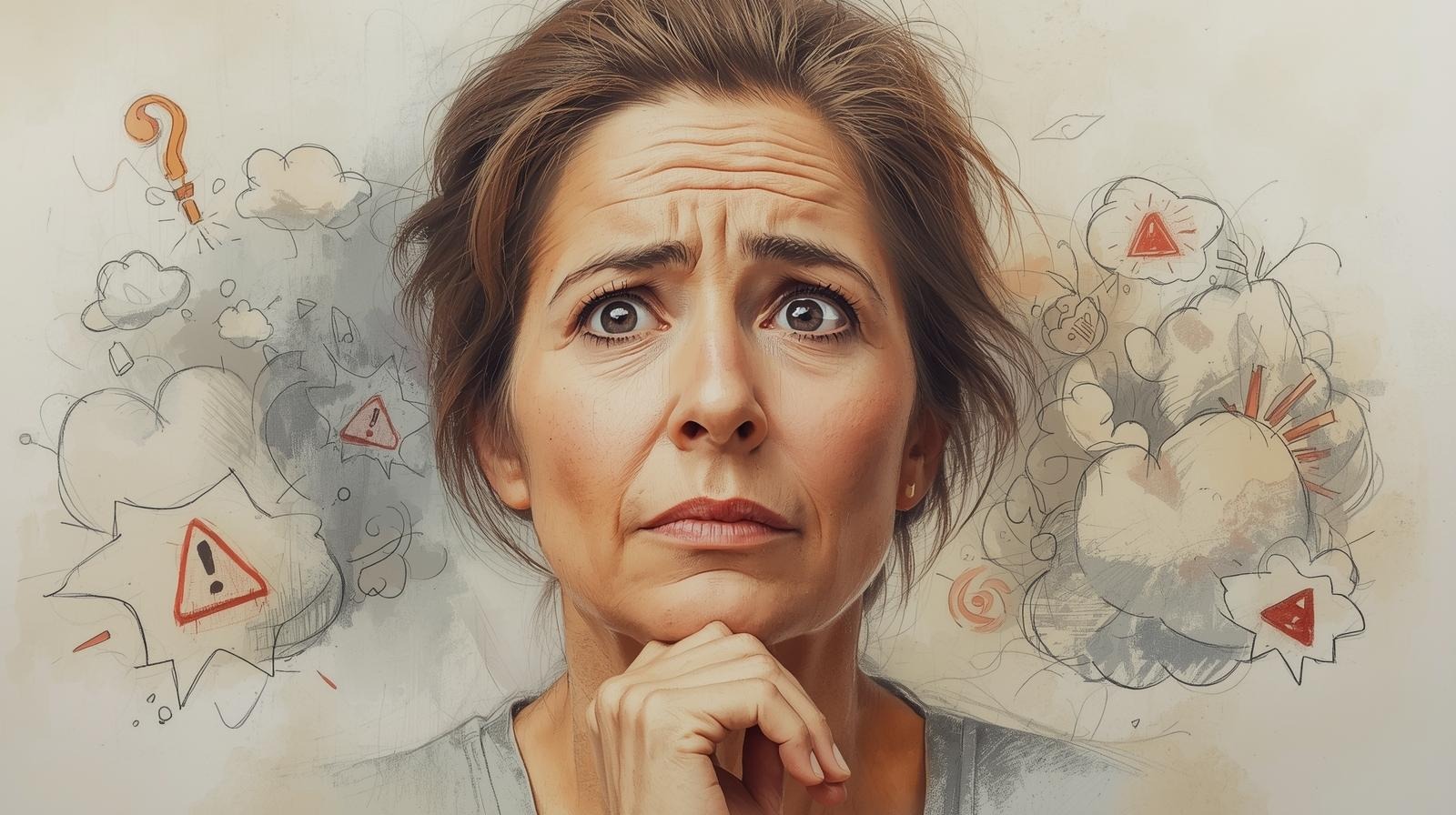
If your body has started acting like a hyper sensitive alarm system, you are not imagining it.
One moment you are fine. The next moment something spikes: heat rises in your chest, your heart feels loud, your breath turns shallow, your thoughts scatter, and your mind flashes the most terrifying headline it can invent. It might feel like a panic attack. It might feel like a heart problem. It might feel like you are losing control in a way that is brand new, especially if you have never been an anxious person.
Then, sometimes, it passes. You are left with that specific kind of exhaustion that comes from surviving something invisible. You may even feel embarrassed, because the outside world did not see what happened inside you. And the question returns, sharper each time: Why does my body feel like an alarm when I’m not in danger?
In this Calm Space article, I want to give you a name that makes the experience feel less lonely and more understandable: menopause panic confusion. This is not a diagnosis. It is a description of a pattern many women report during the menopause transition, especially in perimenopause. The body sends intense signals. The mind tries to interpret them fast. Because the sensations are unfamiliar and powerful, the mind often interprets them as danger. Confusion grows. Fear grows. The alarm gets louder.
This is not weakness. It is biology plus context. It is also treatable and manageable, especially when you stop fighting your body and start translating it.
You will find practical calming tools here, but also something deeper: a way to rebuild trust in your body when your body feels unpredictable.
This article is educational and supportive, not medical advice. If symptoms are new, severe, or frightening, you deserve medical evaluation and reassurance.
The most important reframe: Your alarm is trying to protect You, but the sensitivity has changed
Your nervous system has one job that overrides almost everything else: keep you alive.
To do that, your brain constantly monitors signals from inside your body. It watches temperature, heart rhythm, blood pressure shifts, breathing patterns, blood sugar stability, sleep debt, and stress hormones. Most of this happens without your awareness, until something crosses a threshold and your brain says, “Pay attention.”
During the menopause transition, thresholds can change. The system can become more reactive, especially when vasomotor symptoms like hot flashes and night sweats enter the picture. The North American Menopause Society states clearly that hormone therapy is the most effective treatment for vasomotor symptoms, and it emphasizes individualized decision making based on timing, formulation, route, and a person’s risk profile.
NICE guidance also emphasizes identifying menopause symptoms properly, offering evidence based options, and tailoring care to the individual.
Those are clinical statements, but here is the human translation:
- Your body is not “being dramatic.”
- Your system may be running with a different sensitivity setting than it used to.
- When sensitivity changes, normal sensations can start to feel like emergencies.
Why perimenopause can feel like panic even when You “have no reason” to panic
Many women describe perimenopause with a sentence that sounds simple but carries grief: I don’t feel like myself.
A study exploring this exact phrase, “not feeling like myself,” found that it often clustered with anxiety or vigilance, fatigue, brain fog, sexual symptoms, and volatile mood symptoms. In other words, it was not just a mood problem. It was a whole body state that changed identity and inner stability.
Now imagine what happens when your baseline inner stability shifts. Your brain, which loves predictability, starts scanning for explanations. Scanning is a form of vigilance. Vigilance can feel like anxiety. Anxiety can create more physical sensations. The loop builds.
This is one reason menopause panic confusion can feel so unfair. It is not only a thought problem. It is a body and brain coordination problem.
And it often shows up when other factors are already amplifying the alarm:
- Sleep disruption from night sweats
- Stress load from work, caregiving, or emotional labor
- Stimulant sensitivity that suddenly changes
- Blood sugar swings that hit harder than they used to
- A nervous system that has been “strong for too long” and is now less tolerant of overload
Perimenopause is not the only cause of anxiety, but it can be a powerful amplifier.
A large systematic review and meta analysis found that perimenopausal women had a significantly higher risk of depressive symptoms and diagnoses compared to premenopausal women, with an odds ratio around 1.40. Mood and anxiety often overlap, especially when sleep and stress are involved.
This is not about labeling you. It is about validating the reality: the transition can increase vulnerability, and you deserve support, not dismissal.
The “alarm loop” that creates menopause panic confusion
One of the most helpful things you can do is understand the loop, because understanding turns terror into a map.
Here is the loop in a simple sequence:
Trigger → Sensation → Interpretation → Adrenaline → More sensation → More interpretation
- A hot flash begins, bringing heat, flushing, sweating, sometimes dizziness.
- Your heart speeds up, or you notice it more intensely.
- Your brain searches for meaning.
- It grabs the scariest explanation, because fear is designed to keep you alive.
- Adrenaline rises.
- Now your body sensations intensify.
- Now your mind feels even more convinced something is wrong.
The confusion is not random. It is your brain trying to create certainty during uncertainty.
The calm approach is not “stop the loop by force.” The calm approach is “interrupt the loop by translating it.”
Hot flashes and panic attacks can feel identical in the moment, but the starting point often differs
This is where many women feel trapped. They think, “If this is a panic attack, why did it start when I wasn’t anxious?” Or, “If this is a hot flash, why does it feel like fear?”
Because both can be true.
- A panic attack is typically a fear surge with physical symptoms.
- A hot flash is typically a thermoregulatory surge, and fear can climb on top of it.
When the body starts the cascade, the mind often shows up second, trying to explain. That timing matters, because it changes what helps.
If the first domino is heat and a sudden internal rush, cooling strategies and vasomotor symptom treatment can reduce the frequency of the trigger itself. The Menopause Society’s nonhormone therapy position statement lists several evidence supported options for vasomotor symptoms and notes that paced breathing and simple relaxation do not alleviate vasomotor symptoms and are not recommended for that specific purpose.
That does not mean breathing is useless. It means breathing is not a reliable treatment for hot flashes. But breathing can still help the panic layer, because panic involves the threat system, muscle tension, and hyperventilation patterns.
So we separate the channels:
- Temperature channel: vasomotor surge
- Threat channel: adrenaline interpretation surge
Many women feel better when they stop trying to fix both channels with one tool.

Why palpitations feel so scary in perimenopause
Palpitations are one of the most fear provoking symptoms because they hit your most primal fear button: the heart.
A scoping review on palpitations during menopause found that palpitations are common, and that likely correlates include worse vasomotor symptoms, worse sleep, and worse quality of life. It also highlights that evidence is still limited and more research is needed, which is both frustrating and clarifying: the symptom is real, but the science of best management is still evolving.
Here is the Calm Space truth: palpitations can be benign, but they still deserve evaluation when they are new, changing, or paired with concerning symptoms. Reassurance should never ask you to ignore red flags.
A table that reduces fear without minimizing safety
Below is a “safety and calm” table you can come back to. It is not meant to diagnose you. It is meant to help you decide what to do next, especially when your mind is spiraling.
| What you notice | What it can mean in menopause panic confusion | What to do in the moment | When to seek urgent care |
|---|---|---|---|
| A loud, pounding heartbeat that settles after a short time | Palpitations can correlate with sleep disruption, stress, and vasomotor symptoms | Ground your body first, cool if needed, lengthen exhale, sip water | If you also have chest pain, fainting, severe shortness of breath, severe dizziness, or confusion |
| Fluttering or skipped beats that come and go | Often benign, but unsettling, and can worsen with stimulants and poor sleep | Reduce caffeine and alcohol experiments, track timing and triggers | If episodes are frequent, worsening, or new, book a medical evaluation |
| Racing heart plus fear plus heat surge | Hot flash trigger plus adrenaline interpretation | Treat both channels: cool the body and reassure the mind | If symptoms feel different from usual, severe, or include red flag signs |
Mayo Clinic advises seeking emergency care for palpitations accompanied by chest pain, fainting, severe shortness of breath, or severe dizziness.
Cleveland Clinic similarly advises urgent help for sustained palpitations with chest pain, trouble breathing, dizziness, or confusion.
You are allowed to take symptoms seriously and still learn to calm the fear layer.
Brain fog makes the alarm louder, because confusion itself feels like danger
Brain fog is not just forgetfulness. For many women it is a subtle sense that the mind is less reliable than it used to be. Losing words. Losing the thread. Slower switching. Feeling mentally noisy. That kind of cognitive uncertainty can feel threatening, especially if you pride yourself on competence.
A narrative review notes that cognitive complaints are more common around menopause, a time marked by decreasing estrogen, and it discusses the complexity of the relationship between symptoms, hormones, and cognition. It also emphasizes that hormone therapy is not recommended as a strategy to prevent cognitive decline or dementia.
This matters for calm, because fear loves to interpret brain fog as catastrophe. But most menopause related cognitive complaints are shaped by conditions that are modifiable: sleep disruption, mood symptoms, stress load, and vasomotor symptoms that fragment rest.
When you address those drivers, many women report their cognitive confidence returning. Not perfectly, not overnight, but meaningfully.
The hidden biology: Why hot flash science matters for Your emotional experience
Hot flashes are not “just stress.” They are a neuroendocrine event involving hypothalamic temperature regulation, and newer research has explored neurokinin pathways as a target for nonhormone treatments.
A systematic review on neurokinin 1 and 3 receptor antagonists found evidence suggesting these agents can reduce frequency and severity of hot flashes, though interpretation must stay cautious as research evolves.
A more recent systematic review also examines safety and efficacy of neurokinin 3 receptor antagonists that are approved or in development.
This is not included to push medication. It is included to validate you. When your body heats and surges and your heart pounds, that is a real physiological event. If your mind reacts with fear, that fear is not proof you are weak. It is proof your nervous system is responding to an intense internal signal.
The body alarm decoder: Translate sensations without arguing with Yourself
Menopause panic confusion often improves when you stop trying to “convince yourself” and start translating your nervous system like a calm interpreter.
Here is a decoding table you can use when your body is loud.
| What it feels like | What it might be | A calming translation that works with your body | A small next step that builds trust |
|---|---|---|---|
| Sudden heat, flushing, sweating, wave of urgency | Vasomotor surge that can trigger threat response | This is a temperature alarm, not proof of danger | Cool your skin, loosen clothing, sip water, let the surge crest |
| Heart pounding, fluttering, racing | Palpitations that can worsen with poor sleep and stress | My heart is loud, not automatically unsafe | Track patterns, reduce stimulants, discuss evaluation if new or worsening |
| Dizziness, shaky legs, floaty feeling | Autonomic shift, hyperventilation, blood sugar swings | My nervous system is surging, I can downshift it | Slow exhale, soften jaw, ground feet, eat if you are underfueled |
| Racing thoughts, doom feeling, urge to escape | Adrenaline plus uncertainty | This is adrenaline, not a prophecy | Delay meaning for ten minutes, choose one stabilizing action |
| Brain fog, losing words, mental unreliability | Common complaint amplified by sleep and stress | My brain is tired, not broken | Sleep support, stress reduction, treat night sweats, reduce overload |
The goal is not to be fearless. The goal is to stop treating every sensation as a verdict.
The calm space protocol: When Your body feels like an alarm, use a ritual that Your brain can trust
In panic confusion, you do not need more willpower. You need a protocol. A protocol lowers fear because it replaces improvisation with a plan.
Here is a five phase protocol designed specifically for menopause panic confusion:
Signal → Stabilize → Soothe → Separate → Strategize
Signal: Name what is happening with dignity
When the surge hits, try a sentence that is compassionate and specific:
My body is having a surge. I will not solve my whole life in this moment.
Naming creates a small distance. Distance creates choice.
Stabilize: Remove the accelerators that make alarms louder
During the menopause transition, small deficits can amplify surges. Instead of asking “What is wrong with me,” ask three gentler questions:
- Have I eaten enough today, especially earlier in the day
- Have I had enough water
- Have I had more caffeine or alcohol than my body tolerates lately
This is not about blaming yourself. It is about giving your nervous system fewer reasons to spike.
Soothe: Treat the body first, then the thoughts
If heat is part of the surge, cool the body. A cool cloth on the neck, wrists, or face can reduce intensity, not because you are fragile, but because temperature is part of the trigger.
Then support the threat channel with breathing that does not feel like a performance:
- Let the inhale be natural.
- Let the exhale be longer.
- Soften the jaw.
- Drop the shoulders.
- Feel your feet.
Remember the nuance from the nonhormone therapy position statement: breathing is not an evidence supported treatment for vasomotor symptoms, but it can still support the panic layer by shifting autonomic tone.
Separate: Split sensation from story
This is the most powerful mental move in menopause panic confusion.
- Sensation is real.
- Story is optional.
Try:
I can feel this. I do not need to interpret it yet.
Your brain hates delayed interpretation. That is why this works. It interrupts catastrophic meaning making.
Strategize: Choose the right support based on the main driver
This is where compassion becomes practical. You choose tools that match the driver, instead of forcing one tool to do everything.
If the driver is vasomotor symptoms, discuss evidence based options, including hormone therapy when appropriate and evidence supported nonhormone therapies.
If the driver is sleep disruption, treat sleep like medicine, because sleep debt makes every alarm louder.
If the driver is persistent anxiety, consider therapy and support that trains the nervous system, not just the mindset.
A clinician focused review discusses strategies to cope with stress and anxiety during the menopausal transition and highlights the importance of recognition and supportive interventions.

Treatment options map: Calm is not only mindset, it is physiology plus support
To keep this grounded and non sensational, here is a simple treatment map that respects both evidence and individuality. This is not a prescription. It is a conversation starter with your clinician.
| Approach | Best fit when | What the evidence statements emphasize | Why it can reduce panic confusion |
|---|---|---|---|
| Hormone therapy | Moderate to severe vasomotor symptoms, especially when sleep is disrupted, and no contraindications | Most effective for vasomotor symptoms, individualized risk benefit based on timing and health profile | Fewer heat surges often means fewer adrenaline spirals |
| Evidence supported nonhormone therapies | When hormone therapy is not desired or not appropriate | Recommended options include cognitive behavioral therapy, clinical hypnosis, certain medications, and newer agents in some regions | Reduces vasomotor trigger load, and supports coping |
| Psychological therapy and nervous system training | When fear, avoidance, or identity disruption becomes persistent | Menopause related distress often includes anxiety vigilance and “not feeling like myself” patterns | Helps separate sensation from catastrophe, rebuilds trust |
| Lifestyle experiments that remove accelerators | When episodes cluster around stimulants, skipped meals, dehydration, or stress peaks | Evidence varies, but physiology is consistent: less load often means fewer spikes | Gives you back agency and predictability |
The Menopause Society’s statements are a strong anchor for discussing these options with a clinician.
NICE guidance provides additional evidence based pathways and recommendations.
Your personal alarm fingerprint: The calm power of pattern recognition
Menopause panic confusion thrives on unpredictability. Calm grows when you can predict.
You do not need to track perfectly. You only need to track enough to see your pattern.
Think of it as building an “alarm fingerprint” made of four pieces:
- Timing
- Triggers
- Symptom cluster
- Recovery needs
Here is a tracking table that is simple enough to use and detailed enough to be useful.
| What to track | What to notice | What it often points to | A gentle experiment for one week |
|---|---|---|---|
| Time of day | Do surges cluster late afternoon or at night | Stress hormones, fatigue, blood sugar dips, night sweat spillover | Add a balanced snack earlier, create a decompression ritual before evening |
| Sleep quality | Do episodes follow nights of poor sleep | Lower threat threshold, higher autonomic reactivity | Treat sleep as priority, discuss night sweats management |
| Heat link | Do symptoms begin with warmth or flushing | Vasomotor driver with anxiety riding on top | Cooling tools, discuss vasomotor treatments |
| Stimulants | Does caffeine or alcohol change intensity | Increased palpitations, sleep disruption, anxiety sensitivity | Reduce or time shift stimulants, observe change |
| Thought timing | Do catastrophic thoughts arrive after symptoms begin | Body first, story second pattern | Use separation scripts, delay interpretation |
When you see your fingerprint, you stop feeling cursed. You start feeling informed.
A non conventional but practical idea: “Two tabs” calming
When panic confusion hits, most people try to solve everything in one tab. They think, “Is this menopause, anxiety, heart disease, trauma, stress, all of it?”
That creates more panic.
Try a two tab approach.
- Tab one: safety check.
- Tab two: calming response.
Tab one asks: Do I have red flag symptoms that require urgent care
Mayo Clinic and Cleveland Clinic red flags include chest pain, fainting, severe shortness of breath, severe dizziness, and confusion.
If yes, seek urgent medical help. If no, move to tab two.
Tab two asks: What is the most likely driver right now, heat surge, sleep debt, stimulant sensitivity, or stress peak
Then you apply the matching tool.
This reduces mental chaos because you are not trying to diagnose yourself while your nervous system is spiking.
A clinician conversation that increases the chance of being taken seriously
Many women delay care because they fear dismissal. So here is a calm, clinical way to describe menopause panic confusion without sounding uncertain.
You can say:
I am in the menopause transition and I am having episodes of heat surges, palpitations, dizziness, and anxiety like spikes. They last about X minutes. They happen X times per week. Sleep and night sweats are affecting me. I want to rule out medical causes and discuss evidence based options for vasomotor symptoms and the anxiety layer.
This frames your symptoms as real and trackable. It also aligns with guideline based care.
Emerging science, handled gently: Why “new” does not mean “proven,” but it can still be validating
If you crave a deeper explanation, it can help to know that researchers are exploring multiple biological pathways related to mood and anxiety symptoms around the menopausal transition. Some papers explore gut microbiota and perimenopausal panic disorder, for example, as an emerging area rather than established clinical practice.
You do not need this to heal. But for some women, it is relieving to realize that science is still catching up to lived experience, and that “we do not fully know yet” is not the same as “it is all in your head.”
A message Your nervous system deserves to hear
If you take only one thing from this article, let it be this:
- Menopause panic confusion is not you losing your mind.
- It is your body sending intense signals in a season of recalibration.
- Your job is not to fear the alarm. Your job is to learn the language of the alarm.
You can be someone who feels heat surges and palpitations and brain fog and still lives with dignity and steadiness.
- Not by forcing calm.
- By practicing translation.
- By removing accelerators.
- By getting support that matches the driver.
- By treating your body like a partner, not an enemy.
When your body feels like an alarm, you can respond like someone who understands alarms:
- Check safety.
- Lower the volume.
- Notice patterns.
- Choose evidence informed support.
- Return to yourself, one surge at a time.
Related posts You’ll love
- Mental health isn’t a vibe: The 7 areas most Women ignore until They crash
- Yin practices for Women in a hyper-Yang world: Reclaim soft power, nervous system safety, and deep rest
- When “aging gracefully” becomes a silent demand: The cultural pressure to grow old quietly
- The shame of needing comfort: Why support feels risky
- Prevalence inflation in mental health: Are we pathologizing normal pain, or finally learning a better language for it?
- Safety is the new self care: What Women actually need in 2026 to feel calm, protected, and fully themselves
- Truths for Women who are becoming more themselves with age: 11 powerful lessons on authenticity, self-worth, and confidence

FAQ: Menopause panic confusion
-
What is “menopause panic confusion”?
Menopause panic confusion is a pattern where perimenopause-related body sensations (heat surges, palpitations, dizziness, brain fog) feel so intense that your nervous system interprets them as danger. The result is a “false alarm” loop: sensation → fear → adrenaline → stronger sensation. It’s real physiology plus uncertainty, not a personal weakness.
-
Can perimenopause cause panic attacks or mimic them?
Perimenopause can increase anxiety vulnerability and can strongly mimic panic because hot flashes and autonomic shifts can look and feel like panic symptoms. For some people the body surge happens first, and the fear arrives second as the brain tries to explain what’s happening. If attacks are frequent or life-limiting, clinical support can help.
-
How can I tell the difference between a hot flash and a panic attack?
A hot flash often starts with a sudden heat wave, flushing, sweating, and temperature discomfort, while panic often starts with fear or a sense of threat. But they overlap, and either can trigger the other. A helpful clue is timing: if heat comes first, cooling and vasomotor treatment often reduce the “alarm” frequency.
-
Why do palpitations feel so scary in perimenopause?
Palpitations are scary because the brain treats heart sensations as high priority signals. In perimenopause they can be more noticeable, especially with poor sleep, stress, or stimulant sensitivity, and they can trigger catastrophic interpretations. The goal is to evaluate new or worsening symptoms medically, while also learning nervous-system calming skills.
-
When should I seek urgent medical care for these symptoms?
Seek urgent care if palpitations or “panic-like” episodes come with chest pain, fainting, severe shortness of breath, severe dizziness, or confusion. If symptoms are new, changing, or escalating, book a medical evaluation even if they pass quickly. Safety first is part of real calm, not the opposite.
-
Why does anxiety suddenly feel “chemical” or “out of nowhere”?
In perimenopause, sleep disruption, hot flashes, and autonomic shifts can raise baseline arousal so your mind feels anxious before you even have a worrying thought. The brain then searches for a story to match the body state. This is why nervous-system tools and symptom treatment often help more than “thinking positive.”
-
What can I do in the moment when my body feels like an alarm?
Start with body-first de-escalation: cool your skin, relax your jaw and shoulders, and extend your exhale longer than your inhale for a couple of minutes. Then separate sensation from story by repeating one line: “This is a surge, not a prophecy.” After the wave passes, hydrate and stabilize with food if you’re underfueled.
-
What treatments help hot flashes and the anxiety that rides on them?
The most effective treatment for vasomotor symptoms is hormone therapy for many eligible people, while nonhormone options also exist and can be evidence-based depending on your situation. Reducing hot flashes and night sweats often lowers the number of “alarm triggers,” which can reduce secondary panic. Decisions should be individualized with a clinician.
-
Does hormone therapy help anxiety?
Hormone therapy primarily targets vasomotor symptoms and sleep disruption; when those improve, some people notice their anxiety eases because the body is less reactive. It isn’t a universal anxiety treatment, and it isn’t right for everyone. If anxiety is persistent, combining medical menopause care with therapy can be especially effective.
-
How long does perimenopause anxiety and brain fog last?
For many people symptoms fluctuate and change across the transition rather than staying constant. Duration varies widely, but tracking patterns (sleep, heat surges, caffeine, stress load) often reveals predictable triggers you can reduce. If symptoms are severe or persistent, treatment can improve quality of life without waiting for time alone to fix it.
Sources and inspirations
- Badawy, Y., Spector, A., Li, Z., & Desai, R. (2024). The risk of depression in the menopausal stages: A systematic review and meta analysis. Journal of Affective Disorders.
- Carpenter, J. S., (2022). Correlates of palpitations during menopause: A scoping review. Women’s Health Reports.
- Cieri Hutcherson, N. E., (2024). Systematic review of neurokinin 3 receptor antagonists for vasomotor symptoms. JAMA Network Open (systematic review record).
- Cleveland Clinic. (2024). Heart palpitations and anxiety.Conde, D. M., (2021). Menopause and cognitive impairment: A narrative review of current knowledge. World Journal of Psychiatry.
- Coslov, N., Richardson, M. K., Woods, N. F., (2024). “Not feeling like myself” in perimenopause: What does it mean? Observations from the Women Living Better survey. Menopause.
- Hassan, F., Saleem, A., Samuel, S. S., Sarfraz, Z., Sarfraz, A., Sarfraz, M., & KC, M. (2023). Neurokinin 1 and 3 receptor antagonists for menopausal women: A systematic review and insights into investigational nonhormonal therapy. Medicine (Baltimore).
- Lin, S., (2023). Altered gut microbiota profile in patients with perimenopausal panic disorder. Frontiers in Psychiatry.
- Mayo Clinic. (2022). Heart palpitations: Symptoms and causes.
- National Institute for Health and Care Excellence. (2024). Menopause: Identification and management (NG23).
- Stute, P., & Lozza Fiacco, S. (2022). Strategies to cope with stress and anxiety during the menopausal transition. Maturitas.
- The North American Menopause Society. (2022). The 2022 hormone therapy position statement of The North American Menopause Society. Menopause.
- The North American Menopause Society. (2023). The 2023 nonhormone therapy position statement of The North American Menopause Society. Menopause.




Leave a Reply