Table of Contents
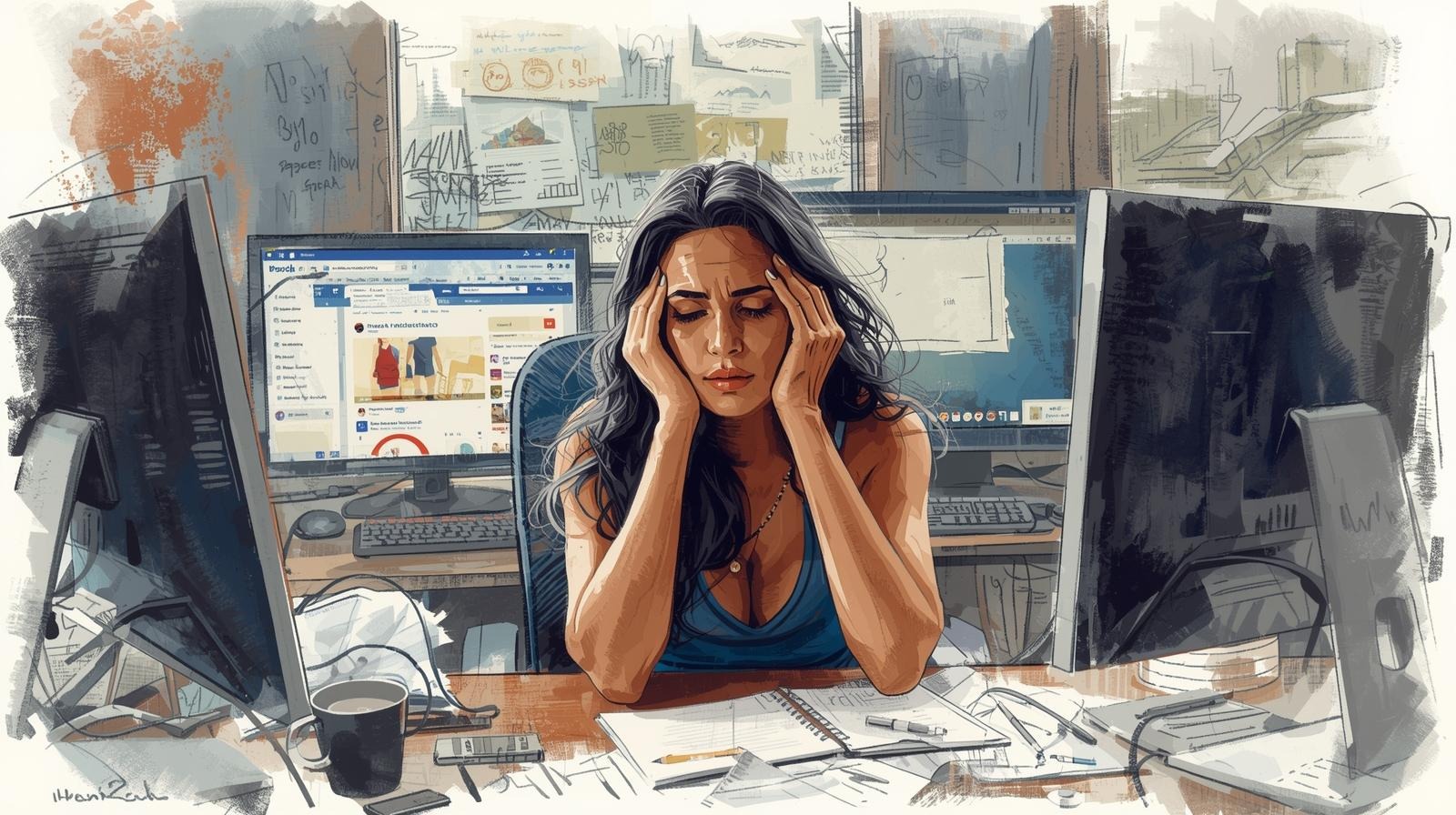
If you have ever opened your phone feeling fine, then closed it feeling behind, you are not “too sensitive.” You are responding normally to an environment built to move the finish line.
One day it is clean girl. Next day it is coquette. Next day it is office siren, then mob wife, then something with a new name that makes yesterday’s self expression feel like an expired product. The strange part is not that trends exist. Trends always existed. The strange part is the speed and the emotional tax: the sense that you can become “outdated” overnight, as if your value had a timestamp.
This article names that experience: microtrend stress. It is not a clinical diagnosis. It is a culture and attention economy pattern that shows up in the body as stress, in the mind as self doubt, and in daily life as pressure to constantly update your look, your routines, your vocabulary, even your personality.
And because women are more frequently evaluated through appearance, consumption, and “keeping it together,” the pressure lands differently. It becomes both personal and social, private and performative, exhausting and weirdly addictive.
Let’s unpack what is happening, why it feels so intense, and how to step out of the loop without becoming boring, isolated, or “above it all.”
Microtrend stress in one sentence
Microtrend stress is the anxiety and self erasure that happens when algorithm driven trends move so fast that your identity feels like it has an expiration date.
Here is the loop most women recognize the moment it is named:
New aesthetic appears → algorithm amplifies it → social comparison spikes → your current self feels slightly wrong → you search, save, buy, mimic, perform → brief relief → the trend flips → you feel behind again.
This “flip” is not your imagination. The Global Fashion Agenda describes the current era as one where trend categories that once defined decades can now feel like a single week on social media, and where micro trends can be old news by the time a purchase arrives.
That is not just a fashion problem. It is a nervous system problem.
What exactly is a microtrend, and why is it different from a normal trend?
A traditional trend used to be a slow cultural wave. It had time to settle, to be adopted, to be adapted, to become part of the background. You could participate casually. You could opt in late. You could ignore it without feeling like you were failing at modern life.
A microtrend is smaller, faster, and more nameable. It is designed to be packaged as an aesthetic you can “try on” quickly, display instantly, and then replace. It often looks like culture, but behaves like a product cycle.
The Global Fashion Agenda points out something important: micro trends often take already common notions and make them marketable by giving them a fresh label. That labeling creates the feeling of novelty, and novelty keeps you scrolling.
Microtrends are not only about clothing. They show up as:
- A new skincare routine that becomes mandatory overnight
- A “that girl” morning ritual that turns self care into a performance review
- A therapy word that becomes a social media personality
- A productivity method that makes your normal day feel lazy
- A relationship standard that makes human complexity feel like a red flag list
The core pattern is the same: a rapid cycle of idealization, imitation, and obsolescence.
Why women feel microtrend stress more intensely
Not because women are weaker. Because women are targeted more precisely.
Women have historically been taught, explicitly and implicitly, that staying “current” is part of staying safe, lovable, employable, and socially accepted. Trend participation is framed as fun, but it often carries consequences. When women do not keep up, the world is quick to interpret it as neglect, aging, laziness, or “letting yourself go.” That is a cultural script, not a personal flaw.
There is also a double bind: be effortlessly natural, but also perfectly curated. Be unique, but not weird. Be confident, but not trying too hard. Microtrends thrive inside that double bind because they constantly offer a “solution” to the anxiety they create.
And the modern trend engine is attached to commerce. Ultra fast fashion business models accelerate production and consumption, making novelty cheap and constant, while pushing the risks down supply chains and onto the planet. Women are not just users in this system. They are a primary market.
Finally, women’s bodies and appearances are more frequently treated as public property. One powerful line from culture criticism in recent years is that bodies are constantly evaluated online, and this creates a unique kind of self surveillance. That surveillance turns “what do I like?” into “how will this look to others?” which is exactly the psychological doorway microtrend stress uses.
The microtrend machine: How Your feed turns into a treadmill
It helps to see microtrend stress as a system, not a mood. Here is the system in plain language:
Attention economy incentives → algorithm rewards novelty and engagement → creators must post constantly → aesthetics become content shortcuts → brands attach products → shopping becomes frictionless → users buy to belong → the cycle restarts faster.
Fashion and trend culture do not exist in a vacuum; they exist inside a global industry with serious environmental costs. UNEP notes the fashion and textiles sector contributes a meaningful share of global greenhouse gas emissions, microplastic pollution, and enormous water use. When microtrends shorten product lifecycles, they do not only shorten your patience. They shorten the lifespan of objects.
Now layer in design patterns that keep you engaged longer than you intended. The German consumer organization vzbv has described “hyper engaging” dark patterns, including mechanisms like autoplay, intrusive notifications, and gamification elements that can increase time spent and encourage impulsive decisions. European data protection authorities have also documented dark patterns as manipulation techniques that exploit human behavioral tendencies.
So when you say, “I don’t know why I keep scrolling,” the answer is not moral weakness. The answer is design.
The psychology underneath: Why it hits so fast, and why it feels personal
Microtrend stress is powered by a few predictable psychological mechanisms.
Social comparison, upgraded by video
Social comparison is not new. What is new is the intensity and frequency of comparison, delivered in high definition, with sound, face, body, lifestyle, and the illusion of intimacy.
Research keeps finding links between social media use, comparison processes, and mental health outcomes. One 2024 study grounded in social comparison theory found that both active and passive Instagram use can influence social comparison, and that social comparison showed a meaningful relationship with depression in their model.
You do not need to be “jealous” to be impacted. You just need to be human.

FoMO becomes aesthetic
FoMO is usually framed as fear of missing out on events. Microtrends turn it into fear of missing out on being the right version of yourself.
A clinical overview of FoMO describes it as involving the perception of missing out followed by compulsive behavior to maintain social connections, and reviews links to mental health, sleep, and wellbeing. The “social connection” here might be literal friends, but it also includes parasocial connection to creators and a sense of belonging to an aesthetic tribe.
Identity becomes a subscription service
When trends move too quickly, identity stops feeling like a home and starts feeling like a feed. Your sense of self becomes something you must refresh.
That is why microtrend stress often shows up as a specific kind of thought:
“I don’t know who I am anymore, I only know what I save.”
Stress and sleep disruption: The quiet cost
Even when the effect sizes are small, the consistency matters. A 2024 systematic review and meta analyses in the Journal of Affective Disorders found small but significant associations between social media use and depression and anxiety, and noted that problematic social media use was associated with depression, anxiety, sleep problems, and lower wellbeing.
Microtrend stress often feels like “just thoughts,” but the body keeps the score through sleep, tension, and mental load.
The lived experience: What microtrend stress looks like in real life
Microtrend stress is sneaky because it masquerades as motivation. It tells you you are improving, when you are actually chasing relief.
Here are some common patterns, mapped in a way that makes the hidden need visible.
| What it looks like on the outside | What it feels like on the inside | The hidden need | A kinder translation you can use |
|---|---|---|---|
| You save endless “outfit formulas” and still feel like you have nothing to wear | Wardrobe whiplash, decision fatigue, never feeling “done” | Stability | “I want to feel at home in my own body again.” |
| You buy “just one thing” to update your look fast | Quick relief, then guilt or regret | Belonging | “I want to feel included without performing for approval.” |
| You feel embarrassed wearing things you loved last year | Shame, self-judgment, tension | Safety from ridicule | “I want to be respected even when I repeat myself.” |
| You keep switching routines (skincare, wellness, habits) | Restlessness, pressure, the feeling you’re always behind | Control | “I’m trying to create certainty in a chaotic world.” |
| One new aesthetic label makes you feel older overnight | Age anxiety, fear of invisibility | Dignity | “I want to be valued beyond novelty.” |
Notice how none of the hidden needs are shallow. Stability, belonging, safety, control, dignity. Microtrend stress often gets dismissed as vanity, but it is frequently a disguised form of deeper emotional labor.
A quick self check: Your microtrend stress score
This is not a diagnosis. It is a mirror.
Read each statement and answer honestly: rarely, sometimes, often.
| Statement | Rarely (0) | Sometimes (1) | Often (2) |
|---|---|---|---|
| I feel a spike of anxiety when a new “core” or aesthetic label pops up | 0 | 1 | 2 |
| I second-guess outfits or routines I used to enjoy because they now feel “dated” | 0 | 1 | 2 |
| I buy things mainly to feel current, not because I truly want them | 0 | 1 | 2 |
| I feel like I need to keep up to be respected at work or socially | 0 | 1 | 2 |
| I open apps for “inspiration” and leave feeling worse about myself | 0 | 1 | 2 |
| I lose time to scrolling even when I promised myself I wouldn’t | 0 | 1 | 2 |
If you land in the higher range, the goal is not to shame yourself. The goal is to stop interpreting the signal incorrectly. The signal is not “you are behind.” The signal is “your nervous system is being over stimulated.”
Why “just stop scrolling” rarely works
Because microtrend stress is not only about content. It is about regulation.
For many women, scrolling is doing at least one job:
- Numbing after a long day
- Seeking a sense of belonging
- Trying to solve an insecurity quickly
- Looking for a version of self that feels exciting again
- Escaping decision fatigue by copying a formula
If you remove scrolling without replacing the need it meets, you will either return to it, or replace it with another loop.
So we need something more compassionate and more strategic.
The microtrend stress antidote: 4 moves that actually change the pattern
Think of these as four doors out of the treadmill. You do not need to use all four at once. Choose the door that feels most realistic this week.
1) Algorithm hygiene: Treat Your feed like a room you live in
A feed is not neutral. It is an environment. And environments shape nervous systems.
Start with one small shift: reduce involuntary exposure. Autoplay, notifications, and frictionless browsing are not minor features. They are engagement levers. Consumer watchdogs have argued that hyper engaging design patterns can drive impulsive decisions and increase time spent..
Here is a practical reframe: you are not “restricting yourself,” you are changing your environment to match your values.
You can do that without becoming disconnected. Consider this sequence:
Notifications off → friction on → intention up.
Friction can be simple. Put the app in a folder. Log out. Remove shopping tabs. Turn off autoplay where possible. Make the platform ask you, gently, “Are you sure?” before it swallows your evening.
2) Identity anchors: Choose what stays true even when trends change
Microtrends win when your identity is trend anchored. Trend anchored identity sounds like:
I am the aesthetic I perform.
Anchored identity sounds like:
I am the values I live.
Try this as a journaling prompt, and answer in full sentences, not keywords:
When I am not trying to be impressive, I feel most like myself when…
Then ask:
What do I want my style and routines to communicate, even if no one likes the post?
This is where many women find relief. Because the nervous system loves continuity. Your brain can tolerate change when there is a stable base.
A helpful metaphor: trends are weather. Values are climate.
3) Replace “aesthetic pressure” with “story logic”
Microtrend stress makes you think your life must look cohesive. But real coherence is not visual. It is narrative.
Instead of asking, “Does this match the trend?” ask, “Does this match my story?”
Story logic makes room for seasons, grief, growth, postpartum realities, hormonal shifts, career changes, and plain old boredom. It lets you be many things without constantly rebranding yourself.
One reason microtrends feel suffocating is that they reduce a whole woman to a single look. Story logic gives you dimensionality back.
4) Spend with compassion, not punishment
Microtrend stress often triggers a shame cycle:
I bought something impulsively → I feel guilty → I promise to become “minimalist” overnight → I feel deprived → I scroll more → I buy again.
That cycle is still trend anchored, just in a different outfit.
If you want to spend less, the most effective path is usually not harsh rules. It is a deeper sense of sufficiency.
Vogue Business has reported on the rise of anti overconsumption movements and “no buy” challenges as a response to hyper consumerist social media culture, including voices arguing that buying less but more mindfully can increase wellbeing. Vogue
The key word is mindfully, not perfectly.
Try a question that interrupts the trance:
If I buy this, what emotion am I hoping to feel in the first 10 minutes?
If the answer is relief, belonging, or worthiness, you are not shopping for an object. You are shopping for a feeling. And feelings deserve care, not checkout.

A non dramatic 7 day microtrend reset that still lets You enjoy style
This is a reset designed for real life, not for a fantasy version of you with unlimited time and zero stress. The point is not detox. The point is agency.
| Day | Theme | What you do (simple) | What it teaches your nervous system |
|---|---|---|---|
| 1 | Notice | Track the exact moments you feel “behind” and what triggered them | “I can observe without obeying.” |
| 2 | Clean your feed | Unfollow comparison triggers, follow wider definitions of beauty and style | “I choose my inputs.” |
| 3 | Wear your favorites | Wear an outfit you love that isn’t trend-coded, on purpose | “My taste is valid.” |
| 4 | 24-hour pause | Wait 24 hours before any trend-influenced purchase | “Urgency isn’t truth.” |
| 5 | Remix | Restyle or repair one item you already own | “Newness can be created.” |
| 6 | Embodiment | Do something that brings you into your body without filming it | “I exist beyond the gaze.” |
| 7 | Write your anchors | Define 3–5 style and life values that stay true through trends | “I choose who I’m becoming.” |
This plan looks simple. The impact is deeper than it appears because it retrains the association between “new trend” and “I must act now.”
How to participate in trends without being swallowed by them
Some women read an article like this and fear it means they must give up fun, beauty, and play. Not at all.
The goal is not to become trend proof. The goal is to become trend fluent. Fluent means you can understand the language without losing your native tongue.
Here are three ways to keep the joy and drop the pressure, explained in full because you deserve nuance.
First, choose one microtrend at a time, and treat it like a costume party, not an identity contract. Play is light. Contracts are heavy. The moment a trend makes you feel like you owe it your consistency, it stops being play.
Second, lower the stakes by using what you already have. A “core” can be a color story, a lipstick, a hairstyle, a playlist, a way of walking, a mood in your home. When microtrends force consumption, they become a shopping mandate. When you translate them into creativity, they become art again.
Third, borrow from slower systems. Thrifting, clothing swaps, repairing, renting, and restyling create novelty without feeding the fastest cycles. The global used clothing system has its own complexities, and recent international reporting has highlighted the scale and challenges of the used clothing crisis. But on a personal level, extending the life of what you already own is often one of the most direct ways to reduce both financial and emotional churn.
The hidden grief behind “feeling outdated”
Let’s name something tender: sometimes microtrend stress is grief in disguise.
- Grief for time passing.
- Grief for versions of you that felt more visible.
- Grief for the ease of dressing without thinking.
- Grief for a world where you were not constantly watched.
When a trend flips and you feel a sting, it may not be about the jeans. It may be about the story your brain tells: I am becoming irrelevant.
That story is painful, and it is also untrue. But it will not loosen its grip through logic alone. It loosens through experiences that prove a different truth.
A different truth sounds like:
- I can be current without being consumed.
- I can evolve without erasing myself.
- I can be seen by people who love my substance.
- I can enjoy beauty without making it a job.
Microtrend stress and money: The quiet debt spiral
Microtrend stress is not only emotional. It can be financial.
When trends become weekly, the cost is not just the item. It is the constant micro spending, the shipping, the returns, the storage, the closet clutter, the mental overhead, the guilt.
A late 2025 feature in The Verge described how frictionless shopping woven into social platforms can contribute to overconsumption, financial stress, and even debt for some people, especially when influencer culture and algorithmic prompts keep the pressure to buy feeling constant. The Verge
That matters because financial stress makes you more vulnerable to emotional buying. Emotional buying makes you more stressed. The loop tightens.
If microtrend stress has become financially painful, please treat that pain as a valid signal, not as another reason to attack yourself. You do not need more discipline. You need a different environment and a different kind of soothing.
When microtrend stress is a sign of something deeper
Sometimes microtrend stress is the surface symptom of deeper issues, like anxiety, depression, perfectionism, trauma history, or body image struggles. If you notice that trend exposure consistently triggers panic, obsessive checking, or intense shame, consider talking to a licensed mental health professional.
Research overviews emphasize that social media can offer benefits and support, but also carries risks and potential harms, and that safety precautions and thoughtful use matter.
Getting support does not mean you are broken. It means you are taking your mind seriously.
A closing reframe: You are not “late,” You are alive
Microtrend stress thrives on one core lie:
If you are not updated, you are not worthy.
Your life is not an app. You do not need patches every week to remain lovable.
Trends will keep trending. That is what systems built on attention and consumption do. The OECD has noted how ultra fast fashion models have reshaped consumption by making it faster and cheaper, while raising risks across supply chains. The system will not slow down out of kindness.
But you can.
You can decide that your style is not a performance review.
You can decide that repeating yourself is not failure, it is identity.
You can decide that your nervous system deserves stability more than your feed deserves novelty.
You can decide that being “outdated” is not a real emergency.
And then, quietly, you can step back into your own timeline.
Because the most modern thing a woman can do right now is refuse to live at algorithm speed.
Related posts You’ll love
- The powerful Identity Closet Method: 7 steps to build a trend-proof personal style You’ll love
- Pluralistic ignorance and the silent struggle: Why You think You’re the only one falling behind (when most people are quietly struggling too)
- The “Monday reset” addiction: Why You restart Your life every week (and how to build change that survives tuesday)
- Female friendship hierarchies: The subtle social rules no one admits (and how to stay true to Yourself inside the circle)
- Why receiving money, help, or gifts feels uncomfortable (psychology explained): Indebtedness, shame, and the “hidden contract” Your brain fears
- The real reason You want a glow-up (hint: it’s not about Your face)
- How to make solo evenings feel private, feminine, and full: A soft night routine for calm, beauty, and emotional rest
- Why Women pay $150,000 for matchmakers in 2026: The quiet luxury of opting out of swipe culture, and what that price tag really buys

FAQ: Microtrend stress
-
What is microtrend stress?
Microtrend stress is the pressure, anxiety, and self-doubt that can show up when online aesthetics and “must-have” trends change so fast that you feel outdated almost overnight. It’s not a medical diagnosis, but it is a real lived experience shaped by algorithms, social comparison, and constant content-driven consumption.
-
Why do online trends change so fast on TikTok and Instagram?
Trends move fast because platforms reward novelty and high engagement. When a new aesthetic name, sound, product, or styling formula starts performing well, algorithms push it to more people. Creators then replicate it quickly to stay visible, which accelerates the cycle and makes yesterday’s look feel “old” sooner.
-
Why does microtrend stress affect women so intensely?
Microtrend stress often hits women harder because women are more frequently judged on appearance, “presentation,” and social relevance. Many women also carry cultural pressure to look effortlessly put together while still being unique and current. That double standard turns trends into a subtle test of worth, not just a playful style choice.
-
Is microtrend stress the same as fear of missing out (FoMO)?
They’re connected, but not identical. FoMO is usually about missing experiences or social connection. Microtrend stress is more about missing “the right version of yourself” in public. It can feel like a fear of falling behind culturally, visually, or socially, even if your real life is stable.
-
Can microtrend stress worsen anxiety or depression?
It can contribute, especially if your scrolling triggers constant comparison, shame, or compulsive checking and shopping. While social media doesn’t affect everyone the same way, many people notice higher stress, lower mood, and worse sleep when trend exposure becomes nonstop.
-
How do I know if I have microtrend stress?
If you regularly open social apps for inspiration and leave feeling behind, embarrassed, or pressured to change yourself, you may be experiencing microtrend stress. Another sign is feeling urgent about buying or updating your look to avoid seeming “outdated,” even when you didn’t want anything before you scrolled.
-
What causes microtrend stress besides fashion?
Microtrend stress isn’t only about outfits. It also shows up in skincare routines, wellness habits, “that girl” productivity culture, therapy-language trends, relationship advice trends, and aestheticized lifestyles. Anything that turns identity into a fast-moving performance can trigger the same stress pattern.
-
How can I stop feeling outdated overnight?
You don’t need to stop caring about style. You need fewer high-pressure inputs and stronger identity anchors. Practical steps include cleaning your feed, reducing notifications, creating a 24-hour pause before trend purchases, and choosing a personal style “baseline” that stays true even when trends flip.
-
How do I enjoy trends without losing myself?
Try being trend-fluent instead of trend-trapped. Pick one microtrend at a time and treat it like play, not an identity contract. Use what you already own, remix instead of rebranding, and set one simple rule like “no purchases for a trend until I can style it three ways.”
-
What is the healthiest way to use social media for inspiration?
Use social media intentionally, not reflexively. Follow creators who make you feel capable, not inadequate. Save fewer posts but act on them more. Set boundaries that add friction, like no scrolling before you get dressed or a daily time limit. Inspiration should expand your options, not shrink your self-worth.
-
Does microtrend stress lead to overconsumption?
It can. When trends are framed as urgent, many people buy for emotional relief rather than true desire. That can create clutter, guilt, and financial stress, which then increases the urge to scroll for “solutions.” Breaking the loop often starts with a pause and a question: “What feeling am I trying to buy?”
-
What should I do if microtrend stress feels obsessive or overwhelming?
If you notice panic, intense shame, compulsive checking, or shopping that feels out of control, consider speaking with a licensed mental health professional. You deserve support, and you don’t have to fight a high-pressure digital environment alone.
Sources and inspirations
- Global Fashion Agenda. (2024). Examining the Era of Micro Trends.
- OECD. (2025). Hitting the headlines: The ultra fast fashion business model and responsible business conduc.
- United Nations Environment Programme. (2025). Sustainable fashion to take centre stage on Zero Waste Day.
- United Nations Environment Programme. (2018). Putting the brakes on fast fashion.
- UNECE. (2024). Reversing direction in the used clothing crisis (report).
- Ahmed, O., (2024). Social media use, mental health and sleep: A systematic review with meta analyses. Journal of Affective Disorders.
- Gupta, M., Sharma, A. (2021). Fear of missing out: A brief overview of origin, theoretical underpinnings and relationship with mental health. World Journal of Clinical Cases.
- Naslund, J. A., (2020). Social Media and Mental Health: Benefits, Risks, and Opportunities for Research and Practice. Journal of Technology in Behavioral Science.
- Ahmad, R., (2024). The Insta Comparison Game: The Relationship between Social Media Use, Social Comparison, and Depression. Procedia Computer Science.
- Verbraucherzentrale Bundesverband (vzbv). (2025). From Amazon to TikTok to Temu: Manipulative designs remain a problem.
- European Data Protection Board. (2022). Dark Patterns: Manipulative design on the internet (case collection).
- Cernansky, R. (2024, January 25). TikTok’s Anti Overconsumption Movement Is a Wake Up Call for Brands. Vogue Business.
- Sato, M. (2025, December 8). Stop, Shop, and Scroll. The Verge.
- Wired. (2021, October 10). Bodies Are Canceled.



Leave a Reply