Table of Contents
There is a particular kind of stress that does not respond to advice. You can understand your triggers. You can know exactly what you “should” do. You can even say the right affirmations in the right voice. And still, your body stays tight, your mind keeps sprinting, or everything goes quiet in that numb, faraway way that makes you feel like you are watching your life through glass.
That experience is not a character flaw. It is state based.
When your nervous system is in a protective state, your access to logic, language, and flexibility changes. That is one reason state switching is often more effective than “fixing” feelings. Instead of asking, “How do I get rid of this emotion,” a more useful question is, “How do I switch into a state where I can respond differently.”
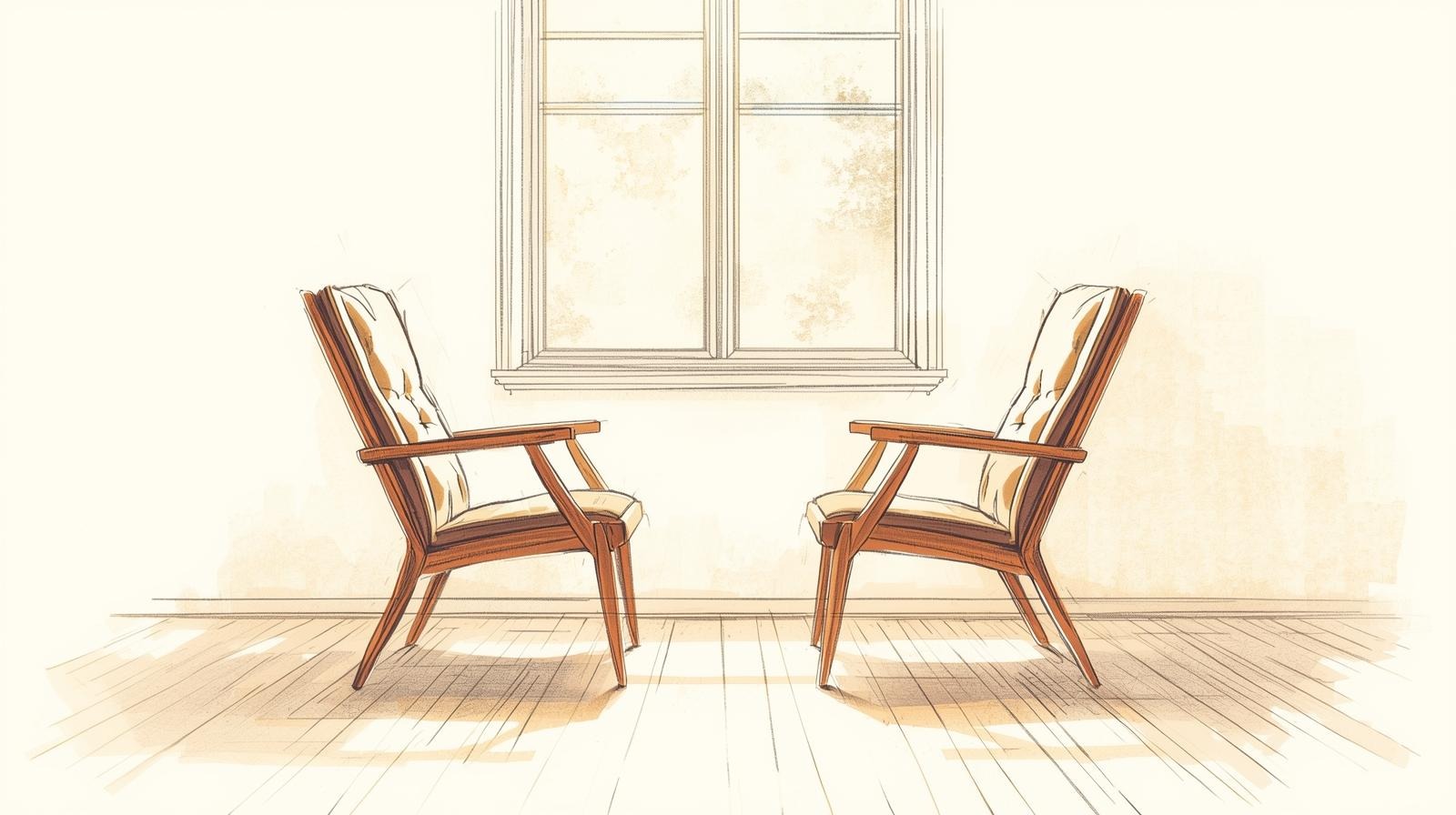
The Two Chair Reset is a short, oddly simple practice that uses two seats and a guided mini dialogue to help you shift states quickly. It is inspired by chairwork, an umbrella term for experiential interventions used across several psychotherapy approaches. Chairwork is not a social media trend. A recent systematic review of randomized controlled trials concludes that chairwork interventions show efficacy across different therapeutic approaches and a range of difficulties, with effect sizes that vary by study and target, which is exactly what you would expect in a broad method applied in multiple contexts.
In Calm Space language, the Two Chair Reset is not about becoming perfectly zen. It is about regaining steering. It helps you move from flooded to guided, from fused with the panic to able to lead it, from numb to gently present. You will probably feel a little silly the first time. That is a feature. The “weird” part interrupts autopilot, and autopilot is where spirals breed.
If you want a one sentence definition you can remember in the moment, here it is.
Signal Seat → Safety Seat → Bridge Action.
You give your protective state a clear place to speak. You move your body into a different context. Then you take one small action that proves you are back in leadership.
Why You cannot always think Your way into calm
When your system detects threat, even social or emotional threat, it shifts toward protection. That shift is not only “in your head.” It changes physiology, attention, and what your brain prioritizes. Models of autonomic regulation describe nervous system states that support mobilization, shutdown, or social engagement, depending on cues of safety and danger.
This matters for one simple reason: most coping strategies fail at the moment you need them because they assume you have full access to yourself. But in a threat state, your access is narrowed. Your mind tends to scan, predict, defend, or collapse. Your body tends to brace or disconnect. You can call it anxiety, overthinking, shutdown, or numbness, but under the label is a state.
So the goal is not to eliminate feeling. The goal is to regain flexibility.
When you build the ability to switch states, you stop being trapped inside one mode. You develop what many researchers call emotion regulation capacity, which is supported by both cognitive processes and body based processes such as interoception, your ability to notice and interpret bodily signals.
The Two Chair Reset is designed for that exact moment when you do not have the energy to journal for an hour, meditate for thirty minutes, or “process your childhood” before your next meeting. It is a fast switch practice.
What chairwork is and why two chairs are not a gimmick
Chairwork refers to a family of experiential methods that use chairs, positioning, and guided dialogue to bring inner parts, conflicts, and needs into clearer contact. In cognitive behavioral contexts, chairwork has been described as a set of techniques that can help people externalize inner experiences, reduce fusion with self criticism, and create emotional shifts that talk alone often cannot create.
The most important thing about chairwork is not the chair. It is the combination of two ingredients.
The first ingredient is physical differentiation. Your body moving from one place to another creates a boundary between “I am the storm” and “I am noticing the storm.” That boundary is tiny, but it is everything.
The second ingredient is structured dialogue. Instead of letting your mind spin in circles, you give it a track to run on. You turn chaos into a conversation.
Research on chairwork includes both qualitative work describing how clients articulate self criticism, self protection, and self compassion during chair dialogues, and broader trial evidence summarized in systematic reviews.
This is why the Two Chair Reset can feel weirdly effective. You are not trying to convince yourself. You are changing context and contact.
What the Two Chair Reset targets: Switching states, not fixing feelings
A lot of self help quietly teaches you to treat certain emotions as problems to solve. The Two Chair Reset teaches you to treat them as signals to meet from a steadier place.
Here is what “success” looks like in this practice.
You do not necessarily feel calm.
You feel steerable.
You might still be sad, still angry, still anxious, still tender. But you can choose your next sentence. You can slow down the spiral. You can feel your feet. You can soften your jaw. You can stop feeding the inner critic. You can make one small move toward what you need.
If you want a visual map, hold this in your mind.
Signal → Safety → Bridge.
Or, if you like slightly nerdy structure.
Name → Tell → Meet → Bridge.
We will use both.
Set up: Your two chairs and your two roles
You need two seats that feel distinct. A dining chair and your desk chair work. A chair and the edge of your bed work. A sofa cushion and the floor work. If you only have one chair, you can sit for one role and stand for the other. The nervous system reads contrast.
You will name the chairs.
Chair A is the Signal Seat.
Chair B is the Safety Seat.
Signal Seat means, this is where the activated or shut down state gets to speak honestly.
Safety Seat means, this is where your regulating voice leads with steadiness, realism, and care.
If the word “safety” feels too big, use “steady.” If “signal” feels strange, use “storm.” Make it yours.
One more important point: the Safety Seat is not about being positive. It is about being truthful in a way that creates options.

The three minute Two Chair Reset, step by step
This is the core method. Read it once now. Then later, when you need it, use the table that follows.
Step 1: Sit in the Signal Seat and name your state
Do not rush. Put both feet down. Let your hands rest somewhere neutral.
Say out loud, in simple words.
Right now, my state is ______.
The strongest body signal is ______.
The urge I notice is ______.
This is not poetic. It is regulatory.
There is a strong research line on affect labeling, the act of putting feelings into words, as a form of emotion regulation that can influence experiential, autonomic, neural, and behavioral domains.
You are not trying to analyze your childhood here. You are giving your system a clear signal: I am noticing what is happening.
Step 2: Still in the Signal Seat, let the state speak for thirty to sixty seconds
Use this structure.
What I am trying to do for you is ______.
What I am afraid would happen if I stopped is ______.
What I need right now is ______.
This is a crucial reframe: you treat the state as protective, even if it is messy. Protective does not mean correct. It means it is trying.
Step 3: Stand up and move to the Safety Seat
Make the movement deliberate. You are not switching chairs like you forgot something. You are switching contexts.
As you sit down, orient to the room. Let your eyes land on a neutral object, then another, then another. Feel your feet. Take one normal breath.
Then speak from the Safety Seat.
I hear you. You are not wrong for feeling this.
Here is what is true in this room right now: ______.
Here is what we are doing in the next ten minutes: ______.
You do not have to disappear. You can soften while I lead.
Compassion focused approaches use structured compassionate relating to shift threat based inner dynamics, and meta analytic evidence suggests compassion focused therapy can improve compassion based outcomes and reduce symptoms in clinical populations, while also noting the field needs more long term and methodologically strong studies.
In other words, you are not making up comfort. You are practicing a kind of inner leadership that research suggests can matter.
Step 4: Bridge with one micro action
End with a bridge statement that includes a small action you will take immediately.
Signal, I am taking you with me. We are doing ______ now.
The action can be tiny. Drink water. Open a window. Write one sentence. Put your hand on your chest and feel the warmth for thirty seconds. Step outside for two minutes. Name five objects. Wash your hands slowly.
Your nervous system trusts action more than promises.
The table You can use when Your brain is scrambled
Use this exactly as written. You can even screenshot it.

Why this works faster than “just journaling”
Journaling can be a beautiful practice, but it keeps you in one posture, one context, one seat. The Two Chair Reset adds physical differentiation, which interrupts fusion. When you move your body, you send a cue that something is changing.
It also adds structured dialogue, which reduces rumination loops. And it adds a bridge action, which creates behavioral proof of leadership.
These ingredients also align with research emphasizing the importance of interoception and autonomic regulation in emotion regulation. A systematic review on interoception, vagal tone, and emotion regulation suggests that awareness of bodily feelings and vagal activation appear centrally important for regulating emotional responses, while also noting limitations in the available evidence base.
The Two Chair Reset is a practical way to train awareness and response without needing an hour of quiet.
The Two Chair Reset is not therapy, but it borrows therapy’s best mechanics
To be clear, this is a simplified self practice. In therapy, chairwork can go deeper, for example working with self criticism, unresolved feelings, or internal conflicts. There is ongoing clinical research on brief chairwork interventions, including work targeting self criticism in depression and examining feasibility and safety.
What we are doing here is lighter. We are using the mechanics, not the full depth.
Mechanics are enough to switch states.
The most common mistake, and the quick fix
The mistake is trying to be wise in the Signal Seat.
People sit in Chair A and immediately start coaching themselves, judging themselves, or explaining why they should not feel this way. That turns the Signal Seat into another place where pressure lives.
In the Signal Seat, your job is not wisdom. Your job is truth.
Truth sounds like.
I feel scared.
I feel blank.
I feel furious.
I feel ashamed.
I feel like running.
I feel like disappearing.
Then you move.
Wisdom belongs in the Safety Seat.
Scripts You can read out loud for different states
These are meant to be used in real life. If the words feel awkward, keep the structure and change the language.
Script A: Anxiety spiral → grounded steering
Signal Seat.
I am speeding up because I think something bad is coming. I am trying to prevent regret or humiliation. If I stop scanning, I fear I will miss the moment I should act. What I need right now is reassurance that we are not in immediate danger and we can take this one step at a time.
Safety Seat.
I hear you. You are trying to protect me. Here is what is true right now: I am in a room, breathing, not being chased. The next ten minutes are simple: water, one clear next step, then a pause. You can stay alert, but you do not get to run the whole body.
Bridge.
I’m taking you with me. We are choosing one next step now.
Script B: Numb shutdown → gentle contact
Signal Seat.
I feel blank. I cannot access emotion. I am trying to reduce overload. If I let myself feel, I fear I will collapse or drown. What I need is less demand and more gentleness.
Safety Seat.
Thank you for protecting me. Numbness is a strategy, not a flaw. Here is what is true: my body is here even if my feelings are quiet. The next ten minutes are about contact, not meaning. I will notice three sensations without forcing anything. You do not have to open everything. You only have to let in a crack of air.
Bridge.
I’m taking you with me. We are doing ninety seconds of sensation now.
Script C: Self criticism → self protection and self respect
Signal Seat.
I am attacking you because I think it will make you improve. If I stop, I fear you will fail and be rejected. What I need is control.
Safety Seat.
I hear the fear underneath the harshness. But we are not using inner violence for growth anymore. Here is what is true: shame rarely creates sustainable change. The next ten minutes are about one small repair action, not punishment. I will protect us from inner abuse. You can advise, but you cannot insult.
Bridge.
I’m taking you with me. We are doing one kind action plus one practical step now.
Qualitative research on emotion focused chair tasks has examined how clients express self criticism, self protection, and self compassion during chair dialogues, highlighting that self protection statements can be prominent, which supports the idea that protective leadership is an active trainable stance, not just a vibe.

Table: The fastest prompts for each state flavor
If you do not want to memorize scripts, memorize prompts.

The nervous system layer, explained without hype
Online, “vagus nerve” content can become exaggerated. The honest version is more nuanced.
Researchers often use heart rate variability, especially vagally mediated measures, as one index of autonomic regulation and flexibility. Reviews suggest links between higher HRV and more adaptive emotion regulation patterns, while also emphasizing the complexity of these relationships and the need for careful interpretation.
There is also a growing evidence base for interventions that directly train physiological flexibility. For example, a meta analysis published in Scientific Reports examined heart rate variability biofeedback and depressive symptoms, reflecting a broader trend of testing whether training autonomic regulation can improve psychological outcomes. Another meta analysis in a comorbid adult context similarly evaluates outcomes and HRV changes, showing the field is actively studying both symptom and physiological effects.
So where does the Two Chair Reset fit.
It is not biofeedback. It is not a clinical protocol. It is a practical state switch exercise that indirectly trains three things that matter.
It trains interoceptive contact, because you name body signals. Interoceptive ability is increasingly recognized as central to emotion experience and regulation, and reviews suggest it can be trained through mind body interventions.
It trains cognitive labeling, because you name the state, which aligns with affect labeling research.
It trains compassionate leadership, because you practice a Safety Seat voice that reduces inner threat, which connects with compassion focused therapy evidence.
That combination is why it can feel fast.
The nonstandard twist: Turn it into a “state switch algorithm” You can run anywhere
Here is a slightly unconventional way to use this practice. Instead of treating it as an exercise you do only when things fall apart, treat it like a short internal operating system you can run in tiny moments.
You do not wait until you are at a ten out of ten. You run it at a four.
Here is the algorithm.
Trigger noticed → state named → body cue named → protective goal named → switch seat → reality checked → ten minute plan chosen → bridge action taken.
Now read that again and imagine it with arrows.
Trigger → Name → Tell → Switch → Meet → Plan → Bridge.
If your mind likes structure, this format can feel strangely relieving because it removes the pressure to “do it perfectly.” You simply run the steps.
Troubleshooting, when it feels fake or awkward
If the Safety Seat voice feels fake, make it more neutral.
Instead of “I love you and everything will be okay,” try something steadier.
I’m here.
I’m not leaving.
We will take one step.
I can handle the next ten minutes.
Neutral is often safer than sweet, especially if your nervous system learned that warmth was inconsistent or conditional.
If the Signal Seat gets louder at first, shorten it.
Do thirty seconds in Signal Seat, then move. The movement is part of the regulation cue. Do not turn the Signal Seat into a stage where panic performs.
If you struggle to feel anything in either seat, add sensory anchors.
In the Safety Seat, press your feet into the floor for five seconds. Let your eyes track slowly across the room. Orientation is a powerful cue.
Table: Choose Your reset version based on time and intensity
This helps you adapt without overthinking.

A seven day Calm Space experiment that makes this automatic
Most people try new tools only when they are already drowning. If you want the Two Chair Reset to work fast in real moments, practice when the intensity is low. That is how state access becomes familiar.
Here is a simple seven day experiment.

This is not about becoming a new person in a week. It is about building a familiar path back to yourself.
The part of You that panics is not Your enemy, it is a signal
One of the quiet gifts of this practice is that you stop treating your protective states like moral failures. You start treating them like information.
Anxious parts try to prevent pain.
Numb parts try to reduce overload.
Critical parts try to keep you safe through control.
You do not have to obey them. But you do have to meet them, because what you resist tends to drive from the back seat.
So tonight, if you want something simple and real, do this.
Signal Seat, one honest minute.
Safety Seat, one steady minute.
Bridge action, one small proof.
Signal → Safety → Bridge.
That is the Two Chair Reset.
Related posts You’ll love
- When You’re triggered but still have to be nice: Composure tools that work in real time (without self abandonment)
- Emotional pace: The calm skill that lets You slow Your reactions without suppressing Your feelings
- The tongue drop technique: A fast calm hack most people never learn (and why it works so well)
- Collecting calm moments like souvenirs: A science backed way to remember Your life
- Quiet confidence: 12 practices that make You feel internally steady (even on hard days)
- The laughter lab at home: A weird 10 minute experiment that makes You feel closer to people fast (backed by science)
- Misreading: The ultimate context check toolkit to stop viral confusion fast

FAQ: The Two Chair Reset
-
What is the Two Chair Reset?
The Two Chair Reset is a short chairwork inspired exercise that helps you switch nervous system states fast by moving between two seats: the Signal Seat (your activated or shut down state) and the Safety Seat (your steady, regulating voice). The physical switch plus structured self dialogue helps you go from spiraling to steerable without forcing “instant calm.”
-
How does the Two Chair Reset help with anxiety?
Anxiety often pulls you into scanning, overthinking, and urgency. The Two Chair Reset interrupts that loop by letting the anxious “signal” speak briefly, then moving your body into a different context where you reality check, choose a ten minute plan, and take one micro action. It’s a quick grounding practice for anxiety because it combines naming feelings, orienting to the room, and leadership language.
-
Can the Two Chair Reset work for numbness or emotional shutdown?
Yes, and it can be especially helpful when you feel disconnected or “blank.” In the Signal Seat you name the shutdown state without judging it, and in the Safety Seat you focus on gentle contact, like tolerable sensations and small, non demanding actions. The goal is not to force emotions, but to restore safe presence in your body.
-
How long does the Two Chair Reset take?
Most people can do a full Two Chair Reset in about three minutes. If you are highly activated, you can shorten the Signal Seat to thirty seconds and spend a little longer in the Safety Seat, making it a four to six minute reset. The key is ending with a bridge action so your nervous system feels forward movement.
-
Is the Two Chair Reset the same as the classic two chair technique in therapy?
It is inspired by the same family of chairwork methods, but simplified for self regulation and fast state switching. In therapy, two chair dialogues can go deeper into inner conflict, self criticism, and unresolved emotional experiences. The Two Chair Reset keeps the structure lightweight and practical so you can use it in everyday overwhelm.
-
What if I only have one chair?
You can do a one chair version by sitting for the Signal Seat and standing for the Safety Seat. Your nervous system still registers contrast through posture, eye orientation, and tone of voice. Keep the sequence the same: name, let the signal speak briefly, switch posture, lead with steadiness, then take one micro action.
-
Can I use the Two Chair Reset at work or in public?
Yes, you can make it subtle. Use two locations instead of two chairs, for example one side of your desk as the Signal Seat and another as the Safety Seat, or sit then stand in a restroom break. You can do the dialogue quietly in your head, but still do the physical switch and the bridge action, like a sip of water or one clear next task.
-
Does the Two Chair Reset help with self criticism and the inner critic?
It can be very effective for harsh self talk because it separates the critic voice from your steady leadership voice. In the Signal Seat, the critic gets heard without taking over. In the Safety Seat, you set an inner boundary, reduce shame based pressure, and choose one respectful next step, which is often more motivating than self attack.
-
Why does switching chairs change how I feel so quickly?
Because state shifts are embodied. Moving your body changes sensory cues, attention, and posture, which can reduce “fusion” with the activated state and make regulation strategies more accessible. The structure also replaces rumination with a clear sequence, which helps your brain exit the loop and return to choice.
-
How often should I practice the Two Chair Reset?
For best results, practice once a day during mild stress, not only during crises. Repetition builds faster access to the Safety Seat voice, so the state switch becomes more automatic when you actually need it. Even a two minute version can train nervous system flexibility over time.
-
What if the Two Chair Reset feels fake or awkward?
Awkwardness is common and not a sign you’re doing it wrong. If “compassionate” language feels cheesy, use neutral steadiness instead, such as “I’m here, I’m not leaving, we’ll take one step.” The point is not perfect wording, it is creating a reliable internal handoff from signal to leadership.
-
Is the Two Chair Reset safe for trauma?
It can be supportive, but if you experience intense dissociation, panic, or trauma memories, it’s wiser to do it gently or with professional support. Keep the Signal Seat brief, anchor in the room with your eyes and feet, and choose very small bridge actions. If it consistently escalates distress, switch to simpler grounding first and consider working with a therapist.
Sources and inspirations
- Ottingerová, L., (2025). The Efficacy of Chairwork Interventions: A Systematic Review of Randomized Controlled Trials. Frontiers in Psychology.
- Pugh, M. (2018). Cognitive behavioural chairwork. International Journal of Cognitive Therapy.
- Torre, J. B., Lieberman, M. D. (2018). Putting Feelings into Words: Affect Labeling as Implicit Emotion Regulation. Emotion Review.
- Pinna, T., Edwards, D. J. (2020). Associations Between Interoception, Vagal Tone, and Emotional Regulation: A Systematic Review. Frontiers in Psychology.
- Bell, T., (2020). Multiplicity, transformation and integration in compassion focused therapy chairwork. Journal of Psychotherapy Integration.
- Millard, L. A., (2023). The effectiveness of compassion focused therapy with clinical populations: A systematic review and meta analysis. Journal of Affective Disorders.
- Wesarg, C., (2022). Childhood adversity and vagal regulation: A systematic review and meta analysis. Neuroscience and Biobehavioral Reviews.
- Pizzoli, S. F. M., (2021). Heart rate variability biofeedback and depressive symptoms: A meta analysis. Scientific Reports.
- Donnelly, D., (2023). Outcomes and correlation in HRV biofeedback for depressive symptoms in comorbid adult populations: A meta analysis. Acta Biomed.
- Porges, S. W. (2025). Polyvagal theory: a journey from physiological observation to neural innervation and clinical insight. Frontiers in Behavioral Neuroscience.
- Lazzarelli, A., (2024). Interoceptive Ability and Emotion Regulation in Mind Body Interventions: An Integrative Review. Behavioral Sciences.
- Bailey, G., Halamová, J., Gablíková, M. (2022). Qualitative Analysis of Chair Tasks in Emotion Focused Therapy Video Sessions. International Journal of Environmental Research and Public Health.
- Kroener, J., (2024). Working with the inner critic in patients with depression using chairwork: a pilot study. Frontiers in Psychiatry.




Leave a Reply