Table of Contents
What ambient anxiety really feels like
Some anxiety arrives loudly. It crashes into your day with a racing heart, a spiraling thought, or a full-body sense that something is wrong.
Ambient anxiety is different.
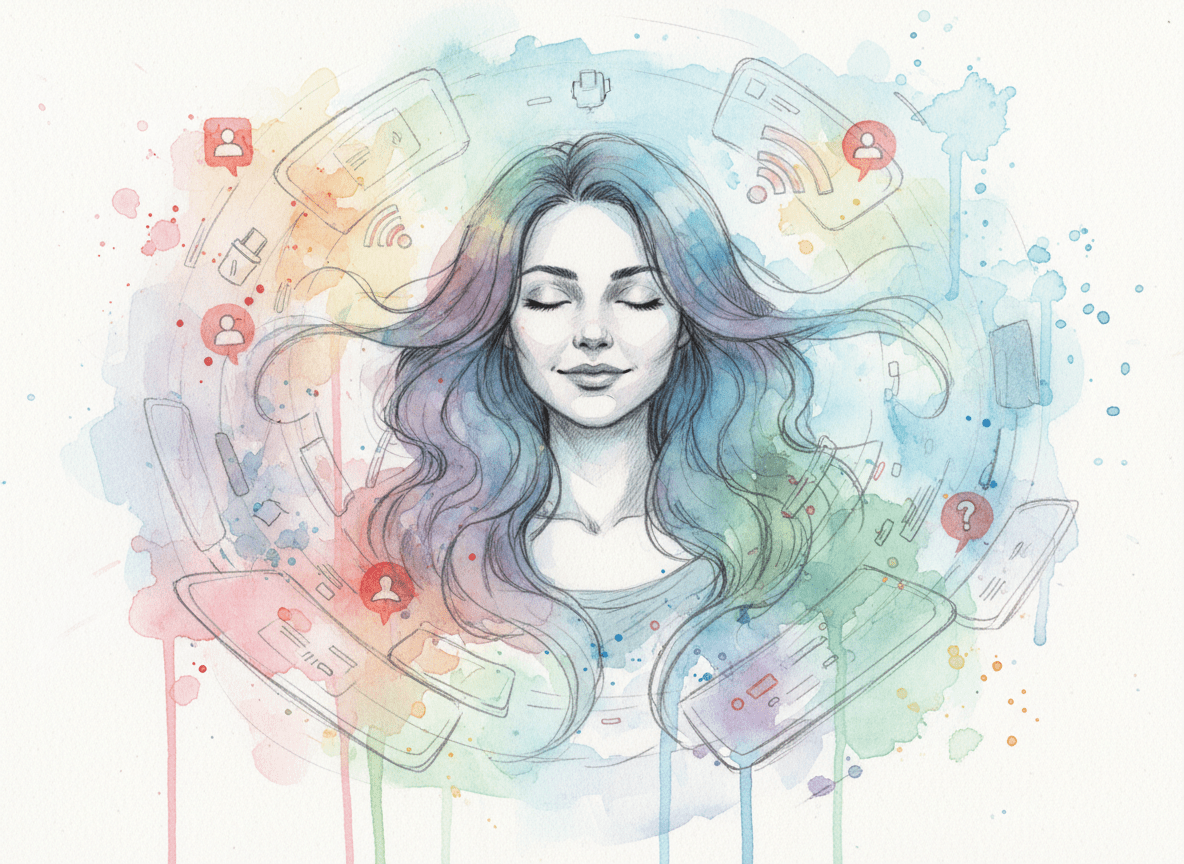
It does not always announce itself as panic. Often, it hums in the background like electricity in the walls. It feels like checking your phone without meaning to. It feels like never fully landing in one moment because part of you is waiting for the next message, the next update, the next subtle reason to stay alert. It feels like rest that never becomes real rest.
That is why so many people miss it. They think anxiety has to be dramatic to count. They think if they are still functioning, still replying, still working, still showing up, then what they feel must be “just stress.” But the body does not only react to emergencies. It also reacts to accumulation. Anxiety disorders are already the most common mental disorders globally, and stress remains deeply woven into modern life; in APA’s 2025 Stress in America survey, 62% of U.S. adults said societal division was a significant source of stress.
In this article, I use ambient anxiety as a descriptive phrase for the low-level, chronic unease many people feel in an environment that rarely goes quiet. It is the kind of anxiety fed by uncertainty, constant contact, unfinished digital loops, attention fragmentation, poor sleep, information overload, and the exhausting emotional demand of being mentally reachable all the time. Research on uncertainty shows that intolerance of uncertainty predicts higher anxiety and worry, and newer work suggests that information overload and rumination can intensify that anxious state even further.
What makes ambient anxiety so draining is not only that it hurts. It is that it becomes normal. You stop asking, “Why do I feel so activated?” and start believing, “This is just how life feels now.”
It does not have to stay that way.
Why the always-on world keeps Your body half-alert
The modern nervous system is asked to do something profoundly unnatural: remain open to interruption almost all the time.
Your devices do not simply give you information. They create anticipation. They train the brain to expect contact, novelty, urgency, and comparison. Even when nothing bad is happening, the possibility that something could happen keeps part of the mind scanning. This is one reason uncertainty can feel so exhausting. The anxious brain is not only reacting to danger. It is trying to prepare for every possible version of it.
The problem is not screens in a simplistic sense. The problem is unclosed loops. A message you have not answered yet. A headline that hints at catastrophe but offers no resolution. A work chat that enters your evening. A social feed that keeps you comparing your internal state to everyone else’s curated external life. A phone that turns every pause into a portal back into stimulation.
And importantly, research suggests it is not merely “being online” that matters most. The sharper mental-health associations appear when use becomes problematic, compulsive, or emotionally dysregulated. A 2024 systematic review and meta-analysis found moderately positive associations between problematic social networking use and several anxiety dimensions, including generalized anxiety, social anxiety, attachment anxiety, and fear of missing out. A 2022 meta-analysis in adolescents and young adults also found a significant relationship between problematic social media use and anxiety symptoms.
Work adds another layer. In an always-on culture, the boundary between “I am available” and “I exist” gets dangerously thin. Research on the right to disconnect describes hyperconnectivity as a growing digital-wellbeing concern, precisely because today’s technologies make it easy for work to keep reaching into hours that were once protected for recovery.
A simplified version of the cycle often looks like this:
Uncertainty → checking → information overload → rumination → worse sleep → thinner emotional resilience → more checking
That loop is not weakness. It is adaptation. Your system is trying to stay ahead of discomfort. The tragedy is that the strategy that promises relief often becomes the thing that keeps anxiety alive. Research on information overload, uncertainty, sleep, and hyperconnectivity supports this broader pattern, even though each person lives it in a slightly different way.
A practical map of ambient anxiety
Table 1 below is a practical synthesis of current evidence on uncertainty, information overload, problematic digital engagement, sleep, and work hyperconnectivity.

Signs Your nervous system is carrying too much background stress
Ambient anxiety rarely says, “Hello, I am ambient anxiety.”
It usually shows up sideways.
Maybe you are more irritable than usual, but only in small ways. Maybe you feel a strange internal rush when your phone lights up, even if the message is trivial. Maybe you are increasingly tired, but true rest does not arrive. Maybe you cannot tell whether you are overwhelmed because you are busy, or busy because you cannot tolerate the feeling of stopping.
Many people notice a creeping loss of emotional spaciousness. Their patience shortens. Their concentration splinters. Their evenings feel oddly thin, as if the day never properly ended. They start to confuse numbness with calm because both can look quiet from the outside.
Sleep is often one of the clearest mirrors. A 2024 systematic review on insomnia and anxiety described sleep disturbance as an important modifiable factor in anxiety and related disorders, noting how insomnia, hyperarousal, dysfunctional cognition, worry, and emotion dysregulation can reinforce one another. In other words, poor sleep is not merely an annoying side issue. It can become part of the machinery that keeps anxious living in motion.
You may also notice something subtler: joy becomes harder to enter. Not impossible, just harder. Presence feels expensive. Leisure becomes another tab in the mind. You sit down to watch something or read something or talk to someone you love, and some part of you remains standing, mentally, by the door.
That is often the real cost of ambient anxiety. Not just fear, but partial absence from your own life.
How to calm ambient anxiety in an always-on world
Calming ambient anxiety is not about becoming perfectly zen while the world stays chaotic. It is about reducing unnecessary activation, increasing your sense of safety in the body, and building a life rhythm that does not keep your nervous system permanently reachable.
The most effective approach is usually not dramatic. It is layered.
1. Lower the background load, not just Your screen time
Many people try to solve ambient anxiety by promising themselves to “use the phone less.” That goal is too vague to hold. A better question is this: Which forms of input leave me more activated than informed?
That shift matters. Because the issue is often not total use. It is the specific forms of use that create emotional residue. Problematic or compulsive digital engagement appears more strongly linked with anxiety symptoms than simple exposure alone. That means your healing may not start with becoming anti-tech. It may start with becoming more selective.
Try reducing background exposure before reducing total exposure. Turn off nonessential notifications. Remove news alerts from your lock screen. Move stimulating apps off your home screen. Keep your phone in another room during the first and last 30 minutes of the day. Batch messages rather than grazing on them all day long.
This is not punishment. It is environmental design. You are not trying to become more disciplined than your nervous system. You are trying to stop throwing pebbles at it every four minutes.
2. Create friction for frantic checking
An anxious system loves immediacy. It wants the answer now, the reassurance now, the update now.
So one of the gentlest ways to calm ambient anxiety is to add tiny, compassionate delays between impulse and action. Not forever. Just enough to let your body remember that urgency is not always truth.
Put one full breath between noticing the urge and unlocking the phone. Drink water before opening email. Stand up before rechecking a message thread. Ask yourself, “What am I hoping this will make me feel?” Often the answer is not “informed.” It is “safe,” “certain,” “less alone,” or “less behind.”
Research on uncertainty and information overload helps explain why this works. If overload and rumination are part of the anxiety chain, then even small interruptions to automatic checking can reduce how intensely the loop runs.
This is not a productivity trick. It is a nervous-system kindness.
3. Give Your body a predictable rhythm
An anxious body does not only need less stimulation. It needs more predictability.
One of the quiet reasons ambient anxiety grows is that the body no longer knows when effort ends. Work leaks into evening. News leaks into meals. Messages leak into rest. The result is a life with very few real edges.
Routine is not glamorous, but it is regulating. Wake up at a similar time when you can. Eat with some regularity. Give the nervous system a repeated cue that morning is morning, afternoon is afternoon, and evening is not a bonus workday.
You do not need a hyper-optimized ritual. You need recognizable markers of safety.
A few examples can help:
Morning light → signal wakefulness and orientation
Midday movement → discharge buildup before it hardens into tension
Evening dimness → tell the body the world is narrowing now
Phone-off window → restore the experience of psychological distance
Predictability does not remove uncertainty from life. It reduces the amount of uncertainty your body has to negotiate at home.
4. Treat sleep as emotional first aid
In a stressed culture, sleep is often framed as a reward you earn after everything else is done. That framing quietly destroys recovery.
If your anxiety feels strangely sticky, sleep deserves serious attention. The link between insomnia and anxiety is not superficial. Sleep disturbance can intensify worry, emotional reactivity, hyperarousal, and cognitive strain, while anxiety itself can make restful sleep more elusive. That bidirectional loop is one reason so many people feel “tired but still mentally on.”
This does not mean you need a perfect sleep routine. It means you may need a more protective one.
A calmer evening tends to work better than a more “productive” one. Reduce late-night emotional input. Stop consuming content that leaves you internally activated. Dim lights earlier. Let your last thirty to sixty minutes feel boring in the best possible way. Calm is rarely manufactured through intensity.
Most of all, stop making sleep another performance arena. The body sleeps more easily when it is met with permission, not pressure.
5. Use movement as discharge, not self-improvement
When anxiety accumulates in the body, it often needs somewhere to go.
Movement can help because it gives activation a pathway. Not as punishment. Not as a body project. As discharge.
The evidence base for physical activity and anxiety is strong enough to take seriously. A 2024 meta-analysis of randomized controlled trials in older adults found that physical activity significantly reduced anxiety symptoms, with benefits across exercise types. WHO also lists regular exercise as helpful for anxiety prevention and self-care.
For ambient anxiety, the best movement is often the kind that says, “Come back into your body,” not, “Fix yourself.”
Walking is particularly underrated. It gives the eyes distance. It softens overfocus. It invites bilateral movement. It changes scenery without demanding high performance. Nature-based walking interventions, in particular, have been associated with improvements in mood, optimism, mental well-being, and nature connectedness, while also helping reduce stress, anxiety, and rumination.
- Think less in terms of “workouts” and more in terms of “state changes.”
- A brisk ten-minute walk can be a state change.
- Stretching before bed can be a state change.
- Shaking out your hands and shoulders after a tense meeting can be a state change.
Your body often needs relief before your mind can believe relief is possible.
6. Practice digital-age mindfulness, not perfectionist mindfulness
Mindfulness is often sold in ways that make anxious people feel worse. Sit perfectly. Empty your mind. Be serene. Achieve peace.
Real mindfulness is humbler than that.
It is the act of noticing what is happening without instantly becoming fused with it. The feeling in your chest. The tightening jaw. The urge to check. The storyline that says, “Something is off; find more information.” Online mindfulness-based interventions have shown beneficial effects on anxiety symptoms in adults, suggesting mindfulness remains a useful tool even when delivered in modern formats.
For ambient anxiety, mindfulness works best when it is short, embodied, and unspectacular.
Try this:
Place both feet on the floor.
Exhale longer than you inhale.
Look around the room and name five ordinary things.
Say quietly, “I am here. Nothing is asking me to solve everything in this second.”
That is mindfulness too.
So is noticing that your body got hijacked by a headline and choosing not to open six more tabs. So is seeing the spiral begin and deciding to wash a cup slowly instead. So is feeling overstimulated and stepping outside before you explain it away.
Mindfulness is not escape from modern life. It is the recovery of choice inside it.
7. Return to the physical world on purpose
Ambient anxiety thrives in abstraction. It grows in projected futures, digital interpretations, imagined conversations, invisible judgments, algorithmic atmospheres.
The physical world interrupts that.
Not always dramatically. Often gently.
A real cup of tea. A shower. Bare feet on the floor. A walk without audio. The weight of laundry in your hands. A room with lower light. Fresh air on your face. One song played all the way through without multitasking.
These are not trivial things. They are cues of embodiment. And embodiment matters because anxiety is often maintained by living a few inches above the body, in prediction, scanning, and cognitive overdrive.
Nature can be especially powerful here, not because it magically cures distress, but because it widens attention and reduces the psychological compression of digital life. Research on nature-based walking suggests meaningful benefits for stress, rumination, mood, and mental well-being.
When people say they want peace, they often imagine a different life. Sometimes what they really need first is a more physical one.
A gentle calm menu for busy, overstimulated days
This framework is practical rather than clinical. Use it like a menu, not a rulebook.

The nonstandard truth: Calm is often more about boundaries than techniques
This part matters.
Many people try to meditate their way out of an environment that is still overstimulating them all day. They try to breathe better while remaining endlessly available. They try to sleep deeper while consuming emotionally charged content right until bedtime. They try to feel peaceful while treating every notification like a moral summons.
That is not a personal failure. It is a design problem.
Sometimes the most healing thing is not adding another coping practice. It is removing one source of unnecessary contact.
A scoping review on the right to disconnect describes how hyperconnectivity and work-related communication outside normal hours have become serious concerns for digital well-being. That matters far beyond corporate policy. It reflects a deeper cultural mistake: the belief that access equals care, speed equals competence, and constant response equals value.
Peace usually begins where total access ends.
You may need:
- a slower morning,
- a later reply,
- a smaller news diet,
- a different evening,
- a stronger boundary with work,
- a more boring phone,
- a more physical life,
- a deeper tolerance for not knowing everything immediately.
These are not glamorous changes. They are powerful ones.
A softer daily rhythm for real inner calm
If ambient anxiety has been your normal for a while, do not try to become a different person overnight. Build a rhythm your body can believe.
In the morning, resist instant invasion. Let your own mind greet you before the world does. Light, water, breath, movement, even two quiet minutes before screens can change the emotional tone of the entire day.
In the middle of the day, interrupt accumulation before it becomes overwhelm. Do not wait until your body is shouting. Give it small exits: a walk, a stretch, a meal eaten without scrolling, one task done with full attention, one moment of looking at something far away.
In the evening, act as if your nervous system deserves a closing ritual. Because it does. Dim the light. Lower the sound. End the endless inputs earlier than feels necessary. Let your body experience the dignity of being unreachable for a little while.
This is what many adults are starving for: not more hacks, but more permission.
- Permission to be offline.
- Permission to be uninformed for one hour.
- Permission to stop refreshing.
- Permission to rest before exhaustion becomes collapse.
- Permission to create a life that does not keep your system on standby.
That permission is not laziness. It is repair.
You do not need to earn calm
Ambient anxiety can make you believe that peace is something you access only after the inbox is empty, the world is stable, the future is clear, and your mind has finally behaved.
That moment rarely comes.
Real calm is not the reward for finishing life correctly. It is a relationship you build with your body, your attention, your boundaries, and your environment. It grows when you stop asking your nervous system to be available to everything at once. It deepens when you choose rhythm over reactivity, embodiment over abstraction, and enough over excess.
The always-on world will keep offering you more stimulation, more urgency, more reasons to remain slightly alert.
You do not have to accept every invitation.
Sometimes healing begins with one quiet decision:
I am allowed to come back to myself now.
Related posts You’ll love
- 5-minute breathing techniques for anxiety and emotional reset: science-backed ways to calm Your mind fast
- Practice corner: The 14-day anti–people-pleasing sprint at work. With FREE PDF workbook!
- The “not my emotion” vocabulary: How to stay separate from other people’s stress without losing Your empathy
- Hosting as calm: Low-stimulus gathering ideas that soothe the nervous system
- Home from a party: Cleanse, calm, close — A science-backed after-social ritual for deep rest
- Practice corner: From FOMO to JOMO—A 14-day reset (with FREE PDF!)

FAQ
-
What is ambient anxiety?
Ambient anxiety is a useful descriptive term for low-level, chronic background unease that may not feel like full panic, but still keeps you mentally and physically on edge. It often shows up as restlessness, compulsive checking, difficulty settling, irritability, and a feeling that you are never fully off.
-
Is ambient anxiety the same as an anxiety disorder?
Not necessarily. Anxiety disorders are clinical conditions with diagnostic criteria, while ambient anxiety is a broader descriptive phrase. Still, persistent anxiety symptoms deserve attention, especially if they are impairing sleep, work, relationships, or daily functioning. WHO notes that effective treatments for anxiety do exist, including psychological interventions and self-care strategies such as relaxation, mindfulness, sleep regularity, and exercise.
-
Why does my phone make me anxious even when nothing bad happens?
Because the phone is not only delivering content. It is delivering anticipation, interruption, novelty, uncertainty, and social evaluation. Problematic social networking use has been linked with multiple anxiety dimensions, which helps explain why you can feel more activated even after “casual” checking.
-
Is social media always bad for anxiety?
No. The stronger concern in current research is not simple use, but problematic or compulsive use. Social media can offer connection, creativity, humor, and support. The key question is whether it leaves you feeling more grounded or more dysregulated afterward.
-
What helps fastest when I feel that “tired but wired” state?
Try body-first calming rather than thought-first calming: a longer exhale, less input, lower light, physical movement, stepping away from screens, and simpler sensory experiences. When sleep and anxiety reinforce one another, reducing stimulation before bed can matter more than forcing yourself to think positively.
-
Can mindfulness really help if my mind is constantly racing?
Yes, but it helps most when you redefine it. Mindfulness is not making your mind empty. It is noticing what is happening without immediately obeying every anxious impulse. Online mindfulness-based interventions have shown benefits for adult anxiety symptoms, which suggests even accessible, modern formats can help.
-
What is better for ambient anxiety: meditation or exercise?
Usually both can help, but in different ways. Meditation can increase awareness and reduce fusion with anxious thoughts. Exercise can discharge built-up activation and regulate mood through the body. For many people with background anxiety, movement can make meditation easier afterward.
-
Does walking outside actually make a difference?
Often, yes. Nature-based walking interventions have been associated with better mood, more optimism, reduced stress, and less rumination and anxiety. It is one of the most accessible low-cost practices for many people.
-
Why do I keep doomscrolling when it makes me feel worse?
Because the anxious brain often confuses more information with more control. Under uncertainty, checking can feel like self-protection. But once information turns into overload and rumination, it may intensify anxiety rather than soothe it.
-
How do I know when I need professional support?
Consider reaching out when anxiety is persistent, worsening, disrupting sleep, affecting appetite or concentration, straining relationships, or making it difficult to function. You also deserve support if you feel constantly overwhelmed even while appearing “high functioning” on the outside.
-
What is one change I should make today?
Choose one boundary that reduces background activation immediately. Turn off nonessential notifications. Keep your phone out of the bedroom. Take a ten-minute walk without audio. Delay morning scrolling. Calm usually returns through repeated small exits, not one dramatic fix.
Sources and inspirations
- American Psychological Association. (2025). Stress in America 2025: A crisis of connection.
- Chen, S., Yao, N., & Qian, M. (2018). The influence of uncertainty and intolerance of uncertainty on anxiety. Journal of Behavior Therapy and Experimental Psychiatry.
- Du, M., Zhao, C., Hu, H., Ding, N., He, J., Tian, W., Zhao, W., Lin, X., Liu, G., Chen, W., Wang, S., Wang, P., Xu, D., Shen, X., & Zhang, G. (2024). Association between problematic social networking use and anxiety symptoms: A systematic review and meta-analysis. BMC Psychology.
- Fu, J., Xu, C., Yan, W., & Li, L. (2023). The effect of intolerance of uncertainty on state anxiety in the regular epidemic prevention and control phase in the context of informatization: A moderated chain mediation model. Applied Research in Quality of Life.
- Goodarzi, S., Teymouri Athar, M. M., Beiky, M., Fathi, H., Nakhaee, Z., Parvizi Omran, S., & Shafiee, A. (2024). Effect of physical activity for reducing anxiety symptoms in older adults: A meta-analysis of randomized controlled trials. BMC Sports Science, Medicine and Rehabilitation.
- Hopkins, J. (2024). Managing the right to disconnect—A scoping review. Sustainability.
- Ma, J., Lin, P., & Williams, J. M. (2023). Effectiveness of nature-based walking interventions in improving mental health in adults: A systematic review. Current Psychology. Advance online publication.
- Palagini, L., Miniati, M., Caruso, V., Alfi, G., Geoffroy, P. A., Domschke, K., Riemann, D., Gemignani, A., & Pini, S. (2024). Insomnia, anxiety and related disorders: A systematic review on clinical and therapeutic perspective with potential mechanisms underlying their complex link. Neuroscience Applied.
- Reangsing, C., Trakooltorwong, P., Maneekunwong, K., Thepsaw, J., & Oerther, S. (2023). Effects of online mindfulness-based interventions (MBIs) on anxiety symptoms in adults: A systematic review and meta-analysis. BMC Complementary Medicine and Therapies.
- Shannon, H., Bush, K., Villeneuve, P. J., Hellemans, K. G. C., & Guimond, S. (2022). Problematic social media use in adolescents and young adults: Systematic review and meta-analysis. JMIR Mental Health.
- World Health Organization. (2025, September 8). Anxiety disorders. World Health Organization.



Leave a Reply