Table of Contents
When stillness feels out of reach
There are seasons in life when silence itself feels heavy. You close your eyes, try to follow your breath, and within moments you’re swept away by a storm of thoughts: unfinished to-dos, looping worries, the hum of emotion that never seems to settle. You open your eyes and feel a quiet defeat. “I can’t meditate,” you whisper to yourself, and the world feels just a bit louder.
But what if the struggle itself were sacred? What if your inability to meditate wasn’t failure, but an invitation—a signal from the body and the soul that you are being called not to do, but simply to be?
Meditation is often portrayed as a straight road to serenity, yet in truth it’s a winding, human path filled with imperfection. Sometimes, forcing stillness when the heart feels chaotic only deepens the ache. Presence can’t be bullied into existence. It arrives softly, in its own time, when we stop chasing it.
In this essay, we will walk together through that doorway beyond meditation—the one that leads to gentle being. You will learn how to find calm not through technique or effort, but through surrender. We’ll explore the science of stillness, the psychology of acceptance, and the art of being present even when your mind refuses to cooperate.
If you’ve ever thought “I can’t meditate,” take a breath. You’re already doing the deeper practice.
1. The paradox of meditation — Why trying harder makes You tenser
We live in a culture that rewards achievement, even in our inner worlds. We want to master calm, to “win” mindfulness, to optimize our healing routines. Meditation becomes another metric of worthiness, another checkbox in the endless list of self-improvement.
Yet presence cannot be scheduled, optimized, or measured. It unfolds like breath—only when we stop holding it.
Research shows that performance-oriented meditators activate the same brain regions associated with self-criticism and perfectionism (the anterior cingulate cortex and default mode network). In a 2021 Frontiers in Psychology study, participants who meditated under pressure to succeed reported higher anxiety and self-judgment than those who practiced with curiosity.
You cannot meditate your way out of being human. The attempt to do it right is the very thing that keeps you from experiencing what meditation was always meant to reveal: your inherent wholeness, here and now.
So when you sit down and your thoughts feel louder than peace—perhaps you’re not failing meditation. Perhaps meditation is failing to meet you where you are.
“Stop trying to calm the storm. Calm yourself; the storm will pass.”
— Zen proverb
2. When meditation doesn’t work — Listening beneath the resistance
What if the moment you “can’t meditate” is actually your body speaking the truth your mind ignores?
Stillness can sometimes stir what’s been buried. Beneath quiet surfaces, old tension, fear, or grief may awaken. It’s not uncommon to feel restless, anxious, or even tearful when you first attempt meditation. According to a 2019 study in Frontiers in Human Neuroscience, certain forms of stillness can activate the same physiological responses as exposure therapy—the body remembering what it once suppressed.
If this happens to you, it doesn’t mean meditation is wrong. It means you are alive, complex, layered. The nervous system sometimes needs to move before it can rest.
You might find that what you truly need in those moments is not more focus, but more gentleness. Instead of fighting restlessness, you could ask: What is this feeling asking for? Maybe it needs air, or music, or motion, or the company of your own breath unmeasured by expectation.
This is the beginning of “just being”: replacing the command “be calm” with the whisper “be kind.”
3. Beyond the cushion — The rise of non-meditative mindfulness
Imagine if mindfulness were not an activity, but a way of walking through life. Imagine awareness not as an appointment, but as a companion.
Recent research in BMC Complementary Medicine and Therapies (2023) describes non-meditative mindfulness—moments of conscious presence woven into daily living. Participants in the study reported that awareness during simple acts—washing dishes, feeling the breeze, listening fully to another—brought as much peace as formal meditation.
This is mindfulness for real life: awareness without agenda. It’s the space between tasks where you suddenly realize you are breathing. It’s the moment in traffic when you notice the sky instead of the delay. It’s the slow sip of tea, the scent of soap, the heartbeat under your hand.
Non-meditative mindfulness removes the hierarchy of “good meditator” versus “bad meditator.” It honors the truth that presence is not a technique but a homecoming.
“Wherever you are, be the soul of that place.”
— Rumi
4. The practice of just being
When you cannot meditate, it doesn’t mean you’ve lost access to peace. It means you are being invited into a subtler rhythm—the rhythm of your own life unfolding.
Begin here: breathe, but do not control it. Let your breath be awkward, shallow, imperfect. Each inhale a reminder that life continues without your effort. Each exhale a quiet surrender.
Then, notice your senses. The temperature of the air. The hum of distant sound. The texture of fabric against your skin. The present moment is rich and sensory; it waits only for you to notice.
Pause often. Even for three seconds. Feel your body’s weight on the earth. These tiny pauses recalibrate your nervous system, teaching safety through awareness. Studies from the University of Wisconsin (2020) show that micro-pauses like these reduce cortisol levels and restore focus within minutes.
If sitting still is unbearable, move gently. Walk slowly enough to feel your feet, stretch your arms with awareness, or sway to music that feels like breath. Movement can be the most honest meditation of all.
And sometimes, simply sit in the art of doing nothing. No app. No mantra. Just the aliveness of existing. At first, it might feel awkward. Over time, it will feel like home.

5. The psychology of “just being”
Psychology echoes what mystics have long known: when we stop trying to control our inner world, healing begins.
Dr. Kristin Neff’s research on self-compassion (University of Texas, 2021) reveals that kindness toward oneself activates the parasympathetic nervous system—the same calming branch that deep meditation targets. Self-compassion is a form of meditation, one that begins where effort ends.
Dr. Marsha Linehan’s work on radical acceptance adds another layer. Acceptance doesn’t mean apathy; it means recognizing that reality, in this moment, cannot be other than it is. When we stop fighting it, we stop adding suffering to pain.
So when you catch yourself thinking, I should be calm by now, or Why can’t I meditate like everyone else?—pause. The voice of “should” is the voice of separation. Replace it with “This is what’s here.”
That small shift—from self-judgment to self-witnessing—is the essence of mindfulness.
6. The science of simply being
In recent neuroscience, the boundary between meditation and being is softening. Researchers now study “micro-mindfulness” and “detached mindfulness”—terms describing awareness that emerges spontaneously rather than through formal practice.
A 2024 arXiv study by Li, Cochrane, and Leshed found that experienced practitioners maintained mindfulness through daily micro-rituals: pausing during emails, mindfully using technology, observing their thoughts in motion. These practices produced the same emotional regulation patterns as longer meditation sessions.
Another 2024 paper modeled “detached mindfulness” and found it significantly reduced emotional reactivity by creating space between emotion and identity. You don’t suppress anger; you observe it move through you, like weather passing through sky.
The message is clear: you don’t need to silence your thoughts to be present. You just need to remember that you are not your thoughts.
“Awareness is like the sky. Thoughts are just clouds passing by.”
7. The perfection trap — Letting go of the ideal practice
One of the greatest obstacles to peace is the belief that peace should look a certain way.
If your meditation doesn’t resemble the serene images online, you may assume you’re doing it wrong. But true mindfulness is messy. Sometimes it’s sitting in tears. Sometimes it’s staring out a window, feeling nothing at all.
Dr. Shauna Shapiro wrote in Mindfulness Journal (2022) that the essence of mindfulness is not self-improvement but self-intimacy. The goal is not to transcend your humanity, but to inhabit it.
When you abandon the idea of perfection, you rediscover wonder. You realize that even your restless mind is sacred. Even your distraction is another doorway to awareness.
8. The body’s wisdom — Finding stillness through movement
If the mind refuses to quiet, the body often knows the way.
Somatic therapists teach that grounding through the body—feeling your feet, noticing your pulse, sensing breath in the belly—restores safety and presence. These simple acts engage the vagus nerve, calming the stress response and inviting the mind to follow.
Dr. Stephen Porges’ Polyvagal Theory (2021) explains that self-soothing begins in the body, not the intellect. When you honor physical sensations instead of fighting them, the body signals to the brain: We are safe now.
So if your thoughts spin during meditation, step into movement. Stretch, sway, breathe through rhythm. The point is not to escape thought, but to anchor yourself in the living body that has carried you this far.
Presence lives in the pulse beneath your skin.
9. A 4-week journey to “just being”
“Peace grows slowly, like light expanding at dawn.”
Below is a gentle, living map—a way to integrate presence into ordinary days without pressure or perfection. Let it guide you softly.
| Week | Focus | Practice | Reflection Prompt |
|---|---|---|---|
| Week 1 | Awareness of the Everyday | Pause three times daily to name five sensory details around you: colors, textures, sounds, scents, sensations. Let each noticing be a tiny prayer of gratitude. | What surprised me about what I usually overlook? |
| Week 2 | Embodied Rest | Spend ten minutes lying down with one hand on your belly and one on your heart. Feel the rhythm of your breath without changing it. Notice how your body softens with permission. | Where does my body naturally relax when I stop trying to control it? |
| Week 3 | Conscious Movement | Take a slow walk outside. Feel each step, the ground supporting you, the air brushing your face. Let your thoughts drift like clouds while your body anchors to earth. | How does movement shift my emotions or thoughts? |
| Week 4 | Open Awareness | Sit quietly for five minutes. Don’t focus on breath or thought—just notice everything: sound, sensation, emotion. Let life be as it is. | What does “being” feel like in my body when I don’t try to fix anything? |
By the end of four weeks, you may realize that you’ve been meditating all along—just in the language of your own rhythm.

10. Returning to meditation—gently
If someday you feel ready to sit again, come as you are. No expectations. No stopwatch. Just you and the breath that never left.
Start with one minute. Feel the weight of your body, the air entering and leaving. When thoughts arise, let them. When emotions stir, let them. Stillness is not the absence of movement—it’s the presence within it.
Meditation, after all, is not a destination. It is a reunion.
11. Creating a “being-friendly” vnvironment
The space around you can hold you as gently as your breath.
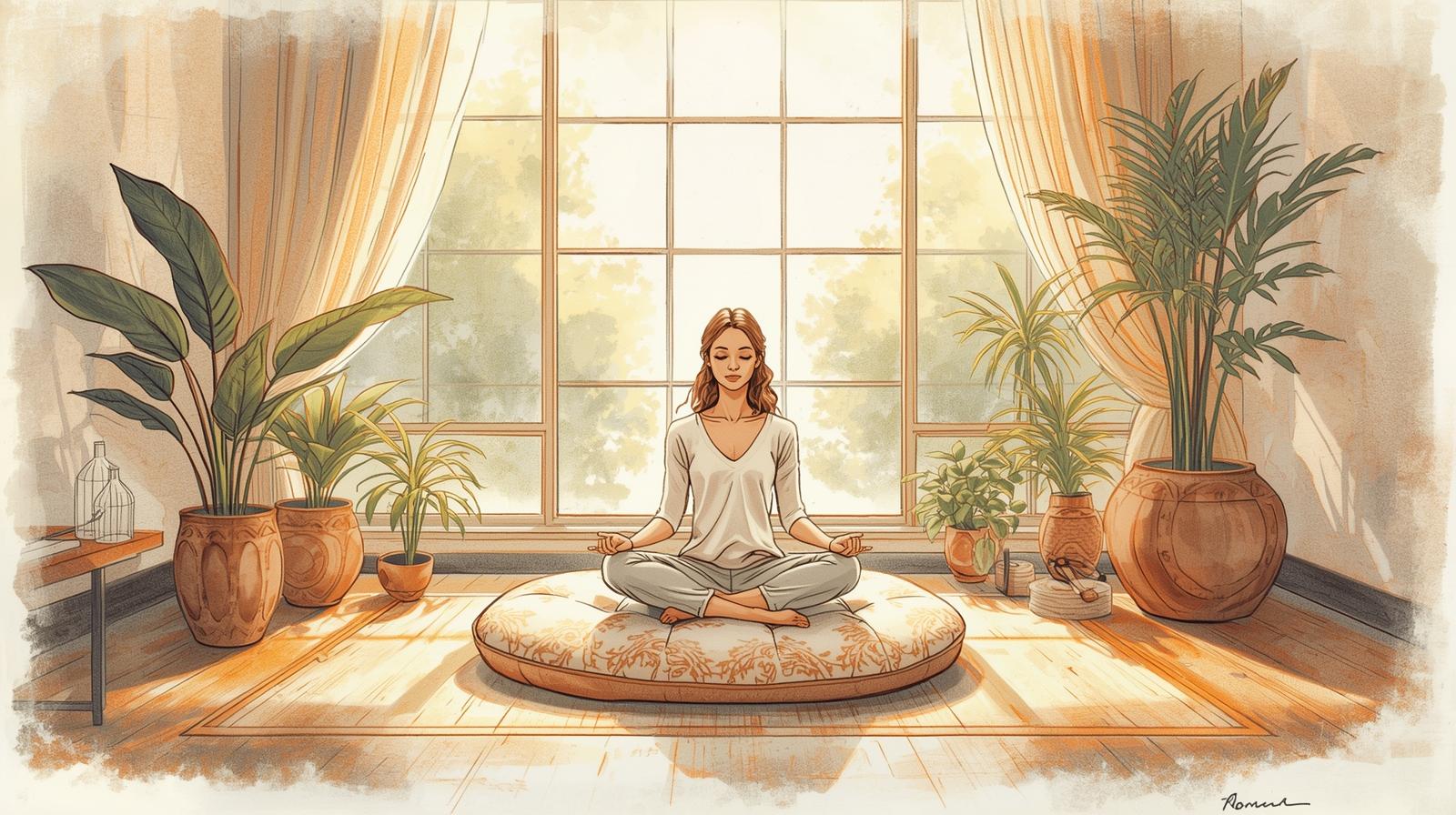
Choose a corner of your home to be your sanctuary—not a perfect altar, but a space where nothing is demanded of you. Add a soft candle, a small plant, or a folded blanket. When you enter this space, whisper to yourself, I am here. That is enough.
In time, the space will begin to hold memory—of stillness, of safety, of simply being. Your nervous system will recognize it as refuge.
Presence, like light, gathers where it’s invited.
12. The spiritual heart of “just being”
Across spiritual traditions, the teaching remains constant: presence is not an achievement but a remembering.
Zen monks speak of “no-mind”—not as emptiness, but as the fullness that remains when striving ends. Rumi calls it “the open secret.” Christian mystics name it contemplation: the gentle gaze upon life without agenda.
When you stop reaching for transcendence, you find yourself fully human—and that humanity is divine enough.
Peace is not something you earn. It’s what’s left when you stop running from what already is.
You Are already here
If meditation feels unreachable, know this: presence is not.
Every sigh, every pause, every moment you choose not to judge yourself is a form of prayer. You do not need to perfect stillness to deserve peace. You only need to be here, alive to the pulse of this moment.
When you stop trying to meditate, you may discover that life itself has been meditating you all along—breathing you, guiding you, waiting patiently for your return.
So breathe.
Be still.
And let this be enough!
Related posts You’ll love
- Your mood isn’t broken — It’s just seasonal: How to use nature’s rhythm to feel balanced all year
- Stop the spiral: How to use self-compassion phrases to instantly soothe Your mind
- How to calm trauma responses through rituals
- How to calm Yourself after a conflict without suppressing
- How rainfall cleanses more than just the earth: A journey into calm, renewal, and inner healing
- Safety isn’t paranoia: The psychology of female precaution and the art of feeling safe without shrinking Your life
- Your inner authority workbook: How to trust Yourself again after too much advice (without getting lost in the self-help noise)

FAQ — When You can’t meditate: Gentle answers for real life
-
Why can’t I meditate no matter how hard I try?
Struggling to meditate often means your nervous system is overstimulated, not that you’re doing anything wrong. When the body feels unsafe or restless, stillness can feel threatening instead of peaceful. Try grounding through movement, breath awareness, or sensory noticing before attempting formal meditation. Remember: presence begins with safety, not silence.
-
Is it okay if I don’t meditate every day?
Absolutely. Mindfulness is not measured by consistency but by sincerity. Non-meditative mindfulness—moments of awareness during everyday life—can be just as healing as sitting practice. Washing dishes, walking slowly, or breathing consciously are all valid ways to reconnect with calm.
-
What should I do when meditation doesn’t work for me?
When meditation feels impossible, shift your focus from doing to being. Replace structure with curiosity. Try gentle body scans, short mindful pauses, or simple breathing awareness without expectation. The goal is not to control your thoughts but to meet yourself as you are.
-
Can mindfulness work without meditation?
Yes. Studies from BMC Complementary Medicine and Therapies (2023) and arXiv (2024) show that non-meditative mindfulness—like mindful walking, sensory awareness, or reflective journaling—supports emotional regulation, stress reduction, and focus as effectively as formal meditation. Awareness is not bound to posture or technique; it’s a way of living awake.
-
Why does meditation make me anxious sometimes?
Stillness can surface emotions or memories stored in the body. This is a natural part of emotional processing. If anxiety arises, open your eyes, move gently, or return to grounding sensations like your feet or breath. You may benefit from somatic (body-based) practices before traditional stillness meditation.
-
How can I be present without meditating?
Presence is simpler than it sounds. You can practice it anytime: noticing the warmth of sunlight, listening deeply to someone’s voice, or feeling your heartbeat. When you stop trying to be mindful and start feeling life directly, you’re already present.
-
Does meditation have to be spiritual?
Not at all. Meditation and mindfulness can be spiritual for some, psychological for others, or simply practical self-care. What matters is not belief, but awareness. If connecting with your senses, breath, or nature brings peace, that is meditation in its truest form.
-
How do I know if I’m actually meditating?
If you’re noticing that your mind wanders and gently returning to awareness—yes, you’re meditating. The presence you cultivate between distractions is the heart of practice. The mind’s movement is not failure; it’s proof that you’re observing, and that’s the entire point.
-
What’s the difference between mindfulness and just “being”?
Mindfulness is the intentional act of paying attention with curiosity. Being is mindfulness without intention—it’s the effortless awareness that happens when you stop trying. Think of mindfulness as the bridge and “being” as the home it leads you to.
-
Can I heal emotionally without meditating?
Yes, deeply. Healing often begins through compassion, not control. Self-kindness, journaling, therapy, and mindful movement all cultivate the same self-awareness that formal meditation aims for. Emotional healing is not limited to any single method—it unfolds wherever love meets awareness.
Sources and inspirations
- Giannou, K., (2023). Meditative and Non-Meditative Mindfulness-Based Practices: A Review. BMC Complementary Medicine and Therapies.
- Li, J., Cochrane, K. A., & Leshed, G. (2024). Beyond Meditation: Understanding Everyday Mindfulness Practices and Technology Use Among Experienced Practitioners. arXiv.
- Conway-Smith, B., & West, R. L. (2024). The Computational Mechanisms of Detached Mindfulness. arXiv.
- Shapiro, S. (2022). Mindfulness and Self-Intimacy. Mindfulness Journal.
- Porges, S. (2021). Polyvagal Theory: Neurophysiological Foundations of Emotions, Attachment, Communication, and Self-Regulation. Norton.
- Neff, K. (2021). Fierce Self-Compassion. HarperOne.
- Mantzios, M., & Giannou, K. (2018). A Real-World Application of Short Mindfulness-Based Practices: Effects on Mood and Stress. Frontiers in Psychology.
- Frontiers in Human Neuroscience. (2019). Meditation and Trauma: When Stillness Activates the System.
- University of Wisconsin (2020). Micro Mindfulness Interventions and Cortisol Regulation.




Leave a Reply