Table of Contents
A quiet shift is happening: Self-worth is becoming a performance review
A few years ago, most self-worth comparisons were human-to-human. You might have compared your life to someone’s highlight reel, your body to someone’s edited photo, your career to someone’s LinkedIn post. It already felt intense.
Now there’s a new competitor in the room—and it doesn’t sleep.
AI can produce a logo in 12 seconds, rewrite a resume in 30, generate 50 business ideas before you finish your tea, and answer questions with a confidence that sounds like certainty. Even if you know it’s “just a tool,” your nervous system may still react like you’re being replaced. Not fired exactly—more like quietly outpaced.
This is the part we rarely say out loud: when we compare ourselves to machines, we don’t just compare output. We compare identity. We start asking:
- If AI can do what I do faster, what am I worth?
- If AI never gets tired, what does my tiredness mean?
- If AI is always available, why am I not?
And underneath those questions lives a deeper fear: Maybe I’m only valuable when I’m useful.
This article is here to interrupt that fear with something sturdier, more grounded, and honestly more human: a new way to define self-worth in the age of AI—one that doesn’t collapse the moment a machine gets “better” at a task.
Why comparing Yourself to AI feels different than comparing Yourself to people
When you compare yourself to a person, part of you knows there’s context: they have a past, limits, private struggles, and invisible support systems. With AI, the comparison feels “pure,” like math.
- AI doesn’t show its bad days.
- AI doesn’t have a fragile body.
- AI doesn’t have childhood wounds.
- AI doesn’t need courage to send the email.
- AI doesn’t feel rejection when it’s ignored.
So your brain makes a classic mistake: it treats AI performance like a fair benchmark for human worth.
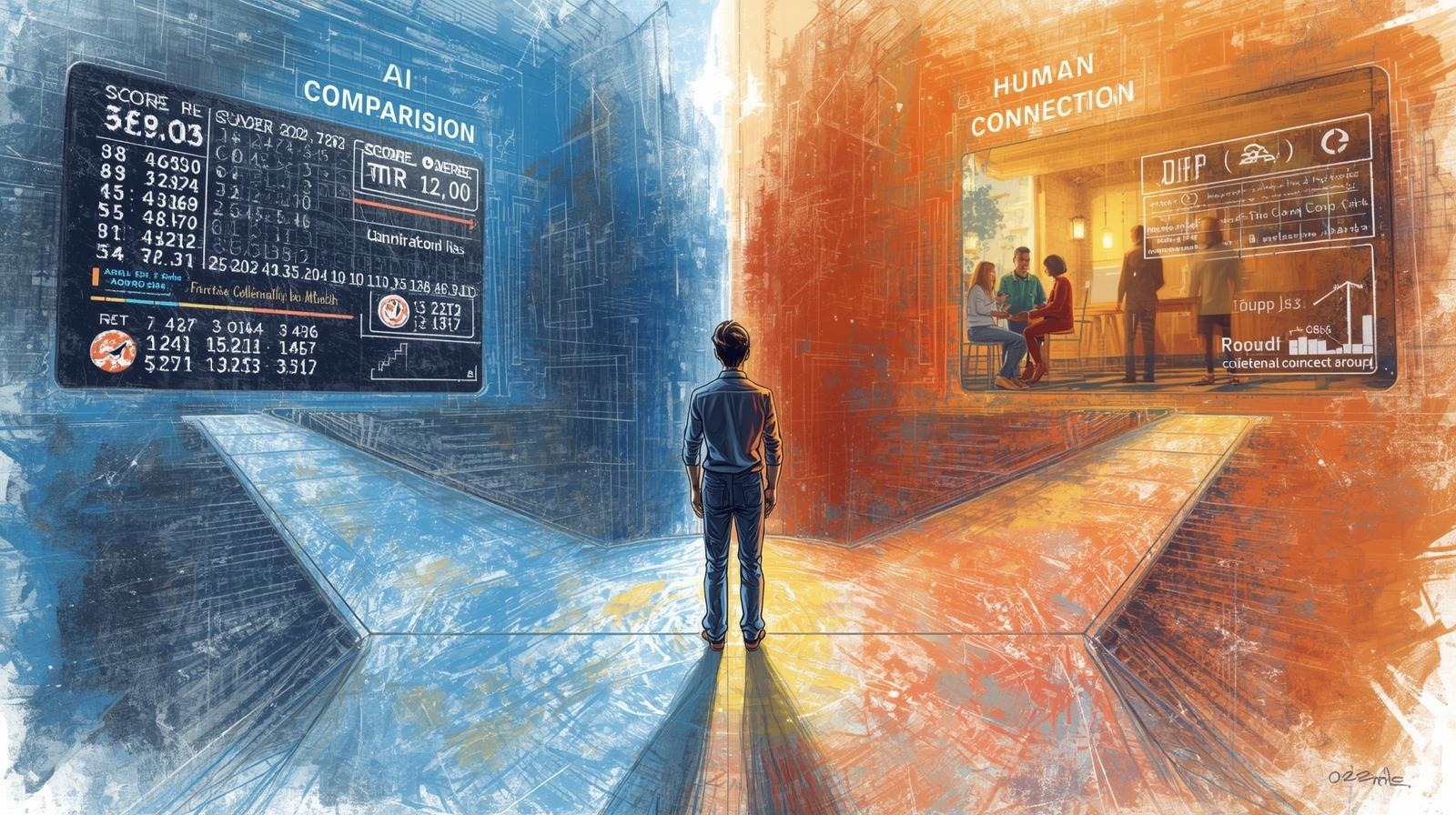
But it’s not a fair benchmark, because AI is not living inside the same rules you are. It is optimized for different outcomes, built on different constraints, evaluated by different metrics. That’s why this comparison hits so deeply: you’re measuring a person by a machine scoreboard.
Let’s make that scoreboard visible.
The machine scoreboard vs. the human scoreboard
Here’s the trap: modern culture already equates worth with productivity. AI simply makes productivity look infinite.
Table 1: Two scoreboards You may be confusing
| What’s being measured | Machine scoreboard (what AI is built to maximize) | Human scoreboard (what actually sustains self-worth) |
|---|---|---|
| Speed | Faster is “better” | Slower can mean depth, care, safety |
| Volume | More outputs win | Too much output can mean burnout |
| Consistency | Never tired, never moody | Rest and fluctuation are healthy |
| Detachment | No feelings = no friction | Feelings carry meaning and values |
| Optimization | One best answer | Multiple true answers depending on context |
| Replaceability | Components swapped easily | Your story and relationships are not swappable |
| Cost | Cheap scaling | Human cost matters: energy, time, dignity |
If you’ve been feeling “less than” lately, it might not be because you’re failing. It might be because you’re grading yourself on the wrong scoreboard.
The AI comparison loop (the part that quietly rewires self-worth)
Comparing yourself to machines rarely happens as one dramatic thought. It’s usually a loop—tiny, repeated moments that train your self-esteem to depend on output.
Here’s how the loop often runs:
Trigger → Interpretation → Self-judgment → Overwork or shutdown → Temporary relief → Stronger comparison next time
Or more simply:
AI does something impressive → “I should be able to do that” → “Why am I slow?” → push harder or freeze → feel worse → compare again
This loop becomes even stickier because AI tools can sound authoritative. Research on confidence and human–AI interaction suggests people’s confidence can shift in response to AI systems in decision settings, and that calibration matters for healthy collaboration.
So if you’ve felt your self-trust wobble after leaning on AI—especially when you’re stressed—there’s a real psychological mechanism underneath it. You’re not “dramatic.” You’re human.
A surprising twist: Comparing with AI doesn’t always lower self-esteem—so what’s the real risk?
Recent work is starting to examine how people compare themselves with generative AI and what that does to self-esteem, with some findings that don’t match the classic “upward comparison always hurts” story.
So the problem isn’t simply “AI makes everyone feel worse.”
The real risk is more specific, and more sneaky:
AI can train you to base self-worth on being fast, flawless, and endlessly available.
Even if you feel inspired at first, the hidden cost can be that your inner standards quietly become inhuman.
That’s when self-worth starts to behave like a battery that only charges when you “perform.”
Social comparison didn’t disappear. It evolved.
We already know that certain kinds of online upward comparison can lead to negative self-evaluations, especially in appearance and lifestyle domains. The AI era adds a new layer: comparison is no longer only about beauty or success. It’s about competence, originality, and replaceability.
You might notice thoughts like:
- You’re not creative, you’re just slower than a generator.
- You’re not smart, you just don’t have instant recall.
- You’re not skilled, you just don’t automate enough.
- You’re not valuable, you’re just expensive.
Those are not neutral observations. They’re value statements disguised as “realism.”
The worth error: Confusing “can” with “is”
One of the strangest emotional side-effects of AI is this: we start treating capability like identity.
- AI can write a poem.
- Therefore, poetry is no longer special.
- Therefore, I am no longer special.
But “can” is not “is.”
A machine can generate a poem without being moved by it. A human can write a line because something broke inside them and they still chose tenderness. Those are not the same act, even if the output looks similar.
Self-worth doesn’t live in output alone. It lives in meaning, relationship, agency, and embodiment.
That last word—embodiment—matters more than ever.

The human advantage nobody markets: Embodiment, context, and care
AI is powerful at pattern completion. Humans are powerful at living.
You carry context in your body: safety, threat, longing, intuition, fatigue, desire, grief. That context shapes decisions in ways no spreadsheet can fully measure.
And in many real-world spaces—healing, parenting, friendship, leadership, intimacy—your value is not your speed. Your value is your presence.
This is where self-worth needs to “move houses,” away from the productivity part of you and into the whole-person part of you.
Signs You’re stuck in machine-comparison mode
Not a diagnosis—just a mirror. See what lands.
Table 2: The machine-comparison symptoms and the human reframe
| If you catch yourself thinking… | It usually means… | A steadier reframe |
|---|---|---|
| “AI would do this faster.” | You’re measuring worth by speed | “My pace protects quality and nervous-system safety.” |
| “My work is pointless now.” | Your identity fused with a task | “My value isn’t identical to my job function.” |
| “I’m behind everyone.” | Comparison is running your attention | “I can choose what I optimize for.” |
| “I should be available 24/7.” | You’re adopting machine norms | “Boundaries are a sign of self-respect.” |
| “If I need help, I’m weak.” | Perfectionism dressed as strength | “Support is a human skill, not a flaw.” |
If you recognized yourself in more than one row, don’t panic. It doesn’t mean you’re broken. It means you’re adapting to a fast cultural shift without a map.
Let’s build the map.
The self-worth upgrade: Shifting from “performance worth” to “person worth”
Try this definition for a moment:
Performance worth says: “I am valuable when I produce.”
Person worth says: “I am valuable because I exist, and what I produce is one expression of that—not the price of entry.”
Most people don’t consciously choose performance worth. They absorb it through school, work culture, family roles, and online metrics. AI simply makes performance worth louder.
So the goal is not to “stop using AI.” The goal is to stop letting AI define the terms of your humanity.
A nonstandard tool: The worth compass (four directions of self-worth)
When you feel the pull to compare yourself to machines, check where your worth is trying to come from:
Output → Approval → Control → Connection
Here’s the twist: AI tends to strengthen the first three and weaken the fourth.
- Output increases.
- Approval feels measurable.
- Control feels tempting.
- Connection can quietly shrink.
The Worth Compass brings you back:
Output is useful, but connection is nourishing. Control can calm anxiety, but approval never stabilizes identity.
If you want a nervous-system-friendly definition of self-worth in the AI era, aim your life toward connection and meaning, not endless optimization.
How to use AI without shrinking Your self-worth
This section is practical on purpose. You can be ambitious and human.
1) Decide what AI is allowed to be in Your life
Not morally. Psychologically.
- If AI is your judge, you’ll live anxious.
- If AI is your assistant, you’ll live resourced.
- If AI is your replacement fantasy, you’ll live terrified.
- If AI is your collaborator, you’ll live curious.
That is not just semantics. It changes how your brain interprets every interaction.
2) Rename the comparison
Instead of “AI is better than me,” try:
“AI is optimized for output. I am optimized for being alive.”
Say it like you mean it. Your nervous system listens.
3) Don’t outsource Your voice
Use AI to brainstorm, structure, and reduce friction. But keep at least one step that stays human: choosing the message, shaping the tone, deciding the values.
Because the fastest way to lose self-worth is to gradually lose authorship.
4) Add feedback that machines don’t have
Research suggests feedback can help calibrate confidence in human–AI decision contexts. In daily life, that can look like: checking your work with a trusted person, testing assumptions, noticing real outcomes—not AI fluency.
Your confidence should be built on reality, not on a tool’s “certainty voice.”
The “good enough” protocol for the AI age
Perfectionism loves AI because AI creates the illusion that flawless is normal.
So you need a protocol that protects your humanity:
Intention → Constraint → Draft → Human edit → Publish → Rest
Constraint is the secret ingredient. Constraint is where human dignity lives.
Try constraints like:
- I will spend 40 minutes, not four hours.
- I will stop at 80% and let it be real.
- I will keep one imperfect sentence because it sounds like me.
- I will not compete with infinite.

If You’re a creative, this is probably the tender spot
Creatives often don’t just make things. They are their craft. AI can hit that identity nerve fast.
- If you’re a writer, you might feel replaceable.
- If you’re an artist, you might feel duplicated.
- If you’re a coach, you might feel like a chatbot can do your job.
- If you’re a designer, you might feel like taste is now automated.
Here’s the reframe that actually holds:
AI can generate content.
Humans generate culture.
Culture includes pain, humor, timing, subtext, grief, rebellion, longing, and lived experience. Even when AI produces something “good,” humans decide what matters, what resonates, what heals, what changes someone.
Also, not every client wants speed. Many want being understood.
A healthier metric: “Does this life feel livable?”
AI pushes output metrics. A human-worthy metric is livability.
Ask yourself, gently:
- When I work this way, do I feel more myself—or less?
- When I use AI, do I feel supported—or judged?
- When I finish a task, do I feel relief—or emptiness?
- Is my ambition making my life larger—or smaller?
Those questions are not productivity questions. They’re self-worth questions.
When AI becomes emotional shelter (and why that matters)
Some people start using AI chatbots not only for work, but for comfort, reassurance, and escape. There’s research suggesting that lower self-esteem can be linked with more problematic patterns of AI chatbot use, with factors like social anxiety and escapism playing a role.
This doesn’t mean “AI is bad.” It means that if you’re feeling lonely, overwhelmed, or unsure of yourself, AI can become a tempting refuge—because it feels safe, instant, and nonjudgmental.
But if your self-worth begins to depend on a tool that never challenges you, you may slowly lose the muscle of real-world connection: repair, vulnerability, mutuality.
If you notice that happening, it’s not shame time. It’s support time.
Rebuilding self-worth in a machine world: A 3-layer reset
Layer 1: Body-based worth (the part AI can’t replace)
Your body is not a productivity container. It is your home.
When you stop treating yourself like a machine, you start noticing: hunger, tension, fatigue, overstimulation. Responding to those signals is not laziness. It’s self-respect.
A human life requires recovery. A machine life demands output.
Choose human.
Layer 2: Relationship-based worth (proof You matter beyond output)
Self-worth stabilizes when it’s witnessed. Not by everyone. By safe people.
Make sure there is at least one place in your week where you are not impressive. Where you are just real. Where you can be messy and still loved.
AI cannot provide mutual witnessing. It can simulate support, but it cannot need you, cherish you, or grow with you as a separate living being.
Layer 3: Meaning-based worth (Your values are the real upgrade)
AI is value-neutral; it serves the prompt. Humans can choose values.
So choose yours on purpose:
Do you want to optimize for money, impact, beauty, peace, intimacy, creativity, freedom, service, learning?
There is no universal “right.” There is only what makes your life true.
When you choose values, comparison loses oxygen. Because you stop trying to win someone else’s game.
You were never meant to be infinite
- Machines can scale. Humans can heal.
- Machines can optimize. Humans can love.
- Machines can produce. Humans can become.
If AI has made you feel smaller lately, I want you to consider this possibility: the problem isn’t you. The problem is the standard you’ve been pressured to adopt.
You don’t need to outperform machines to be worthy.
You need to belong to yourself again.
And that is a very human kind of victory.
Related posts You’ll love
- Self-help hustle: The shocking truth about when healing turns into performance
- High value dating is making Women anxious, not secure: The hidden cost of turning love into a score
- Family loyalty can be a trauma bond in nice clothing: When “being a good daughter or son” becomes a survival strategy
- The childhood role You still play in Your marriage without noticing
- Intermittent kindness is still a control system: Variable reward, trauma bonds, and the quiet engineering of compliance
- 16 affirmations for Women who dread Christmas because They feel behind in life. How to rewrite Your holiday story of success, love, and self-worth. FREE PDF GIFT!
- Why compliments feel uncomfortable — Self-worth reframes that actually work

FAQ: AI is changing self-worth
-
Is it normal to feel less confident because AI seems “better” than humans?
Yes. Many people feel a drop in confidence when they compare human pace, energy, or creativity to AI output. AI can look effortless, which can trigger perfectionism and performance pressure. The key is remembering you’re comparing different systems: a tool built for output versus a person built for meaning, relationships, and recovery.
-
Why do I keep comparing myself to AI, even when I know it’s just a tool?
Because comparison isn’t only logical, it’s emotional. When AI produces results instantly, your brain may translate that into a social threat: “I’m falling behind” or “I’m replaceable.” That stress response can happen even if you intellectually understand AI’s limits. This is a nervous-system reaction, not a character flaw.
-
Can using ChatGPT or generative AI damage self-esteem?
It can, especially if you start using AI as a standard you must match. Self-esteem tends to dip when you interpret “faster output” as “higher worth.” A healthier approach is to use AI for assistance while keeping your human voice, values, and final decisions in your hands. The tool should reduce pressure, not become your inner judge.
-
How do I stop feeling replaceable at work because of AI?
Start by separating role tasks from identity. Jobs include tasks that can be automated, but your value includes judgment, trust, communication, context, and relationships. Focus on human strengths that scale through leadership and collaboration, not just speed. Then set a learning plan so you feel equipped rather than threatened, without turning your life into endless upskilling.
-
Does AI make perfectionism and burnout worse?
It can. AI raises expectations for speed, volume, and constant availability, which can intensify perfectionism. Burnout often follows when you try to live by “machine rules” in a human body. Protect yourself with constraints like time limits, rest, and “good enough” finishing standards, so your worth doesn’t depend on flawless output.
-
What should I do if AI triggers anxiety, shame, or “I’m not enough” thoughts?
Treat it as a signal, not a verdict. Pause, name the comparison, and shift to a human metric such as livability, meaning, or connection. If the anxiety persists, reduce exposure during vulnerable times, and add grounding habits before using AI. If shame feels intense or constant, talking with a mental health professional can help.
-
How can creatives protect their self-worth when AI can generate art and writing?
Anchor worth in authorship and meaning, not novelty alone. Your creative value includes lived experience, taste, emotional truth, and cultural context. Use AI as a brainstorming assistant if it helps, but keep at least one stage fully human, like concept selection, narrative intention, or final voice. That preserves identity and reduces “I’m being replaced” fear.
-
Is comparing yourself to AI the same as social media comparison?
It overlaps, but it often hits different. Social media comparison is usually about lifestyle, beauty, and status. AI comparison tends to target competence, intelligence, creativity, and productivity, which can feel more identity-threatening. The emotional impact can be stronger because AI appears tireless and “objective,” even though it’s not a fair benchmark for a human life.
-
What is a healthy way to use AI without losing confidence?
Use AI to remove friction, not to define your worth. Let it help with brainstorming, structure, drafts, or research prompts, while you keep ownership of your message, ethics, and tone. Build a habit of “human review” where you check if the output matches your values and sounds like you. The goal is support, not self-erasure.
-
Can AI help self-growth without replacing therapy or real relationships?
Yes, when used carefully. AI can offer journaling prompts, reflection questions, and coping ideas, but it cannot provide mutual care, attachment repair, or real-world accountability. For deeper wounds such as trauma, severe anxiety, or depression, professional support is the safest path. Think of AI as a tool in your toolkit, not your only mirror.
-
How do I rebuild self-worth in the AI era?
Rebuild on three foundations: embodiment, connection, and values. Embodiment means honoring limits and recovery. Connection means being seen by safe people outside performance. Values mean choosing what you optimize for, rather than defaulting to speed and productivity. When these foundations are strong, AI becomes a tool you use, not a scoreboard you live under.
-
What are clear signs I’m letting AI define my worth?
You feel guilty for resting, ashamed for being slower, afraid to publish anything imperfect, or pressured to be available all the time. You may also notice you trust AI “certainty” more than your own judgment. When those patterns appear, it’s time to reset standards back to human ones: pace, presence, boundaries, and meaning.
Sources and inspirations
- UNESCO. (2021/2022). Recommendation on the Ethics of Artificial Intelligence.
- OECD. (2019). Recommendation of the Council on Artificial Intelligence (OECD Legal 0449).
- NIST. (2023). Artificial Intelligence Risk Management Framework (AI RMF 1.0) (NIST AI 100-1).
- European Commission. (2024). AI Act: Regulatory framework on artificial intelligence (Regulation (EU) 2024/1689) overview.
- European Parliament. (2024). Artificial Intelligence Act: MEPs adopt landmark law (press release / summary).
- Chong, L., Zhang, G., Goucher-Lambert, K., Kotovsky, K., & Cagan, J. (2022). Human confidence in artificial intelligence and in themselves: The evolution and impact of confidence on adoption of AI advice. Computers in Human Behavior.
- McComb, C. A., (2023). A Meta-Analysis of the Effects of Social Media Exposure to Upward Comparisons.
- Taylor, J., & Armes, G. (2024). Social comparison on Instagram, and its relationship with self-esteem and body-esteem. Discover Psychology.
- Godard, R., (2024). Are active and passive social media use related to mental health, wellbeing, and social support outcomes? A meta-analysis of 141 studies. Journal of Computer-Mediated Communication.
- Luo, X., (2021). Investigating the Influence of Self-Compassion-Focused Interventions on Posttraumatic Stress: A Systematic Review and Meta-Analysis.
- Yao, R., (2025). Connecting self-esteem to problematic AI chatbot use: multiple mediating roles of psychological states.
- (arXiv preprint). (2025). As Confidence Aligns: Exploring the Effect of AI Confidence on Human Self-confidence in Human–AI Decision Making.
- World Health Organization. (2019). Recommendations on digital interventions for health system strengthening.
- (SAGE journal article). (2025). Does Comparing with Generative Artificial Intelligence… (study on comparisons with GAI and self-esteem; publication page).
Leave a Reply