Table of Contents
If your home looks “fine” but your body still feels on edge inside it, you are not imagining things. Color is not just decoration. It is information your brain reads all day long. And when you are stressed, tired, anxious, overstimulated, or emotionally raw, your brain reads color even faster.
This article is a Calm Space guide for using paint and decor in a grounded, evidence aware way to support inner peace. Not the overly magical version of “chromotherapy fixes everything,” and not the cynical “color psychology is fake.” Something more useful: a modern, nervous system friendly approach that blends research, design strategy, and the kind of self trust you build by testing what actually calms you.
You will also see a few nontraditional ideas, like “chromatic anchors,” “emotional zoning,” and a simple way to measure whether your new palette is helping, not just looking pretty.
This piece focuses on color therapy, calming paint colors, soothing home decor, nervous system regulation, stress reducing interior design, and how to create a peaceful home environment through color, light, texture, and air quality.
The honest truth about color therapy
“Color therapy” is an umbrella phrase. People use it to mean at least three different things, and mixing them up is where disappointment happens.
One meaning is clinical or quasi clinical chromotherapy, where colored light or color exposure is used as an intervention. The evidence here is mixed and often preliminary, with some promising early studies and many limitations. Treat it as an “interesting adjunct,” not a replacement for medical care or mental health treatment.
Another meaning is color psychology, which studies how humans tend to associate colors with emotions and behaviors. Those associations show up across large bodies of research, but they are not universal rules. Culture, context, brightness, saturation, and personal memory matter. A massive systematic review found people do reliably link colors with emotions, yet the strength and direction of the link depends on many moderators.
The third meaning is the one we will use here: environmental color design. This is not about “curing” anything. It is about shaping the sensory messages of your space so your nervous system stops bracing and starts exhaling. In this version, paint and decor become part of a supportive environment, similar to how lighting, sound, temperature, and natural elements can influence stress and comfort.
If you take one idea from this section, let it be this:
Color is a dial, not a diagnosis.
You are not trying to pick the “right” color.
You are trying to tune your space until your body feels safer inside it.
Why color can affect calm, even when You “don’t care about decor”
Your visual system is not a polite houseguest. It does not wait to be invited.
The brain processes basic visual features such as brightness and contrast quickly, and those features connect with attention, arousal, and emotional processing. In one immersive built environment study, researchers found that blue colored interiors modulated physiological and neural indicators linked to emotional response. The details are complex, but the core takeaway is simple: interior color can shift measurable body signals, not only opinions.
At a broader level, humans consistently associate certain hues with certain emotional tones. Yellow often maps to joy, dark colors to sadness, and lighter colors to more positive feelings, though again, context and culture matter.
This is why a room can feel “loud” even when it is silent. It is also why repainting a single wall can feel like you moved house, emotionally.
But here is the twist most design advice misses: calm is not only about hue.
A deep, saturated navy can feel heavy and pressurized.
A pale, dusty blue can feel like breathing space.
A bright, icy hospital blue can feel alienating.
Same hue family, totally different nervous system outcome.
So we need a better framework than “blue is calming.”
The calm space color equation
To make this practical, here is a simple equation you can use when choosing paint and decor.
Inner peace tends to increase when these elements work together:
Hue → Lightness → Saturation → Finish → Texture → Lighting → Air quality
Think of it like tuning an instrument. Hue is one string, but the whole guitar matters.
Hue is the color family, like blue, green, beige, terracotta.
Lightness is how close it is to white or black.
Saturation is how intense it is.
Finish is matte, eggshell, satin, which changes glare and softness.
Texture is what your eyes and skin read from fabric, wood, ceramics, rugs.
Lighting changes everything, because paint is a mirror for light.
Air quality matters because a “calm room” that smells sharp or triggers headaches is not calm.
Lighting and health focused reviews emphasize that indoor light influences sleep, wakefulness, and physiology. If you paint a room perfectly but blast cool, bright light at night, your body may still struggle to wind down.
And if you repaint with high emitting products and trap fumes, you may feel worse, not better. VOC research in residential indoor environments and coatings shows why low emitting choices and ventilation matter.
This is the foundation. Now we can get creative without becoming unrealistic.
A new way to choose colors: Build a “nervous system palette,” not a trendy palette
Most people pick colors with their eyes. Calm spaces are built with the body.
Try this question first:
When I imagine feeling deeply at peace at home, what is my body doing?
Maybe your shoulders drop.
Maybe your jaw loosens.
Maybe you stop scanning the room.
Maybe your breathing slows.
Now translate that into a design intention. You are not choosing “a color.” You are choosing an internal state.
Here are three common intentions and how they translate visually:
Soothing → lower contrast, softer edges, gentle lightness shifts
Grounding → warmer neutrals, earthy pigments, heavier textures, stable repetition
Clearing → brighter lightness, simple lines, fewer competing tones, more daylight reflection
None of these require you to become minimalist or beige. They require coherence.
A coherent palette is one where your eyes do not keep being pulled into micro decisions. That constant tiny choosing is low grade stress.

The emotional zoning method
This is one of the most effective, nonstandard strategies I know for peace at home, especially if you feel overstimulated or emotionally “switched on” all the time.
Instead of painting each room based on what it is “supposed to be,” you paint and decorate based on what your nervous system needs in that zone of the home.
You create three zones:
Recovery zone, where your body downshifts
Connection zone, where you feel warm and open
Focus zone, where your mind feels clear but not tense
You can do this in a studio apartment or a big house. You can do it with paint, textiles, art, and lighting.
Recovery zone colors tend to be lower saturation, medium to high lightness, with soft warm or soft cool undertones, depending on what your body reads as safe. Research on color emotion associations supports that cool hues often map to lower arousal, while higher saturation tends to read as more activating.
Connection zone colors often include warmer tones or warm accents, because warmth is psychologically associated with social comfort for many people, as long as it stays muted enough not to become “busy.”
Focus zone colors often benefit from clarity and reduced chaos. Many people do well with gentle greens, blue greens, or calm neutrals paired with strong organization and clean lighting.
You do not need dramatic differences between zones. You are creating emotional cues, not a theme park.
Table 1: Inner peace goals and the color qualities that often support them

Use the table like a menu, not a rulebook.
The “chromatic anchor” technique (a calm trick that works even if You cannot repaint)
A chromatic anchor is a single, repeated color note that tells your nervous system, “you are home, you are safe.”
It works because repetition reduces cognitive load. Your eyes stop hunting. Your body stops bracing.
Pick one anchor color and repeat it quietly across the space in three to seven places. Not identical objects, just the same color family.
Example:
Soft sage in a pillow, a plant pot, a throw, a framed print detail, a candle, a bedside book cover
Or:
Warm clay in a ceramic bowl, a kitchen towel, a small artwork, a lamp shade, a bath mat
Your anchor can be a neutral, or it can be a color. What matters is that it is stable.
If you want this to feel truly calming, keep the anchor muted rather than loud. Associations between color attributes like saturation and emotional arousal show up in multiple lines of research and computational analyses.
This is especially powerful for people who feel emotionally scattered, numb, or in recovery from a hard season. Anchors give your brain fewer decisions.
Paint choices that actually change how a room feels
Paint is not one decision. It is four decisions:
Color family
Undertone
Finish
Placement
Most “calming color” advice ignores undertone, finish, and placement, then people wonder why the same shade looks wrong in their home.
Undertone: The hidden emotional temperature
A gray can have a blue undertone and feel colder.
A gray can have a warm undertone and feel like a soft blanket.
If you only read the paint name, you miss this.
A practical test: hold a true white sheet of paper next to the sample in your room. The undertone shows itself immediately.
If you are building a Calm Space palette, choose undertones intentionally:
- warm undertones for cocooning and safety
- soft cool undertones for quiet and airiness
- avoid sharp icy undertones if you want softness
Finish: The glare factor
A shiny finish reflects more light and can create glare hotspots. In a nervous system sense, glare can feel like micro stress.
Matte often reads as softer and quieter. Eggshell is a good compromise for cleanability in many spaces. If you are sensitive to light, consider reducing sheen on large wall surfaces and using slightly higher sheen only where you need durability.
Placement: The “what Your eyes meet first” rule
Your nervous system is most affected by the color surfaces you see most often.
If you want a big calm impact with minimal change, paint what your eyes meet first when you enter the room, or what you face while resting.
That is why a bedroom accent wall behind the bed can feel so regulating. It becomes a visual exhale point.
A nontraditional approach: The gradient wall, or “slow color”
Instead of one flat color, consider a subtle tonal gradient, sometimes called an ombré wall. You can do it with paint blending, limewash, or mineral paints that naturally create variation.
Why it can feel calming:
- your eyes stop locking on harsh edges
- the wall reads like sky or stone
- variation feels organic, like nature
Nature like visual patterns are often restorative. Biophilic environment research shows stress recovery benefits when indoor environments include natural elements and cues. Color that behaves like nature, shifting gently, can support that same direction.
This is not for every home, but if you want “nonstandard” calm, it is a beautiful option.
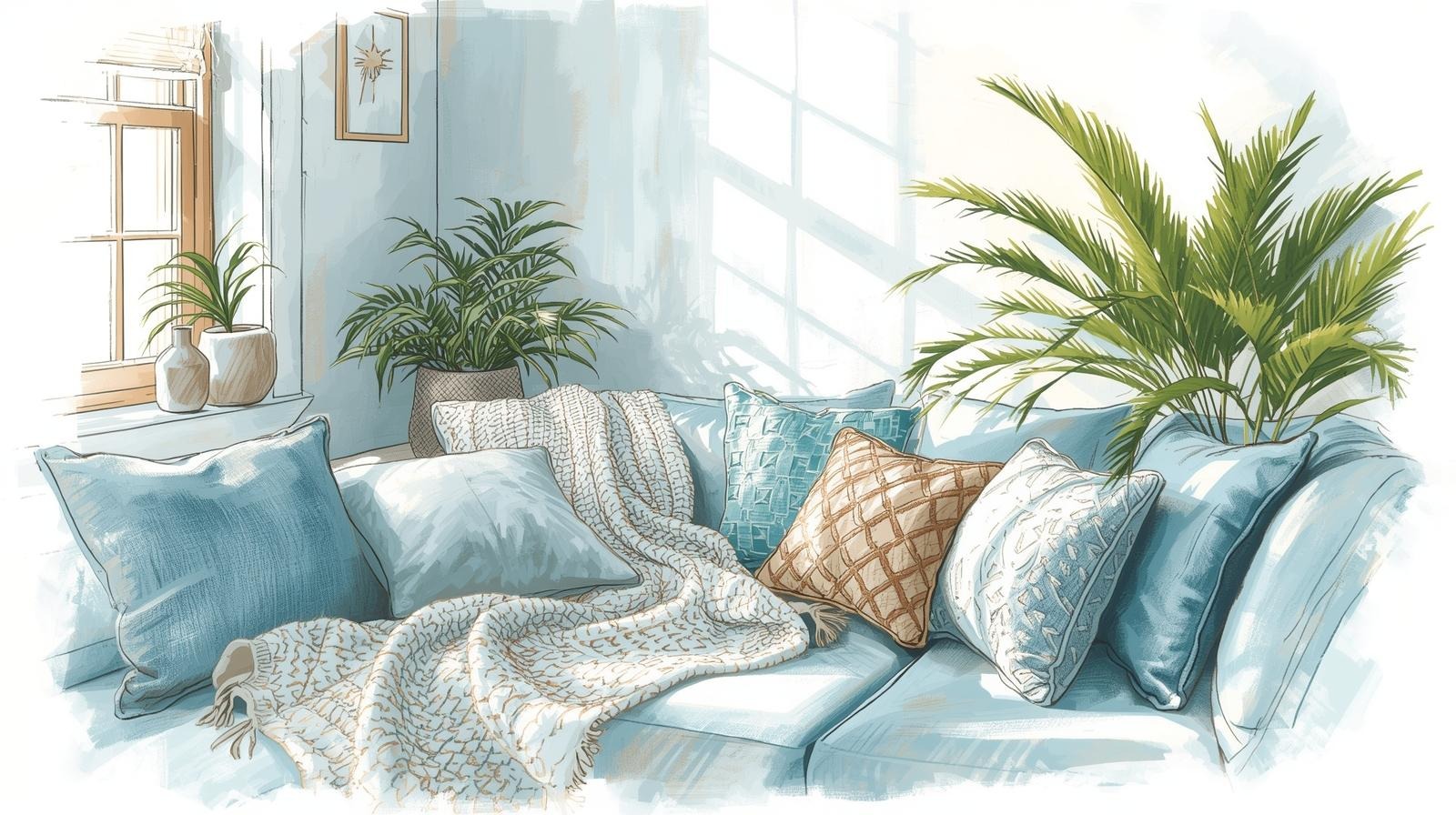
Decor that supports calm: Texture is the secret second language
If color is the message, texture is the tone of voice.
A room can be painted perfectly and still feel emotionally cold if everything is slick, hard, and reflective.
Soft textures absorb light and soften the edges of attention. Natural textures also connect to biophilic design principles, which have strong evidence for stress recovery.
If you want a simple formula:
Soft color + soft texture = calm that you can feel in your chest.
Shiny color + shiny texture = stimulation, even if the hue is “calming.”
You can add softness without buying a whole new life.
Try this sequence:
Hard surfaces → add one large soft surface
Bright points → reduce them or warm them
Chaos corners → simplify them and add one calm anchor
Even a single large rug, a linen curtain, or a textured throw can shift the whole room.

Lighting: The paint color’s best friend or worst enemy
Paint is light made visible.
This is why someone can swear a color is soothing, and in your room it feels awful. Your room has different light.
Health focused lighting reviews and consensus statements emphasize that light affects circadian rhythms and physiology, and the timing and spectrum of light matters.
A calm lighting rhythm often looks like this:
Morning and midday → brighter, more daylight exposure if possible
Late afternoon → soften intensity
Evening → warm, dim, low glare
This is not only aesthetic. Evening light that is too bright or too blue rich can interfere with winding down, and many sources discuss melatonin and circadian implications of light exposure.
If you are repainting, test samples at three times:
- morning
- late afternoon
- night with your usual lamps on
A calm wall color should stay emotionally stable across all three.
Table 2: Calm lighting and color pairing

This is where “calm space” becomes real life, not Pinterest.
Room by room: Paint and decor choices that promote inner peace
Bedroom: Make it a recovery zone, not a productivity museum
If you want inner peace, the bedroom is the easiest place to start, because your nervous system spends hours there in vulnerability.
A calm bedroom often succeeds with:
- one main wall color that feels like a soft envelope
- lower contrast between wall and bedding
- warm, dimmable light in the evening
- darkness control for sleep
If you love cool colors, use cool hues but keep them dusty rather than icy. If you love warm neutrals, choose warm whites and mushroom tones rather than bright cream that turns yellow in artificial light.
If you want a deeper wall color, choose matte and keep saturation low. Deep does not have to mean dramatic.
Living room: Calm connection
A living room is often both connection zone and decompression zone.
If your living room feels tense, check the “visual noise” first:
- too many competing frames
- too many small objects
- high contrast patterns everywhere
Calm does not mean empty. It means your eyes know where to rest.
One nonstandard idea: create a “resting wall.” Choose one wall in the room that stays visually quiet and coherent. This becomes the nervous system’s landing strip.
You can do that with paint, or simply by reducing contrast and clutter on that wall, then placing one large, soothing piece of art or texture there.
Bathroom: Micro calm and sensory softness
Bathrooms can become quiet rituals, especially if you choose colors that suggest cleanliness without harshness.
Many people do well with:
- soft mineral greens
- warm stone neutrals
- muted blue grays
Then add tactile calm:
- a thick towel
- a matte soap dispenser
- a small plant
- a warm light source
The point is not luxury. The point is “my body is allowed to soften here.”
Work nook: Calm focus, not sterile focus
A focus zone does not need to be gray and corporate.
Try:
- a calm neutral wall
- one grounding accent
- a consistent anchor color
Then pair it with lighting that supports alertness during the day. Home lighting evidence reviews highlight the relationship between lighting conditions and health outcomes, and they repeatedly call for better real world guidance.
If you tend to overwork, make the evening lighting in this zone warmer and dimmer so the space itself cues you to stop.
If you are sensitive, anxious, or healing: trauma informed color design
Some people feel worse with “calming” colors because calm can feel unfamiliar. Your nervous system may interpret stillness as danger if your history taught you that bad things happen in quiet moments.
If that resonates, go gently.
Instead of repainting everything to be serene, try “micro doses of safety.”
Micro dose formula:
neutral base + tiny warm anchor + soft texture + control of light
This gives you choice. Choice is safety.
Also consider:
- avoid stark contrast that can feel alerting
- avoid overly cold, clinical tones if they remind you of hospitals or emotional
- distance
- avoid intense saturated reds if you already feel wired
You are not trying to force peace.
You are building a room that makes peace possible.
Air quality: The calm detail people forget
Inner peace is hard when your body is reacting to your environment.
Paint and coatings can release VOCs that affect indoor air quality. Research on VOCs in residential indoor environments and coatings highlights health related concerns, which is why low emitting options and ventilation are practical parts of a calming makeover.
If you are repainting, calm choices include:
- low VOC or zero VOC paints when available
- good ventilation during and after painting
- letting the space off gas before long stays if you are sensitive
For health based indoor air assessment, agencies such as Germany’s Umweltbundesamt discuss indoor air guide values and health oriented evaluation approaches. Umweltbundesamt
This is not meant to scare you. It is meant to support you. A calm home is one your body trusts.
A simple 7 day “Does this palette actually calm me?” experiment
This is my favorite part, because it turns design into self trust.
You do not need fancy tools. You just need a tiny tracking ritual.
Pick one change:
- a paint sample wall
- a new anchor color repeated in the room
- a lighting shift at night
- a texture upgrade like curtains or rug
Then track for 7 days, once per day, same time.
Use this table as a template.
Table 3: Calm space tracking log

If your tension drops even one point consistently, that is meaningful.
If it rises, that is also meaningful. You learned something about your system.
This experiment is how you stop copying trends and start designing for you.
Calm color rituals: Turn decor into a daily regulation cue
Here is a creative, nonstandard practice that many people find surprisingly effective.
Choose one calming color in your space and create a 30 second ritual around it.
Example:
You sit in the same chair every evening.
Your eyes find the sage pillow.
You breathe slowly.
You let that color be a cue, not a decoration.
Ritual map:
Enter room → find chromatic anchor → exhale longer than inhale → soften jaw → name one safe thing → continue your evening
It is simple, but it trains your brain that your home contains reliable signals of safety.
If you want a little science flavor behind it, remember that color emotion associations are a real phenomenon across research, even though they are not deterministic. You are using association and repetition on purpose.
Your home can become a quiet ally
Inner peace is not only an internal practice. It is also an environment.
When your space gives your nervous system softer messages, you spend less energy bracing. That energy comes back to you as patience, clearer thinking, deeper rest, and a gentler relationship with yourself.
If you take one next step after reading this, let it be small and measurable:
Choose one chromatic anchor.
Repeat it quietly.
Warm your evening light.
Track your body’s response for a week.
Calm is not a mood you force.
Calm is a system you build.
Related posts You’ll love
- One small comment ruined Your day? A neuroscience informed mood recovery protocol that brings You back to calm
- The calm confidence glow: Why peace makes Women look more powerful (and why people believe it before You speak)
- The calm Women lose in relationships: Reclaiming Your inner space (without becoming “less loving”)
- The shame spike: What happens in Your brain when You feel embarrassed (and why it hits like a wave)
- Dopamine vs. peace: Why quick rewards make calm feel boring
- How to catch micro-negativity in Your thoughts (and reclaim inner peace)
- The emotional tax of being “polite” in public: Why social niceness can cost You inner peace

FAQ: Color therapy, calming paint colors, and peaceful home decor
-
What is color therapy in interior design?
Color therapy in interior design means using paint colors, decor tones, and visual harmony to support a calmer mood and a more regulated nervous system at home. It is not a medical treatment. It is an environment strategy that helps reduce visual stress, soften overstimulation, and create a stronger sense of safety and comfort.
-
Does color therapy really work for stress and anxiety?
Color can influence how a space feels because your brain processes brightness, contrast, and saturation constantly. Many people experience real shifts in calm when they reduce harsh contrast, choose softer tones, and improve lighting. Results vary, so the best approach is to test small changes and track how your body responds over a week.
-
What are the best calming paint colors for inner peace?
The most calming paint colors are usually low-saturation shades with gentle undertones. Many people feel soothed by dusty blues, muted greens, warm off-whites, soft greige, and light mushroom tones. The key is not the color name. The key is how it looks in your lighting and how your body feels in the room.
-
What colors should I avoid if I feel overstimulated at home?
If you are easily overstimulated, be cautious with very bright whites, high-saturation reds, intense neon accents, and sharp high-contrast patterns. These choices can keep your attention “switched on.” If you love bold colors, you can still use them, but make them smaller and more controlled, like one calm accent instead of an entire wall.
-
Is blue always the most relaxing color for a bedroom?
Blue can be relaxing, but it is not automatically calming. A soft, muted blue often feels peaceful, while an icy or very bright blue can feel clinical. For bedroom calm, prioritize gentle saturation, matte finishes, and warm evening lighting. Your goal is a “soft exhale” effect, not a cold or sterile vibe.
-
What is the best color palette for a calm bedroom and better sleep?
A calm bedroom palette usually works best with one main soothing wall color, plus two quiet supporting neutrals. Examples include dusty blue with warm white, soft sage with creamy off-white, or mushroom beige with a gentle clay accent. Pair it with warm, dimmable lighting at night to support a sleep-friendly environment.
-
How do I choose a paint color that will look calm in my lighting?
Test paint samples in the real room at three times → morning, late afternoon, and night with your lamps on. Look for emotional stability, meaning the color still feels gentle and safe across changing light. Also check undertones by placing a plain white sheet of paper next to the sample to reveal hidden warmth or coolness.
-
Matte vs eggshell paint: which is better for a calming space?
Matte paint often feels calmer because it reduces glare and visual sharpness, especially in bedrooms and living rooms. Eggshell is a practical option when you need easier cleaning while still staying relatively soft. If you are sensitive to light or feel tense in bright rooms, reducing wall sheen can make a noticeable difference.
-
Can I use color therapy if I rent and cannot repaint?
Yes. You can use renter-friendly color therapy through decor choices → curtains, bedding, rugs, art, lampshades, and repeated “anchor colors.” A simple method is choosing one muted anchor color and repeating it in three to seven items across the room. Repetition lowers visual stress and makes a space feel more emotionally coherent.
-
How can I make a small apartment feel calmer with color?
In small spaces, calm comes from simplicity and lightness, not from being boring. Use a limited palette, reduce contrast, and keep the biggest surfaces quiet. Then add warmth through texture like linen, wool, wood, or ceramics. One stable anchor color repeated around the room can make a studio feel grounded instead of scattered.
-
What is a “chromatic anchor” and why does it help?
A chromatic anchor is a single calming color you repeat quietly in several places to signal safety and consistency to your brain. It helps because your eyes stop scanning for “what goes with what,” and your attention settles faster. It is a low-cost way to make your home feel emotionally reliable without redesigning everything.
-
How do I know if my new colors are actually improving my mood?
Try a simple 7-day check-in. Each day, rate body tension and mind noise from 1 to 10 while sitting in the space for two minutes. If scores drop consistently, your palette is supporting calm. If they rise, adjust saturation, contrast, lighting warmth, or clutter density until the room feels easier to breathe in.
Sources and inspirations
- Jonauskaite, D., (2025). Do we feel colours? A systematic review of 128 years of colour emotion research. Psychonomic Bulletin & Review.
- Bower, I. S., (2022). Built environment color modulates autonomic and EEG indices of emotional response. Psychophysiology.
- Amani, H., (2020). The effects of colour in work environment: A systematic review. Iranian Journal of Ergonomics.
- Azeemi, S. T. Y., Raza, S. M. (2019). The mechanistic basis of chromotherapy. Medical Hypotheses.
- Cheron, G., (2022). Effects of pulsed wave chromotherapy and guided relaxation on brain activity. Frontiers in Psychology.
- Osibona, O., (2021). Lighting in the home and health: A systematic review. International Journal of Environmental Research and Public Health.
- Brown, T. M., (2022). Light exposure for physiology, sleep, and wakefulness: recommendations and a standard for measurement. PLOS Biology.
- Ticleanu, C., (2021). Impacts of home lighting on human health. Lighting Research & Technology.
- Wong, N. A., (2022). Research on artificial blue light safety and digital devices. International Journal of Environmental Research and Public Health.
- Yin, J., (2020). Effects of biophilic indoor environment on stress and anxiety recovery. Environment International.
- Alvarado, J., (2025). Text to image models reveal specific color emotion associations. [PMC article].
- Mai, J. L., (2024). Volatile organic compounds (VOCs) in residential indoor environments and health risk. ScienceDirect article page.
- Růžičková, J., (2025). Indoor airborne VOCs from water based coatings: transfer dynamics and health implications. [PMC article].
- Umweltbundesamt (2025). German Committee on Indoor Air Guide Values.



Leave a Reply