Table of Contents
TikTok has a way of getting under your skin. One day you open the app “just for a minute” and suddenly your For You Page knows that you’re exhausted, that you’re questioning your relationship, that you might have ADHD, that you’re secretly obsessed with cottagecore or gym-tok or healing-your-childhood-wounds-tok. It feels almost supernatural, as if the algorithm has slipped past small talk and gone straight into your subconscious.
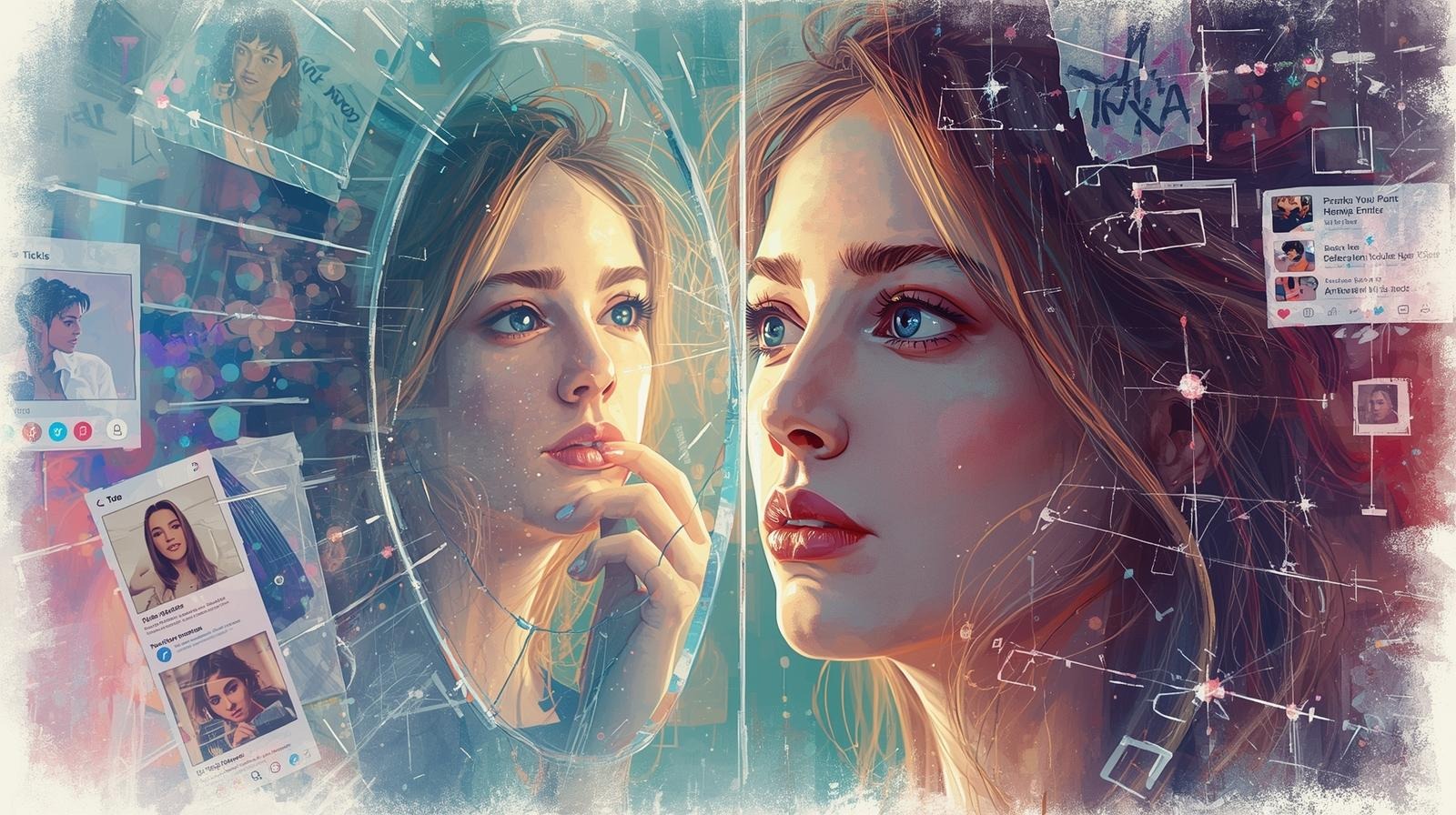
But what if we take that feeling seriously for a moment? What if we treat the TikTok algorithm as a kind of mirror: a reflection of your micro-choices, your unspoken fears, your hidden longings? And what happens when that mirror doesn’t just reflect you, but starts subtly rewriting who you think you are?
This article invites you into a mindful, psychologically informed exploration of TikTok as an “algorithmic mirror.” We will look at what your feed might be saying about you, how it affects your mental health and identity, and how you can turn this mirror into a tool for self-awareness rather than self-destruction.
The strange intimacy of the for You page
Most social platforms show you at least some posts from people you consciously chose: friends, creators you followed, pages you liked. TikTok is different. Its core promise is not “see your friends” but “see what will keep you watching.” The For You Page is essentially a live experiment running on your attention.
Recent research on TikTok’s recommender system suggests that the platform rapidly personalizes content based on tiny signals: how long you watch, whether you rewatch, the sound you tap, the comments you read, the videos you save but never share. Over time, these signals form a behavioral portrait that is often more precise than anything you could put into words.
Psychologists are beginning to describe this portrait as part of the “algorithmic self”: a version of you that is constructed from data traces and continuously updated by AI systems. TikTok is a particularly powerful example because its short-form videos provide a dense, emotionally charged stream of cues that algorithms can quickly learn from.
That is why your FYP can feel uncannily intimate. It is not reading your mind, but it is reading your habits, and habits are often closer to the truth than the stories we tell ourselves.
How TikTok quietly builds a portrait of You
To understand the “mirror,” it helps to demystify what the algorithm is actually doing.
At a high level, TikTok’s system learns from three layers of information. First, there are explicit signals, such as the language you chose, the topics you searched, or accounts you followed. Second, there are implicit signals, like watch time and scrolling patterns, which turn out to be even more predictive. Third, the algorithm cross-references you with “lookalike” clusters of users whose behavior resembles yours, to predict what you might want next.
In psychological language, this is a form of continuous, machine-driven personality and preference assessment. A 2023 mini-review found that TikTok’s algorithm can influence users’ perceived identity, values, and sense of self by repeatedly surfacing content that fits or slightly nudges their existing tendencies. Another study described this as “the algorithmized self,” where people increasingly understand who they are through what the feed reflects back to them.
We can imagine the process as a looping sequence:
You click → the algorithm infers → the feed adjusts → you click again → the portrait sharpens.
Over time, this loop turns into a feedback system that not only reflects you, but trains you.
Algorithm as mirror: What Your feed says about Your inner world
If you treat your FYP like a mirror, what exactly is it reflecting?
It is not simply “what you like.” It is showing patterns of attention. You might scroll past ten lighthearted videos and then linger on the one about burnout, or relationships with emotionally unavailable partners, or a creator talking about being the “therapist friend.” You might think of yourself as “fine,” while your nervous system quietly leans toward content about anxiety, people-pleasing, or trauma.
One way to make this visible is to turn your feed into a kind of self-awareness table. Imagine looking at it like this:
| What You Tend To Do → | What The Algorithm Infers → | What The Feed Reflects Back → |
|---|---|---|
| You pause on videos about burnout, “quiet quitting,” and weekend exhaustion, even if you don’t like or comment. → | You are drawn to content about overwork, chronic fatigue, and emotional exhaustion. → | Your feed gradually fills with creators talking about burnout, hustle culture, and collapse on the couch at 6 p.m. |
| You rewatch videos about “healing your inner child” and dysfunctional families. → | You have unprocessed family experiences and a curiosity about trauma-informed healing. → | You start seeing more content on attachment styles, generational trauma, and “going no contact.” |
| You watch “self-diagnosis” videos on ADHD, BPD, or autism all the way to the end. → | You feel misunderstood, overwhelmed, or out of sync with others and are searching for an explanatory label. → | Your feed becomes dense with mental health labels, symptom checklists, and creators describing their diagnosis journey. |
| You gravitate toward fitness, “what I eat in a day,” and body transformation videos. → | You are focused on appearance, health, or control through the body. → | The algorithm offers more idealized bodies, restrictive eating content, or extreme “discipline” routines. |
Seen this way, TikTok begins to look like a psychological inkblot test that you continually fill in with your behavior. The algorithm doesn’t “know” why you lingered on a video about abandonment wounds; it only knows that you did. But once that becomes a pattern, it keeps placing similar videos in front of you.
Research suggests that this repetition matters. Studies have found that algorithmically curated feeds can strengthen certain identity narratives by repeatedly exposing users to the same themes, especially around mental health, self-diagnosis, and personality labels. The mirror does not just reflect what you clicked once; it reflects what you keep returning to.
From reflection to reinforcement: When the mirror starts to shape You
A mirror is neutral. An algorithm is not. TikTok is optimized for engagement, not well-being or accuracy. That means the system has a built-in bias toward whatever keeps you watching, even if it quietly deepens your anxiety or narrows your worldview.
Large-scale studies of social media personalization show that when feeds are heavily optimized for engagement, they can create echo chambers, increase addictive behaviors, and reduce exposure to diverse or corrective information. On TikTok specifically, experimental work has shown that personalized feeds change how long people stay on the platform and how invested they feel in the content compared to non-personalized feeds.
Translated into everyday experience, this means that if your “mirror” notices you respond strongly to content about relationships where you are always the fixer, it is likely to serve you more and more of that narrative. Over time, this can subtly reinforce the identity of “the one who fixes everyone,” whether or not that identity is serving you.
Something similar happens with emotions. If the algorithm learns that you are more engaged when content is intense, outraged, or tearfully confessional, your feed may slowly tilt toward extremes. You might start to feel as if everyone is traumatized, everyone is cheating, everyone is being diagnosed with something, or everyone is healing at a speed you can’t keep up with.
In psychological terms, the algorithmic mirror can amplify cognitive distortions. It does not just show you a slice of reality; it shows you a slice of reality weighted by your strongest emotional reactions.

Mental health, body image, and the cost of being seen too much
The mental health research around TikTok is still emerging, but some trends are sobering. A 2025 cross-sectional study of adolescents found that higher TikTok use was associated with more anxiety, depression, and sleepiness. A systematic review of TikTok and mental health reported links between problematic use and symptoms such as low mood, poor sleep, and compulsive checking, especially among young users.
Body image is another area of concern. A 2024 review highlighted that TikTok’s algorithm and interface design can inadvertently promote disordered eating by repeatedly surfacing hyper-idealized body content to adolescents who show interest in related themes. Other research and news-reported studies suggest that even brief exposure to idealized TikTok content can lower appearance satisfaction and increase body dissatisfaction in young women.
At the same time, mental health content on TikTok is a double-edged sword. On one side, creators offer validation, destigmatize therapy, and share coping tools. On the other, recent analyses of top mental-health-related videos show a high rate of oversimplifications and misinformation, often wrapped in therapeutic language. Users may walk away with labels but no context, or with tips that feel good in the moment but are not evidence-based.
From a self-love perspective, the painful paradox is this: the place that makes you feel deeply “seen” can also chip away at the very self you are trying to heal. When the algorithmic mirror keeps showing you trauma, pathology, and unattainable standards, it can nudge you toward seeing yourself primarily through what is broken, not what is alive and growing.
Is this really “You”? Data double, algorithmic self, and identity
So if your TikTok feed feels like it knows you, is that really you?
Researchers increasingly talk about a “data double”: a digital replica of you that exists in the servers of platforms, built from probabilities rather than personality. On TikTok, this data double is what the algorithm is responding to. It is not a soul, or a story, or a nuanced biography. It is a moving target of correlations: people who watched this video also watched that one, and you look statistically similar to them.
Yet psychology tells us that mirrors matter. Identity is not formed in isolation; it is co-created with the reflections we receive from others. The “algorithmic self” is what emerges when those reflections come primarily from AI-driven systems rather than human relationships.
Some scholars describe this as a new stage of self-making, where people experiment with identities across platforms, guided by what the algorithm amplifies or ignores. Others use psychoanalytic metaphors, comparing social media feeds to a digital mirror stage in which we learn to love or hate a curated image of ourselves.
From a mindful, compassionate stance, an important distinction emerges:
The algorithmic mirror shows a version of you that is heavily edited by algorithms and engagement metrics.
Your deeper self is larger, slower, and more multi-dimensional than any feed can capture.
The danger is not that TikTok “knows the real you,” but that you might start believing that what the feed reflects is all you are.
Using the algorithmic mirror for self-awareness (instead of self-sabotage)
The good news is that once you see your feed as a mirror, you can start relating to it differently. Instead of asking, “Why is TikTok like this?”, you can gently ask, “What does my For You Page think I am hungry for—and is it right?”
One powerful practice is to treat a scrolling session as a form of guided self-reflection. You might open the app not to escape, but to observe. You watch your own reactions as if you are your own researcher. Which videos make your shoulders drop and your breath deepen? Which ones leave you slightly ashamed or wired? Where do you feel curiosity, envy, relief, or panic?
You can even imagine journaling alongside your FYP. As you scroll, you mentally highlight patterns: “Here is my fear of being abandoned.” “Here is my obsession with productivity.” “Here is my longing for softness, community, and slowness.” In this mode, the algorithmic mirror becomes a starting point for self-inquiry rather than a script you passively accept.
Another subtle but powerful move is to experiment with intentional engagement. Because TikTok’s algorithm is so responsive, small changes in your behavior can slowly shift the reflection. You might decide, for one week, to fully watch and engage only with content that leaves you feeling grounded, compassionate, and connected. That doesn’t mean you avoid hard topics; it means you prioritize creators who speak about them in nuanced, non-sensational ways.
Over time, you may notice the mirror changing. More diverse bodies, more nuanced mental health discussions, more creators whose energy feels like nourishment rather than adrenaline. The feed will not become perfect, but the “you” it reflects might become a little closer to who you are trying to become.
A second table: Rewriting the mirror in Your favor
To make this more concrete, imagine a second table — this time with you as the one steering the feedback loop:
| If You Consciously Choose → | The Algorithm Learns → | The Mirror Starts To Show → |
|---|---|---|
| You save and rewatch videos that normalize rest, boundaries, and saying “no” without guilt. → | You are highly engaged with content about healthy boundaries and self-respect. → | A growing stream of creators who model assertiveness, rest, and self-compassion in everyday life. |
| You pause on nuanced, evidence-informed discussions of mental health and skip over oversimplified, label-heavy content. → | You prefer depth over virality in the mental health space. → | More creators who reference research, therapy, and personal growth in grounded ways. |
| You intentionally diversify your feed by watching content from people with different body types, ages, backgrounds, and life paths. → | You respond positively to diversity and plurality. → | A less homogenous, more realistic representation of beauty, success, and happiness. |
| You close the app when you notice your nervous system ramping up rather than pushing through. → | Your high-arousal triggers don’t consistently lead to extended watch time. → | Over time, fewer extreme, outrage-driven or panic-inducing videos. |
The arrows in this table point in both directions. You are not powerless; you are co-creating the mirror. This co-creation is subtle and slow, but it is real.
Boundaries, rituals, and caring for the self behind the screen
Seeing the algorithm as a mirror also highlights something simple but profound: mirrors need boundaries. You would not stare into a physical mirror for three hours and then be surprised that you feel disconnected from your body. The same applies to digital mirrors.
Time-based boundaries are one layer. Large observational studies have found that higher time on TikTok, in particular, is associated with more mental health difficulties compared to some other platforms. That does not mean “all TikTok is bad,” but it does suggest that your nervous system has a saturation point.
Emotional boundaries are another layer. Before opening the app, you might ask: “What state am I in right now, and what do I actually need?” If you are exhausted and lonely, a feed full of idealized relationships or hyper-productive routines may intensify the pain. If you are activated by trauma content, an algorithmically amplified stream of trauma narratives might leave you flooded instead of empowered.
Rituals can help. You might decide that TikTok is only for certain times of day, or that you will close it after noticing three signs of nervous system overload: jaw tension, shallow breathing, or the sense that you are no longer in your body but hovering above it. You could pair the app with small grounding actions: drinking water, stretching your shoulders, placing a hand on your heart when you see something that hits too close.
These tiny gestures remind you that there is a living, breathing person watching the feed, not just a profile being optimized for engagement.

When to reach beyond the algorithm
There is a final, tender piece to the mirror metaphor: at some point, you need people, not just patterns.
TikTok can be a gateway to feeling less alone, especially around experiences like trauma, neurodivergence, or growing up in invalidating environments. But when the algorithm is your primary source of reflection, you miss out on the slow, imperfect, but deeply regulating presence of real relationships and professional support.
Clinical and public-health research consistently emphasizes that while online communities can offer validation, they cannot substitute for assessment and care from trained mental health professionals, especially when it comes to complex issues like eating disorders, trauma, or mood disorders. If your feed is constantly telling you that you are broken, disordered, or beyond repair, it may be time to pause and invite a different kind of mirror into your life: a therapist, a support group, a trusted friend who sees your nuances.
Reaching beyond the algorithm does not mean rejecting technology. It means remembering that your worth, your healing, and your identity cannot be fully captured in a series of swipes and watch times. The algorithmic mirror is powerful, but it is still just glass and code.
Looking back at the mirror
When TikTok seems to know you better than your friends, it is tempting to interpret that as evidence that technology is more attuned, more understanding, even more “loyal” than the humans in your life. But what the algorithm knows is not your soul; it is your patterns. What it reflects is not your whole self; it is the slices of you that are most profitable to amplify.
The invitation, especially on a site like CareAndSelfLove.com, is not to demonize TikTok or to romanticize life without algorithms. It is to reclaim your agency inside the loop. You can look at your For You Page and ask, with curiosity rather than judgment:
What stories about me is this mirror reinforcing?
Which of those stories feel true and life-giving?
Which ones feel like old wounds being replayed for the sake of engagement?
And then, slowly, you can begin to respond. You can engage differently, set boundaries, seek out content that nourishes rather than depletes, and, when you are ready, step away from the glass and back into embodied, offline life.
In the end, the most healing question is not “What does the algorithm say about me?” but “Who am I, when no algorithm is watching?”
Related posts You’ll love
- When TikTok knows too much: 6 guided exercises to set boundaries with social media
- Words of power that protect You from social media envy: Healing language for digital age self-love
- How to stop hating yourself on social media: 7 ways to build self-love in a world of constant comparison
- “Is this all there is?” Understanding the mid-20s and 30s existential crisis no one prepared You for
- Why You’re addicted to checking who viewed Your story: The hidden psychology of approval
- Practice corner: How to break the habit of checking who viewed Your story. FREE PDF!
- Practice corner: Trigger vs intuition — Therapist-approved drills to break avoidance loops (TikTok myth detox), FREE PDF WORKBOOK
- Your therapist would hate this TikTok: The pop psych myth that keeps You stuck (and the science based way out)

FAQ: TikTok, algorithms and Your mental health
-
Why does my TikTok For You Page feel like it knows me so well?
TikTok’s For You Page feels eerily accurate because the algorithm is constantly learning from your behavior. It tracks how long you watch certain videos, what you rewatch, which sounds you tap, what you save, and which creators you keep coming back to. Over time, these small signals create a detailed picture of your interests and emotional triggers. The algorithm does not “read your mind,” but it does read your patterns, which can feel even more revealing than what you consciously notice about yourself.
-
Is the TikTok algorithm really a mirror of my inner world?
The TikTok algorithm can act like a partial mirror of your inner world, especially the parts you respond to most strongly. It reflects back your attention: your fears, curiosities, obsessions, and longings, based on what you consistently watch. However, it is not a complete mirror of who you are. It exaggerates the themes and emotions that keep you engaged and often ignores parts of your life that are less “clickable” but still deeply important, like your offline relationships, values, and quiet moments.
-
Can TikTok affect my mental health and self-esteem?
Yes, TikTok can influence your mental health and self-esteem, both positively and negatively. On the positive side, you might feel seen, validated, and less alone, especially around topics like trauma, neurodivergence, or anxiety. On the negative side, a feed filled with idealized bodies, extreme productivity, or constant trauma narratives can increase anxiety, body dissatisfaction, comparison, and emotional overwhelm. The impact depends on what your feed is showing you, how long you use the app, and how regulated or dysregulated you already feel when you open it.
-
Why does TikTok keep showing me trauma and mental health content?
If your TikTok feed keeps showing trauma and mental health content, it is usually because you have unintentionally signaled interest. Spending more time on videos about trauma, mental health labels, or healing journeys tells the algorithm that this content “works” for you. The system then offers more videos in that category to keep your attention. This doesn’t necessarily mean you are defined by trauma, but it does mean your behavior has trained the algorithm to prioritize those topics in your personal “mirror.”
-
How can I make my TikTok feed healthier and more supportive?
You can gently retrain your TikTok feed by engaging intentionally. Choose to fully watch and like videos that leave you feeling grounded, hopeful, and informed, rather than panicked or ashamed. Save content that normalizes rest, boundaries, and diverse bodies. Skip or scroll past videos that feel sensational, triggering, or oversimplified. Over time, the algorithm will adjust to these new patterns, and your For You Page will gradually reflect a more nourishing and balanced version of your interests.
-
Is TikTok bad for my mental health, or does it depend on how I use it?
TikTok is not automatically “bad” or “good” for your mental health. It depends on how you use it, how much you use it, and what your feed is filled with. Long, unintentional scrolling sessions when you are already anxious, lonely, or exhausted can easily make you feel worse. Short, mindful sessions where you actively choose who to follow and what to engage with can offer education, comfort, and inspiration. The key is to notice how you feel after using TikTok and adjust your habits accordingly.
-
Why does TikTok feel more validating than my real-life relationships?
TikTok can feel more validating than real life because the algorithm is designed to show you content that aligns with your internal world very quickly. When creators describe experiences that sound exactly like yours, you might finally feel seen. In contrast, friends and family may not have the language, personal experience, or emotional skills to reflect you in the same precise way. Still, as comforting as algorithmic validation can be, it cannot fully replace the depth, repair, and co-regulation that come from real-life relationships and, when needed, professional support.
-
Should I trust TikTok for mental health advice and self-diagnosis?
You can treat TikTok as a starting point for curiosity, not as a final diagnosis or treatment plan. Some mental health creators on TikTok are licensed professionals who share grounded, evidence-based content. Others use therapeutic language without training and may oversimplify or misrepresent complex conditions. If TikTok videos are making you wonder about a possible diagnosis or encouraging specific treatments, it is important to follow up with a qualified mental health professional rather than relying solely on the algorithmic feed.
-
What does “algorithmic self” or “data double” mean in the context of TikTok?
The “algorithmic self” or “data double” is a term used to describe the version of you that exists inside platforms like TikTok. It is built from your likes, watch time, comments, reposts, and viewing habits. This digital double is what the algorithm reacts to and optimizes for; it is a statistical portrait, not a full human being. The risk is that you may start to believe that this narrow, engagement-based version of you is your whole identity, when in reality your offline self is richer, deeper, and less predictable than any data profile.
-
How can I use my TikTok For You Page for self-awareness instead of self-sabotage?
You can use your For You Page as a tool for gentle self-reflection. Instead of scrolling on autopilot, notice what types of videos grab you, which ones you replay, and how your body feels as you watch. Ask yourself questions like: “What does this pattern say about what I am craving or fearing?” or “Is this content mirroring a wound, a desire, or a value?” By approaching your feed with curiosity instead of judgment, you can learn about your themes and triggers, and then decide—consciously—what you want to keep reinforcing and what you want to shift.
-
How do I know when it is time to take a break from TikTok?
It might be time to take a break when you notice signs like: feeling emotionally drained after scrolling, struggling to sleep because your mind is full of videos, comparing your life harshly to people on your feed, or finding it hard to stop watching even when you want to. Physical signals like tight shoulders, shallow breathing, or a sense of numbness can also be clues. If TikTok leaves you more disconnected from your body and your real life than before you opened it, a pause, time limit, or intentional detox can be deeply supportive for your mental health.
-
When should I talk to a therapist instead of relying on TikTok content?
You should consider talking to a therapist when TikTok is bringing up intense feelings you cannot process alone, when you recognize patterns like self-harm, disordered eating, panic attacks, or overwhelming trauma responses, or when your daily life, relationships, or work are suffering. TikTok can make you feel less alone and give you language for your experience, but it cannot offer personalized, sustained care. A therapist can help you explore the themes your algorithmic mirror keeps reflecting and support you in slowly rewriting those patterns in a way that honors your story, your nervous system, and your future.
Sources and inspirations
- Bhandari, A., & Bimo, A. (2022). Why’s everyone on TikTok now? The algorithmized self and the future of self-making on social media. Social Media + Society.
- Bilali, A., Katsiroumpa, A., Koutelekos, I., Dafogianni, C., Gallos, P., Moisoglou, I., & Galanis, P. (2025). Association between TikTok use and anxiety, depression, and sleepiness among adolescents: A cross-sectional study in Greece. Pediatric Reports.
- Carpenter, A. (2023). Associations between TikTok use, mental health, and body image among college students (Honors thesis). University of Mississippi.
- Han, J. (2024). TikTok use and body image issues: A review on algorithm and interface design tactics that promote disordered eating in adolescents. Research in Arts and Social Sciences.
- Ionescu, C. G., & Gherheș, V. (2023). Are TikTok algorithms influencing users’ self-perceived identity and personal values? Social Sciences.
- Jain, L., & Hsieh, G. (2025). Exploring problematic TikTok use and mental health issues: A systematic review. Current Psychology.
- Joseph, J. (2025). The algorithmic self: How AI is reshaping human identity, agency, and mental health. Frontiers in Psychology.
- Risco, M., & Guess, A. (2024). Feed for good? On the effects of personalization algorithms in online platforms (CRC TR 224 Discussion Paper No. 580). University of Bonn.
- Trap of Social Media Algorithms: A systematic review of algorithmic personalization and its social consequences. (2025). Societies.
- UNSW Sydney. (2023, August 21). TikTok and body image: Idealistic content may be detrimental to mental health.
- Woodward, M. J., (2025). Time spent on social media and associations with mental health: Platform-specific patterns for TikTok, YouTube, and Snapchat. Journal of Technology in Behavioral Science.
- Yao, N., (2025). TikTok use in relation to mental health and well-being: A systematic review of current evidence. Current Opinion in Psychology.
- Wired. (2025). Eating disorder content is infiltrating TikTok. Some creators are going viral debunking it.
- The Guardian. (2025). More than half of top 100 mental health TikToks contain misinformation, study finds.
- The British Psychological Society. (2025). What the algorithm teaches you: A reflection on social media and self-worth.



Leave a Reply