Table of Contents
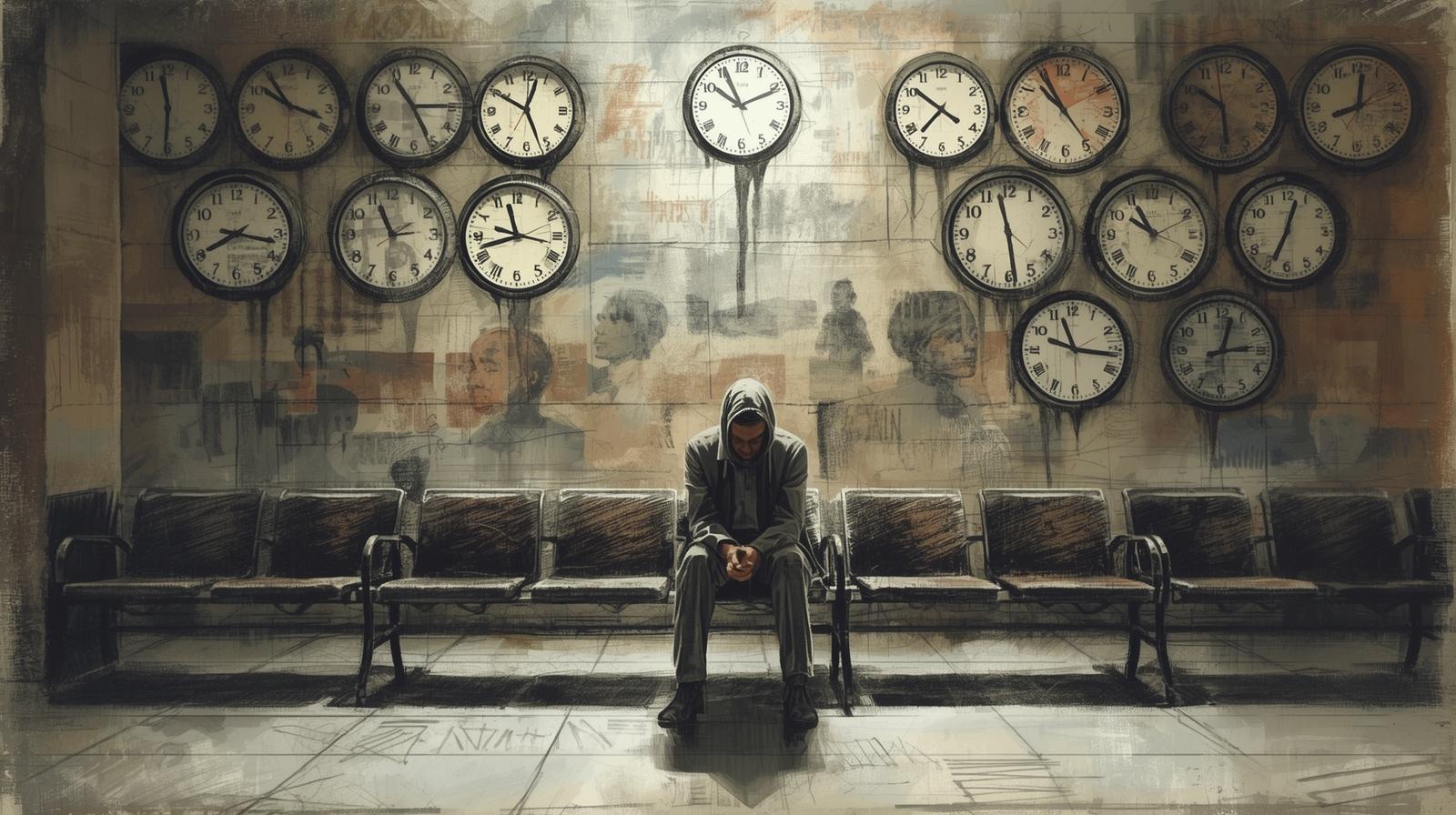
There is a particular kind of exhaustion that does not come from overwork, heartbreak, or visible crisis. It comes from suspension. From living as if your actual life is a waiting room and your real life is somewhere just beyond the next milestone. After the next job. After the next relationship. After the glow-up. After the move. After healing a little more. After becoming more disciplined, more attractive, more secure, more confident, more “ready.”
Many people know this feeling intimately: the sense that life is not exactly wrong, but not yet properly underway. You function, perform, plan, scroll, optimize, and imagine. You tell yourself you are preparing. You are building. You are almost there. And yet the version of life you are waiting for never fully arrives. It keeps changing shape. It keeps moving one horizon further away.
This pattern is not simply about impatience. It is not always laziness, lack of ambition, or poor planning. In many cases, it is a psychological strategy. Waiting can become an elegant form of self-protection. It allows us to preserve hope, avoid disappointment, soften uncertainty, and keep a fantasy version of ourselves untouched by contact with reality. Research on procrastination, perfectionism, experiential avoidance, future anxiety, and psychological flexibility helps explain why some people do not merely delay tasks. They delay inhabiting their own lives.
What makes this pattern especially painful is that it often looks responsible from the outside. It can wear the costume of self-improvement. It can sound like wisdom. “I just want to be ready.” “I’m waiting for the right season.” “I need to sort myself out first.” But beneath those sentences there is often a hidden emotional bargain: I will allow myself to fully live once I become someone safer to be. That bargain can quietly steal years.
This article explores the psychology behind that bargain. Not in a dramatic, pathologizing way, but in a human one. Because waiting for your life to begin is one of the most common modern forms of self-abandonment. And the way out is rarely becoming perfect. More often, it is learning how to stop outsourcing your aliveness to the future.
The quiet grief of living in “almost”
One of the hardest parts of this experience is that it rarely looks like grief at first. It looks like ambition. It looks like standards. It looks like having potential. But emotionally, it often carries the shape of loss. You miss moments you were physically present for because some part of you kept saying, not yet. You postpone joy until it feels deserved. You postpone connection until you feel more lovable. You postpone rest until you have finally earned it. You postpone creative expression until you can do it brilliantly.
Over time, this creates a strange emotional split. Your body is living in one timeline, but your permission to feel alive has been assigned to another one. The result is not just frustration. It can become emptiness, numbness, chronic dissatisfaction, and the eerie sense that life is happening near you rather than through you.
Psychologically, this split overlaps with what self-discrepancy research describes as the tension between the actual self and the ideal self. When the gap between who you are and who you believe you must become grows too wide, distress often rises with it. That distress does not always lead to action. Sometimes it leads to freezing, postponing, self-monitoring, and retreat into fantasy.
Recent work on perfectionism and self-compassion suggests that it is not simply high standards that hurt people most, but the painful sense of discrepancy and falling short. Self-compassion appears to soften that impact by reducing the emotional violence of not yet being who you hoped to be.
That matters because many people are not waiting for life itself. They are waiting for permission. Permission from an imagined future self who is calmer, more impressive, more healed, and somehow unquestionably worthy.
What are we really waiting for?
On the surface, people say they are waiting for concrete things:

Most of these are not really logistical statements. They are emotional ones. They translate into needs for safety, control, coherence, identity, and self-trust.
This is why advice like “just stop waiting” often fails. People are not attached to waiting because it is fun. They are attached to waiting because it regulates something. It reduces immediate discomfort. It creates a story of eventual rescue. It preserves the possibility that a better self is coming, and that when that self arrives, life will finally feel easier to inhabit.
In psychology, procrastination is increasingly understood not merely as a time-management problem but as an emotion-regulation problem. A recent meta-analysis covering 88 studies and more than 63,000 participants found a moderate positive association between procrastination and negative emotions such as depression, anxiety, and stress. Longitudinal work also suggests procrastination can precede later depression and anxiety symptoms, even if the exact pathways are more complex than older models assumed.
That is a useful lens here. If delaying a task can soothe discomfort for a moment, delaying a whole stage of life can do the same. You do not have to test yourself. You do not have to risk visible imperfection. You do not have to discover that the dreamed-of life still contains ordinary sadness, ordinary insecurity, and ordinary you.
Waiting is often emotional avoidance in elegant clothing
Let us name something gently but clearly: in many cases, chronic waiting is avoidance with excellent manners.
Not all waiting is avoidance. Sometimes waiting is wise. Sometimes timing matters. Sometimes resources, grief, health, or real-life constraints genuinely require patience. But when waiting becomes your default relationship with yourself, it often starts functioning as experiential avoidance: the attempt to escape difficult internal states such as fear, shame, uncertainty, grief, disappointment, or vulnerability.
Research on procrastination has repeatedly linked it with transdiagnostic processes such as emotion dysregulation, worry, rumination, perfectionism, and experiential avoidance. In other words, delay often serves a soothing function in the short term, even when it damages wellbeing in the long term.
That short-term soothing can be seductive. Consider the following loop:
Discomfort about the present self
→ Fantasy about a better future self
→ Temporary emotional relief
→ Less immediate pressure to act now
→ More delay, comparison, and shame
→ An even bigger need for fantasy
This is not stupidity. It is a protective cycle. The mind says, Let’s not expose ourselves yet. Let’s imagine a cleaner beginning. The problem is that a cleaner beginning almost never comes. Real life does not begin when the mess is over. Real life is the place where the mess is metabolized.
There is also an identity payoff hidden inside this pattern. As long as your “best life” is still ahead of you, it remains uncontaminated by reality. Untested potential can feel safer than imperfect embodiment. A dream cannot disappoint you until you begin living it.
The future-self trap: When hope becomes a form of delay
Future orientation is not inherently harmful. In fact, future-oriented thinking can support motivation, planning, and resilience. But future orientation becomes psychologically costly when it is severed from the present and turned into emotional outsourcing.
A healthy future says, I care about what I’m building, so I will take one step now. An unhealthy future says, I cannot fully exist until that future arrives.
That distinction matters. Research on psychological flexibility emphasizes the capacity to pursue valued aims while staying in contact with present-moment reality, including difficult feelings. Psychological flexibility is associated with better wellbeing and more adaptive behavior, while inflexibility often shows up as avoidance, fusion with thoughts, and narrowed action. Recent studies also suggest that improvements in psychological flexibility can help reduce procrastination, especially when paired with better time and effort management.
In other words, the issue is not having a future self. The issue is treating that future self like your emotional landlord.
A lot of modern suffering comes from this hidden arrangement:
“Current me is not enough to fully live.”
“Future me will finally know how.”
“So current me must keep preparing for future me.”
But future selves are notoriously poor rescuers. They inherit the nervous system, habits, beliefs, and unprocessed fears of the present self unless something is practiced now. The fantasy of future transformation can become a way of avoiding the ordinary, humbling work of present participation.
This is one reason some people remain stuck even while doing “everything right.” They are journaling, planning, healing, consuming advice, watching content, creating new systems, and waiting for the click of readiness. Yet readiness is often not a feeling that arrives before action. It is a feeling that grows inside action.
Why this pattern feels so intense in modern life
This way of living has always existed, but contemporary life gives it new fuel.
Digital environments increase exposure to curated identities, upward comparison, and the feeling that everyone else is already inside the life stage you are still preparing for. Research suggests passive social media use is particularly likely to trigger unhealthy social comparison, especially upward contrast, which can intensify stress and lower wellbeing.
At the same time, broader social media research shows that online spaces are not purely harmful; effects are mixed and depend on how people use them, the kind of connection they experience, and whether comparison or social support becomes dominant.
This matters because waiting thrives in comparison-heavy environments. You scroll past polished careers, bodies, homes, relationships, routines, and reinventions, and the mind quietly concludes: I should not begin my messy version yet. Look how complete everyone else already is.
Add perfectionistic culture, self-branding, constant optimization, and uncertainty about the future, and the pressure intensifies. People do not just want a life anymore. They want a coherent, aesthetically satisfying, psychologically optimized life. That raises the threshold for participation. Ordinary living starts to feel insufficient.
Uncertainty also plays a major role. People high in intolerance of uncertainty tend to experience more day-to-day psychological distress, and meaning in life may help buffer some of that impact. When uncertainty feels unbearable, waiting can become an attempt to negotiate with reality: I will commit once the unknown becomes known. But adulthood never fully offers that bargain.
So the modern version of waiting is not just, “I’ll do it later.” It is often, “I’ll become visible later, when uncertainty, comparison, and imperfection no longer sting so much.”
Patience vs. self-abandoning delay
Not every pause is pathology. Some pauses are sacred. Some are strategic. The real question is whether your waiting keeps you connected to life or increasingly estranged from it.

A useful self-check is this: Does my waiting still contain movement? If yes, you may be in a season of wise incubation. If not, you may be trapped in deferred-life mode.
Another check is emotional. Healthy patience can be frustrating, but it does not usually make you disappear from your own life. Self-abandoning delay often does. It shrinks your relationships, your spontaneity, your joy, your sense of authorship, and eventually your trust in yourself.
The hidden role of perfectionism
Perfectionism deserves special attention here because it often disguises itself as discernment. It sounds intelligent. Selective. Principled. But maladaptive perfectionism is deeply related to discrepancy, self-criticism, and feeling perpetually not-yet-enough.
Recent research with emerging adults found that self-compassion reduced the strength of the relationship between discrepancy and lower psychological wellbeing. In simpler language, the more brutally you interpret the gap between who you are and who you think you should be, the harder it becomes to live. The more compassion enters that gap, the more livable life becomes again.
Perfectionism also feeds waiting through a cruel fantasy: If I cannot begin beautifully, I would rather remain unrealized than be ordinary in public.
But ordinariness is not the enemy of a meaningful life. Avoidance is.
And this is where many sensitive, thoughtful people get stuck. They are not avoiding because they do not care. They are avoiding because they care so much that imperfection feels like exposure. Waiting becomes a strategy for preserving dignity.
Unfortunately, it often produces the opposite. The longer people wait, the more shame accumulates. The more shame accumulates, the harder starting becomes. The harder starting becomes, the more seductive fantasy grows.
A more honest model of healing: Life does not start after You “fix Yourself”
One of the most painful myths in self-development culture is the idea that you must become fully healed before you are allowed to belong to your own life.
Healing matters. Reflection matters. Therapy matters. Boundaries matter. Growth matters. But many people accidentally turn healing into another waiting room. They imagine a future version of themselves who will feel no ambivalence, no fear, no grief, no insecurity. Only then, they think, will love be possible, work be possible, creativity be possible, rest be possible.
That is not healing. That is purification fantasy.
Psychological flexibility offers a more humane alternative. It does not ask whether you are free from discomfort. It asks whether you can move toward what matters while making room for discomfort. Recent evidence also suggests that psychological flexibility and emotion regulation can help buffer the relationship between future anxiety and distress.
This is deeply liberating. It means the goal is not to become a person with no fear. The goal is to become a person who no longer lets fear decide whether life gets lived.
You do not need to feel finished to be present. You do not need to be certain to participate. You do not need to love every part of yourself to stop abandoning yourself.
How to stop waiting for the “real” version of life
The way out is rarely dramatic. It is usually embarrassingly small. But small does not mean weak. Small means repeatable.
1. Stop using the phrase “when life finally begins”
Language shapes identity. If you keep describing the present as a pre-life stage, your mind will treat it that way. Replace that script with something more honest: This is my life, even if it is unfinished. Especially because it is unfinished.
2. Lower the threshold for what counts as living
Many people secretly define “real life” in cinematic terms: clarity, confidence, partnership, beauty, momentum, certainty. Real life is much plainer. It may be a walk taken without your phone. A tender meal eaten alone. An email sent before you feel ready. A class joined with shaking hands. A creative act made badly but honestly.
3. Translate fantasy into contact
When you catch yourself imagining the future, ask: What is the smallest present-tense behavior that belongs to this desire? Not the perfect move. The honest one.
Dream of being more connected
→ text one person
Dream of being creative
→ make one ugly page
Dream of a healthier life
→ cook one decent meal
Dream of being more confident
→ do one visible thing while uncertain
Research on goal processes suggests that flexibility and intrinsically meaningful motives help support wellbeing over time. The point is not rigid achievement at all costs, but values-linked movement.
4. Build self-trust through completion, not self-critique
People often wait because they do not trust themselves. Then they try to create trust by thinking harder, planning harder, and criticizing themselves harder. It rarely works. Self-trust grows through evidence. Through tiny completed promises. Through repeated contact with the self who shows up.
5. Practice “messy life exposure”
If avoidance keeps life on hold, then one antidote is controlled exposure to imperfect participation. Let yourself be seen before you feel fully formed. Go to the dinner without being at your best. Publish the imperfect essay. Apply before you feel complete. Wear the body you currently have into the daylight of your own life.
6. Replace self-judgment with self-compassion, not self-excusing
Self-compassion does not mean passivity. It means refusing to turn every delay, flaw, or unfinished edge into proof that you are disqualified from living. It reduces the emotional cost of being a human in progress, which makes action more possible, not less.
The unconventional shift: From future achievement to present permission
Here is the less conventional truth: many people do not need a new five-year plan. They need new permission structures.
They need permission to enjoy while still becoming. Permission to belong before arrival. Permission to make meaning before certainty. Permission to be lovable while unfinished. Permission to stop treating current life as a draft version of something more official.
This is not anti-growth. It is anti-postponement.
A meaningful life is not usually built by finally reaching a flawless state and then beginning. It is built by repeatedly refusing the lie that only a perfected self deserves intimacy, beauty, rest, joy, contribution, or tenderness.
Goal adjustment research is relevant here too. When circumstances change or cherished goals become blocked, wellbeing is often protected not by stubbornly clinging to one exact imagined future, but by adapting, reengaging, and allowing life to take shape in more than one acceptable form.
That may be one of the deepest cures for chronic waiting: giving up the monopoly of one imagined life.
Because sometimes the version of life that never quite arrives is not the life you actually need. It is just the life you believed would finally make you feel exempt from being human.
Your life is not waiting for Your better replacement
If this pattern has been living in you, there is a good chance you are not behind in the way you think you are. You may simply be tired from negotiating with an impossible internal standard. Tired from trying to earn entry into your own existence. Tired from believing that the future version of you is the only one qualified to live well.
But the future is not the place where your worth becomes valid.
It is not the place where your life becomes official.
It is not the place where you finally become real.
You are already the person your life is happening to.
And perhaps the deepest healing is not finally becoming the ideal self you were promised. Perhaps it is learning to stop exiling the current self from love, presence, risk, pleasure, and participation.
The life you keep calling “later” may not need more waiting.
It may need your return.
Related posts You’ll love
- Calm without closure: How to feel better even if life is unresolved (a science based calm space guide)
- Power phrases for Women who want better, not more
- Better atmosphere for Women: Why They don’t always need a reset
- The reach out reset: A 14 day practice for Women to break the midlife silence epidemic with FREE PDF
- Safety isn’t paranoia: The psychology of female precaution and the art of feeling safe without shrinking Your life
- Time scarcity reset: 11 exercises to break the “always behind” feeling without changing Your whole life (WITH PDF!)
- How to stop waiting for Your life to begin: 12 evidence-based exercises to reconnect with the present and feel more alive now, FREE PDF
- The reach out reset: A 14 day practice for Women to break the midlife silence epidemic with FREE PDF

FAQ
-
Why does it feel like my life hasn’t started yet?
It often feels this way when you are emotionally invested in a future version of yourself and treat the present as preparation rather than participation. Self-discrepancy, perfectionism, avoidance, and future anxiety can all contribute to that suspended feeling.
-
Is this just procrastination?
Not exactly, but it overlaps with procrastination. Procrastination is often about delaying tasks, while this pattern can involve delaying identity, joy, intimacy, or self-expression. The underlying mechanism is often similar: avoiding present discomfort for short-term emotional relief.
-
Can perfectionism make me postpone living?
Yes. Maladaptive perfectionism can make people feel that life should only be entered once they are more complete, impressive, or in control. Research suggests that discrepancy and self-criticism are especially harmful, while self-compassion can buffer their impact on wellbeing.
-
Is waiting for the “right moment” always unhealthy?
No. Sometimes waiting is practical, wise, or necessary. It becomes unhealthy when it turns into a chronic pattern that reduces your contact with life, values, and relationships rather than protecting them.
-
Why do I keep imagining a better future self instead of acting now?
Because the imagined future self can provide hope, relief, and emotional distance from current shame or uncertainty. Fantasy can temporarily soothe distress, which is why it becomes so compelling. But it can also widen the gap between intention and lived experience.
-
Does social media make this worse?
For many people, yes. Passive scrolling and upward comparison can increase stress and dissatisfaction, especially when other people’s polished lives become a measuring stick for your unfinished one. At the same time, social media effects are mixed and can also support connection depending on how it is used.
-
Why do I feel guilty enjoying my life before I’ve “earned” it?
Because many people internalize the idea that rest, joy, beauty, or love must be justified by productivity, healing, success, or self-improvement. That belief often has deeper roots in conditional worth, not reality.
-
Can anxiety about the future keep me stuck in the present?
Yes. Future anxiety is associated with distress, and psychological flexibility appears to help reduce its impact. When uncertainty feels intolerable, waiting can become a coping strategy designed to avoid commitment until the future feels safer.
-
What actually helps me stop waiting?
Small present-tense actions help more than grand reinventions. Psychological flexibility, self-compassion, values-based action, and flexible goal adjustment all support healthier movement than perfectionistic self-pressure.
-
How do I know if I’m being patient or self-abandoning?
Ask whether your waiting still includes meaningful movement. Healthy patience preserves contact with life. Self-abandoning delay usually shrinks it.
-
When should I talk to a therapist about this?
It is worth seeking support when waiting turns into chronic numbness, hopelessness, severe avoidance, depression, anxiety, or a repeated inability to participate in relationships, work, or daily life. Therapy can help you understand what your waiting is protecting and what it is costing.
Sources and inspirations
- Asikainen, H., Hailikari, T., & Katajavuori, N. (2024). Explaining the changes in procrastination in an ACT-based course: Psychological flexibility and time and effort management as mediators. Frontiers in Psychology.
- Benedetto, L., Macidonio, S., & Ingrassia, M. (2024). Well-being and perfectionism: Assessing the mediational role of self-compassion in emerging adults. European Journal of Investigation in Health, Psychology and Education.
- Dickson, J. M., Hart, A., Fox-Harding, C., & Huntley, C. D. (2023). Adaptive goal processes and underlying motives that sustain mental wellbeing and New Year exercise resolutions. International Journal of Environmental Research and Public Health.
- Hamm, J. M., Tan, J. X. Y., Barlow, M. A., Delaney, R. L., & Duggan, K. A. (2022). Goal adjustment capacities in uncontrollable life circumstances: Benefits for psychological well-being during COVID-19. Motivation and Emotion.
- Jamil, L., Ashouri, A., Zamirinejad, S., & Mahaki, B. (2021). Investigating the structural model of procrastination based on transdiagnostic factors. Medical Journal of the Islamic Republic of Iran.
- Johansson, F., Rozental, A., Edlund, K., Côté, P., Sundberg, T., Onell, C., Rudman, A., & Skillgate, E. (2023). Associations between procrastination and subsequent health outcomes among university students in Sweden. JAMA Network Open.
- Klein, R. J., Jacobson, N. C., & Robinson, M. D. (2023). A psychological flexibility perspective on well-being: Emotional reactivity, adaptive choices, and daily experiences. Emotion.
- Morse, J. L., Luong, G., Prince, M. A., & Steger, M. F. (2023). Disentangling trait and daily experiences of uncertainty and meaning in life: Implications for daily anxiety, negative affect, and somatic symptoms. Anxiety, Stress, & Coping.
- Nie, Y., Wang, W., Zhou, F., Wang, T., Li, S., Liu, C., & Gao, J. (2025). The association between procrastination and negative emotions in healthy individuals: A systematic review and meta-analysis. Frontiers in Psychiatry.
- Yue, Z., Zhang, R., & Xiao, J. (2022). Passive social media use and psychological well-being during the COVID-19 pandemic: The role of social comparison and emotion regulation. Computers in Human Behavior.



Leave a Reply