Table of Contents
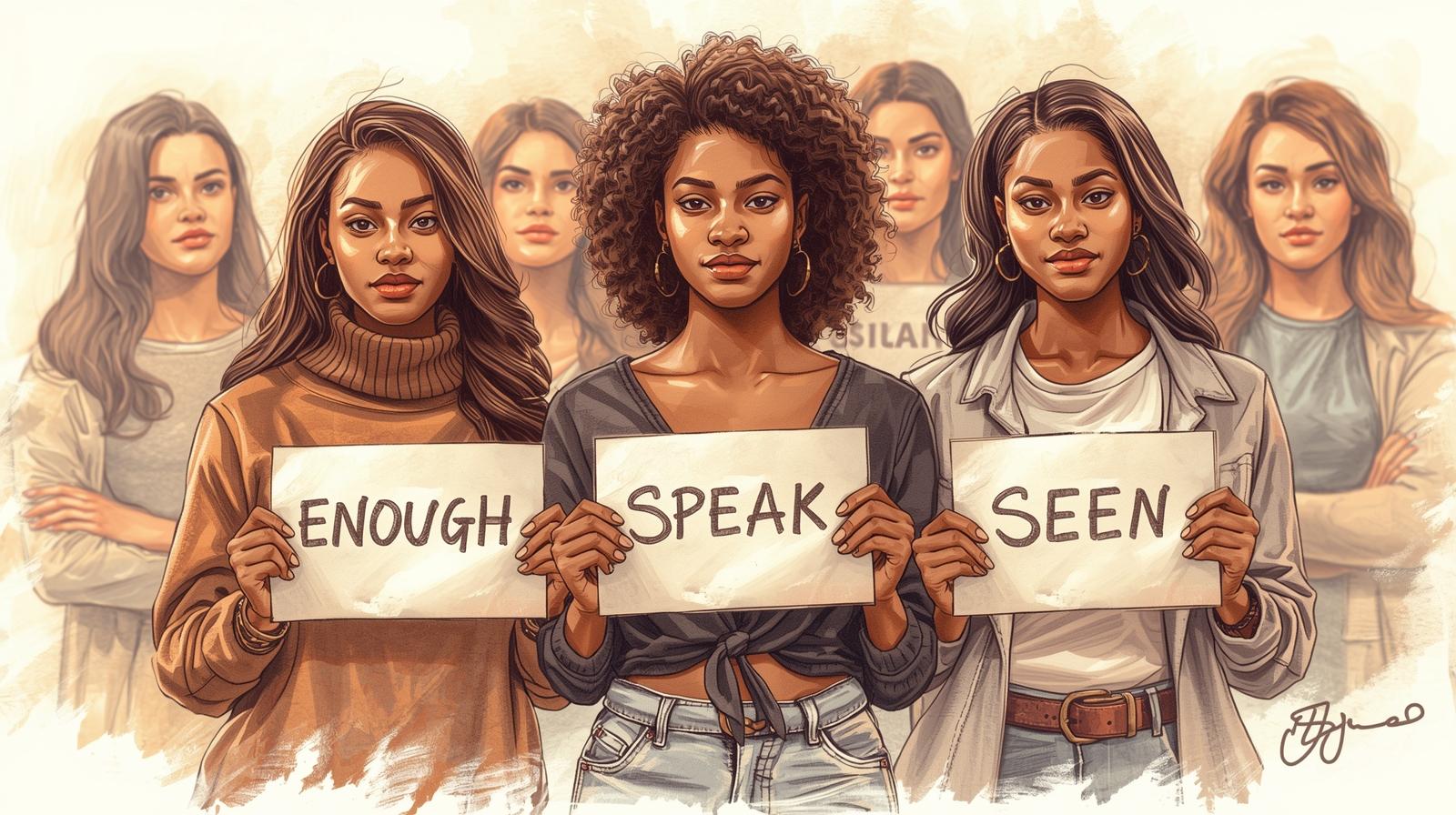
There is a particular kind of pain in feeling invisible as a woman.
It is not always dramatic. Sometimes it is so quiet that even you struggle to name it. It can happen in a meeting when your idea lands only after a man repeats it. It can happen in a relationship where you are cherished for what you provide but not really known for who you are. It can happen in a family where you are everyone’s emotional infrastructure and yet somehow the least asked-about person in the room. It can happen online, in public, in motherhood, in work, in aging, in beauty culture, in illness, and in ordinary conversation.
And because it is often subtle, it can become dangerous in a subtle way too.
When something hurts you loudly, you tend to respond. But when something hurts you quietly, repeatedly, socially, and almost “normally,” you may begin to adapt to it. You make yourself smaller. You explain less. You ask for less. You apologize more quickly. You tell yourself you are being too sensitive. You swallow the sentence that was sitting in your throat. You perform calm while feeling erased. Over time, invisibility can become not just something that happens to you, but something you begin to rehearse inside yourself.
That is why this article is not just about language in a decorative sense. It is about language as return. Language as re-entry. Language as a hand at your own back.
Research across gender bias, microaggressions, self-silencing, belonging, and self-compassion suggests that women’s experiences of being dismissed, invalidated, overlooked, or reduced are not imaginary personal defects. They are often shaped by real social patterns. Studies have linked gendered invalidation and subtle bias with diminished belonging, strain, and reduced well-being, while self-silencing has been associated with depression and emotional burden in multiple groups of women. At the same time, self-compassion and supportive inner language have been associated with lower distress and healthier coping.
So no, you do not need prettier words so you can tolerate disappearance more elegantly.
You need words that return you to yourself.
Not slogans. Not performance. Not fake brightness.
Words that help you remember:
I am still here.
I still belong to myself.
I do not need to vanish to be loved.
This piece is built around return words rather than traditional affirmations. They are shorter, steadier, and more honest. Each one is meant to meet you where you actually are: tired, angry, overextended, doubting, raw, brilliant, half-numb, still breathing.
Let’s begin there.
Why feeling invisible as a Woman hurts more than people admit
Feeling invisible is not simply a matter of wanting attention. Very often, it is about wanting basic recognition: to be heard accurately, regarded fully, and responded to as a real subject rather than a function, a role, a body, or a convenience.
That ache becomes especially intense when invisibility is repeated inside gendered systems. Research on women’s professional and social experiences shows patterns of minimized expertise, gender bias, subtle invalidation, presumed incompetence, and structural under-recognition. Work on gender microaggressions has even identified invisibility itself as a recurring theme in women’s reported experiences, alongside objectification and environmental invalidation. Research on intersectional bias further suggests that invisibility can become even more persistent for women navigating both racism and sexism at once.
And when this happens over time, many women do something deeply understandable: they begin to self-silence.
Self-silencing is not weakness. It is often adaptation. It can begin as protection: stay agreeable, avoid conflict, don’t be “too much,” don’t appear needy, don’t create inconvenience, don’t say the honest thing if the room is not safe for the honest thing. But research has repeatedly linked self-silencing with emotional distress, depression, and diminished well-being. In some groups of women, especially Black women navigating gendered racism, self-silencing can operate as a vigilance-based strategy to survive environments that are already loaded with threat, bias, and expectation.
That matters because it changes the goal.
- The goal is not to become louder in every room.
- The goal is not to become harder.
- The goal is not to become endlessly “confident” on command.
The goal is to stop abandoning yourself while waiting to be recognized.
That is where words can help.
Why “return words” work better than forced positivity
A lot of affirmations fail not because affirmations are useless, but because they are asked to do the wrong job.
If you feel deeply unseen and someone tells you to repeat, “I am magnetic, radiant, unstoppable,” your body may not receive that as comforting. It may receive it as pressure. Sometimes the nervous system does not need grandiosity. It needs congruence. It needs language that feels believable enough to hold.
That is why I love the idea of return words.
A return word does not demand that you become a new person in five seconds. It simply helps you come back to the person you already are beneath the noise, the shrinking, the social static, and the reflex to disappear.
- Some words regulate by naming a boundary.
- Some restore dignity.
- Some interrupt shame.
- Some call your body back into the room.
- Some help you stop outsourcing your worth.
- Some remind you that tenderness is not weakness.
This matters because compassionate inner language is not trivial. Evidence suggests that self-compassion interventions can reduce depressive symptoms, anxiety, and stress, and writing practices grounded in self-compassion may help women shift away from shame, separation, and harsh social comparison.
In other words: the words you rehearse inside yourself are not nothing.
They can become a climate.
And over time, climate becomes character.
A simple table to come back to in hard moments

Keep this table. Screenshot it. Print it. Fold it into your journal. Let it be a small verbal first-aid kit.
14 words to return to when You feel invisible as a Woman
1. Here
When invisibility hits, the first thing many women lose is not intelligence, beauty, or worth. It is presence. You leave the room while still sitting in it. Your face stays composed, but internally you float a little above yourself. You start narrating the situation from outside your own body: Maybe I’m overreacting. Maybe it’s fine. Maybe I should just let it go.
Here is the antidote.
It is the word that interrupts self-erasure before it becomes self-betrayal. It says: I am still in this moment. I am allowed to register what just happened. I do not need to vanish because the room failed to see me correctly.
Try this:
Dismissed → doubt → Here.
Put one hand on your chest, one on your thigh, and say quietly:
“I am here. My experience is happening. I will not abandon it.”
Sometimes that is the whole miracle. Not fixing the room. Not winning the conversation. Just staying with yourself long enough to remain real.
2. Mine
There are seasons when invisibility arrives through overuse. You become useful enough to be needed, but not cherished enough to be protected.
Your labor is expected. Your emotional intelligence is assumed. Your availability becomes communal property. Your softness becomes public infrastructure. Your listening is harvested. Your energy is drawn from like a well that no one remembers to refill.
That is when you need Mine.
Not as selfishness, but as reclamation.
Mine reminds you that your attention is not a public utility. Your body is not a service corridor. Your care is not permissionless access. Your creativity is not available to every demand just because you are good, capable, and generous.
Say:
“My time is mine.”
“My body is mine.”
“My inner life is not open to invasion.”
For many women, reclaiming selfhood starts less with grand self-love and more with this quieter sentence: What belongs to me must stop being handled like it belongs to everyone else.
3. Enough
This may be the hardest word in the entire article.
Because when a woman feels invisible, she often responds by trying to become undeniable. More polished. More productive. More agreeable. More attractive. More useful. More emotionally intelligent. More accommodating. More impressive. More exhausted.
Underneath that overfunctioning is usually a brutal bargain:
If I become extraordinary enough, maybe I will finally be treated as real.
But Enough breaks the bargain.
It does not mean you stop growing. It means you stop treating worth like an exam with no passing grade.
Research on shame and self-compassion suggests that harsh self-judgment and chronic comparison can intensify distress, while more compassionate ways of relating to the self can support better emotional outcomes.
So when you reach for Enough, you are not becoming complacent. You are becoming sane.
Try:
“I am enough before I explain more, prove more, or produce more.”
That sentence can feel almost scandalous at first. Let it.
A woman who no longer believes she must audition for dignity becomes much harder to erase.
4. No
Many women are taught to say no only after they have become exhausted, resentful, dysregulated, or nearly broken.
Before that point, there is often a long corridor of softened refusals:
Maybe later.
I’ll try.
Let me see.
It’s okay.
Don’t worry about me.
But sometimes invisibility survives because access to you remains too easy.
No is not cruelty. It is contour. It is one of the clearest words a woman can return to when she has been disappearing through compliance.
No can sound like:
- “No, that does not work for me.”
- “No, I am not available for that.”
- “No, I don’t agree.”
- “No, I need more time.”
This is not about becoming cold. It is about becoming legible to yourself.
If your boundaries are always negotiated against your own well-being, your inner world learns a painful lesson: I am not worth defending.
Let No teach it something new.
5. More
Invisibility has a way of shrinking desire.
You stop asking what you truly want because wanting feels embarrassing when you have already been overlooked. So you lower the bar. You tell yourself not to be dramatic. You confuse disappointment with maturity. You call deprivation “being realistic.”
That is why More matters.
Not more noise.
Not more perfection.
Not more external validation.
- More life.
- More aliveness.
- More honesty.
- More room.
- More reciprocity.
- More beauty.
- More rest.
- More creative risk.
- More spiritual oxygen.
Say:
“I am allowed to want more than being tolerated.”
“I am allowed to want more than survival.”
There is something deeply healing about permitting yourself expansion before you know exactly how it will arrive.
Sometimes More is the first word that breaks the spell of emotional poverty.
6. Speak
If invisibility is repeated long enough, your throat begins to remember silence faster than it remembers truth.
You rehearse sentences internally but never deliver them. You edit yourself before anyone asks you to. You bury reactions under composure. You offer the “easier” version of what happened. You become articulate everywhere except where it matters most.
Speak is not a command to perform boldness. It is permission to stop colluding with your own disappearance.
Research on self-silencing suggests that repeatedly suppressing one’s own thoughts and feelings can carry real psychological costs.
So start smaller than self-reinvention.
Try:
- “That did not sit right with me.”
- “I want to add something.”
- “I’m not finished.”
- “That’s not how I experienced it.”
- “I need you to hear me all the way through.”
The point is not to sound perfect. The point is to remain in relationship with your own truth.
A trembling voice is still a voice.
7. Body
A woman can feel invisible and hyper-visible at the same time. That contradiction is one of the strangest wounds many women carry.
You may be seen as a body but not as a person. Seen as attractive or unattractive, desirable or undesirable, polished or neglected, young or aging, acceptable or not—but still not truly met. Objectification creates a kind of counterfeit visibility. Your form is noticed while your interiority is bypassed.
That is why Body must be reclaimed as a return word.
- Not body as ornament.
- Not body as project.
- Not body as apology.
- Not body as evidence.
Body as home.
Research on shame, body image, and self-compassion suggests that self-compassionate approaches can help reduce body-related distress and support a less punitive relationship with the self. Qualitative work with women has also found that self-compassion writing can shift attention away from external appearance-based valuation and toward acceptance and perspective-taking.
Try saying:
“My body is not a product to market or a problem to solve today.”
“My body is where my life is happening.”
That is not a small return. It is a sacred one.

8. Name
There is power in naming.
Invisibility thrives in vagueness. If you cannot name what happened, you are more likely to internalize it. You may call dismissal “nothing.” You may call loneliness “being dramatic.” You may call imbalance “just how things are.” You may call disrespect “miscommunication.”
But when you name reality, the fog begins to thin.
Name means naming the feeling. Naming the pattern. Naming the need. Naming the boundary. Naming the grief. Naming the hunger. Naming the exact shape of the thing that keeps happening.
Examples:
“I feel dismissed.”
“I notice I am doing all the emotional labor again.”
“This relationship becomes intimate only when it needs something from me.”
“I am lonelier than I have admitted.”
Naming is not overreacting. It is orienting.
A woman who can name her experience has already become harder to gaslight.
9. Belong
One of the deepest wounds invisibility creates is not merely hurt. It is belonging uncertainty.
You begin to wonder:
- Do I belong here if I am not performing?
- Do I belong here if I stop being easy?
- Do I belong here if I age?
- Do I belong here if I tell the truth?
- Do I belong here if I need something too?
That quiet uncertainty can shape behavior for years. It can make you overprepare, overgive, over-polish, over-smile, and overread people’s reactions.
But belonging is not something you should have to purchase with self-erasure.
Research suggests that social connection and belonging matter profoundly for mental and physical well-being, while exclusion and low support are linked with worse emotional outcomes.
So return to this sentence:
“I do not have to become less human to belong.”
And when necessary, add this one too:
“If a space only welcomes the edited version of me, it is not belonging. It is conditional access.”
That distinction can change a life.
10. Rest
Sometimes invisibility is not about being unseen in one conversation. It is about being chronically overtaxed.
Women are often expected to remain emotionally available, relationally intelligent, aesthetically managed, professionally competent, and quietly resilient at the same time. That constant proving can become a kind of invisible labor in itself. Research on women’s work and gendered structures has linked these conditions with strain, work-family conflict, and reduced well-being.
Which is why Rest belongs in a power vocabulary.
- Rest is not giving up.
- Rest is not laziness.
- Rest is not becoming irrelevant.
- Rest is not failure.
Rest is refusal to measure your humanity by output alone.
Try:
“I do not need to collapse before I deserve rest.”
“Rest is one way I stop disappearing from my own life.”
This word matters especially for women who are praised mostly for endurance. Endurance can become a cage when it is the only form of strength you are allowed to embody.
Rest opens another door.
11. Soft
The world often gives women two false options after hurt: be sweet and silent, or become so armored that nothing tender survives.
But Soft offers a third path.
- Soft does not mean naive.
- Soft does not mean passive.
- Soft does not mean available for harm.
Soft means your inner life does not have to become brutal to become protected. You can be discerning without becoming cynical. You can be boundaried without becoming unreachable. You can be powerful without severing yourself from warmth.
This matters because many women who feel invisible begin to mistrust tenderness itself. They assume softness is what got them overlooked. In truth, it was not softness. It was the absence of mutuality, safety, and respect around that softness.
Return to:
“My softness is not the problem.”
“What I need is stronger structure around my tenderness.”
That sentence changes everything.
12. Whole
Invisibility fragments. You become a role here, a function there, a body elsewhere, a performer somewhere else.
Daughter. Partner. Mother. Professional. Helper. Listener. Beautiful one. Strong one. Reliable one. Easy one. Sensible one.
But where are you when all those pieces are being consumed separately?
Whole is the word that gathers you.
It reminds you that your identity is not reducible to usefulness, desirability, competence, or relational labor. You are not only the version of yourself that performs well under pressure. You are not only the part of yourself others can immediately understand.
Say:
“I am a whole person, not a single role.”
“I refuse to relate to myself only through what I produce for others.”
Wholeness is not a mood. It is a practice of integration. It is the repeated act of refusing fragmentation as your identity.
13. Again
There are days when invisibility does not knock you down once. It knocks you down repeatedly.
You get dismissed in the morning, compared by noon, ignored in the evening, and by night you are tempted to conclude that the problem must be you.
That is when you need Again.
Again is a resurrection word. A resilience word. A non-dramatic, non-performative, deeply adult word.
Again says:
- I will come back to myself again.
- I will say the boundary again.
- I will choose the better standard again.
- I will stop explaining my humanity again.
- I will practice self-respect again.
- I will start over without calling myself a failure.
There is enormous dignity in repetition.
Healing is rarely a single breakthrough. More often, it is a thousand quiet returns.
Again.
Again.
Again.
14. Seen
This final word is both a hope and a standard.
Because yes, part of the healing is learning to see yourself more accurately. But another part is becoming honest about where you are not being seen well enough by others.
Seen means you stop romanticizing relationships, friendships, workplaces, and communities that benefit from your presence while failing to regard your personhood.
To be seen is not merely to be admired. It is to be known with accuracy. To be listened to without being pre-edited. To be met as a subject. To be responded to as someone whose inner world matters.
So return to these questions:
- Where am I truly seen?
- Where am I only useful?
- Where am I only legible when I am pleasing?
- Where do I keep begging for basic recognition?
The word Seen can become a filter.
Not everyone deserves continued access to the most real parts of you.
And that realization is not bitterness.
It is wisdom.
A 90-second visibility ritual for the moments You start to disappear
When you feel yourself shrinking in real time, try this:
Step 1 → Pause
Plant both feet on the ground. Unclench your jaw. Exhale longer than you inhale.
Step 2 → Choose one return word
Not five. Not fourteen. One.
Here. Mine. Enough. No. Speak. Rest.
Step 3 → Say one honest sentence
Examples:
“I need a second.”
“That mattered to me.”
“No, that doesn’t work.”
“I’m still here.”
Step 4 → Make one self-loyal action
Leave the room. Correct the record. Put the phone down. Delay the reply. Drink water. Write the truth down before you edit it.
This ritual will not solve structural sexism, cultural erasure, or relational imbalance in 90 seconds. And that is important to say clearly: words do not replace justice, boundaries, repair, therapy, or change.
But they can do something essential.
They can stop the moment from becoming self-abandonment.
And very often, that is the turning point.
Final remember
If you have been feeling invisible as a woman, I want to say something plainly:
- You are not weak for being hurt by that.
- You are not vain for wanting to be recognized.
- You are not too much for wanting reciprocity.
- You are not failing because erasure has exhausted you.
There are forms of pain that never look dramatic from the outside. They look like over-giving. Like smiling politely. Like being “the strong one.” Like keeping the peace. Like staying efficient. Like becoming incredibly competent while quietly starving for witness.
But a woman is not meant to live as a beautifully managed absence.
You are allowed to return.
- Return to your body.
- Return to your standards.
- Return to your voice.
- Return to your hunger.
- Return to the sentence you almost said.
- Return to the self that still knows she was never meant to disappear just to be acceptable.
And when you forget—as all humans do—begin with one word.
Not a perfect one.
Not a flashy one.
Just a true one.
Then come back.
Related posts You’ll love
- Words of Power for emotional emptiness: 33 great healing words to help You feel again
- When love felt earned from the beginning: 33 healing mantras for Women recovering from conditional love
- Stop being ‘humble’: 9 practices to heal Your shame around success, FREE PDF
- Why self love feels cringe at first: What that reaction reveals about Your conditioning, shame, and fear of warmth
- Respect debate trap: Why You keep getting pulled in and how to exit fast
- The “Good Woman” Contract I never signed (but keep living by): How invisible gender rules steal Your voice, time, and power
- Why time alone can feel both peaceful and painful: The psychology of solitude, loneliness, and emotional healing
- Practice corner: Rebuild self worth in the AI age (7 grounded exercises that actually work)

FAQ
-
What does it mean to feel invisible as a woman?
It usually means feeling overlooked, dismissed, misread, under-valued, or only partially recognized. Sometimes women are noticed for what they provide, how they look, or how easy they are to be around—but not fully seen as complete human beings with depth, voice, and need.
-
Is feeling invisible the same as low self-esteem?
Not always. Low self-esteem can make invisibility hurt more sharply, but feeling invisible is often relational and social too. In many cases, it is a response to repeated invalidation, subtle bias, unequal emotional labor, or environments where women are not accurately acknowledged.
-
Why do words help in moments like this?
Because words shape interpretation. The language you return to in painful moments can either deepen shame or create steadiness. Self-compassion research suggests that kinder, more grounded inner language can support emotional regulation and reduce distress over time.
-
Are these affirmations?
Not exactly. They are closer to anchors than affirmations. Traditional affirmations often try to push you upward immediately. Return words help you come back to yourself first, which is often more believable and more useful.
-
Which word should I start with?
Start with the word that gives you the strongest sense of relief, not the word that sounds the most impressive. For some women that is Here. For others it is No, Enough, or Rest.
-
What if saying these words feels fake?
That is normal. You do not need instant emotional agreement. You only need enough honesty to stay in contact with yourself. Even saying, “I want to believe this,” can be a powerful beginning.
-
Can journaling make these words more effective?
Yes. Writing can slow down internal chaos and help you name what is actually happening. Research on self-compassion-based writing suggests it may help shift perspective and reduce shame-based mental loops.
-
What if I feel invisible mostly in relationships?
Then pay close attention to whether you are being loved for your full self or mainly for your emotional labor, compliance, beauty, reliability, or availability. The right return words there are often Mine, No, Name, and Seen.
-
Can feeling invisible affect mental health?
Yes. Chronic invalidation, low belonging, self-silencing, and lack of social support have all been associated with poorer emotional well-being in research.
-
Is invisibility worse for some women than others?
Yes. Intersectional research suggests that invisibility can be intensified for women of color and other women navigating multiple forms of marginalization at once.
-
What should I do if words are not enough anymore?
If invisibility has become chronic, painful, or tied to trauma, depression, anxiety, abuse, or severe loneliness, support matters. Words can help you return to yourself, but sometimes healing also requires therapy, safer relationships, stronger boundaries, and environments where you do not have to fight to be regarded as human.
Sources and inspirations
- Abrams, J. A., Hill, A., & Maxwell, M. (2019). Underneath the mask of the strong Black woman schema: Disentangling influences of strength and self-silencing on depressive symptoms among U.S. Black women. Sex Roles.
- Babic, A., & Hansez, I. (2021). The glass ceiling for women managers: Antecedents and consequences for work-family interface and well-being at work. Frontiers in Psychology.
- Bruck-Segal, D., Schwartz, R. M., Cohen, M. H., Weber, K. M., Burke-Miller, J. K., Kassaye, S., & Brody, L. R. (2020). The costs of silencing the self and divided self in the context of physical abuse, racial/ethnic identity, and medication adherence in women living with HIV. Sex Roles.
- Gartner, R. E. (2021). A new gender microaggressions taxonomy for undergraduate women on college campuses: A qualitative examination. Violence Against Women.
- Han, A., & Kim, T. H. (2023). Effects of self-compassion interventions on reducing depressive symptoms, anxiety, and stress: A meta-analysis. Mindfulness.
- Holt-Lunstad, J. (2024). Social connection as a critical factor for mental and physical health: Evidence, trends, challenges, and future implications. World Psychiatry.
- Lewiss, R. E., & Jagsi, R. (2021). Gender bias: Another rising curve to flatten? Academic Medicine.
- Mills, J. S., Minister, C., & Samson, L. (2022). Enriching sociocultural perspectives on the effects of idealized body norms: Integrating shame, positive body image, and self-compassion. Frontiers in Psychology.
- Pogrebna, G., Angelopoulos, S., Motsi-Omoijiade, I., Kharlamov, A., & Tkachenko, N. (2024). The impact of intersectional racial and gender biases on minority female leadership over two centuries. Scientific Reports.
- Raque, T. L., Lamphere, B., Motzny, C., Kauffmann, J., Ziemer, K., & Haywood, S. (2023). Pathways by which self-compassion improves positive body image: A qualitative analysis. Behavioral Sciences.
- Scott, J., Floyd James, K., Méndez, D. D., Johnson, R., & Davis, E. M. (2023). The wear and tear of racism: Self-silencing from the perspective of young Black women. SSM – Qualitative Research in Health.



Leave a Reply