Table of Contents
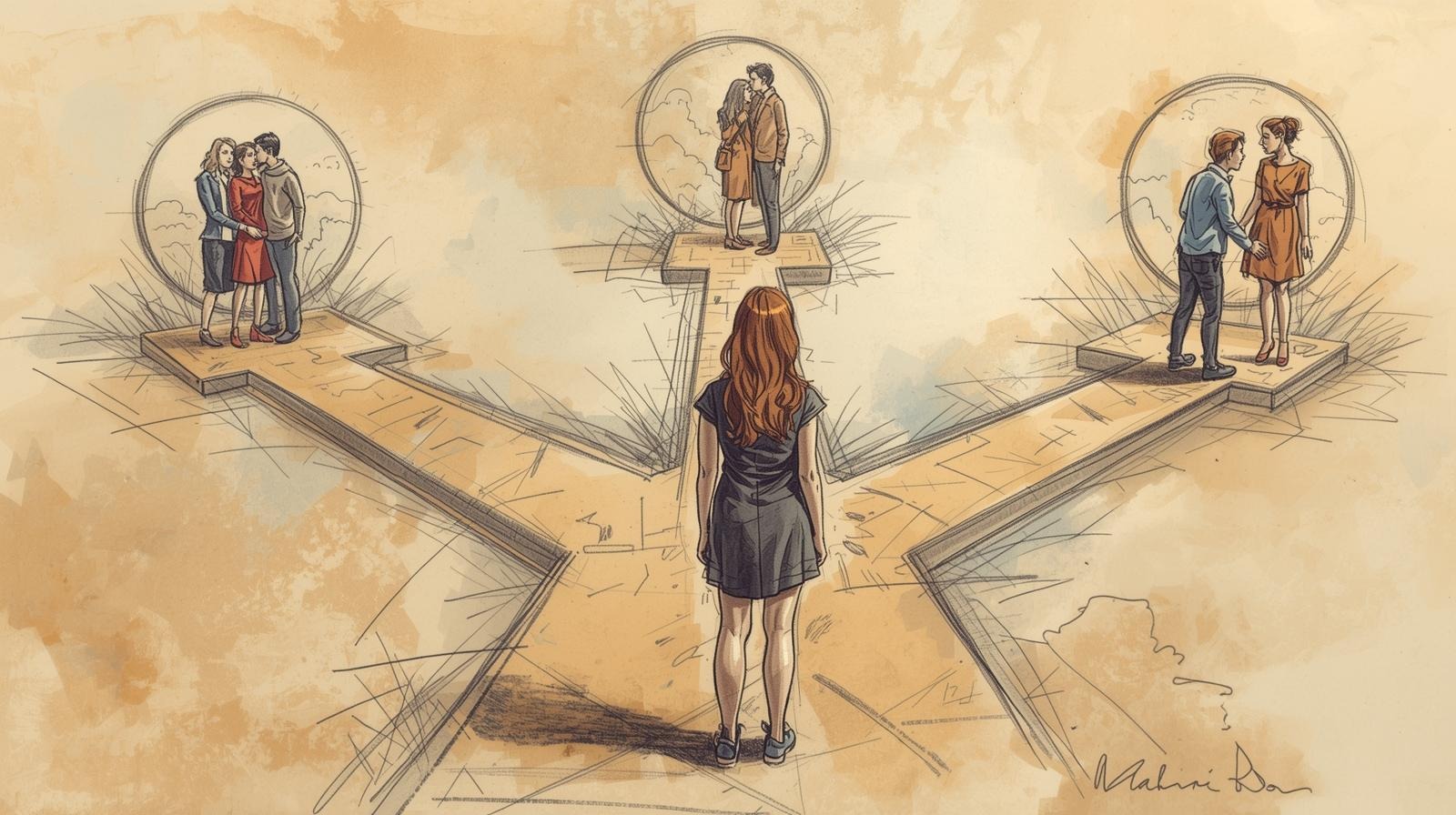
You have probably noticed that you are not the same person in every room.
With one friend you are witty and loud, words spilling out without filter. With another you become the listener, the one who carries the emotional bags. At work you might be hyper competent but oddly quiet about your own needs. With family you might turn into a careful negotiator, smoothing over tension before it explodes.
None of this makes you fake. It makes you human. We are all a moving constellation of roles, histories, fears and hopes. The deeper question is not “Why am I different with different people.” The deeper question is “Who gets access to which version of me, and does that feel fair to my nervous system and my mental health.”
This article is a long, gentle exploration of that question. It combines what we know from research about boundaries, authenticity and self compassion with very practical exercises so you can draw an actual map of your relationship world and see, with compassionate clarity, how your energy and honesty are distributed.
You do not need perfection. You need a map that helps you stop giving the most intimate, hard working version of yourself to people who have not earned it, and to start letting the most alive, honest version of you be seen where it is safe.
What relationship boundaries really are (and why they are not selfish walls)
Psychological boundaries are often described as invisible lines that separate “me” from “not me.” That sounds abstract until you realise how tangible they feel in your body. When a boundary is respected, there is usually a sense of space, choice and dignity. When a boundary is crossed, you might feel suddenly small, invaded or oddly fuzzy, as if you are losing sight of yourself in the interaction.
Recent work on personal and psychological boundaries emphasises that they are not just social rules but part of how we sense our own identity and safety. Researchers describe boundaries as mental and emotional structures that help us distinguish our own needs, feelings and values from those of others, which in turn supports concentration, personal power and a stable sense of self.
Healthy boundaries are not rigid stone walls. They are more like living membranes. They let in what nourishes you and filter out what harms you. Mental health organisations consistently highlight that clear relationship boundaries protect against burnout, reduce anxiety and support more stable self esteem and relational trust. When boundaries are too loose, you may feel overused, over responsible or permanently tired. When they are too tight, you may feel cut off and lonely even when surrounded by people.
So when we talk about “mapping your relationship boundaries,” we are really talking about tracing where your energy, honesty and care are flowing, and whether the channels you have built over time are still good for your long term wellbeing.
Why you have different versions of Yourself in the first place
Before you judge yourself for feeling like a different person in different relationships, it helps to remember that some flexibility is psychologically healthy. We are social creatures whose nervous systems are wired to respond to context. You act differently at a funeral than at a birthday party for a reason.
Studies on authenticity and wellbeing make an important distinction here. They suggest that authenticity is not about behaving identically in every situation, but about feeling that your behaviour fits your core values and inner experience, even when circumstances change. In other words, you might still be your authentic self when you are quieter at work and more playful with friends, as long as you do not feel you are betraying yourself in either place.
Mindfulness based research also shows that when people are more aware of their inner state, they are better able to choose responses that feel congruent rather than automatic. In one study, authenticity partly explained why mindfulness was linked with better psychological wellbeing, suggesting that being present to your own feelings and values makes it easier to act in line with them.
So multiple versions of you are not the problem. The real problem appears when one version takes over in contexts where it does not belong. Perhaps your super responsible, hyper empathetic caretaker self runs every relationship, leaving no room for rest. Perhaps your conflict avoidant, endlessly agreeable self has taken the wheel in places where you actually need to disagree.
When that happens repeatedly, your sense of authenticity suffers. Large meta analyses show that people who feel less authentic report significantly lower wellbeing and engagement across life domains. Mapping who gets what version of you is a way to bring this pattern into the light, not to shame yourself, but to see where the mismatch between context and version might be quietly exhausting you.
Boundary styles: porous, rigid and flexible
To understand your map, it helps to have some language for how boundaries tend to operate. Many clinicians and researchers talk informally about three broad styles. These are not diagnoses, more like weather patterns that can shift over time.
Porous boundaries mean you tend to absorb other people’s feelings and responsibilities as if they were your own. You may say yes when you mean no, overshare quickly or feel guilty for having preferences. Rigid boundaries mean you keep people at arm’s length almost by default. You might avoid vulnerability, rarely ask for help or feel suspicious of closeness. Flexible boundaries are somewhere in the middle; you can open or close the gate depending on context, relationship history and your current capacity.
A 2020 paper on flexible relational boundaries suggests that people who can adjust their boundaries while still honouring their own needs tend to show more self compassion and healthier relationships. Meanwhile, psycho educational resources and emerging empirical work highlight that chronic lack of boundaries is linked with stress, resentment, burnout and symptoms of anxiety and depression, while overly rigid boundaries are associated with isolation and difficulty receiving support.
To make this more concrete, imagine your social world laid out as a series of rooms. In each room, a particular boundary style dominates. The table below shows how this might look.
| Boundary style in a relationship room | Inner experience | Typical behaviours | Long term emotional cost |
|---|---|---|---|
| Porous | “I must keep everyone happy or I will lose them.” | Saying yes automatically, rescuing, oversharing, absorbing others’ mood | Exhaustion, resentment, blurred sense of self |
| Rigid | “If I let people in, they will hurt or use me.” | Avoiding vulnerability, deflecting support, quick withdrawal | Loneliness, feeling misunderstood, numbness |
| Flexible | “I can care for others and myself at the same time.” | Saying yes or no thoughtfully, pausing before reacting, requesting repair | Deeper intimacy, more stable energy and wellbeing |
Your goal is not to force every relationship into the flexible column overnight. The first goal is simply to see which rooms you spend most time in, and whether those rooms match the level of trust, history and reciprocity in that connection.

First practice: sketching your relationship map
Take a sheet of paper and imagine you are drawing a little city of your life. In the centre of the page, write your name and draw a circle around it. This is your inner home, the place where your full self lives. Around that centre, draw several concentric circles, like ripples in a pond. These will represent distance from your emotional core.
In the innermost ring just outside your own circle, write the names of people who see you the most fully. These may or may not be family. Ask yourself who has earned access to your honest feelings, your messy process, your vulnerable stories. In the next ring, write names of people who know parts of you but not the whole picture. Perhaps colleagues, extended family, newer friends. Further out, note acquaintances, community members, people you interact with but rarely reveal much to.
Now the important twist. Next to each name, write a few words describing which version of you tends to show up with them. You might write “caretaker,” “entertainer,” “therapist friend,” “student,” “fixer,” “quiet observer,” “leader,” “confidante,” “surface only,” “playful,” “hyper rational,” or anything else that fits. Let it be intuitive.
You can add one more layer of information by marking the boundary style you most often use with that person. Perhaps a tiny “P” for porous, “R” for rigid, “F” for flexible. Your map does not need to be artistic. It just needs to reflect reality as you currently feel it.
As you fill in the names, you may already sense certain tensions. Perhaps someone is very close to the centre but mostly interacts with your performative, overly responsible self. Or someone further away in the circle actually gets a surprisingly honest, grounded version of you. Do not judge these patterns yet. This is data gathering.
Reading your map: patterns, surprises and quiet red flags
Once your map is sketched, hold it at arm’s length and gently scan for patterns.
Notice first where your most energetically expensive versions of you are concentrated. The caretaker who listens for hours, the problem solver who always finds a way, the peacemaker who anticipates conflict and smooths it before it erupts: where do these selves cluster.
Then notice where your playful, creative or quietly thoughtful selves appear. Are they mostly present in safer, lower demand relationships, or do they have a place in your closest ties.
Research on boundaries and mental health suggests that when a person’s inner and outer life are chronically misaligned, especially in high demand relationships, their risk for emotional exhaustion and stress rises. At the same time, recent work on authenticity shows that when people feel they can show up more fully in important relationships, they experience higher wellbeing, better relational quality and more stable self esteem.
To make the reading process easier, you can translate your map into a simple table like the one below.
| Relationship category | Typical version of you that shows up | Dominant boundary style | Does this feel sustainable long term → yes / no |
|---|---|---|---|
| Inner circle (closest people) | Example: fixer, therapist friend, over responsible adult | Often porous | Example answer: no, feels draining |
| Trusted but not intimate | Example: more balanced, honest but not oversharing | Often flexible | Example answer: yes, feels good |
| Work relationships | Example: highly competent, emotionally invisible | Mix of rigid and porous | Example answer: partly, would like more voice |
| Family of origin | Example: peacekeeper, child role, avoids conflict | Often porous or rigid | Example answer: no, leaves me anxious |
| Casual / new connections | Example: light, playful, measured sharing | Often flexible | Example answer: mostly yes |
Fill this table with your own answers based on the map you created. The final column is crucial. Your honest “yes” or “no” about sustainability is your inner compass speaking. If you see many “no” entries in relationships that demand a lot of time and emotional labour, that is a sign that your boundaries and versions may need revision.
Choosing where to renegotiate access
It is tempting to read your map and immediately think, “I have to fix everything.” That is a quick route to overwhelm. Instead, think about renegotiating access in a very targeted way.
Ask yourself which relationship currently has the biggest mismatch between how close this person is to your emotional centre and how safe or respected you feel with them. Perhaps there is someone in your inner ring who consistently gets a self sacrificing version of you but offers little reciprocity. Or someone further out who has proven steady, supportive and kind, but still only sees a guarded fraction of who you are.
Boundaries research and clinical guidance emphasise that you are not responsible for other people’s reactions when you begin to set limits, but you are responsible for deciding how much of your limited emotional energy you give away. Redesigning your relationship map is less about judging anyone and more about aligning access with demonstrated safety and mutuality.
Pick one relationship where a small change would make a meaningful difference. Then ask two questions.
First, “What version of me shows up here by default.” Second, “What version of me would feel healthier and more honest in this connection.”
For example, with a friend you might realise that your default is “on call therapist.” The healthier version might be “mutual human being who both listens and is listened to.” Or with a family member, your default might be “permanent peacekeeper,” while the healthier version would be “adult who sometimes disagrees and trusts the relationship to survive it.”
This is where boundary language enters. Moving from one version to another usually requires small boundary statements: “I care about you and I also have less energy for late night crisis calls,” or “I want to share more of what is going on with me, if you are open to that,” or “I am not able to fix this, but I can sit with you while you feel it.”
You are not obligated to announce, “My boundaries are changing.” But you are allowed to start behaving in ways that match the version of yourself you want to inhabit with that person.
Letting self compassion sit between you and the fear of change
Every change on your map will stir something in you. Fear, guilt, anger, grief, hope.
Self compassion research is clear that how you relate to your own suffering in these moments matters as much as the boundaries themselves. People who practise self compassion tend to show greater resilience, more balanced emotional regulation and even more empathy for others, rather than less. Rather than forcing yourself through boundary changes with harsh self talk, you can learn to speak to yourself differently.
When you notice guilt rising after you say no, pause and name what is happening. “This is the old belief that I have to overgive to be loved.” When you notice fear after asking to be listened to, acknowledge it: “Part of me is terrified they will leave if I need anything.” Then add a third sentence that reflects your new commitment: “I am allowed to protect my energy and still be a caring person.”
This kind of inner dialogue does not make discomfort vanish, but it stops you from turning inevitable discomfort into a story about your worth. Boundaries then become less about punishment or distance and more about ongoing acts of compassion for all involved, including you.
Writers and clinicians working from trauma informed perspectives often note that boundaries are one of the most compassionate things you can offer, because they communicate clearly what is possible and prevent the slow build up of unspoken resentment that poisons connection.
When you hold your own hand emotionally in this way, it becomes easier to tolerate the fact that as you shift your map, some people may step closer, some may stay where they are, and some may slowly drift outward.

Updating Your map over time: boundaries as a living practice
One of the most liberating ideas to keep in mind is that your relationship map is not a static portrait. It is more like a weather chart. Conditions change. People grow or resist growing. You heal, relapse into old patterns, heal again.
New research is beginning to link authenticity with long term brain health, suggesting that living in closer alignment with one’s values and self concept may support both mental and neurological wellbeing across the lifespan. That is a powerful invitation to treat your own authenticity and boundaries as central health practices, not optional extras.
You might choose to revisit your map every few months. Notice whether some names have naturally moved closer as trust has grown. Notice whether some have drifted outward as you stopped doing all the emotional labour. Ask yourself whether different versions of you are becoming available in more rooms. Perhaps your playful side shows up more often even with serious colleagues. Perhaps your thoughtful, quiet self gets more space even in noisy family gatherings.
Each time you redraw the circles, you are practising the belief that you are allowed to be a dynamic person with evolving needs and limits. And you are acknowledging that different people get different levels of access to your inner world, not based on obligation or old loyalty alone, but based on how they actually show up.
In this sense, mapping your relationship boundaries is less about control and more about stewardship. You are stewarding your time, your energy and the many versions of yourself with care. You are asking, again and again, a simple and radical question: “Does this distribution of me still make sense for who I am becoming.”
Relationship Boundaries Workbook, FREE PDF!
Who gets the widest, warmest version of You
Take a moment now, perhaps after reading, to close your eyes and picture the version of you that feels most like home. Maybe she laughs freely, maybe he thinks deeply, maybe they move slowly and listen to the body before making commitments. This is the version of you that does not feel performative or strategic. It may not be endlessly cheerful, but it is real.
Then gently ask: “Who in my life currently gets to meet this version of me most consistently.”
If several faces come to mind, let gratitude wash through you. Those are relationships worth nurturing with tenderness, honesty and ongoing boundary care. Research on authenticity repeatedly shows that being seen in this way is strongly linked with life satisfaction and relational quality.
If only one or two faces appear, or none, do not panic. This is not evidence that you are unlovable. It is a sign that something in the way you distribute yourself has been skewed, often for very understandable reasons: survival, culture, trauma, learned roles. With awareness, self compassion and small boundary experiments, your map can change.
The quiet goal of all the practices in this article is simple. That over time, the version of you that feels most like home does not live only in your journal or your imagination. They get to exist, more often, in real conversations, with real people, in a life that increasingly fits the shape of your soul.
Related posts You’ll love
- When You start saying what You really think, some people will leave (Good.)
- Micro-rebellions: 21 tiny acts to break up with a life that no longer fits You. FREE PDF!
- Practice corner: Reframing age and success – A guided reflection workbook for Your real life. FREE PDF!
- Practice corner: Daily exercises to heal the shadow side of jealousy (without shaming Yourself)
- 14-day situationship fatigue detox: Gentle practices to stop settling and attract real love. FREE PDF!
- When TikTok knows too much: 6 guided exercises to set boundaries with social media
- How to stop overfunctioning in relationships: A 14 day practice plan that builds boundaries, calm, and real self worth, FREE PDF
- Why the gender pay gap becomes a relationship issue at home: The hidden economics of love, power, and everyday choices

FAQ – Mapping Your relationship boundaries
-
What does “mapping your relationship boundaries” actually mean?
Mapping your relationship boundaries means taking a clear look at who is in your life, how close they are to your emotional core and which version of you tends to show up with them. You might feel like the fixer with one person, the entertainer with another and more relaxed and honest with someone else. When you map this consciously, you can see where your energy, time and emotional labour go, and start aligning access to you with trust, safety and mutual respect.
-
Is it normal to show different versions of myself in different relationships?
Yes. It is completely normal and psychologically healthy to show different sides of yourself in different contexts. You are not supposed to act the same way with your boss as you do with your closest friend. The key question is whether those different versions still feel authentic and respectful of your needs. If you feel like you are constantly performing or abandoning yourself to keep the peace, your relationship boundaries may need attention, even if the roles you play look “normal” from the outside.
-
How can I tell if my boundaries in a relationship are too porous or too rigid?
If your boundaries are too porous, you may notice that you say yes when you mean no, feel responsible for other people’s moods and end most interactions drained or resentful. If your boundaries are too rigid, you might rarely share anything personal, reject support and feel alone even around people who care about you. Healthy, flexible boundaries allow you to adjust how much you give and share depending on trust, history and your current capacity. When you map your relationships, look for patterns where you always overgive or always shut down; those are signs a boundary reset could help.
-
What does it mean that “not everyone gets the same version of you”?
“Not everyone gets the same version of you” means that access to your energy, vulnerability and time should be different depending on how safe, respectful and reciprocal the relationship is. Someone who repeatedly ignores your needs does not deserve the same level of emotional intimacy as someone who consistently shows up and listens. Mapping your relationship boundaries helps you see where you may be giving the most generous, hard-working version of yourself to people who have not earned that closeness, and where healthier people might be receiving only a guarded or distant version of you.
-
How do I start changing my relationship boundaries without blowing up my life?
You do not have to make dramatic announcements or cut people off overnight. Start with small, concrete shifts. That might mean pausing before you say yes, sharing a little less in relationships that feel unsafe or asking for more reciprocity in relationships that matter. You can say things like, “I care about you and I also need more time for myself,” or “I would like our conversations to be more balanced; I want to share what is happening for me too.” Over time, these small boundary adjustments reshape who gets what version of you, without sudden explosions or ultimatums.
-
What if people get angry or pull away when I change my boundaries?
When you change long-standing patterns, some people will feel uncomfortable, confused or even angry, especially if they benefitted from your lack of boundaries. Their reaction does not automatically mean you are doing something wrong; it often means the unspoken rules of the relationship are shifting. Your job is to stay as clear and kind as possible while protecting your energy. If someone consistently punishes you for having limits, that is information about the role they should play on your relationship map. Healthy relationships can tolerate change, renegotiation and honest conversations about what you need.
-
Can mapping my relationship boundaries really improve my mental health?
Yes. When you consciously map and adjust your relationship boundaries, you usually reduce overcommitment, emotional overload and hidden resentment. This frees up energy for rest, creativity and genuinely nourishing connections. People who feel more authentic and better able to set boundaries tend to report lower stress, less burnout and higher life satisfaction. Over time, knowing who gets what version of you becomes a powerful mental health practice: you stop scattering your energy everywhere and start investing it where your whole self is welcomed, not just the version that makes others comfortable.
Sources and inspirations
- Sutton, A. (2020). Living the good life: A meta analysis of authenticity, well being and engagement. Personality and Individual Differences.
- Rivera, G. N., (2019). Understanding the relationship between perceived authenticity and well being. Review of General Psychology.
- Chen, S., (2019). The mediating role of authenticity on mindfulness and well being. International Journal of Mental Health Promotion.
- Snyder, K. S., & Luchner, A. F. (2020). The importance of flexible relational boundaries. Self Compassion Research Lab White Paper.
- Shulakevich, O. (2019). The phenomenon of psychological boundaries. Problems of Modern Psychology.
- Reid, S. (2021). Setting healthy boundaries in relationships. HelpGuide.org.
- Oaks Integrated Care (2023). Why boundaries are important and how to set them.
- Stutts, L. A., (2022). Increasing self compassion: Review of the literature and future directions. Mindfulness.
- Fuochi, G., (2018). Self compassion, empathy and openness to others. The Journal of Social Psychology.
- Stirland, L. E., (2023). Authenticity and brain health: A values based perspective. Alzheimer’s & Dementia: Translational Research & Clinical Interventions.


Leave a Reply