Table of Contents
What if food was never meant to be a test?
If you are tired of food rules, I want you to know this first: you are not weak for feeling exhausted. You are not “undisciplined” because another plan stopped working. You are not failing because your body keeps asking for food, pleasure, softness, rhythm, and rest. You may simply be tired of turning every meal into a moral exam.
Many women I speak to have spent years living inside a quiet food courtroom. Breakfast becomes evidence. Lunch becomes a verdict. Dinner becomes a negotiation. A cookie becomes a character flaw. Hunger becomes suspicious. Fullness becomes failure. And somewhere in the middle of all this monitoring, tracking, fixing, shrinking, optimizing, and comparing, eating stops feeling like nourishment and starts feeling like surveillance.
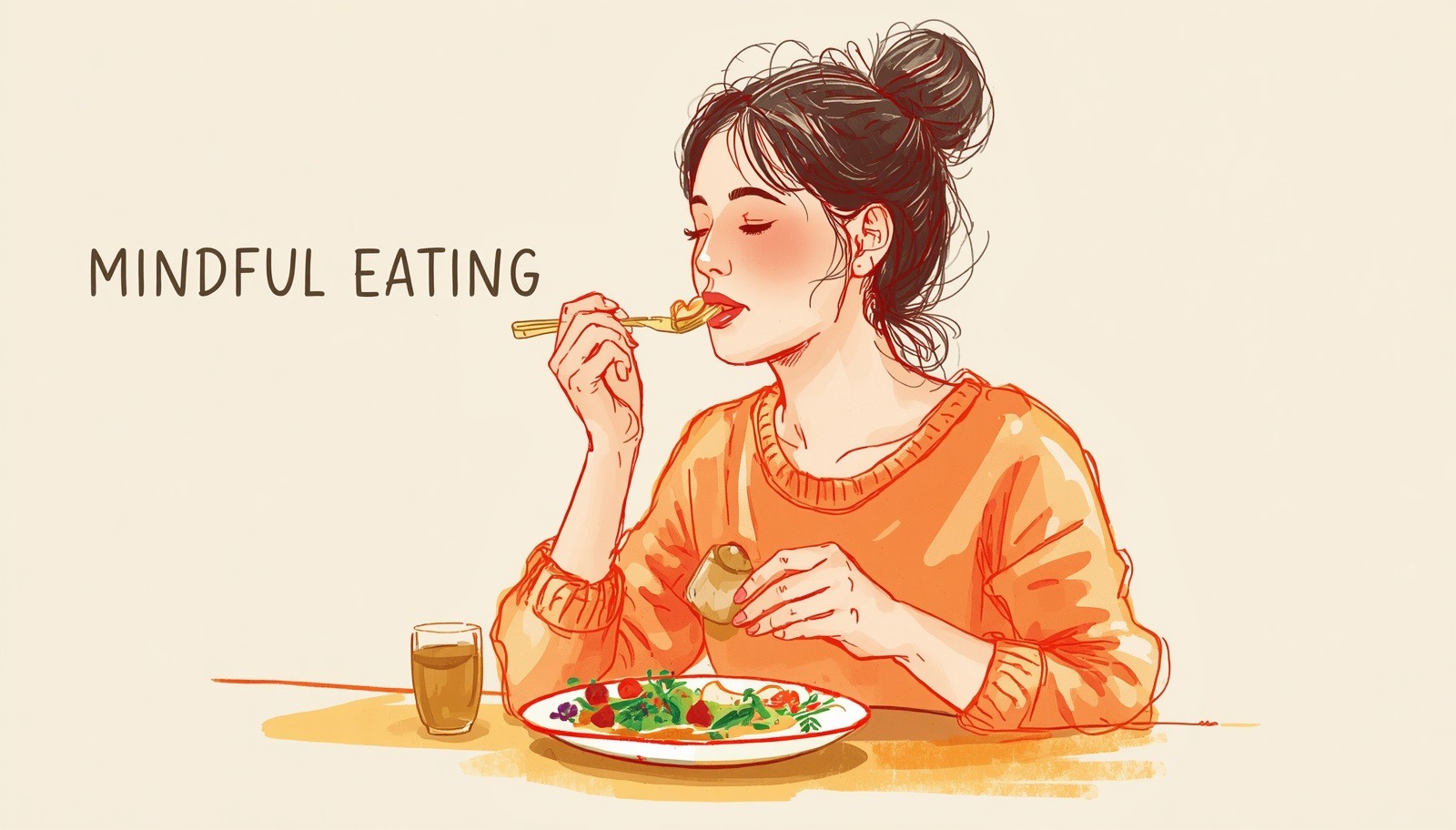
Mindful eating offers a different doorway. It is not another food rule wearing softer clothing. It is not “eat slowly so you eat less.” It is not a wellness performance where every meal must be silent, organic, perfectly plated, and emotionally regulated. At its best, mindful eating is a practice of coming back into relationship with your body, your senses, your needs, your culture, your preferences, and your life.
Research on intuitive eating and mindful eating has grown substantially in recent years. Intuitive eating has been associated with better psychological health, lower disordered eating behaviors, more body appreciation, and lower body image disturbance in several studies and reviews. Mindfulness-based eating approaches have also been explored for emotional eating, external eating, binge eating, fullness awareness, and eating regulation.
The evidence does not say that one practice magically heals everyone. It does suggest something powerful: when people move away from rigid external control and toward internal awareness, compassion, and flexibility, their relationship with food can become less chaotic and less shame-driven.
This article is for the woman who knows too much about food but trusts herself too little. It is for the woman who can recite nutrition advice but struggles to hear her own hunger. It is for the woman who has been praised for control while quietly losing connection. It is for the woman who does not want another plan; she wants peace.
Before we begin, one important note: if you are living with an eating disorder, active restriction, binge-purge cycles, severe anxiety around eating, or medical nutrition needs, please use this article as gentle education rather than treatment. Mindful eating can be supportive, but it is not a substitute for care from an eating disorder-informed therapist, registered dietitian, or medical professional.
Control vs. connection: The shift that changes everything
Most food rules are built on the assumption that your body cannot be trusted. They say, “If you listen to yourself, you will lose control.” But connection asks a braver question: “What if control has been making you feel more disconnected, not safer?”
Food rules often promise certainty. They simplify the emotional complexity of eating into clean categories: good or bad, allowed or forbidden, clean or toxic, disciplined or lazy. This can feel comforting at first because rules reduce decision fatigue. But over time, rigid rules can narrow your life. They can make social meals stressful, hunger confusing, cravings louder, and self-worth dependent on compliance.
Connection does not mean eating without care. It means replacing domination with dialogue. It means asking: What is my body telling me? What would satisfy me? What would support my energy? What am I feeling? What do I need besides food? What do I need from food? This shift matters because food is not only biological. It is emotional, cultural, relational, sensory, practical, and deeply human.
Table 1: From food control to food connection

A connection-based approach is not passive. In fact, it requires more attention than rules do. Rules are rigid; connection is responsive. Rules tell you what to do before your body even speaks. Connection asks you to listen before deciding. That listening is the foundation of mindful eating.
Practice 1: The three-breath food threshold
Most people do not begin eating when they begin chewing. They begin eating emotionally and mentally several minutes before the first bite. You may start eating while answering emails, standing at the counter, scrolling through your phone, feeding your children, replaying a conversation, or already judging what is on your plate.
The Three-Breath Food Threshold is a tiny ritual that marks the transition from doing to receiving. Before eating, pause for three slow breaths. You do not need candles, silence, or a perfect environment. You can do this in a car, office, kitchen, restaurant, or messy family dinner. The point is not to become perfectly calm. The point is to arrive.
Try this:
Breath one → Notice your body.
Ask: “Where do I feel hunger, tension, tiredness, or anticipation?”
Breath two → Notice your mind.
Ask: “Am I bringing rules, guilt, urgency, or comparison to this meal?”
Breath three → Offer permission.
Say quietly: “I am allowed to be here. I am allowed to eat. I am allowed to listen.”
This practice is powerful because it interrupts autopilot without turning eating into a project. Mindfulness-based eating approaches often emphasize awareness of internal cues, emotional states, and sensory experience. A brief pause can create enough space to shift from reaction to relationship.
I like this practice because it respects real life. You do not need to chew every bite thirty times. You do not need to transform lunch into meditation. You simply create a doorway. Over time, that doorway teaches your nervous system that meals do not have to begin with panic, guilt, or speed. They can begin with presence.
Practice 2: The hunger weather report
Many women have been trained to treat hunger as a problem to delay, suppress, or outsmart. But hunger is not a moral weakness. Hunger is communication.
The Hunger Weather Report helps you observe hunger without immediately obeying, resisting, or judging it. Instead of asking, “Should I be hungry?” ask, “What kind of hunger is here?”
You can imagine your inner landscape like weather:
→ Clear hunger: physical emptiness, stomach cues, low energy, difficulty focusing.
→ Storm hunger: intense urgency, shakiness, irritability, or feeling out of control.
→ Fog hunger: unsure, disconnected, numb, or unable to tell what you need.
→ Heart hunger: desire for comfort, pleasure, memory, celebration, or soothing.
→ Mouth hunger: sensory desire for taste, crunch, warmth, sweetness, saltiness, or texture.
→ Routine hunger: the body expecting food because it is your usual eating time.
The goal is not to rank these as “real” or “fake.” That is just another food rule. The goal is to become more fluent in your own signals. Sometimes heart hunger matters. Sometimes mouth hunger matters. Sometimes routine hunger is wise because your schedule requires eating before you become ravenous. Sometimes fog hunger tells you that years of dieting have made body cues harder to hear.
Intuitive eating research often emphasizes the importance of internal regulation, including hunger and satiety responsiveness. However, many people need practice before these cues feel clear again, especially after long periods of dieting or restriction.
Use this sentence before or during meals:
“The hunger I notice right now feels like ______, and the kindest next step may be ______.”
For example: “The hunger I notice right now feels like storm hunger, and the kindest next step may be eating something steady before I make big decisions.” Or: “The hunger I notice right now feels like heart hunger, and the kindest next step may be food plus a phone call, blanket, or rest.”
This is connection. Not control. Not chaos. Connection.
Practice 3: The plate-as-compass method
A food rule asks, “Is this allowed?”
A food compass asks, “Where is this meal helping me go?”
The Plate-as-Compass Method is a non-diet way to bring nutrition back without making it punitive. Instead of building a plate around fear, you build it around direction. You ask what you want this meal to support.
Maybe you want steadiness before a long work session. Maybe you want pleasure at a birthday dinner. Maybe you want warmth after a hard day. Maybe you want convenience because you are exhausted. Maybe you want fiber, protein, color, and satisfaction because you know your body feels better when meals have enough substance. Maybe you want nostalgia because your grandmother’s soup makes you feel rooted.
This practice protects you from two extremes. On one side is rigid dieting, where nutrition becomes control. On the other side is reactive rebellion, where any mention of nutrition feels unsafe because it reminds you of restriction. A compass gives you a third option: gentle nutrition without self-punishment.
Ask these four compass questions:
- Energy → What would help me feel physically supported for the next few hours?
- Pleasure → What taste, texture, temperature, or memory would make this satisfying?
- Practicality → What is realistic with my time, money, energy, and access today?
- Kindness → What choice would feel caring rather than controlling?
This method aligns with research suggesting that intuitive eating is not the opposite of health-promoting eating. Some studies show that intuitive eating can coexist with diet quality and health-supportive behaviors when it is grounded in body trust rather than restriction.
The Plate-as-Compass Method is especially helpful for women who fear that releasing food rules means abandoning themselves. You are not abandoning care. You are changing the emotional tone of care. You are moving from “I must fix myself” to “I want to support myself.”
Practice 4: The food rule funeral
This one is unconventional, but it can be deeply freeing.
A Food Rule Funeral is a written ritual for retiring one food rule that has been running your life. Not all rules disappear because you logically disagree with them. Some rules have emotional roots. They may have protected you from criticism, helped you feel accepted, or given you an illusion of safety during uncertain seasons. That is why simply saying “stop thinking that” rarely works.
Choose one rule. Start with something specific:
→ “I cannot eat carbs at dinner.”
→ “Dessert is only allowed if I exercised.”
→ “I must compensate after eating more than planned.”
→ “Eating after 8 p.m. means I failed.”
→ “If I eat one cookie, I will lose control.”
→ “Healthy women do not crave comfort food.”
Now write a short goodbye letter:
Dear rule,
You entered my life when ______.
You promised to help me feel ______.
For a while, you may have given me ______.
But you also cost me ______.
I no longer need you to protect me through fear.
I am replacing you with ______.
Then create a replacement practice. Not a replacement rule. A practice.
For example:
Old rule: “I cannot eat carbs at dinner.”
Replacement practice: “At dinner, I will notice what combination of foods helps me feel satisfied, steady, and peaceful.”
Old rule: “Dessert is only allowed if I worked out.”
Replacement practice: “Dessert can be part of pleasure, celebration, or satisfaction. Movement does not need to earn food.”
This ritual works because it respects the emotional history of food rules. Weight stigma, body shame, and restrictive ideals do not live only in the mind. They become habits, fears, scripts, and identity patterns. Research links weight stigma with disordered eating cognitions and behaviors, which is one reason compassionate unlearning matters (Levinson et al., 2024).
You may need to repeat the funeral more than once. That is normal. A rule that has lived in your nervous system for ten years may not vanish after one journal entry. But every time you name it, question it, and replace it with a kinder practice, you weaken its authority.
Practice 5: The satisfaction scan
Many women are afraid of satisfaction because they confuse it with excess. But satisfaction is not the enemy of balanced eating. In many cases, satisfaction is what helps a meal feel complete.
Think about the times you ate the “safe” option but kept searching the kitchen afterward. You were physically fed, perhaps, but not satisfied. The body may have received volume, but the whole person did not receive pleasure, texture, warmth, culture, or enough energy. A satisfaction deficit can keep the mind preoccupied with food.
The Satisfaction Scan helps you ask better questions while eating:
→ Taste: Is this flavor what I wanted?
→ Texture: Do I want crunch, creaminess, softness, chew, crispness, or warmth?
→ Temperature: Would this feel better hot, cold, fresh, toasted, or comforting?
→ Enoughness: Is this meal substantial enough for my real hunger and day?
→ Atmosphere: Am I eating in a way that lets me register the experience?
→ Emotion: Am I enjoying this, tolerating it, rushing it, or judging it?
You do not need every meal to be deeply satisfying. Some meals are practical. Some are chaotic. Some are “good enough.” But if satisfaction is chronically missing, eating can become more mentally noisy.
The research on intuitive eating often includes attention to eating for physical rather than emotional reasons, reliance on hunger and fullness cues, body-food choice congruence, and unconditional permission to eat. Satisfaction is part of this broader shift because it helps reduce the forbidden-fruit effect of deprivation.
Here is the unconventional part: sometimes the most mindful choice is to improve the food instead of trying to improve your willpower.
Add the sauce. Toast the bread. Choose the ripe fruit. Sit down for five minutes. Put the snack on a plate if that helps you see it. Eat the chocolate without pretending you wanted carrots. Make the meal more honest.
A satisfied body is often quieter than a controlled body.
Practice 6: The five-bite data walk
This practice is not about eating less. It is about gathering information.
During any meal or snack, choose five bites as “data bites.” They do not have to be consecutive. For each one, notice something different:
Bite 1 → Arrival: What is my pace right now?
Bite 2 → Flavor: What taste is most present?
Bite 3 → Body: Is my hunger changing?
Bite 4 → Emotion: What feeling is sitting beside me?
Bite 5 → Choice: What would feel caring next?
The Five-Bite Data Walk helps women who feel overwhelmed by mindful eating. Instead of staying present for the entire meal, which can feel unrealistic, you collect five moments of information. That is enough to begin rebuilding trust.
This practice also softens all-or-nothing thinking. You do not need to eat perfectly mindfully. You do not fail because you got distracted. You simply return for one bite, then another. Mindfulness is not permanent attention; it is the act of coming back.
Self-compassion matters here. Studies have linked self-compassion with more mindful eating, intuitive eating, well-being, body esteem, and healthier eating patterns. Self-compassion may help because it reduces the threat response that shame creates. When you are not attacking yourself, it becomes easier to listen.
A useful sentence:
“This bite is not a test. It is information.”
That sentence alone can change the emotional temperature of a meal. Instead of monitoring yourself like a guard, you accompany yourself like a witness.
Practice 7: The “both can be true” reframe
Food-rule thinking loves false choices:
→ I can care about health or enjoy food.
→ I can be disciplined or free.
→ I can eat vegetables or eat dessert.
→ I can love my body or want to change how I feel.
→ I can be mindful or eat quickly.
→ I can choose nutrition or choose comfort.
The “Both Can Be True” Reframe helps you exit these traps. It teaches your brain to hold complexity.
Try these:
→ “I can want to feel energized and still eat for pleasure.”
→ “I can care about nutrition and refuse to shame myself.”
→ “I can feel full and still be worthy of kindness.”
→ “I can eat emotionally sometimes and still have a healthy relationship with food.”
→ “I can want more body peace and not love every inch of my body today.”
→ “I can make a practical food choice without turning it into a rule.”
→ “I can be learning and still feel messy.”
This is a radical practice because diet culture often rewards certainty. But healing often requires nuance. Women are rarely suffering because they lack information. Many are suffering because every food decision has been stripped of nuance and loaded with identity.
The “Both Can Be True” Reframe is also helpful for women who fear intuitive or mindful eating will become another perfection project. You can eat mindfully and sometimes eat distracted. You can practice body respect and still have difficult body image days. You can make peace with food and still notice that certain foods affect your digestion, energy, or mood. Flexible thinking is part of recovery from rigid rules.
Research on intuitive eating interventions suggests benefits in body appreciation, quality of life, and eating-related outcomes, but the point is not to turn intuitive eating into another standard you must perform perfectly. The deeper goal is psychological flexibility and compassionate self-trust.
When in doubt, place the word “and” between two truths.
“I am anxious about this meal, and I can take one supportive step.”
“I ate past fullness, and I do not need to punish myself.”
“I want gentle nutrition, and I want joy.”
That “and” is a bridge back to connection.
Practice 8: The next-meal repair
One of the most damaging food rules is the idea that eating must be corrected through punishment. Many women do not consciously call it punishment, but it appears in subtle forms: skipping the next meal, choosing only “clean” foods the next day, overexercising, drinking coffee instead of eating, or mentally promising to “be good tomorrow.”
The Next-Meal Repair is a practice of returning to care without compensation.
After a difficult eating moment, ask:
- What happened without judgment?
- What might have contributed: hunger, stress, restriction, emotion, environment, tiredness, alcohol, conflict, loneliness, distraction?
- What does my body need next: food, water, rest, steadiness, digestion support, compassion, movement, connection?
- What would I do if I refused to punish myself?
That final question is the medicine.
The next meal is not a debt payment. It is a repair opportunity. Repair means you return to rhythm. You feed yourself again. You do not create a famine because you disliked a previous choice. You do not make your body earn safety.
This practice matters because restriction can intensify preoccupation with food and may contribute to cycles of overeating, guilt, and renewed restriction. Weight stigma and shame can also worsen disordered eating patterns, making compassion more than a “nice idea.” Compassion can be a protective practice.
Here is a simple repair script:
“I am not starting over tomorrow. I am returning to care now.”
Use it after overeating. Use it after under-eating. Use it after emotional eating. Use it after a meal that felt chaotic. Use it when old guilt appears. The goal is not to erase discomfort. The goal is to stop turning discomfort into self-abandonment.
Table 2: The 8 mindful eating practices

Table 3: Food rule → mindful reframe → practice

How to start without turning this into another project
Choose one practice for seven days. Not eight practices. Not a complete identity transformation. One.
If your meals feel rushed, begin with the Three-Breath Food Threshold. If hunger feels confusing, begin with the Hunger Weather Report. If guilt is loud, begin with the Food Rule Funeral. If you often feel unsatisfied after “healthy” meals, begin with the Satisfaction Scan. If you spiral after eating more than planned, begin with the Next-Meal Repair.
The key is repetition without perfection. A practice becomes trustworthy when it is small enough to return to on imperfect days.
You might also create a simple weekly reflection:
→ What food rule showed up most often this week?
→ Which practice helped me feel even 5% more connected?
→ Where did I use shame when I needed support?
→ What did my body communicate clearly?
→ What is one way I can make eating easier next week?
I often think of mindful eating as a language. At first, the body’s signals may feel faint or confusing. That does not mean you are broken. It may simply mean you have been speaking the language of rules for a long time. Fluency returns through contact, curiosity, and patience.
FROM CONTROL TO CONNECTION: A mindful eating workbook for Women tired of food rules (FREE PDF!)
A gentle reminder about nutrition
Releasing food rules does not mean nutrition no longer matters. It means nutrition is no longer allowed to become a weapon against your body.
Gentle nutrition can include protein, fiber, fruits, vegetables, enough carbohydrates, fats, hydration, regular meals, cultural foods, convenience foods, pleasure foods, and medical needs. It can include learning what helps your digestion, energy, hormones, mood, and concentration. But the emotional posture changes. You are not eating vegetables because you were “bad.” You are not choosing a filling breakfast because you fear your appetite. You are not drinking water to suppress hunger. You are caring for a living body.
A connected eater can ask both:
“What would nourish me?”
and
“What would satisfy me?”
That is the practice. Not perfection. Relationship.
You are allowed to come home to Yourself
Food rules often begin as a search for safety. They promise belonging, confidence, control, praise, health, desirability, or certainty. But many women eventually realize that rules can take more than they give. They may shrink anxiety for a moment while expanding fear over time. They may create the appearance of discipline while quietly eroding trust.
Connection asks for something softer and stronger.
It asks you to listen when hunger speaks. It asks you to notice satisfaction without apologizing for pleasure. It asks you to bring nutrition back as care, not punishment. It asks you to stop treating one meal as a moral biography. It asks you to repair instead of restrict. It asks you to use “and” where shame taught you “either/or.”
You do not have to master all eight practices. You do not have to become a perfectly mindful eater. You only have to begin returning to yourself in small, repeated ways.
One breath before a meal.
One retired rule.
One satisfying bite.
One next meal without punishment.
One moment of saying: “My body is not my enemy.”
One choice made from care instead of fear.
That is how control loosens.
That is how connection grows.
That is how food becomes food again.
Related posts You’ll love
- Why eating “normally” feels so hard in a culture obsessed with Female control
- Daily phrases that help You eat without guilt: Transforming Your inner food dialogue
- Stop putting Your desires on trial: 17 things Women need to remember when wanting more feels wrong
- Why summer can feel worse than it looks on instagram: The hidden psychology of sunny-season sadness
- Understanding emotional hunger vs. physical hunger: Mindful eating and self-awareness
- Why hyper-connected Women still need deeper quiet: The calm space We’re missing in a noisy digital world
FAQ
-
Is mindful eating the same as intuitive eating?
Not exactly. Mindful eating focuses on awareness during eating: noticing hunger, fullness, taste, pace, emotions, and body cues. Intuitive eating is a broader non-diet framework that includes rejecting diet mentality, making peace with food, body respect, movement, satisfaction, and gentle nutrition. They overlap, and many women benefit from using both.
-
Will mindful eating help me lose weight?
Mindful eating should not be treated as a disguised weight-loss method. Some people’s weight may change, some may stay the same, and some may gain weight depending on their history, restriction, health status, and body needs. The main goal is a healthier relationship with food, less guilt, more awareness, and more sustainable self-care.
-
What if I do not know when I am hungry or full?
That is common, especially after years of dieting, stress, trauma, emotional suppression, or irregular eating. Start with neutral observation. Notice energy, mood, focus, stomach sensations, thoughts about food, and physical urgency. Hunger and fullness cues often become clearer when you eat regularly and stop treating hunger as a threat.
-
Can I practice mindful eating if I emotionally eat?
Yes. Emotional eating does not make you a failure. Food is one way humans soothe, celebrate, connect, and cope. The goal is not to ban emotional eating but to expand your choices. You can ask, “What am I feeling, what does food offer me, and what else might I need alongside food?”
-
What if mindful eating makes me more anxious?
If paying close attention to food increases anxiety, pressure, obsessive thoughts, or body monitoring, simplify the practice. Use grounding instead of intense tracking. For example, take one breath, notice one flavor, or practice eating with less guilt. If anxiety feels severe, work with an eating disorder-informed professional.
-
Do I have to eat slowly?
No. Slow eating can be useful, but it is not the whole point. Some meals are quick because life is quick. Mindful eating is not about performing calmness. It is about bringing moments of awareness into real eating. One mindful breath is better than turning slow eating into another rule.
-
How do I stop labeling foods as good or bad?
Begin by replacing moral language with descriptive language. Instead of “bad,” try “sweet,” “salty,” “rich,” “convenient,” “comforting,” “energizing,” “less satisfying,” or “not what my body wants today.” Food can have different nutritional qualities without carrying moral status.
-
Can I still care about health?
Absolutely. The goal is not to reject health. The goal is to remove shame, rigidity, and punishment from health. You can care about blood sugar, digestion, energy, strength, sleep, and mental health while also caring about pleasure, flexibility, culture, and peace.
-
What should I do after overeating?
Pause. Breathe. Refuse punishment. Ask what happened with curiosity: Were you too hungry? Distracted? Sad? Restricting earlier? Seeking comfort? Then return to regular eating at the next meal or snack. Repair comes from rhythm, not compensation.
-
How long does it take to rebuild trust with food?
It depends on your history. If you have followed food rules for years, trust may return gradually. Think in months, not days. Every non-punishing meal, every moment of listening, every repaired spiral, and every retired rule is evidence that you can become safe with food again.
-
What is the best first practice for beginners?
Start with the Three-Breath Food Threshold. It is short, accessible, and powerful. Before eating, take three breaths: notice your body, notice your mind, and offer permission. This creates a small pause between old rules and a new relationship.
Sources and inspirations
- Babbott, K. M., Cavadino, A., Brenton-Peters, J. M., Consedine, N. S., & Roberts, M. E. (2023). Outcomes of intuitive eating interventions: A systematic review and meta-analysis. Eating Disorders.
- Belon, K. E., Serier, K. N., VanderJagt, H., & Smith, J. E. (2022). What is healthy eating? Exploring profiles of intuitive eating and nutritionally healthy eating in college women. American Journal of Health Promotion.
- Carbonneau, N., Cantin, M., Barbeau, K., Lavigne, G., & Lussier, Y. (2021a). Self-compassion as a mediator of the relationship between adult women’s attachment and intuitive eating. Nutrients.
- Carbonneau, N., Holding, A., Lavigne, G., & Robitaille, J. (2021b). Feel good, eat better: The role of self-compassion and body esteem in mothers’ healthy eating behaviours. Nutrients.
- Carrard, I., Rothen, S., & Rodgers, R. F. (2021). Body image concerns and intuitive eating in older women. Appetite.
- Hazzard, V. M., Telke, S. E., Simone, M., Anderson, L. M., Larson, N. I., & Neumark-Sztainer, D. (2021). Intuitive eating longitudinally predicts better psychological health and lower use of disordered eating behaviors: Findings from EAT 2010–2018. Eating and Weight Disorders.
- Kao, T. S. A., (2025). Effects of mindfulness-based interventions on obesogenic eating behaviors: A systematic review and meta-analysis. Obesity Reviews.
- Levinson, J. A., Kinkel-Ram, S. S., Myers, B., & Hunger, J. M. (2024). A systematic review of weight stigma and disordered eating cognitions and behaviors. Body Image.
- Linardon, J., Tylka, T. L., & Fuller-Tyszkiewicz, M. (2021). Intuitive eating and its psychological correlates: A meta-analysis. International Journal of Eating Disorders.
- Rezende, F., Oliveira, B. M. P. M., & Poínhos, R. (2024). Assessment of intuitive eating and mindful eating among higher education students: A systematic review. Healthcare.
- Shaw, R., & Cassidy, T. (2022). Self-compassion, mindful eating, eating attitudes and wellbeing among emerging adults. The Journal of Psychology.



Leave a Reply