Table of Contents
Why self-massage matters in everyday life
Tension does not arrive all at once. It creeps into the body little by little, hidden in the way you hold your shoulders while answering emails, in the stiffness of your neck as you scroll on your phone, or in the heaviness of your legs after a long commute. Most people learn to ignore these signals, pushing through fatigue until the body protests with pain, headaches, or restless nights.
Self-massage is one of the simplest yet most profound ways to listen to these signals and respond with care. Unlike professional massage, which requires scheduling and money, self-massage is always available. It is an intimate dialogue between you and your own body, a reminder that you can soothe, comfort, and release yourself. This practice is not only about easing tight muscles. It is also a mindful ritual that slows your breathing, softens your nervous system, and reconnects you with the parts of yourself you often forget to notice.
In the world of wellness, self-massage is increasingly recognized as a bridge between physical therapy, mindfulness, and emotional regulation. By learning specific techniques, you gain a toolkit for daily resilience. Every touch becomes a statement: I am here for myself. I deserve rest and release.
The science of stress and tension
To understand why self-massage is so effective, it helps to look at what tension really is. When your brain perceives stress, it activates the sympathetic nervous system—the classic “fight or flight” response. Adrenaline and cortisol surge, preparing you to act quickly. While this response is life-saving in emergencies, most modern stressors are not life-threatening. Deadlines, traffic jams, and emotional conflicts activate the same pathways, but the body is left with no outlet for the heightened energy.
Muscles respond by contracting, often in protective patterns. The shoulders hunch, the jaw tightens, and the lower back stiffens. Over time, this chronic muscular guarding becomes habitual. Even when the stressor passes, the body stays braced. Researchers have found that chronic muscle tension not only causes pain but also reinforces the cycle of stress by sending signals back to the brain that something is wrong.
Self-massage interrupts this cycle. By applying pressure, warmth, and mindful touch, you stimulate mechanoreceptors in the skin and muscles that communicate with the parasympathetic nervous system—the branch responsible for “rest and digest.” Blood flow increases, fascia softens, and the brain receives a message of safety. In other words, when you massage your own body, you are teaching your nervous system how to relax again.
The healing power of touch
Touch is one of the earliest forms of communication we experience as human beings. Long before we speak, the body responds to touch—whether it is soothing, protective, or nurturing. Neuroscientific research has shown that touch activates areas of the brain linked to emotional regulation, bonding, and even immune response. In professional massage, clients often describe not only physical relief but also a sense of being cared for and understood. When practiced as self-massage, this same principle applies, but the caregiver and receiver are the same person.
The psychology of touch is deeply intertwined with safety and trust. Gentle pressure can reduce cortisol levels, stimulate oxytocin release, and create a sense of connection with the self. For individuals who carry stress in their body due to anxiety, trauma, or simply the demands of a busy lifestyle, self-massage acts as a self-soothing mechanism. Each stroke, each kneading motion, communicates to the nervous system: you are safe, you can let go now.
There is also a fascinating connection between fascia—the connective tissue that surrounds muscles—and emotional experience. Fascia is responsive not only to physical strain but also to emotional states. Chronic stress can stiffen fascia, restricting movement and increasing discomfort. By manually manipulating muscles and fascia through self-massage, you encourage hydration, elasticity, and flow within the tissue. The result is not only freer movement but also a subtle release of emotional holding patterns. Many people find themselves sighing, yawning, or even feeling emotional during self-massage because their body is finally allowed to soften.
What makes self-massage unique is that it empowers you to become both healer and observer. Unlike in professional settings, you can immediately adjust pressure, linger where you feel resistance, or combine the practice with breath and visualization. It is a deeply personal form of bodywork that prioritizes agency and attunement. Instead of outsourcing relaxation, you learn to generate it within yourself, which builds long-term resilience.
Creating a calming environment for self-massage
Although self-massage can be performed anywhere and at any time, creating a calming environment significantly amplifies its effects. The nervous system is highly responsive to sensory cues—light, sound, smell, and temperature all play a role in signaling safety or stress. By consciously shaping your environment, you prime your body and mind to enter a state of relaxation even before you begin.
Start with lighting. Dim, warm-toned light is more conducive to relaxation than harsh overhead brightness. A simple lamp or candle can shift the mood instantly, telling your body that it is time to wind down. Next, consider sound. Some people find silence restorative, while others prefer calming music, nature sounds, or guided meditation tracks. The rhythm of slow, steady music can synchronize with your breathing, encouraging deeper relaxation.
Aromatherapy can be another powerful ally. Essential oils such as lavender, chamomile, sandalwood, or bergamot are known for their calming properties. By diffusing them in the room or mixing a few drops with a carrier oil for massage, you engage the olfactory system, which has a direct connection to the limbic brain—the seat of emotion and memory. Scent anchors the experience, making your self-massage not just a physical act but a multisensory ritual.
The physical setup also matters. Choose a comfortable chair, yoga mat, or bed where you can fully relax. Keep massage tools—such as a tennis ball, foam roller, or small massage stick—nearby if you like using them. While hands are the primary tools for self-massage, props can help reach deeper layers of muscle or harder-to-access areas. Finally, prepare your mind. Take a few slow breaths, close your eyes, and set an intention. This simple pause turns the practice from a mechanical action into a mindful experience of self-connection.
Self-massage for the head and neck
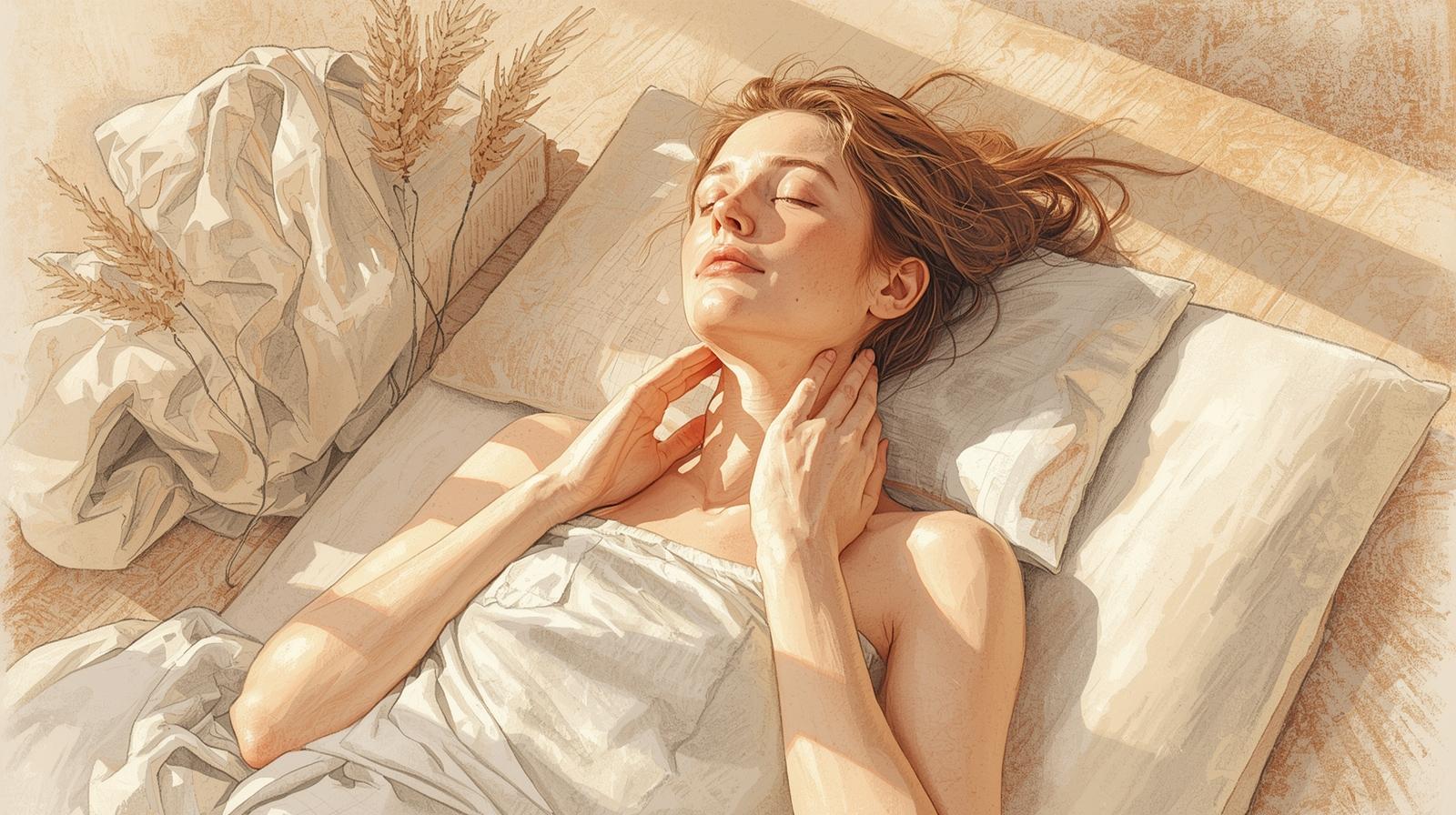
The head and neck are prime locations for tension, especially in a world dominated by screens and constant information. Eye strain, jaw clenching, and forward head posture all contribute to headaches and stiffness. Self-massage in this region can be profoundly relieving and even improve focus and sleep quality.
Begin with the scalp. Place the pads of your fingers near your temples and gently circle them, gradually moving across the crown and down to the base of the skull. Imagine you are shampooing your hair, but slower and with more presence. The scalp is richly innervated, and stimulating it increases blood flow, awakens hair follicles, and sends soothing signals to the brain.
For the temples, use gentle circular motions with two fingers, applying just enough pressure to feel a pleasant release without discomfort. This technique can reduce tension headaches and calm an overstimulated mind. If you experience jaw tightness, place your fingertips along the sides of your jaw, just in front of the ears, and slowly massage downward toward the chin. This area, where many people unconsciously clench, often holds suppressed stress. Moving the fingers in slow, downward strokes encourages the jaw to soften and release.
The back of the neck is another critical area. Using both hands, cradle the base of your skull where it meets the neck. Apply gentle pressure with your thumbs, moving in small circles along the ridge of bone known as the occipital ridge. This technique helps relieve tension headaches, eye strain, and neck stiffness. If you have more time, gently knead the muscles along the sides of the neck, moving from the base upward. Always stay mindful of your comfort, avoiding excessive pressure near sensitive structures like the throat.
Self-massage of the head and neck is not just mechanical relief. It is an invitation to let go of mental clutter. As you massage, notice the connection between physical tension and your thoughts. Often, releasing the jaw or scalp coincides with a quieter mind. Pairing this practice with slow breathing enhances the calming effect, reminding you that mental and physical release are deeply intertwined.
Releasing shoulder and upper back tension
Few areas of the body carry as much daily burden as the shoulders and upper back. Whether from hunching over a desk, carrying emotional stress, or holding physical loads, this region often becomes a storage unit for tension. People describe their shoulders as “tight knots” or speak of “carrying the weight of the world,” which is more than a metaphor—it is a physical reality.
To begin releasing this area, start by placing your right hand on your left shoulder. Using the heel of your hand or your fingers, press and knead into the trapezius muscle—the large band that runs from the base of the skull down to the shoulder blade. Apply firm but comfortable pressure, experimenting with circular or squeezing motions. Repeat on the other side. This simple technique immediately increases circulation and signals the muscles to relax.
Another effective method is to use a tennis ball or massage ball against a wall. Stand with your back to the wall, place the ball between your shoulder blade and the wall, and gently roll up and down or side to side. This allows you to target deep knots that are difficult to reach with your hands alone. Focus especially on the rhomboids, the muscles between the shoulder blades, which often tighten from prolonged sitting.
Stretching and self-massage can also be combined for maximum effect. After kneading the shoulders, interlace your fingers, stretch your arms forward, and round your upper back, breathing deeply into the space between your shoulder blades. This creates both muscular release and an emotional sense of openness. Many people feel an immediate sense of relief, as if a literal weight has been lifted.
The shoulders are also symbolic in many healing traditions. They are where we “shoulder” responsibility and burdens. Self-massage here can become a ritual of letting go—not only of muscular knots but also of the invisible expectations and obligations you carry. Each press, each release, becomes an act of forgiveness toward yourself for carrying too much.
Lower back and hips
The lower back is one of the most common places where people experience chronic discomfort. Long hours of sitting compress the lumbar spine, weaken stabilizing muscles, and reduce circulation. Emotional stress also tends to manifest here, as the hips and lower back are closely tied to feelings of stability and support. When this area is tight, it can affect not only physical comfort but also emotional grounding.
To begin a self-massage for the lower back, find a comfortable position where you can reach the area without straining. Sitting on the floor with your knees bent is often easiest. Place your fists or the heels of your hands on either side of your spine, around the lower back. Using firm, circular motions, press into the muscles along the spine, working outward toward the sides. Never press directly on the vertebrae—focus on the soft tissue where tension gathers.
A tennis ball or massage ball can be an invaluable tool for this area. Lie on your back with the ball positioned under the lower back muscles, just above the hips. Slowly shift your weight side to side, allowing the ball to press into knots and tight spots. If you find an especially tense area, pause there, breathe deeply, and let your body soften around the pressure. This combination of sustained pressure and mindful breathing encourages both muscular release and nervous system relaxation.
The hips, too, hold a remarkable amount of tension. In many somatic traditions, the hips are considered a storehouse of unprocessed emotions. From a purely physical perspective, sitting for long periods shortens the hip flexors and strains the glutes, creating imbalance and discomfort. To massage this area, sit with one ankle resting on the opposite knee in a figure-four position. Place your hands on the outer hip of the leg that is lifted, pressing and kneading the gluteal muscles. Explore different angles, moving from the side of the hip toward the sit bone.
For deeper release, lie on your back with a massage ball under one glute and gently roll in small circles. This can target the piriformis muscle, which is often implicated in sciatic pain. Again, breathe deeply into the sensation, allowing the muscles to melt under the pressure. Combining hip self-massage with gentle stretches—such as pulling the knee toward the chest—can enhance the release and leave you feeling more open and grounded.
Regularly caring for the lower back and hips is transformative not only for posture and mobility but also for emotional balance. Many people notice that when their hips feel freer, they walk with more ease, breathe more deeply, and even sleep more soundly. It is a reminder that our emotional lives are inseparable from our physical bodies.

Hands and wrists
In our digital age, the hands and wrists are perhaps the most overused and under-cared-for parts of the body. Hours of typing, texting, and gripping create repetitive strain that can lead to stiffness, numbness, or even chronic conditions like carpal tunnel syndrome. Yet, our hands are also deeply symbolic—they are the tools through which we create, connect, and care for others. Self-massage for the hands and wrists is therefore both practical and symbolic: it restores mobility and honors the body’s capacity to do and to give.
Begin with the palms. Using your thumb, press into the base of the opposite hand, moving in slow circles. Gradually work your way up to the center of the palm and then toward the base of each finger. This stimulates reflex points that correspond to different parts of the body, echoing the principles of reflexology. Many people report not only hand relief but also a surprising sense of full-body relaxation when massaging the palms.
For the fingers, gently pull and twist each one, starting at the base and moving toward the tip. This not only stretches the joints but also improves circulation. Pay special attention to the base of the thumb, an area that often becomes tight from texting or typing. Using your opposite thumb, knead this area in small circles, applying enough pressure to feel a release without causing pain.
The wrists deserve particular care. Place your opposite thumb on the inner wrist and your fingers on the outer wrist. Gently press and circle, moving slowly up and down the joint. Then, with your other hand, lightly stretch the wrist by bending it backward and forward, holding each position for a few breaths. This combination of massage and stretching enhances flexibility and reduces stiffness.
For those who experience chronic strain, a massage ball can also be used on the forearms. Place your forearm on the ball on a table and roll it back and forth, focusing on the muscles just below the wrist. This area is often tight from gripping and benefits from sustained pressure.
Massaging your hands and wrists can become a daily ritual, especially if you work at a computer. It only takes a few minutes but can significantly reduce tension and prevent long-term strain. Symbolically, it is also a way of acknowledging the hard work your hands do every day—writing, holding, cooking, caring, creating. By caring for them, you care for the part of yourself that reaches into the world.
Legs and feet
The legs and feet are our foundation. They carry us through the world, often without much recognition. Yet by the end of the day, they can feel heavy, sore, or restless. Foot and leg massage is not only physically restorative but also profoundly grounding. It reconnects you with the sensation of being supported, of belonging to the earth beneath you.
Start with the calves. Sit comfortably and place one leg across the other. Using both hands, knead the calf muscle, squeezing and releasing as if you are kneading dough. Move slowly from the ankle up toward the knee. This encourages circulation, especially beneficial if you spend much of your day sitting. For deeper pressure, use your knuckles or a massage ball to press into tight spots.
The thighs also benefit from self-massage. Sitting on the floor, place your fists or palms on the front of your thighs and press downward, moving from the hips toward the knees. Then switch to the sides of the thighs, working into the iliotibial band, a common site of tightness. Be gentle here, as this tissue can be sensitive. Combining massage with slow stretching of the legs can further enhance the release.
The feet are perhaps the most rewarding part of the body to massage. Begin by holding one foot in your hands and pressing into the arch with your thumbs. Move slowly along the length of the arch, applying steady pressure. Then, massage the heel, which often carries hidden tension. For the toes, gently pull, twist, and stretch each one. Finally, press into the ball of the foot and along the outer edge.
Using a tennis ball for foot massage can be transformative. Place the ball under your foot while standing or sitting and roll it back and forth, pausing on tender spots. This stimulates reflex points that correspond to different organs and systems in the body, promoting overall relaxation. Many people find that even a few minutes of foot massage before bed improves sleep quality and reduces feelings of restlessness.
Leg and foot massage also have a symbolic quality. In many cultures, washing or massaging feet is seen as an act of humility and care. When you massage your own feet, you acknowledge their tireless support and give back to the foundation that carries you each day. It is a ritual of gratitude as much as of release.

Breathwork and self-massage integration
While self-massage alone is deeply effective, combining it with mindful breathing elevates the practice to a whole new level. Breath is the bridge between body and mind. When you breathe shallowly and quickly, you reinforce stress signals. When you breathe deeply and slowly, you activate the parasympathetic nervous system, amplifying the relaxation response.
As you massage, try synchronizing your movements with your breath. For example, when pressing into a tight spot, inhale slowly and deeply through your nose. As you exhale, soften your muscles and allow the pressure to sink deeper. This creates a rhythm where the breath guides the release, turning the massage into a moving meditation.
Visualization can also enhance the effect. Imagine that each inhale brings fresh energy into the area you are massaging, and each exhale releases tension, heaviness, or stress. This imagery helps the brain reframe the experience from one of pain or resistance to one of healing and flow.
Another powerful technique is to use breath as a diagnostic tool. While massaging a tight muscle, notice how your breathing responds. If your breath becomes shallow or held, it may signal that the area is carrying more than just physical tightness—it may hold emotional residue. In such cases, slow your massage, breathe intentionally, and allow space for any emotions that surface. This gentle witnessing of both body and breath fosters integration and healing.
By weaving breath into self-massage, you create a holistic practice that addresses not only muscles and fascia but also the nervous system and emotional body. It transforms self-massage from a mechanical routine into a mindful ritual of self-connection. Every inhale and exhale becomes a reminder that release is not forced but allowed, not demanded but invited.
Emotional release through self-massage
The body and mind are not separate worlds. What you experience emotionally often imprints itself physically, settling into muscle fibers, connective tissue, and breath patterns. Many people describe feeling a “knot in the stomach” when anxious, a “weight on the chest” when sad, or “tight shoulders” when overwhelmed. These expressions are not poetic exaggerations—they are accurate descriptions of how emotions inhabit the body.
Self-massage creates a safe container for these stored emotions to surface and release. When you press into tight tissue with awareness, you may notice unexpected waves of emotion. Sometimes this release comes as a sigh or yawn, other times as tears or laughter. These responses are not random—they are the nervous system’s way of discharging held tension. Allowing them to happen without judgment is part of the healing process.
For example, the hips are often considered emotional storage centers. As you massage this area, you may feel vulnerable or unexpectedly emotional. Instead of resisting, you can breathe through the sensation and acknowledge whatever arises. This does not mean self-massage is a substitute for therapy, but it can be a complementary practice that helps you access and process feelings you might otherwise suppress.
The key is to approach self-massage as both physical and emotional care. Create a mindset of curiosity rather than control. If you find a tender spot, ask yourself gently: What am I holding here? You may not get an immediate answer, but the very act of asking opens space for awareness. Over time, this practice can cultivate greater emotional resilience and self-understanding.
It is also helpful to close a self-massage session with intentional grounding. After working through areas of tension, place your hands gently on your heart or belly, breathe deeply, and silently affirm: I am safe. I am here. I am allowed to let go. This integration ensures that the release you experience does not leave you feeling raw or unsettled but instead restores balance and peace.
The role of aromatherapy and oils
While self-massage can be performed without any tools, the use of oils and aromatherapy enhances both the physical and emotional benefits. Oils reduce friction, allowing smoother movements, while their scents engage the brain’s limbic system, which governs emotion and memory. This dual action deepens the sense of relaxation and turns self-massage into a multi-sensory ritual.
Carrier oils such as jojoba, sweet almond, or coconut oil provide nourishment for the skin and serve as a base. They allow your hands to glide over muscles without pulling, creating a soothing experience. Into these carrier oils, you can blend essential oils tailored to your needs. Lavender and chamomile are well-known for calming anxiety and promoting sleep. Eucalyptus and peppermint refresh and energize, making them ideal for morning routines. Rose and sandalwood can evoke feelings of comfort and emotional openness, supporting practices of self-love.
The science behind aromatherapy is compelling. When you inhale the molecules of essential oils, they travel through the olfactory system to the limbic brain. This part of the brain influences heart rate, stress levels, hormone balance, and even memory recall. This is why a particular scent can instantly transport you to a childhood memory or shift your mood within seconds. Incorporating aromatherapy into self-massage therefore creates a direct pathway to emotional regulation.
When preparing oils, keep safety in mind. Essential oils are highly concentrated and should always be diluted before applying to the skin. A general guideline is three to five drops of essential oil per tablespoon of carrier oil. Always perform a patch test first, especially if you have sensitive skin.
Beyond oils, the environment itself can be infused with scent. Diffusers, incense, or even freshly cut herbs can add layers of sensory depth to your practice. The key is to choose scents that resonate with you personally, creating an association between self-massage and relaxation that deepens over time.
Building a daily self-massage ritual
The true power of self-massage lies not in a single session but in consistency. When practiced daily, even for just a few minutes, self-massage becomes a ritual that reconditions the nervous system, improves circulation, and cultivates emotional balance. Like brushing your teeth or stretching, it becomes a small but transformative act of self-maintenance.
Creating a daily ritual begins with intention. Decide when self-massage fits best into your day. Morning sessions can energize and prepare you for the day, while evening sessions can help you unwind and signal to the body that it is time to rest. Some people even incorporate mini-massage breaks during work, massaging their hands, neck, or temples for two minutes to reset focus.
Start small. A ritual does not need to be elaborate. Even five minutes of mindful touch can make a difference. For example, you might begin with massaging your temples and jaw in the morning, followed by a few deep breaths. At night, you might focus on your feet and shoulders, combining massage with calming music or dimmed lights.
The key is consistency. By repeating these actions daily, you train your body to associate self-massage with safety and calm. Over time, the very act of sitting down to massage yourself can trigger a relaxation response, much like Pavlovian conditioning. The more consistent you are, the more powerful the effect becomes.
Ritualizing self-massage also adds an emotional dimension. You are not simply relieving sore muscles—you are making a statement of worthiness. In a world that often demands constant productivity, taking time each day to touch your body with care is an act of resistance and self-respect. It says: I deserve rest. I deserve attention. I am not just a machine to be driven; I am a being to be cared for.
When to seek professional support
While self-massage is a powerful tool, it is not a substitute for professional medical or therapeutic care when needed. There are times when tension signals deeper issues that require expertise. Knowing when to seek support ensures your self-care practice remains safe and effective.
If you experience persistent or severe pain that does not improve with self-massage, it may indicate underlying conditions such as nerve compression, musculoskeletal imbalances, or injury. In such cases, consulting a physical therapist, chiropractor, or physician is important. Self-massage can still be a supportive practice, but it should complement professional guidance rather than replace it.
Emotional releases during self-massage can sometimes surface unresolved trauma. While this is a natural process, it can feel overwhelming without proper support. If you find yourself consistently experiencing intense emotional reactions during self-massage, working with a therapist can provide a safe space to process these feelings. Self-massage can then become a grounding tool alongside therapy, rather than a standalone approach.
Pregnant individuals, people with certain medical conditions (such as circulatory disorders, skin conditions, or recent surgeries), or those taking specific medications should consult with a healthcare provider before incorporating regular self-massage. Adjustments or specific contraindications may apply, and professional advice ensures your practice supports rather than complicates your health.
Remember that professional massage therapists bring a depth of expertise that self-massage cannot fully replicate. Their trained hands can access areas that are difficult to reach, and their knowledge of anatomy allows them to work with precision. Seeking professional support does not diminish the value of self-massage; instead, it expands your toolkit for care. Many people find that alternating between self-massage and professional sessions offers the best of both worlds.
Self-massage is ultimately about cultivating a relationship with your own body, but like all relationships, there are moments when external guidance enriches the journey. By knowing your limits and seeking help when necessary, you honor both your autonomy and your interconnectedness with others.
Reconnecting with Your body
In a world that constantly pulls your attention outward—to deadlines, screens, and responsibilities—it is easy to forget the quiet language of your body. Tension builds silently, like background noise, until it becomes too loud to ignore. Self-massage is not just a method for silencing that noise; it is a way of listening, of honoring, and of restoring balance between body and mind.
Throughout this guide, we have explored the science of how stress imprints itself in muscles, fascia, and the nervous system. We have seen how the healing power of touch, even when it comes from your own hands, can activate profound shifts in physiology and emotion.
We have walked through techniques for releasing tension in the head, neck, shoulders, back, hips, hands, and feet, discovering how each part of the body tells its own story of labor, stress, and resilience. We have explored how breathwork, aromatherapy, and ritual transform mechanical techniques into a holistic practice that nourishes both body and soul.
But perhaps the most important lesson is not about muscles or techniques. It is about relationship—the relationship you cultivate with yourself. Every time you choose to pause, to breathe, and to place your hands gently on your own body, you affirm that you are worthy of care. You transform self-massage from a wellness practice into an act of radical self-love.
This relationship grows over time. At first, you may approach self-massage as a way to fix discomfort. But as the practice becomes a ritual, you begin to notice subtler layers: how your breath changes as you release a knot in your shoulders, how emotions soften as your hips let go, how gratitude wells up when you massage your feet after a long day. These are not small shifts—they are reminders that you are whole, that healing is accessible, and that you already carry within you the tools for calm.
There will be times when you need professional support, and honoring those moments is also part of self-care. But day to day, your hands can be your greatest allies. They are always with you, always ready to soothe, to release, to reconnect. Self-massage is a practice of remembering that you are both healer and healed, giver and receiver.
As you carry these techniques forward, consider making them part of your daily rhythm. Even two minutes of temple massage at your desk, or a foot massage before sleep, can shift the trajectory of your day. Over weeks and months, these small acts accumulate, reconditioning your nervous system and reshaping your relationship with your body.
The invitation of self-massage is simple: return home to yourself. In each touch, find presence. In each release, find space. And in the quiet that follows, rediscover the calm that has always been waiting within you.
Related posts You’ll love:
- Tension mapping: How to notice where Your body stores stress
- How to transition from work mode to relax mode: A complete guide to inding inner calm after busy days
- The role of MINIMALISM in creating a calm mindset
- How to use movement to process emotions: An expert guide for healing
- How to create a picnic ritual for relaxation: A complete guide to mindful outdoor calm
- Jaw release meditation: Why relaxing one muscle can calm Your whole nervous system (and change everything)
- How rainfall cleanses more than just the earth: A journey into calm, renewal, and inner healing

FAQ: Self-massage techniques for releasing daily tension
-
What is self-massage and how does it work?
Self-massage is the practice of applying massage techniques to your own body using your hands, fingers, or simple tools like massage balls. It works by stimulating muscles, fascia, and nerves, which improves blood circulation, reduces muscle stiffness, and activates the parasympathetic nervous system responsible for relaxation.
-
Can self-massage really reduce stress?
Yes. Research shows that massage lowers cortisol (the stress hormone) and increases oxytocin and serotonin, which promote feelings of calm and connection. Even a few minutes of self-massage can quiet the nervous system and create a sense of safety and balance.
-
How often should I practice self-massage?
For best results, practice short self-massage sessions daily. Even 5–10 minutes focusing on your neck, shoulders, or feet can make a noticeable difference. Longer sessions a few times a week are also beneficial for deeper release.
-
Do I need oils or tools for self-massage?
You can practice self-massage with just your hands, but oils and tools can enhance the experience. Carrier oils like jojoba or almond oil help your hands glide more smoothly, while massage balls or foam rollers allow you to reach deeper layers of muscle.
-
What areas of the body benefit most from self-massage?
Common areas that hold daily tension include the neck, shoulders, upper back, lower back, hips, hands, and feet. Regularly massaging these areas improves mobility, reduces pain, and releases emotional and physical stress.
-
Can self-massage release emotions as well as tension?
Yes. Emotions are often stored in the body, especially in areas like the hips and shoulders. As you release muscular tension, you may also notice emotional shifts such as sighing, crying, or feeling lighter. This is a natural and healing response.
-
Is self-massage safe for everyone?
In general, yes, but people with certain conditions—such as recent injuries, circulatory disorders, or pregnancy—should consult a healthcare provider first. If you experience severe or persistent pain, it’s important to seek professional medical or therapeutic support.
-
Can self-massage improve sleep?
Absolutely. Evening self-massage, especially of the feet, shoulders, or temples, signals the body to relax, lowers heart rate, and prepares the nervous system for rest. When paired with calming breathwork, it can significantly improve sleep quality.
-
How does self-massage compare to professional massage?
Self-massage offers immediate, daily relief and builds self-awareness, while professional massage provides deeper and more targeted treatment. The two practices complement each other—self-massage is ideal for everyday maintenance, while professional sessions address more complex issues.
-
What is the best time of day to practice self-massage?
It depends on your needs. Morning sessions can energize and prepare you for the day, while evening sessions are perfect for winding down and releasing accumulated tension. Even short mid-day massages for the hands or neck can restore focus.
Sources and inspirations
- McEwen, B. S. (2007). Physiology and neurobiology of stress and adaptation: central role of the brain. Physiological Reviews.
- Bialosky, J. E., Bishop, M. D., & George, S. Z. (2009). The mechanisms of manual therapy in the treatment of musculoskeletal pain: a comprehensive model. Manual Therapy.
- Diego, M. A., & Field, T. (2009). Moderate pressure massage elicits a parasympathetic nervous system response. International Journal of Neuroscience.
- Price, C. J., & Hooven, C. (2018). Interoceptive awareness skills for emotion regulation: Theory and approach of Mindful Awareness in Body-oriented Therapy (MABT). Frontiers in Psychology.
- Maratos, F. A., & Sheffield, D. (2012). Modifying the Stroop emotional Stroop task to study anxiety: The impact of touch. Cognitive Processing.
- Uvnäs-Moberg, K. (2009). The oxytocin factor: Tapping the hormone of calm, love, and healing. Da Capo Press.
- Herz, R. S. (2009). Aromatherapy facts and fictions: a scientific analysis of olfactory effects on mood, physiology and behavior. International Journal of Neuroscience.
- Lee, M. S., Choi, J., Posadzki, P., & Ernst, E. (2012). Aromatherapy for health care: an overview of systematic reviews. Maturitas.
- Kalisch, R., Müller, M. B., & Tüscher, O. (2015). A conceptual framework for the neurobiological study of resilience. Behavioral and Brain Sciences.
- Sullivan, A. B., & Scheman, J. (2008). Utilization of complementary and alternative medicine for the treatment of pain. Pain Medicine.
- Lund, I., Lundeberg, T., Carleson, J., & Svensson, E. (2006). Is there a role for massage in the treatment of chronic pain? Clinical Journal of Pain.
- Smith, C. A., & Collins, C. T. (2011). Massage interventions for women in labour. Cochrane Database of Systematic Reviews.
- Moyer, C. A., Rounds, J., & Hannum, J. W. (2004). A meta-analysis of massage therapy research. Psychological Bulletin.




Leave a Reply