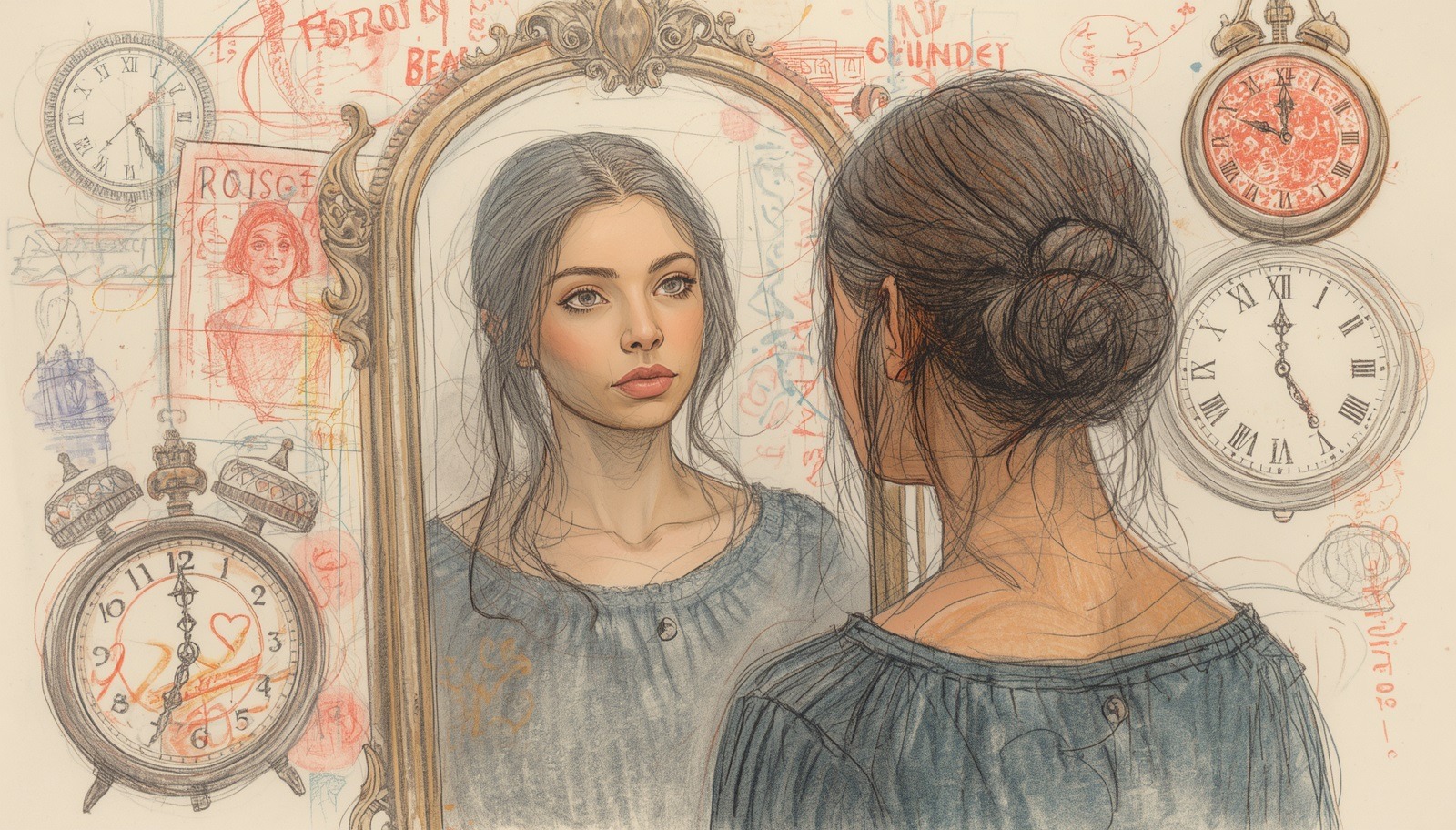
I keep noticing something strange about the way we speak to women about time.
We encourage a woman to become more experienced, but not more visibly experienced.
We want her to know what she wants, understand her nervous system, manage her money, build a career, identify red flags, recover from heartbreak, set better boundaries and stop apologizing for taking up space.
We want her to acquire all the wisdom that usually requires decades.
But we would prefer those decades not to show on her face.
She is expected to have the judgment of a woman who has lived, the emotional control of a woman who has healed and the confidence of a woman who no longer needs approval.
Visually, however, she is encouraged to remain somewhere around 35.
Not 22, because that may look inexperienced.
Not 55, because our culture still struggles to associate visibly older women with desirability, freshness and possibility.
Thirty-five has become an unofficial cultural compromise: old enough to be competent, but young enough not to make other people uncomfortable with the evidence of time.
I do not believe women are literally handed a document stating that they must look 35 forever. The expectation is more sophisticated than that. It is delivered through compliments, beauty routines, workplace advice, camera filters, celebrity transformations, dating preferences, skincare language and seemingly innocent observations about who has “aged well.”
The contract is never signed.
It is absorbed.
Grow wiser → remain smooth.
Become powerful → remain visually nonthreatening.
Live fully → hide the evidence.
I call this the age-freeze contract: the unspoken expectation that a woman must continue developing internally while appearing externally preserved.
And I think it is doing far more to women than making them dislike a few lines around their eyes.
It is changing how they relate to time itself.
Why are Women expected to look 35 forever?
Women are expected to look 35 forever because modern culture rewards a narrow combination of female traits: maturity without visible aging, confidence without hardness, authority without intimidation, sexuality without the signs of hormonal change and beauty without obvious effort.
The pressure comes from several overlapping systems:
→ Gendered ageism makes women’s social value appear to decline earlier than men’s.
→ Beauty marketing transforms ordinary aging into a series of correctable problems.
→ Social media places filtered, edited and cosmetically altered faces inside everyday comparison.
→ Workplace culture can make youthfulness feel connected to energy, adaptability and professional relevance.
→ Dating culture often treats male aging as neutral while framing female aging as a loss of value.
→ Wellness language can disguise appearance control as health, discipline or self-respect.
→ Cosmetic intervention makes visible aging appear increasingly optional.
The World Health Organization defines ageism through stereotypes, prejudice and discrimination based on age. Crucially, ageism can be directed not only at other people but also at ourselves. In other words, a woman may learn to reject her future face long before anyone openly rejects her.
I believe that internalized element is essential.
The most efficient beauty standard is not one that requires someone else to criticize you every morning. It is one that teaches you to perform the criticism automatically.
“Forever 35” is not about one exact age
I want to make one distinction clear before going further.
There is nothing scientifically exceptional about 35.
A woman does not cross a universal biological line on her thirty-fifth birthday. Different women experience changes in skin, hair, body composition, hormones, energy and health at different times. Culture, genetics, economic circumstances and medical history all affect how aging is experienced.
Here, 35 is a symbol rather than a diagnosis.
It represents the visual age at which a woman is imagined to possess adult competence without yet displaying too many features culturally associated with later life.
She may have a career, but she is not supposed to look “set in her ways.”
She may have relationship experience, but she should remain romantically marketable.
She may have authority, but her face should still communicate accessibility.
She may have lived through stress, grief, childbirth, caregiving, illness or exhaustion, but none of these experiences should become too visible.
The ideal is not simply youth.
It is youth combined with evidence of successful adulthood.
That is why the standard is so difficult to reach. A woman is expected to possess qualities that take time to acquire while concealing the time it took to acquire them.
Table 1: The modern “Forever 35” contract

I do not think Women are afraid of wrinkles alone
When a woman says she is afraid of looking older, I do not automatically hear vanity.
I hear a possible collection of fears hiding behind one sentence.
- Will I still be noticed?
- Will I still be considered attractive?
- Will younger colleagues be treated as more adaptable?
- Will my partner continue to desire me?
- Will people start calling me difficult instead of direct?
- Will I be expected to become quieter?
- Will I still be allowed to experiment with clothes, work, love or reinvention?
- Will the world interpret my face as evidence that my most important years are behind me?
This is why telling women to “just embrace their wrinkles” can feel so inadequate.
The wrinkle may not be the central problem.
The wrinkle may have become a symbol of anticipated social loss.
When appearance is connected to attention, opportunity, income and belonging, changing one’s appearance can feel less like a neutral physical transition and more like a change in social status.
I do not think we can resolve that fear by repeating that aging is beautiful. Women need more than another attractive slogan.
They need to know that their visibility, authority and right to participate do not have an expiration date.
The real standard is not youth—it is aesthetic punctuality
I have started thinking about modern beauty pressure as a demand for aesthetic punctuality.
A woman is expected to look exactly the right age for the social role she occupies.
If she looks very young, she may be patronized or treated as inexperienced.
If she looks visibly older, she may be described as tired, dated, severe or no longer relatable.
She is expected to land in the narrow middle:
→ Young enough to be desirable.
→ Mature enough to be credible.
→ Polished enough to look successful.
→ Natural enough not to appear vain.
→ Maintained enough to suggest discipline.
→ Relaxed enough to suggest confidence.
Aesthetic punctuality is exhausting because the acceptable visual age does not move forward at the same speed as the woman.
She turns 41, but the target remains 35.
She turns 49, but the target remains 35.
She turns 58, and success is measured by whether strangers assume she is 45.
Instead of allowing every age to develop its own visual identity, we treat later womanhood as a less successful imitation of earlier womanhood.
Middle-aged women become “older versions” of young women rather than complete people occupying a legitimate stage of life.
The female face has become a progress report
I often notice how quickly appearance language becomes moral language.
A woman does not simply look different.
- She has “maintained herself.”
- She has “let herself go.”
- She is “fighting aging.”
- She has “given up.”
- She is “disciplined.”
- She “still takes pride in her appearance.”
These phrases do more than describe a face. They create a story about character.
Smooth skin becomes evidence of control.
Thinness becomes evidence of discipline.
A rested appearance becomes evidence of responsible self-care.
Gray hair, changing weight or visible fatigue can be interpreted as neglect.
This is what I call maintenance morality: the belief that successfully controlling visible aging demonstrates virtue.
Once maintenance becomes moral, opting out becomes difficult. A woman may not simply decide that she does not want a certain routine. Her choice may be interpreted as a failure to care about herself.
Consider the phrase “She looks good for her age.”
It sounds kind.
Often, it is intended kindly.
But the compliment contains a hidden expectation: women of that age are not normally expected to look good.
Her beauty is framed as an exception to her age rather than an expression of it.
The compliment rewards her for successfully avoiding membership in a devalued category.
Women are allowed to age only if They make aging look aspirational
Our culture occasionally celebrates older women, but I think we need to examine which older women receive that celebration.
They are often unusually slim, wealthy, energetic, fashionable, able-bodied, professionally successful and conventionally beautiful.
Their hair may be gray, but it is thick, styled and glossy.
Their skin may show some age, but their jawline remains defined.
Their clothes communicate confidence rather than economic limitation.
Their aging is praised because it remains aesthetically controlled.
This is not genuine acceptance of aging.
It is an expansion of the beauty standard to include a carefully selected group of older women who can still satisfy most of its requirements.
Even “natural aging” becomes a performance.
A woman may be permitted to show wrinkles if the rest of her body remains youthful.
She may be praised for gray hair if her skin remains smooth.
She may be celebrated for rejecting cosmetic procedures if she happens to age in a conventionally attractive way.
The message becomes:
You may age visibly, but you must make visible aging look expensive.
The disappearing middle of female life
When I look at popular representations of womanhood, I see a crowded beginning and a carefully curated end.
There are endless images of women in their twenties and early thirties.
There are also selected images of striking older women who are presented as exceptional, timeless or inspirational.
What is less visible is the ordinary middle.
The 43-year-old whose face has begun changing but who does not have a transformation story.
The 49-year-old whose sleep, skin and body have shifted during perimenopause.
The 55-year-old who does not want every conversation about her appearance to become a debate about empowerment.
The 62-year-old who enjoys makeup but does not want to use it as camouflage.
The 70-year-old who is neither trying to look younger nor volunteering to disappear.
A systematic review of research on women’s experiences of the aging body concluded that body image remains relevant across the female lifespan. The review also emphasized the importance of considering women’s embodied experiences within healthy-aging research rather than assuming body-image concerns belong only to younger women.
Research across adulthood has similarly found that women reported more body dissatisfaction and greater importance of appearance than men. In that study, women’s body dissatisfaction did not simply vanish with age, even though body appreciation may develop or improve in other ways.
That apparent contradiction makes sense to me.
A woman can become wiser, more self-compassionate and less interested in pleasing everyone while still being affected by a culture that repeatedly evaluates her appearance.
Inner growth does not make external pressure imaginary.
Social media did not invent aging anxiety—it made it continuous
Women have compared their appearances for generations.
What has changed is the speed, scale and intimacy of the comparison.
A woman can now compare her morning face with hundreds of professionally lit, strategically posed, filtered, injected, surgically altered or digitally edited faces before she has even left her bed.
She usually sees the result without seeing the infrastructure behind it.
She may not see:
→ The ring light.
→ The selected angle.
→ The smoothing tool.
→ The deleted photographs.
→ The professional makeup.
→ The cosmetic procedure.
→ The recovery period.
→ The financial cost.
→ The hormonal or medical treatment.
→ The photographer’s direction.
→ The editing completed after the image was taken.
The brain receives a finished face without receiving its production notes.
Eventually, an exceptional image begins to feel like an ordinary woman.
A 2022 study found relationships between highly visual social-media use and attitudes toward cosmetic procedures. Following influencers who had undergone procedures and using Instagram filters were associated with greater cosmetic-procedure acceptance or intention, although such findings should not be interpreted as proving that social media directly causes an individual decision.
A 2024 systematic review also described associations among appearance-focused social-media exposure, body dissatisfaction, social appearance anxiety and interest in cosmetic procedures. As with much of this research, the evidence includes correlational and cross-sectional studies, which means the direction of influence can be complex.
I think the psychological shift is still profound.
A woman no longer compares herself only with celebrities or strangers.
She compares herself with a technologically improved version of herself.
The digital doppelgänger gap
I call the distance between a woman’s physical face and her edited face the digital doppelgänger gap.
The filtered version is especially persuasive because it still appears to be her.
It has her eyes.
Her expressions.
Her identity.
But the skin is smoother.
The jaw may be narrower.
The eyes may be brighter.
The lips may be fuller.
The facial proportions may have been subtly changed.
Because the image feels familiar, it does not register as fantasy in the same way as a fashion photograph might.
It feels like potential.
The thought is no longer:
“I wish I looked like her.”
It becomes:
“I could look like me, but better.”
That creates a new form of dissatisfaction. The physical face may begin to appear unfinished because the digital version is always available as a reference.
The edited image becomes the standard.
The mirror becomes the disappointing reproduction.
This process can be almost invisible. A woman may believe she is simply choosing a flattering photograph. But repeated exposure to the adjusted face can slowly change what she perceives as normal.
Edit the face → become familiar with the edit → return to the mirror → experience reality as decline.
The mirror is being asked to compete with software designed to improve it.
It cannot win.
Beauty marketing no longer waits for Women to age
Earlier forms of anti-aging advertising often focused on reversing visible changes.
Contemporary beauty culture increasingly sells anticipation.
Do not wait for the line.
Prevent it.
Do not wait for the loss of volume.
Preserve it.
Do not wait until your face changes.
Begin maintaining it now.
The future face is presented as a risk that responsible women should manage in advance.
This is commercially powerful because prevention has no natural endpoint.
A visible concern may eventually be treated, accepted or forgotten.
A future concern can be monitored indefinitely.
A woman does not need to dislike herself today.
She needs only to fear tomorrow.
The fear can start early. A woman in her twenties may already be advised to prevent a face she has never had. Instead of experiencing youth as a stage of life, she is taught to use it as a preparation period for resisting age.
I find this particularly sad.
The young woman is not fully allowed to be young because she is already managing the possibility of no longer being young.
The middle-aged woman is not fully allowed to be middle-aged because she is encouraged to preserve an earlier visual identity.
And the older woman is praised when she appears to have escaped her own age.
No one is permitted to arrive.
Cosmetic procedures are not the illain
I do not want this article to become another set of rules for women.
I am not interested in dividing women into natural and artificial, liberated and insecure, authentic and altered.
That division is simplistic and often cruel.
A woman may genuinely enjoy Botox, fillers, laser treatments, surgery, makeup, hair color or an elaborate skincare routine.
- She may experience a cosmetic procedure as creative, satisfying or personally meaningful.
- She may also feel professional pressure to maintain a particular appearance.
- She may be making a strategic choice within an unfair system.
- She may feel both freedom and fear at the same time.
The procedure itself cannot tell us the whole story.
Global statistics demonstrate that aesthetic intervention has become a mainstream part of contemporary appearance management. The International Society of Aesthetic Plastic Surgery reported approximately 7.8 million botulinum-toxin procedures performed by plastic surgeons worldwide in 2024, making it the most common nonsurgical procedure in its survey. Adults aged 35–50 represented the largest age group for that procedure, with approximately 3.7 million treatments reported.
These numbers do not reveal why each person chose treatment, and they should not be used to shame anyone.
They do, however, show that facial intervention is no longer rare or culturally distant.
When enough altered faces surround us, the untreated face can begin to look unusually aged—even when it is entirely ordinary.
That changes the comparison field for everyone, including women who never intended to participate.
The choice is personal, but the menu is cultural
People often say, “Women should be free to choose.”
I agree.
But I also think we should examine how choices are created.
A choice does not occur in an empty room.
It occurs after years of seeing which women are praised, hired, desired, promoted, mocked, ignored and described as having “let themselves go.”
It occurs after advertising has named ordinary features as defects.
It occurs after the camera has shown a woman an edited version of her own face.
It occurs inside a dating culture that may display age as a searchable category.
It occurs inside workplaces where older women may worry about being perceived as less current or less energetic.
Freedom is not proved merely by the existence of options.
We also need the freedom to refuse an option without expecting punishment.
A woman is not fully free to “choose” youthfulness if visible aging threatens her income, desirability or social warmth.
And she is not fully free to reject beauty practices if she must turn that rejection into another polished identity.
The calmest question I know is not:
“Is this choice feminist?”
It is:
What would I choose if I felt completely safe from judgment?
The answer may still be the procedure.
It may still be the hair color.
It may still be the expensive cream.
But the question creates a small separation between desire and fear.
That separation is where genuine agency begins.
Looking young can feel like professional insurance
Appearance pressure is not confined to beauty or dating.
For some women, youthfulness can feel professionally protective.
Gendered ageism can affect assumptions about adaptability, technological competence, energy, authority and cultural relevance. Women may also face a contradictory standard in which they must appear experienced but not old, confident but not intimidating, polished but not overly concerned with appearance.
A study based on interviews with 24 women working in the media industry documented experiences of gendered ageism, including discriminatory behavior, reduced opportunities and pressure connected to aging in a highly visible professional environment. The study focused on media, so its findings should not automatically be generalized to every workplace, but it illustrates how gender and age can combine in professional judgments.
In a large U.S. survey reported by AARP, 62% of working women aged 18 and over said they had experienced age discrimination, rising to 66% among working women aged 50 and over. Survey responses are not the same as independently verified discrimination cases, but they show that many women perceive age as having real consequences at work.
When women spend money and energy trying to appear younger, I therefore hesitate to call the behavior irrational.
They may be responding to a real social signal.
The unfairness lies in the fact that women must carry the cost of adapting to the bias.
Men are often allowed to become distinguished
The gender difference is not that men never experience ageism or appearance pressure. They do.
The difference is that male aging has historically been given more positive cultural categories.
A man may become distinguished.
Seasoned.
Authoritative.
Established.
Silver-haired.
A woman is more likely to be told that she looks wonderful because she appears younger than she is.
His age may strengthen the story of his competence.
Her competence may be required to compete with her age.
This double standard is visible in entertainment, politics, business and dating, where older men may remain central while women of similar ages are repositioned as less relatable or less desirable.
I am cautious about universal statements here. Not every man benefits from aging, and factors such as race, class, disability, health and body size influence how any individual is treated.
But the cultural scripts remain different.
A man is more often permitted to look like he has accumulated power.
A woman is encouraged to accumulate power while keeping her face reassuringly unchanged.
Perimenopause enters a culture that already distrusts female aging
For many women, midlife appearance changes do not happen in isolation.
They may coincide with sleep disruption, stress, caregiving responsibilities, altered body composition, changing skin, changes in hair, menopausal symptoms and shifts in sexual well-being.
A systematic review published in 2023 found relatively consistent associations between menopausal symptoms and more negative body-image perceptions, while also emphasizing limitations in the existing research and the need for further study.
I find it important to frame this carefully.
Menopause does not automatically cause a woman to dislike her body.
The transition occurs inside a culture that has already taught her what female aging supposedly means.
A hot flash is physiological.
The belief that it makes her less feminine is cultural.
A change in body composition is physical.
The interpretation that she has lost control is cultural.
A change in skin or hair is real.
The idea that these changes reduce her social relevance is learned.
The body changes, and society supplies the insult.
The visibility tax
I call the extra labor women perform to remain socially legible as they age the visibility tax.
This tax may be paid through:
→ Time spent researching products and treatments.
→ Money spent on maintenance.
→ Energy spent comparing photographs.
→ Anxiety before professional events.
→ Strategic clothing choices.
→ Hair appointments organized around hiding regrowth.
→ Avoidance of certain lighting or cameras.
→ Mental calculations about whether an outfit is “too young.”
→ Repeated checking of the neck, jaw, hands or under-eye area.
→ Pressure to appear energetic even when exhausted.
Not every beauty practice is a tax. Many are enjoyable.
The tax is the part that does not feel optional.
It is the work performed not because a woman wants beauty, but because she fears the consequences of being read as older.
The tax is also unequal.
A wealthy woman may have more resources to pay it.
A woman in a public-facing profession may face greater pressure to pay it.
A woman with limited income may be judged for failing to display the polished appearance associated with competence.
Racialized beauty standards, disability, body size and gender expression can add further layers to how age is perceived.
There is no single female experience of aging.
But many women are charged something for making time visible.
The impossible triangle: Young, natural and effortless
The modern woman is expected to satisfy three incompatible demands.
1. Look young
Her skin should remain smooth, her body energetic and her style current.
2. Look natural
The work required to appear younger should not be obvious.
3. Look effortless
She should not reveal that maintaining the appearance requires thought, money, pain or time.
This creates a system in which women are criticized for aging and criticized for visibly resisting aging.
A woman who has procedures may be mocked for looking artificial.
A woman who does not may be judged for failing to maintain herself.
A woman who speaks honestly about the pressure may be accused of insecurity.
A woman who claims not to care must still remain attractive enough for her indifference to be admired.
Table 2: The contradictory rules of female aging

The psychological cost is larger than low self-esteem
The age-freeze contract does not affect only whether a woman likes her reflection.
It can change how she experiences time, money, memory and identity.
Anticipatory aging anxiety
She begins fearing changes that have not happened.
A small line is interpreted as the beginning of a rapid decline.
A photograph becomes a prediction.
Instead of inhabiting her current age, she is already defending herself against the next one.
Temporal shame
She feels embarrassed that time can be seen on her.
Age becomes private information she believes her face has disclosed without permission.
Appearance hypervigilance
The face stops appearing as a whole.
It becomes a list of zones:
- Forehead
- Eyes
- Cheeks
- Jaw
- Neck
- Lips
- Hairline
- Hands
Each area produces a separate maintenance assignment.
Identity lag
Inside, she may feel continuous.
Outside, photographs show change.
She may understand intellectually that she is aging while emotionally expecting to encounter the face she had ten years earlier.
Financial leakage
A single product may be affordable.
A single treatment may feel manageable.
But prevention has no endpoint. The combined expense of products, appointments, procedures, supplements and maintenance can redirect significant resources away from rest, healthcare, education, travel or financial security.
Reduced body trust
When every new feature is interpreted as deterioration, the body no longer feels like a home.
It becomes an unpredictable object that requires supervision.
Research involving older women has linked body dissatisfaction with psychological and social quality-of-life domains, negative mood and sleep, demonstrating that body image can remain relevant well beyond early adulthood.
I do not want to replace anti-aging with compulsory self-love
I am skeptical of advice that tells women they must love every visible change.
Love every wrinkle.
Celebrate every gray hair.
Feel grateful for every change.
This can become another performance.
A woman is allowed to dislike a photograph.
She is allowed to miss her former face.
She is allowed to color her hair.
She is allowed to have a procedure.
She is allowed to feel uncertain about a changing body.
She is also allowed to stop turning every uncomfortable feeling into an emergency.
The goal does not need to be constant body love.
A calmer goal is body neutrality with personal agency.
Instead of asking:
“Do I believe this feature is beautiful?”
I might ask:
“Does this feature deserve to control my day?”
Instead of:
“Have I fully accepted aging?”
I might ask:
“Can I experience this change without immediately trying to punish, hide or correct myself?”
Instead of:
“Am I confident enough to go natural?”
I might ask:
“What choice gives me the most peace rather than the most social approval?”
This approach leaves room for complexity.
It allows care without obsession.
Preference without panic.
Beauty without obedience.
Preference, protection or panic?
When I think about an appearance decision, I find it useful to identify which of three voices is speaking.
The voice of preference
“I enjoy this.”
“I like the result.”
“This routine feels pleasurable.”
“I would still choose it if nobody commented.”
Preference is usually specific and flexible.
The voice of protection
“I believe this appearance helps me avoid a professional or social penalty.”
“I work in an image-focused field.”
“I notice that people treat me differently when I present myself this way.”
Protection may be strategic rather than superficial.
The voice of panic
“I cannot allow anyone to see me like this.”
“If I stop maintaining this, everything will collapse.”
“This change means I am becoming irrelevant.”
“I must fix it immediately.”
Panic is urgent, global and punishing.
The same action can come from any of these voices.
Hair color can be pleasure, protection or panic.
Botox can be curiosity, strategy or fear.
Makeup can be creative expression or a requirement for feeling safe enough to leave home.
The point is not to judge the action.
The point is to understand the relationship behind it.
Table 3: The age-pressure reality check

Stop asking, “Do I look old?”
I think “Do I look old?” is usually the wrong question.
It combines too many fears into a single word.
The person asking may really mean:
- Do I still look attractive?
- Do I look unwell?
- Will my partner desire me?
- Do I look less competent?
- Will younger people dismiss me?
- Am I still allowed to wear this?
- Do I look like myself?
- Have I become invisible?
The word “old” hides the actual wound.
A more useful sentence might be:
“I am afraid this photograph makes me look excluded from the kind of womanhood I still want.”
That sentence is more vulnerable, but it is also more precise.
You can examine the fear of exclusion.
You can question where the image of acceptable womanhood came from.
You can build a larger version of womanhood.
You cannot solve “old” as though it were a cosmetic defect.
Create an age-visible environment
We learn what is normal through repetition.
When nearly every woman we see online has smooth skin, carefully shaped features, controlled body composition and professional presentation, ordinary aging may begin to look unusually dramatic.
I recommend creating what I call an age-visible environment.
This does not mean following only glamorous older celebrities. That can create another exceptional standard.
Look for ordinary variety:
→ Women with expressive foreheads.
→ Women whose skin has texture.
→ Women whose bodies have changed.
→ Women with gray hair who are not turning it into a political statement.
→ Women who use cosmetic procedures and discuss them honestly.
→ Women who do not use them.
→ Women who dress creatively without trying to appear younger.
→ Women whose beauty is not their main public contribution.
→ Women who are serious, sensual, intellectual, eccentric, tired, ambitious, funny and visibly older.
The nervous system becomes less alarmed by what it regularly sees.
A feature stops looking like failure when it is returned to the range of ordinary human variation.
Practice temporal disobedience
The age-freeze contract asks women to treat time as an enemy.
I prefer the idea of temporal disobedience.
Temporal disobedience does not require rejecting beauty or refusing every intervention.
It means refusing to organize your entire identity around appearing untouched by time.
It may look like:
→ Keeping a photograph even though your skin is not smooth.
→ Wearing something you love without asking whether it is age-appropriate.
→ Declining to explain your gray hair.
→ Getting a procedure without pretending it was morally empowering.
→ Refusing a procedure without presenting yourself as superior.
→ Allowing your face to move while you speak.
→ Choosing rest over another form of optimization.
→ Beginning something new at an age culture associates with decline.
→ Letting your current face become familiar rather than treating it as temporary.
Temporal disobedience says:
I am not late because I no longer look young.
I am not deteriorating because my body records time.
I do not need to resemble my past to remain recognizable to myself.
Reclaim beauty without turning it into employment
I do not want women to abandon beauty.
Beauty can be pleasurable.
It can be playful, artistic, sensual, cultural and deeply personal.
The problem begins when beauty operates like employment.
You perform continuous labor.
You meet changing standards.
You pay for the necessary equipment.
You receive conditional benefits in return.
And you are never permitted to retire.
A woman should be able to wear lipstick without believing her natural face is unacceptable.
She should be able to enjoy skincare without treating every line as evidence of failure.
She should be able to pursue a cosmetic treatment without signing a lifetime contract with youth.
She should be able to stop a treatment without feeling that she has abandoned herself.
She should be able to age without turning the process into a public lesson in confidence.
The goal is not to care less about everything.
It is to care from a place that still belongs to you.
What would change if Women were allowed to look Their age?
Imagine that a 50-year-old woman did not need to be praised for looking 38.
Imagine that a middle-aged face was not interpreted as a failed young face.
Imagine that professional competence was not visually coded as slim, polished, energetic and youthful.
Imagine that romantic possibility did not appear to narrow according to an appearance timeline.
Imagine that menopause was treated as a life transition rather than the beginning of female disappearance.
Imagine that older women did not need to be extraordinary to remain visible.
Cosmetic procedures would still exist.
Skincare would still exist.
Fashion, makeup and hair color would still exist.
But they could operate as tools rather than entrance fees.
Women could choose them for pleasure instead of protection.
And women who declined them would not be treated as though they had withdrawn from public life.
Aging would not become emotionally simple. Change, loss and mortality would remain real.
But women would no longer have to experience those realities alongside the humiliation of being told that visible time is a presentation error.
Your face is allowed to know what You know
The expectation that women should look 35 forever is not really about one birthday.
It is about a culture that wants women to gain wisdom without displaying age, to become powerful without becoming visually intimidating and to move forward without leaving youth behind.
The age-freeze contract asks a woman to collect experience while erasing its receipt.
I do not think the answer is to declare every wrinkle beautiful.
I do not think women must reject procedures, abandon beauty routines or prove that they are above caring.
I think the deeper freedom is quieter.
It is being able to make an appearance choice without believing that the choice determines your eligibility for love, work, attention or relevance.
It is noticing the difference between pleasure and panic.
It is allowing your current face enough time to become familiar.
It is understanding that looking older is not the same as becoming less alive.
You may still miss an earlier version of yourself.
You may still feel unsettled by a photograph.
You may still want to change something.
But you do not have to interpret every visible year as evidence that you have failed to maintain the woman you were supposed to remain.
Your life has moved.
Your knowledge has grown.
Your standards have changed.
Your face is allowed to know what you know.
It is allowed to show that you were here for all of it.
Related posts You’ll love
- Are We prisoners of Our own lives? 11 invisible cages of modern life — and the words that can set You free
- Truths for Women who are becoming more themselves with age: 11 powerful lessons on authenticity, self-worth, and confidence
- Body comments survival guide: Powerful lines to shut down weight, skin, and aging remarks
- Practice corner: Reframing age and success – A guided reflection workbook for Your real life. FREE PDF!
- Late bloomer energy: Why Your ‘delayed’ life is secretly Your biggest superpower
- Practice corner: Aging authentically — Letting go of the performance of grace
FAQ
-
Why are women expected to look younger than their actual age?
Women’s social value has historically been connected more strongly to beauty, fertility and desirability than men’s. Contemporary media, workplace expectations, dating culture and beauty marketing continue to reinforce the belief that youthfulness protects female relevance.
-
Why does the article focus specifically on age 35?
Thirty-five is used as a cultural symbol rather than a biological cutoff. It represents an imagined point at which a woman appears mature and competent while still retaining the social privileges associated with youth.
-
Is 35 considered old for a woman?
No. Thirty-five is not medically or biologically old. The anxiety attached to the age reflects cultural expectations rather than an objective decline in a woman’s value, attractiveness or potential.
-
What is gendered ageism?
Gendered ageism occurs when sexism and ageism interact. An older man may be described as experienced or distinguished, while a woman of the same age may be treated as less attractive, less adaptable or less culturally relevant.
-
Does social media cause women to fear aging?
Social media is unlikely to be the sole cause. However, repeated exposure to filtered, edited and cosmetically altered faces can influence what users perceive as normal. Research has found associations between appearance-focused social-media behavior, body dissatisfaction and greater acceptance of cosmetic procedures.
-
Is getting Botox or cosmetic surgery a sign of insecurity?
Not automatically. Women choose cosmetic treatments for many reasons, including enjoyment, curiosity, professional strategy, self-expression and distress. The most useful question is whether the decision feels flexible and personally meaningful or urgent and necessary for basic acceptability.
-
Why does being told “You look young for your age” feel so good?
Youth is socially rewarded. The compliment can temporarily reassure a woman that she remains attractive, relevant or protected from negative stereotypes. Its power also reveals how negatively visible aging has been framed.
-
Why can body-image concerns become stronger during perimenopause?
Perimenopause may involve changes in sleep, skin, hair, body composition, mood and physical comfort. These changes occur inside a culture that already places high value on female youthfulness, which may intensify appearance concerns for some women. Research suggests associations between menopausal symptoms and more negative body image, although experiences vary widely.
-
How can I reduce anxiety about looking older?
Reduce repetitive mirror and photograph checking, limit highly edited appearance content, delay decisions made during panic and identify the specific fear hidden beneath “looking old.” Increasing exposure to ordinary, age-visible women can also make natural variation feel more familiar.
-
Is anti-aging skincare harmful?
Skincare is not inherently harmful. It can support sun protection, comfort and enjoyment. The problem arises when normal aging is framed as an emergency, when expectations become unrealistic or when the routine is driven primarily by fear and compulsive monitoring.
-
What is a healthier alternative to trying to look 35 forever?
A healthier goal is not forced love for every physical change. It is agency: caring for your appearance in ways you genuinely value while refusing to treat visible aging as evidence of neglect, failure or disappearing worth.
Sources and inspirations
- AARP. (2022). AARP national survey reveals close link between discrimination and working women’s financial health.
- Cameron, E., Ward, P., Mandville-Anstey, S. A., & Coombs, A. (2019). The female aging body: A systematic review of female perspectives on aging, health, and body image. Journal of Women & Aging.
- Hermans, A. M., Boerman, S. C., & Veldhuis, J. (2022). Follow, filter, filler? Social media usage and cosmetic procedure intention, acceptance, and normalization among young adults. Body Image.
- International Society of Aesthetic Plastic Surgery. (2025). ISAPS international survey on aesthetic/cosmetic procedures performed in 2024.
- Kilpela, L. S., Verzijl, C. L., & Becker, C. B. (2021). Body image in older women: A mediator of BMI and wellness behaviors. Journal of Women & Aging.
- Mironica, A., Popescu, C. A., George, D., & Tegzeșiu, A. M. (2024). Social media influence on body image and cosmetic surgery considerations: A systematic review. Cureus.
- Quittkat, H. L., Hartmann, A. S., Düsing, R., Buhlmann, U., & Vocks, S. (2019). Body dissatisfaction, importance of appearance, and body appreciation in men and women over the lifespan. Frontiers in Psychiatry.
- Ross, K. (2024). Gendered ageism in the media industry: Disavowal, discrimination and the pushback. Journal of Women & Aging.
- Vincent, C., McGannon, K. R., Spence, J. C., & Berry, T. R. (2023). Associations between menopause and body image: A systematic review. Women’s Health.
- World Health Organization. (2021). Global report on ageism. World Health Organization.



Leave a Reply